Font size
 Worksheets
Unit 3 AOS1 revision
Total questions: 187
Worksheet time: 3hrs 40mins

ATG TGA CAG



In the trp operon, __ acts as a __ and helps the repressor bind to the operator.
tryptophan, corepressor
tryptophan, inducer
lactose, corepressor
lactose, inducer
Where does the RNA Polymerase bind to for the initiation of
Regulator
Structural genes
Operator
Promotor
When tryptophan (try) is absent, the trp represser unbinds from the operator and this results in RNA synthesis to do what?
be blocked
proceed
Which of the following is a protein produced by a regulatory gene?
operon
inducer
repressor
corepressor
trp is a..
repressible operon
inducible operon
When tryptophan is high in the cell
the operon is turned off
the operon is turned on
when tryptophan is high in the cell...
RNA polymerase cannot bind, so no transcription
RNA polymerase can bind, so transcription happens
When tryptophan is low in the cell
the operon is on
the operon is off
Are enzymes used up in chemical reactions?
Yes, they can not be used again for another reaction
No, they can be used again in another reaction
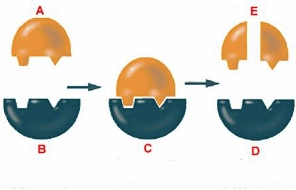
Which letter represents the enzyme?
A
B
Which letter represents the substrate?
A
B
Which letter represents the Product ?
B
C
D
E
Enzymes are "Specific", which best describes this?
function best under certain environmental conditions
speeds up only one type of reaction.
can catalyze the same reaction over and over again.
Enzymes are "Sensitive" which best describes this?
function best under certain environmental conditions
speeds up only one type of reaction. (Like a lock and key!!!) Example: Amylase – only breaks down starches.
can catalyze the same reaction over and over again.
Proteins


Which of these is most likely an enzyme?
CRISPR-Cas9 is a type of ________ system found in bacteria.
digestive
endocrine
circulatory
immune
CRISPR-Cas9 was discovered in which of the following organisms?
protists
fungi
bacteria
viruses
Scientists have adapted it to turn it into a biotechnology tool for _______ DNA.
building
editing
destroying
synthesizing
The enzyme portion of this complex is called ________.
CRISPR
Replicase
Lysozyme
Cas9
What type of RNA is used as a GPS of sorts, to find or locate specific genes?
mRNA
gRNA
tRNA
rRNA
What is PAM?
a 3 letter sequence for binding on the target DNA
the main gene portion of the DNA
the cut site for Cas9
a 10 letter sequence for binding on the target DNA
Which is the correct order for the PCR process
denaturation, elongation, annealing
annealing, elongation, denaturation
denaturation, annealing, elongation
annealing, denaturation, elongation
Process of determining the precise order of nucleotides within a segment of DNA
Gel electrophoresis
Polymerase chain reaction
DNA sequencing
DNA amplification
What is PCR used for
genetic testing
paternity testing
determining evolutionary relationship
DNA profiling
In gel electrophoresis, which direction do the DNA fragments move?
negative to negative electrodes
negative to positive electrodes
positive to negative electrodes
the DNA doesn't move, the gel does
What happens during the denaturing step of a PCR reaction
DNA nucleotides on each backbone are broken apart
A heat tolerant polymerase initiates the copying of each strand of DNA
DNA primers attache to the 3' ends of the target sequence
The DNA double helix is separated into two single strands
Where is Taq polymerase sourced from
man-made in a laboratory
thermal pools
salt mines
all of the above
Choose the correct order for the temperature changes that occur during the PCR process
95° - 1 minute / 55° - 1 minute / 72° -2 minutes
95° - 1 minute / 72° -2 minutes / 55° - 1 minute
55° - 1 minute / 95° - 1 minute / 72° -2 minutes
95° - 1 minute / 72° -2 minutes / 52° - 1 minutes
Choose the correct term to match the definition:
short nucleic acid that provides a starting point for DNA synthesis
short tandem repeat
agarose gel
Taq polymerase
primer


1. The DNA base sequences recognized by Endonuclease are called
a).Restriction Site
b). Recognition Site
c).Fragmentation Site
d).cutting Site
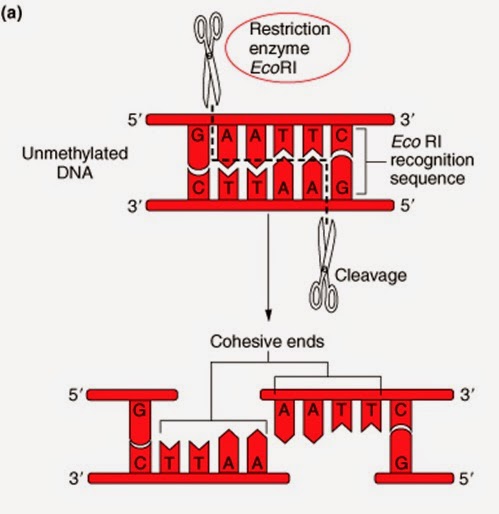
The recognition sites for restriction enzymes are :
a).Tautomer
b). Pallindrome
c).Metamere
d).Acronym
Restriction Enzymes are isolated from :
a).Protozoa
b). Bacteria
c).Virus
d).Fungi
Restriction Enzymes were primarily used as :
a).Defence by Protozoa against antibiotics
b).Tool by Virus to cleave Bacterial genome
c)Defence by Bacteria against bacteriophages viruses
d).All of the above
In molecular cloning, a __________ is used to insert a fragment of DNA into the host cell.
plasmid
DNA fragment
bacterium
virus
The enzyme used to join the DNA fragments
Topoisomerase
DNA ligase
DNA polymerase
Reverse transcriptase
Which of the following tools of recombinant DNA technology is INCORRECTLY paired with one of its uses?
restriction endonuclease - production of DNA fragments for gene cloning.
DNA ligase - enzyme that cuts DNA, creating sticky ends.
reverse transcriptase - production of cDNA from mRNA.
Taq polymerase - copies DNA sequences in the polymerase chain reaction.
Which of the following terms describes the process of the uptake of recombinant plasmids into bacteria cells?
amplification
insertion
transformation
screening
Which enzyme helps fuse the foreign into the new DNA?
DNA Polymerase
DNA ligase
To produce desired protein _____________ should be taken from any source like human, animal and plant.
recombinant DNA
Target DNA
plasmid
ligase

Which of the following enzymes can cut nucleic acids?
DNA polymerase
restriction endonuclease
modifying enzymes
reverse transcriptase

What type of cut is this photo?
Blunt
sticky
What is the pigment in chloroplasts that is involved in photosynthesis?
Chlorosynthesis
Chlorophyll
Chloroplast
Green
Which gas enters the leaves through the stomata and is required for photosynthesis?
hydrogen
oxygen
nitrogen
carbon dioxide
Which statement about photosynthesis is correct?
Plants get the energy they need to start photosynthesis from water.
Plants get the energy they need to start photosynthesis from soil.
Plants get the energy they need to start photosynthesis from sunlight.
Plants do not require energy to perform photosynthesis.
Which of the following are reactants of photosynthesis?
CO2 and H2O
O2
H2O and Glucose
None of the above
Photosynthesis produces Glucose for plants. This is a form of __________________________ for plants.
Chemical energy
Thermal energy
Light energy
Radiant energy
In which organelle does photosynthesis occur?
Cell Wall
Chlorophyll
Chloroplast
Cytoplasm

Stomata are made of specialized cells called ______ which surround a tiny pore/opening
stoma
guard cells
dermal cells
diffusion channels

Leaves will have the highest number of stomata when
temperatures are unusually high and CO2 levels are also high
temperatures are low and CO2 levels are also low
temps are high and CO2 levels are low
temps are low and CO2 levels are high
What is another name for the light independent phase of photosynthesis?
Calvin cycle
Rubisco
Stroma
Krebs cycle
Where in the chloroplast does the light dependent phase occur?
Stroma
Thylakoid membrane
Grana
Pigments, mainly chlorophyll
What are the products of the light dependent phase of photosynthesis? (select all)
ATP
Glucose
Oxygen
NADPH
What are the products of the light independent phase of photosynthesis? (select all)
Rubisco enzyme
Glucose
Oxygen
Carbon dioxide
What is the stroma? (select all)
The site of the Calvin Cycle
The intracellular liquid of the chloroplast
Pancake-like stacks where photosynthesis takes place
Enzyme containing liquid where the light independent phase takes place
Rubisco is ...
a pigment which captures light energy
a membrane protein used to transport electrons
an enzyme which catalyzes carbon fixation
a simple glucose monomer produced in the calvin cycle
What is carbon fixation?
The joining of inorganic carbon atoms into an organic molecule
Taking carbon gas and fixing it to a solid
Correcting an error in the carbon atom
Being obsessed with carbon
How is glucose transported out of the chloroplast?
Passive diffusion through the membrane going with its concentration gradient
Facilitated diffusion using a carrier protein as glucose is a large molecule
Active transport through a protein against a concentration gradient
Exocytosis as glucose is a large molecule
Do chloroplasts contain their own DNA?
Yes, contained in a nucleus
Yes, circular strands of DNA suspended in the stroma
No, they do not contain their own DNA

The flat disk-like structures inside the chloroplast are called
Pancakae
Stroma
Lamellae
Thylakoids

Stacks of thylakoids are called
Granum / grana
Lamellae
Stroma
High-rise

Granum are connected by
DNA strands
Thylakoid sheets
Stroma
Lamellae
How many membranes do chloroplasts have?
One - similar to the cell membrane it surrounds the chloroplast
Two - one surrounding the chloroplast and the thylakoid membrane
Three - a double membrane surrounding the chloroplast and the thylakoid membrane
Which of the following outputs of the light dependent reactions of photosynthesis are used in the Calvin cycle?

Rubisco is important in which step of photosynthesis
energizing the electrons in chlorophyll in order to activate NAD+
carbon fixation when CO2 is bound to RUBP during the Calvin cycle
regeneration phase as RUBP is made during the Calvin cycle
reduction of the carbon chain during the Calvin cycle
Photorespiration lowers the efficiency of photosynthesis by preventing
Carbon dioxide molecules from being produced
Preventing the fixation of CO2 by Rubisco
Prevents formation of ATP molecules
Prevents oxygen reduction
have higher rates of photorespiration when the temperature increases
can continue to fix CO2 even at relatively low CO2 concentrations and high oxygen concentrations.
do not use rubisco for carbon fixation.
grow better under cool, moist conditions.
In C4 plants the initial reactions to fix CO2 occur in the
Guard cells
Epidermal cells
Mesophyll cells
Bundle-sheath cells
Where does the Calvin cycle take place? (pick the most accurate answer)
stroma of the chloroplast
thylakoid membrane
Bundle sheath cells
mesophyll cells
Why C4 plants are able to carry out photosynthesis efficiently?
They do not use the Calvin cycle during photosynthesis
They use PEP carboxylase to fix carbon dioxide before entering the Calvin cycle
They are adapted to cold climates and absorb CO2 efficiently
They conserve water efficiently
Which of the following does NOT occur during the Calvin Cycle
carbon fixation
oxidation of NADPH
release of oxygen
regeneration of the carbon dioxide acceptor
The alternative pathways of photosynthesis using the C4 or CAM systems are said to be compromises. Why?
C4 compromises on water loss and CAM compromises on photorespiration.
Both minimize photorespiration but expend more ATP during carbon fixation.
CAM plants allow more water loss, whereas C4 plants allow less CO2 into the plant.
C4 plants allow less water loss but CAM plants allow more water loss.
Photorespiration involves
the production of oxygen gas during the break down of sugar
the breakdown of sugar when CO2 levels are low.
the production of massive amounts of ATP in the thylakoid
water being pulled out of the plant
Why does photorespiration occur?
stomata are closed and the ratio of CO2 levels compared to O2 is too low
stomata are closed and O2 levels are too low.
stomata are open and too much water is leaving the plant by the process of transpiration
stomata are open and the plant receives too much CO2
The process of photosynthesis in C4 plants involves
Physically separates carbon fixation and the Calvin cycle in different cells
Converting carbon dioxide into organic acids at night time to be used during the day
Photorespiration occurs when Oxygen levels are high
The light dependent and independent reactions occurring in different cells
Which type of plant does not have a carbon dioxide storage method
C3
C4
CAM

What would be the expected effect on plants if the atmospheric CO2 concentration was doubled?
All plants will experience increased rates of photosynthesis.
C3 plants will have faster growth; C4 plants will be minimally affected.
C4 plants will have faster growth; C3 plants will be minimally affected.
C3 plants will have faster growth; C4 plants will have slower growth.
In C4 plants, the Calvin cycle occurs in
Guard cells
Epidermal cells
Mesophyll cells
Bundle-sheath cells

Transpiration
Photorespiration
Photosynthesis
Signal Transduction

Malate or other organic acids

All forms of photosynthesis involve the enzyme RuBisCo in the Calvin cycle.
True
False


As the intensity of light increases, the rate of photosynthesis in a C3 plant will...
steadily increase
increase exponentially
increase, then level off, then decrease
decrease at first, then increase
The process of photosynthesis in CAM plants has a disadvantage which is
Plant entering photorespiration when temperature increases
A low overall rate of photosynthesis (leading to a slow growth rate) due to limited storage of malate
Photorespiration when Oxygen levels are high
The light dependent and independent reactions occurring in Bundle sheath cells requiring energy expenditure
A nucleotide does NOT contain
sugar
polymerase
nitrogen base
phosphate group
Which of the following nucleotides bonds with uracil?
guanine
cytosine
thymine
adenine
DNA is copied into 2 new strands of DNA during a process called:
replication
translation
transcription
transformation
In DNA replication, a section of DNA with bases ATTC will line up with bases:
GAAC
AUUG
ATTC
TAAG
One difference between DNA and RNA is that
DNA= 1 strand
DNA contains ribose sugar
DNA has a double strand
RNA is more complex
The process by which the genetic code of DNA is copied into a strand of mRNA is called:
translation
transformation
transcription
replication
A group of 3 letters representing an amino acid is called:
nucleotide
ribosome
codon
anticodon
If the triplet code in DNA is AGT, then the mRNA codon would be:
TCA
AGT
TCU
UCA
What happens during the process of translation?
mRNA is made from DNA
mRNA attaches o tRNA and makes protein
copies of DNA molecules are made
transfer RNA is made from mRNA
In protein synthesis, amino acids are brought to the ribosome by:
DNA
mRNA
tRNA
rRNA
Changes in the DNA sequence that affect genetic information are known as:
replications
transformations
mutations
prokaryotes
A mutation that involves a single nucleotide is called:
chromosomal mutation
point mutation
inversion
translocation
DNA controls our heredity by coding for what substance in our body?
fats
carbohydrates
proteins
lipids
How many nitrogen bases are needed to specify 3 amino acids?
3
6
9
12

T A C A G G C C T


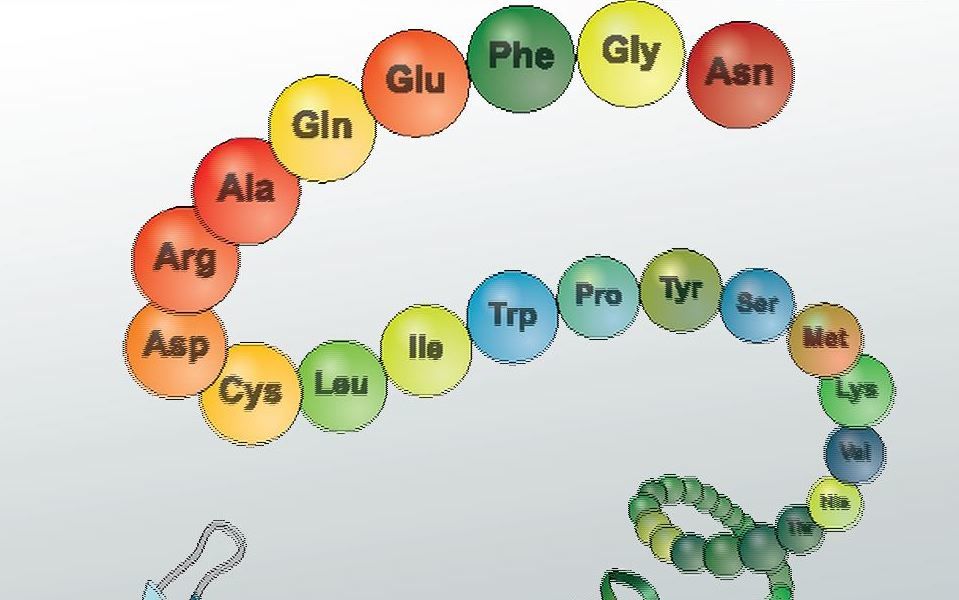
which of the following terms refers to the order in which amino acids are linked together in a protein.
Primary
Secondary
Tertiary
Quaternary
The chain of amino acids folds and coils on itself
Primary
Secondary
Tertiary
Quaternary
The entire polypeptide forms a three-dimensional structure
Primary
Secondary
Tertiary
Quaternary
Two or more polypeptides attached together and work as one unit
Primary
Secondary
Tertiary
Quaternary

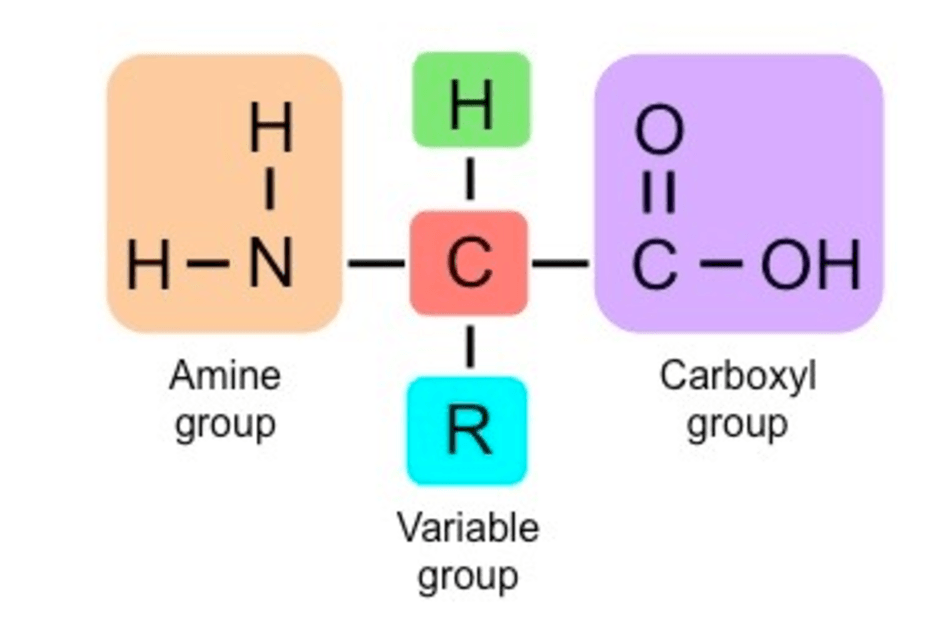
The diagram shows a bond forming between two amino acids. What is the name of this reaction?
Condensation
Hydrolysis
Pepysis
Oxidation