
 Worksheets
Unit 10 Test Review
Total questions: 144
Worksheet time: 3hrs 48mins

Translate the blue shape to the pink shape...
5 Right
2 Down
5 Left
2 Up
3 Right
1 Down
3 Left
1 Up

Translate shape B to shape A...
5 Right
3 Up
5 Left
3 Down
3 Right
3 Up
3 Left
3 Down

Slide 3 up and 2 right

When translating left or right on a coordinate plane, what coordinate is affected?
x-coordinate
y-coordinate
When translating up or down on a coordinate plane, what coordinate is affected?
x-coordinate
y-coordinate
(x, y) -----> (x, y +4)
What is the algebraic representation of a figure is Translated 9 units right and 3 units down?
(x, y) -->
(x - 9, y + 3)
(x, y) -->
(x + 9, y - 3)
(x, y) -->
(x + 3, y - 9)
(x, y) -->
(9x, 3y)

Quadrilateral PQRS is reflected across the y-axis. Which rule describes this transformation?
(X,Y) -> (-X, Y)
(X,Y) -> (X, -Y)
(X,Y) -> (6X, 6Y)
(X,Y) -> (X + 6, Y + 4)
Quadrilateral PQRS is reflected across the x-axis. Which rule describes this transformation?
(X,Y) -> (-X, Y)
(X,Y) -> (X, -Y)
(X,Y) -> (6X, 6Y)
(X,Y) -> (X + 6, Y + 4)

The rotation can be represented by the rule:
(x, y) → (y, -x)
True
False
The figure was rotated 90 degrees clockwise or 270 degrees counterclockwise.
True
False
The figure was rotated from quadrant I to II.
True
False

The location of O' is (-8, 1).
True
False
The rotation can be represented by the rule:
(x, y) → (-y, x)
True
False
The rectangle was rotated 90 degrees clockwise.
True
False

The location of C' will be (-2, 5).
True
False
Ivy will rotate the triangle 180 degrees.
True
False
Triangle A'B'C' will be in quadrant I.
True
False

What's the degree of rotation in this image?
90 degrees
180 degrees
270 degrees
360 degrees

This figure is in quadrant 4. If it is rotated 90 degrees counter clockwise, which quadrant will it end in?
quadrant 1
quadrant 2
quadrant 3
quadrant 4

What type of transformation is this an example of?
rotation
translation
reflection
dilation

If this figure is rotated 180 degrees, which quadrant will it end up in?
quadrant 1
quadrant 2
quadrant 3
quadrant 4

Which quadrant is Point U located?
quadrant 1
quadrant 2
quadrant 3
quadrant 4
Rotations, like translations and reflections, produce congruent figures.
true
false
Counter clockwise (CCW) is a _________________ direction while clockwise (CW) is a _________________ direction.
positive; negative
negative; positive
negative; negative
positive; positive
How many directions are there in rotations?
1
2
3
4
A rotation is a __________ of a point, line, or figure on a coordinate plan.
flip
slide
enlargement or reduction
turn or spin
What do translations, reflections, and rotations have in common?
they all produce congruent figures
they all slide a figure on a coordinate plane
they all produce mirror like images on a coordinate plane
they all turn a figure on a coordinate plane
A car driving down a straight road is an example of a _________.
rotation
reflection
translation
dilation
A spinning merry go round in a park is an example of a _______________.
translation
reflection
rotation
dilation
We see reflections in mirrors and water.
true
false


What directions would you give?
Reflect over the line: ________



The point A (8, 12) was dilated to become point A' (2, 3). What was the scale factor?
½
¼
4
2
State the coordinate of the image of the given point B (4,9) under a dilation with center at the origin with the given scale factor of 2.
B' (2 , 4.5)
B' (-8 ,-18)
B' (8 ,18)
B' (9 ,4)
A dilation produces a congruent figure
True
False

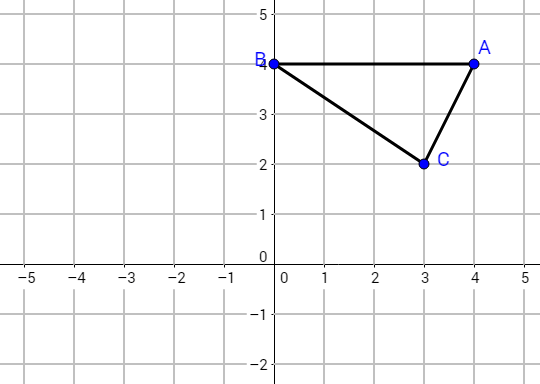
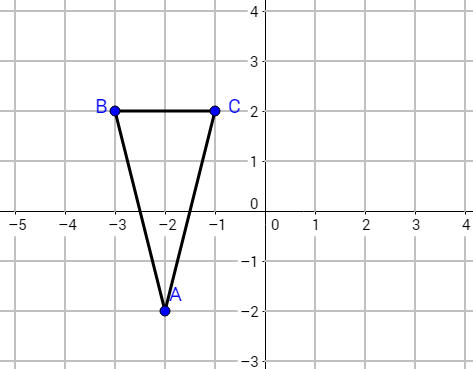
ABC is dilated about P(2, -4) by a scale factor of 3.
FInd the coordinates of B'.
B'(0, 6)
B'(-2, 0)
B'(-4, 4)
B'(-4, 2)
B'(-6, 4)

ABC is dilated about P(3, -1) by a scale factor of 0.5.
Find the coordinates of A'.
A'(-2, 5)
A'(-7, 2)
A'(-2, 2)
A'(-3.5, -2.5)

What is the center of dilation, P?
P(0,0)
P(0, -1)
P(2, 0)
P(0, 2)
P(-2, 0)

What is the center of dilation, P?
P(0,0)
P(3, -1)
P(3, -2)
P(2, -3)
What can you say about the scale factor, k?
k > 1
k = 1
0 < k < 1

Find the order of rotational symmetry in this shape.
2
3
4
5

Find the order of rotational symmetry in this shape.
1
2
3
4



Find the order of rotational symmetry in this shape.
6
8
7
4


What order of rotation and angle of rotation does the picture have?
Order = 0, 360⁰
Order = 1, 360⁰
Order = 2, 180⁰
Order = 3, 120⁰



Find the order of rotational symmetry in this shape.
order 3
order 2
order 1
no order of rotation









Find the order of rotational symmetry in this shape.
1
2
3
4
Find the order of rotational symmetry in this shape.
2
3
4
5
Find the order of rotational symmetry in this shape.
3
2
1
0

Find the order of rotational symmetry in this shape.
4
8
7
6
Find the order of rotational symmetry in this shape.
6
8
7
4

Find the order of rotational symmetry in this shape.
0
1
2
3
A figure has _______ symmetry when a line (or lines) divide the shape into two equal parts.
Line
Rotational
Point
Which of the following letters does not have line symmetry, but has point symmetry:
H
I
Z
X
How can we determine if a figure has point symmetry?
If it appears unchanged when turned upside down (rotated 180 degrees).
If a reflected image appears created by a line that intersects the middle of the figure.
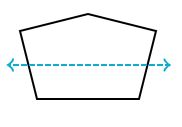
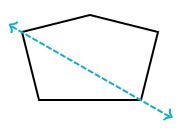
Which of the following shapes show a line of symmetry?
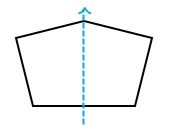
Which of the following letters does not have line symmetry, but has point symmetry:
H
I
Z
X

Determine what type of symmetry this shape has. Check all that apply.
Line
Point
Both
None

Does this shape have line or point symmetry?
Line
Point
Which of the followings has line and point symmetry?
U
H
S
A


A line is continuous in both directions.
A line segment has one endpoint and one side that is continuous.
Describe the transformation on f(x):
f(x) + 3
vertical stretch of 3
shifts 3 units to the right
shifts 3 units up
shifts 3 units left
Describe the transformation on f(x):
2 f(x)
shifts 2 units up
shifts 2 units to the right
vertical shrink, wider
vertical stretch, more narrow
Describe the transformation on f(x):
F(x) - 2
shifts 2 units up
shifts 2 units to the right
shifts 2 units down
shifts 2 units to the left
Describe the transformation on f(x):
- f(x)
shift 1 unit left
reflection over y-axis
shift 1 unit down
reflection over x-axis
Describe the transformation on f(x):
1/3 f(x)
vertical shrink
vertical stretch
shifts 1 unit up
shifts 3 units right
Describe the transformation on f(x):
f (x + 3)
shifts 3 units left
shifts 3 units right
shifts 3 units up
shifts 3 units down
Describe the following transformation on f(x):
f(x - 7)
shifts 7 units right
shifts 7 units left
shifts 7 units down
shifts 7 units up

Describe the transformation from function f (blue) to g (red):
shifted 1 unit right
vertical shrink, wider
vertical stretch, more narrow
shifted 1 unit up

Use the graphs of f and g to describe the transformation from the graph of f to the graph of g.
shifts 2 units left
shifts 2 units up
shifts 2 units down
shifts 2 units right

Use the graphs of f and g to describe the transformation from the graph of f to the graph of g.
shifts 2 units left
shifts 2 units down
shifts 2 units right
shifts 2 units up

Use the graphs of f and g to describe the transformation from the graph of f to the graph of g.
reflection over x -aixs
reflection over y-axis
vertical shrink
vertical stretch

Use the graphs of f and g to describe the transformation from the graph of f to the graph of g.
shifted 2 units down
shifted 2 units up
vertical stretch, more narrow
vertical shrink, wider

Use the graphs of f and g to describe the transformation from the graph of f to the graph of g.
vertical shrink, wider
vertical stretch, more narrow
shifted 2 units left
shifted 2 units right

Use the graphs of f and g to describe the transformation from the graph of f to the graph of g.
reflection over x-axis
shifted up 2 units
vertical stretch
vertical shrink

Use the graphs of f and g to describe the transformation from the graph of f to the graph of g.
shifts 1 unit right
shifts 1 unit left
shifts 1 units up
shifts 1 unit down

Use the graphs of f and g to describe the transformation from the graph of f to the graph of g.
vertical shrink
reflection over y-axis
reflection over x-axis
vertical stretch

Use the graphs of f and g to describe the transformation from the graph of f to the graph of g.
vertical shrink
reflection over y-axis
reflection over x-axis
vertical stretch

Use the graphs of f and g to describe the transformation from the graph of f to the graph of g.
3 units right
3 units up
vertical stretch, more narrow
vertical shrink, wider

Use the graphs of f and g to describe the transformation from the graph of f to the graph of g.
reflection over y-axis
reflection over x-axis
vertical stretch
vertical shrink

Use the graphs of f and g to describe the transformation from the graph of f to the graph of g.
shifts 2 units up
shifts 6 units up
vertical stretch, more narrow
vertical shrink, wider

