
 Worksheets
AP Physics 1: SHM
Total questions: 48
Worksheet time: 10hrs 41mins
When is the pendulum at maximum velocity
At its lowest point
At its highest point
It moves at a constant velocity
It is at rest
Kinetic Energy is ________ proportional to Potential Energy.
When does the mass move at maximum velocity in a mass-spring system?
At equilibrium
At the farthest point from the equilibrium
At its hightest point
At its lowest point
What are the two requirements for a simple harmonic oscillator?
The object vibrates about the equilibrium point and the restoring force is proportional to the displacement
The object moves left to right and the restoring force is proportional to the displacement
The object vibrates about the equilibrium and the restoring force is greater than the displacement
The object moves left to right and the restoring force is greater than the displacement
When is the pendulum at 0 velocity
At its lowest point
At its highest point
It moves at a constant velocity
It is at rest
When does the mass move at 0 velocity in a mass-spring system?
At equilibrium
At the farthest point from the equilibrium
At its hightest point
At its lowest point
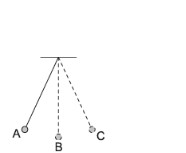
A pendulum oscillates as shown. At which of the following positions is the potential energy equal to the total energy?
A
B
C
Not enough information
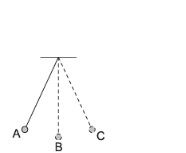
A pendulum oscillates as shown. At which of the following positions is the kinetic energy equal to the total energy?
A
B
C
Not enough information given.
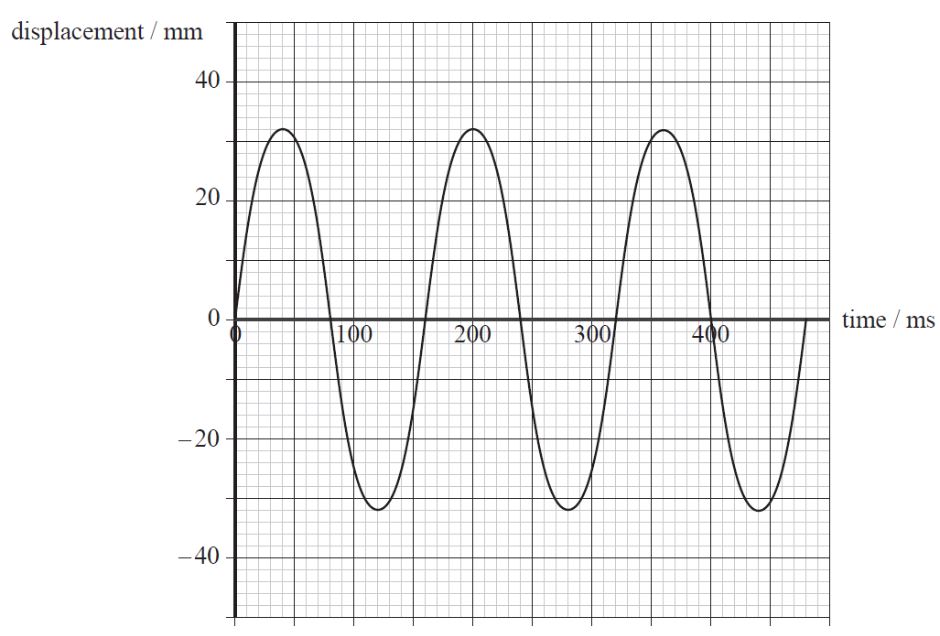
The graph shows the variation with time of the displacement of an object undergoing simple harmonic motion. At which of the following time values is kinetic energy zero?
0 ms
40 ms
80 ms
100 ms
A simple pendulum has a period of 2 s for small amplitude oscillations.
The length of the pendulum is most nearly
1/6 m
1/4 m
1/2 m
1 m
2 m
An object swings on the end of a cord as a simple pendulum with period T. Another object oscillates up and down on the end of a vertical spring. also with period T. If the masses of both objects are doubled. what are the new values for the Pendulum Period, TP, and the Spring Period, Ts?
TP = 2T and TS = T2
TP = T and TS = T2
TP = T and TS = T
TP = T2 and TP = T

What is the amplitude of this motion?
(a)

An object is attached to a spring and oscillates with amplitude A and period T, as represented on the graph above. The nature of the velocity v and acceleration a of the object at time T/4 is best represented by which of the following?
v > 0, a > 0
v > 0, a < 0
v > 0, a = 0
v = 0, a < 0
v = 0, a = 0

The frequency of the motion would be closest to..
0.125 Hz
0.16 Hz
2π*6 Hz
8 Hz
Which of the following is true for a system consisting of a mass oscillating on the end of an ideal spring?
The kinetic and potential energies are equal at all times.
The kinetic and potential energies are both constant.
The maximum potential energy is achieved when the mass passes through its equilibrium position.
The maximum kinetic energy and maximum potential energy are equal, but occur at different times.
The maximum kinetic energy occurs at maximum displacement of the mass from its equilibrium position.
A spring has a spring constant of 5 N/cm. What is its extension when loaded with 15 N?
0.33 cm
5 cm
75 cm
3 cm

Objects with different masses are hung on a spring. The diagram shows how much the spring stretches. What is mass M?
175 g
150 g
200 g
166 g
As a pendulum gets longer, what happens to the period?
doesn't change
decreases
increases
Pendulum "A" is on Jupiter Pendulum "B" is on the Moon. The Moon has less gravity than Jupiter. The pendulums have the same mass and length. Which Pendulum is moving faster?
A
B
Same
A butcher puts 300 g of chopped beef in the 1 kg pan and places it on top of his scale. The scale has a spring constant of 400 N/m. What is the period of vibration of the scale?
0.36 s
0.02 s
5.5 s
1.3 s
The period of an ocean wave is 10 s. What is its frequency?
10 cycle/second
1 cycle/second
0.5 cycle/second
0.1 cycle/second
A simple harmonic oscillator takes 4.8 s to undergo five complete vibrations. What is the frequency?
1 Hz
0.96 Hz
1 s
0.96 s
What is the frequency of a pendulum that has a period of 10 s?
10 Hz
1/1000 Hz
.1 Hz
For a system in simple harmonic motion, which of the following is the time required to complete a cycle of motion?
amplitude
period
frequency
revolution

The diagram shows a velocity-time graph for a mass moving up and down on the end of a spring. Which point represents the velocity of the mass when at the lowest point of its motion?
A
B
C
D
Your friend wishes to make a simple pendulum that serves as a timing device. She plans to make it such that its period is 1.00 second. What length must the pendulum have?
1 m
.5 m
.25 m
More than 1 meter

If a pendulum has 20 J of potential energy at point 1, how much kinetic energy will it have a point 3?
0 J
10 J
20 J
30 J

As a pendulum swings from its highest to lowest position, what happens to its kinetic and potential energy?
Both the potential energy and kinetic energy decrease
The potential energy decreases while the kinetic energy increases
The kinetic energy decreases while the potential energy increases
Both the potential energy and kinetic energy increase
Student X attaches an object of mass M to the end of a string of length L so that a simple pendulum is constructed. Student Y attaches an object of mass M to a string of length 4L to construct a second pendulum.
Which of the following claims correctly compares the periods of both pendula?
The period of Student X’s pendulum is the same as the period of Student Y’s pendulum.
The period of Student X’s pendulum is four times the period of Student Y’s pendulum.
The period of Student X’s pendulum is twice the period of Student Y’s pendulum.
The period of Student X’s pendulum is half the period of Student Y’s pendulum.
A certain pendulum with a 1.00 kg bob has a period of 3.50 s. What will happen to the period of the pendulum if the 1.00 kg bob is replaced by a bob with a mass of 2.00 kg?
Increase
Decrease
Stays the same
Need more information
Two pendulums are in simple harmonic motion. Pendulum A is longer than pendulum B. Pendulum A has a larger mass than B. The period of pendulum A is
longer than pendulum B
shorter than pendulum B
the same as pendulum B
not enough information
By what factor will the kinetic energy of an object increase if the velocity of the object is tripled?
The kinetic energy will stay the same.
3
6
9
If you double the frequency of a vibrating object, its period:
Halves
Is quartered
Doubles
A weight on the end of a spring bobs up and down one complete cycle in 5 seconds. It's period is:
0.20 sec
5.00 sec
None of the above

When the mass reaches point x = 0 its resorting force?
Maximum and positive
Maximum and negative
Zero
Less than maximum and negative

When the mass reaches point x = +A its instantaneous velocity is?
Maximum and positive
Maximum and negative
Zero
Less than maximum and positive

When the mass reaches point x = +A its acceleration is?
Maximum and positive
Maximum and negative
Zero
Slightly less than maximum and positive
1. A mass-spring oscillating system undergoes SHM. Which of the following graphs represents the elastic potential energy as a function of position?


The angle between the string of a pendulum at its equilibrium position and at its maximum displacement is the pendulum’s
period.
frequency.
vibration.
amplitude.
Suppose that a pendulum has a period of 4.0 s at Earth’s surface. If the pendulum is taken to the moon, where the acceleration due to gravity is much less than on Earth, will the pendulum’s period increase, decrease, or stay the same?
Increase
Decrease
Stays the same
Need more information
An object undergoes SHM and position as a function of time is presented by the following formula: x= (0.1 m) Sin (4πt). What is the period of oscillations?
2s
0.1s
0.5s
4s
There is a pendulum with a hanging mass of 4 kg and a length of 3 m. What mass should you put on a spring with constant k=240 N/m so that it would have the same period as a pendulum?
73.4 kg

A particle undergoes SHM represented by the graph. Which of the following is true about the amplitude and period of oscillations?
A = 1m, T = 0.8s
A = 1m, T = 0.1s
A = 1m, T = 0.4s
A = 2m, T = 0.4s
A simple pendulum with a length of 1 m oscillates on the surface of a hypothetical planet X. What is the surface gravity on the planet if the period of oscillations is 4 s?
1.6 m/s2
3.7 m/s2
11.2 m/s2
2.5 m/s2
9,8 m/s2
What is the effect of increasing the mass on a spring's period of oscillation?
It increases the period.
It decreases the period.
It has no effect on the period.
It initially increases the period, then decreases it.
For a mass-spring system undergoing simple harmonic motion, the spring constant is doubled. What happens to the frequency of the system?
It is halved.
It is doubled.
It remains the same.
It is quadrupled.
In a simple pendulum, if the length of the string is quadrupled, how does the period of the pendulum change?
It doubles.
It halves.
It remains the same.
It quadruples.
Match the following
21kx2
Elastic Potential Energy
2 1mv2
Kinetic Energy
F = −kx
Restoring Force
E = K + Us
Total Energy
Fnet=ma
Resultant Force

