
 Worksheets
Prep ups 3 (haloalkane. alcohol, carbonyl, carboxylic acid)
Total questions: 41
Worksheet time: 21mins

What is the IUPAC name for the following compound?
4-bromo-7-chloro-1-phenylheptane.
1-phenyl-4-bromo-7-chloroheptane
4-bromo-1-chloro-7-phenylheptane.
1-chloro-4-bromo-7-phenylheptane.
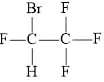
What is the IUPAC name for the following compound?
Trifluorobromocarbon
Tribromofluoroethane
1-Bromo-1,2,2,2-tetrafluoroethane
2-Bromo-1,1,1,2-tetrafluoroethane
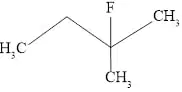
Choose the CORRECT IUPAC name for the compound.
1-fluoropropane
2-fluorobutane
2-fluoro-2-methylpropane
2-fluoro-2-methylbutane
Q is a secondary haloalkane with formula C5H11Br and optically active. Identify Q.
CH3CH2CH2CH2CH2Br
CH3CH(Br)CH2CH2CH3
(CH3)2C(Br)CH2CH3
(CH3)2C(Br)C(CH3)2CH2CH3
Choose the CORRECT structure for 3-chloro-3-methylbut-1-ene.


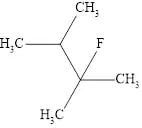
Classify the following compound.
Methyl haloalkane
Primary haloalkane
Secondary haloalkane
Tertiary haloalkane
Classify the following haloalkane.
CH3(CH2)2CH(Br)CH3
Primary
Secondary
Tertiary
Quaternary
The following statements are true about alkyl halides EXCEPT
the C–X bond is polar.
the C–X bond is susceptible to electrophilic attack.
reaction of methyl halides with strong nucleophiles occurs via SN2 mechanism.
tertiary alkyl halides undergo the elimination reaction with alcoholic potassium hydroxide.
CH3Br is a reactive haloalkane due to
the polarisation of Carbon-halogen bond.
carbon as electron rich readily attached by nucleophile.
electrophilic substitution.
all answer are correct
What is the organic product when 2-chlorobutane reacts with aqueous sodium hydroxide?
Butene
Butane
Butan-2-ol
Sodium butanoate
Choose the type of mechanism for the reaction below.
CH3CH2Cl + KOH → CH3CH2OH + KCl
Electrophilic addition
Nucleophilic addition
Electrophilic substitution
Nucleophilic substitution
Choose alkyl halide that reacts fastest with alcohol.
Bromomethane
1-Bromobutane
Bromocyclohexane
1-Bromo-1-methylcyclopentane
Which of the following compounds is least easily hydrolysed by aqueous sodium hydroxide?
C6H4Br2
C6H5CH2Br
CH3CHClCH2CH2CH3
CH3CH2CH2CH2CH2Cl
Determine the criteria of unimolecular nucleophilic substitution.
The rate of reaction depends on concentration of haloalkane only.
There is only one step mechanism.
The reaction is second order.
Primary haloalkane is more reactive towards SN1 reaction compared to tertiary haloalkane.
Which of the following is the most reactive towards SN1 reaction?
1-bromopropane
2-bromopropane
2-bromo-2-methylpropane
1-bromo-2,2-dimethylpropane
Which of the following compounds favors bimolecular nucleophilic substitution reaction?

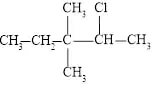
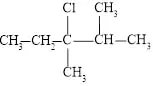
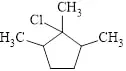
Which of the following haloalkanes undergo SN1 mechanism in a hydrolysis reaction?
CH3CH2CH2CH2Br
CH3CH2CH(Br)CH3
CH3C(CH3)(Br)CH3
CH3CH(CH3)CH2CH2Br
The following statements is true about SN1 reaction EXCEPT
rate = k[RX][Nu-].
H2O is a better nucleophile than OH-.
react faster with tertiary alkyl halides.
reaction involve formation of carbocation.
The following statements about SN2 reaction are true EXCEPT
it involves a two-step mechanism.
the reaction rate is fastest with unhindered alkyl halide.
an inversion of configuration occurs at the stereogenic/chiral centre.
the rate of reaction is influenced by the concentrations of the alkyl halide and nucleophile.
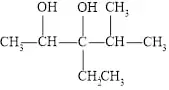
Choose the CORRECT name for the following compound.
3-isopropylpentane-2,3-diol
3-isopropylpentane-3,4-diol
3-ethyl-4-methylpentane-2,3-diol
4-methyl-3-ethylpentane-2,3-diol
Isopropyl alcohol is a common name of an alcohol. Give the IUPAC name for this alcohol.
2-methylethanol
2-propanol
2-methylpropanol
2,2-dimethylpropanol
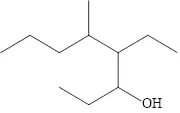
Give the IUPAC name for the following compounds
3-ethyl-2-propylhexan-4-ol
3-propyl-2-ethylhexan-4- ol
4-ethyl-5-methyloctan-3-ol
5-ethyl-4-methyloctan-3-ol
Which of the following is the correct structure for 2-methyl-3-phenyl-1-propanol?


Choose the structure of 2-nitrocyclohexanol.


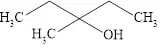
Classify the following alcohol.
1°alcohol
2°alcohol
3°alcohol
Methyl alcohol
Which of the following is a secondary alcohol with the molecular formula C4H8O?


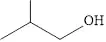

Which of the following are NOT secondary alcohols?


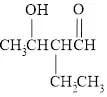
Give the IUPAC name for the following compound.
2-ethyl-3-hydroxy-1-butanal
3-ethyl-2-hydroxy-4-butanal
2-ethyl-3-hydroxy-3-pentanal
2-ethyl-3-hydroxy-1-pentanal
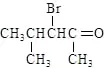
Choose the CORRECT name for compound given.
4-methyl-3-bromo-2-pentanone
2-methyl-3-bromo-4-pentanone
3-bromo-4-methyl-2-pentanone
3-bromo-2-methyl-4-pentanone
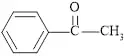
What is the common name for the following compound?
Acetaldehyde
Benzaldehyde
Acetophenone
Benzophenone
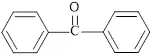
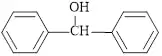
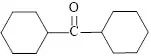
Choose the correct structure for diphenylmethanone.
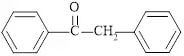
Choose the CORRECT formula for 2,3-dimethylbutanoic acid.
C4H10O2
C6H12O2
C6H12COOH
C5H12 COOH
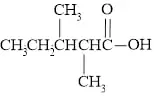
Gives the IUPAC name for the compound given.
3,4-dimethylpentanoic acid
3,4-dimethylhexanoic acid
2,3-dimethylpentanoic acid
2,3-dimethylhexanoic acid
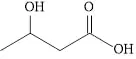
Which is the CORRECT IUPAC name of the following compound?
2-hydroxybutanoic acid
3-hydroxybutanoic acid
2-hydroxypropanoic acid
1-carboxypropan-2-ol
What is the common name for a carboxylic acid with two carbon atom?
Butyric acid
Propionic acid
Acetic acid
Formic acid
The common name for CH3CH2COOH is
formic acid
acetic acid
propionic acid
butyric acid
Which of the following is the CORRECT common name for pentanoic acid?
Formic acid
Acetic acid
Propionic acid
Valeric acid
Choose the CORRECT structural formula for 2-methyl-3-phenyl-butanoic acid.


Which of the molecule below is 2-ethylpentanoic acid?


Which compound has the highest boiling point?
Butane
Butanol
Butanal
Butanoic acid
2,4-dinitrophenylhidrazine is used in
Tollen’s test.
Fehling’s test
Brady’s test
Iodoform test

