
Font size
 Worksheets
Test revision 29.3 - 29.6
Total questions: 45
Worksheet time: 15mins
How do your senses help maintain homeostasis?
You rely on your sensory organs to collect information about the world around you.
Once your brain has information from sensory organs, it triggers a response that will maintain homeostasis.
For example your pupils shrink when too much light enters the eyes
For example when you get goose bumps when cold air touches skin
All answers are correct.
A photoreceptor in the eye that detects only light intensity and contributes most to black and white vision.
Rod cell
Cone cell
Mechanoreceptor
Thermoreceptor
Hair cell
Sensory neuron in the eye that detects color.
Rod cell
Cone cell
Hair cell
Receptor
Chemoreceptor
A mechanoreceptor in the inner ear that detect sound waves when bent.
Rod cell
Cone cell
Hair cell
Receptor
Chemoreceptor
A receptor that detect heat or temperature change.
Rod cell
Photoreceptor
Mechanoreceptor
Thermoreceptor
Hair cell
A receptor that detect chemicals dissolved in water.
Chemoreceptor
Photoreceptor
Mechanoreceptor
Thermoreceptor
Hair cell
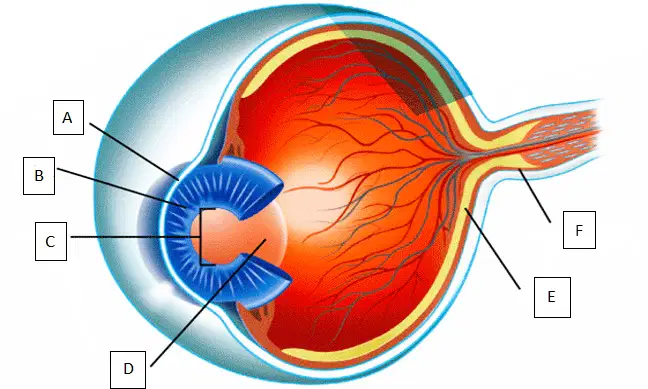
Label the part of the human eye shown by B.
Cornea
Pupil
Iris
Lens
Label the part of the human eye shown by F.
Optic nerve
Cornea
Iris
Retina
Which part is the bundle of axons that carry the impulses to the brain?
B
C
D
E
F

Which part of the human ear is indicated by A?
(a)
Which part of the human ear is indicated by B?
(a)
Which part of the human ear is indicated by F?
(a)
Which part of the human ear is indicated by J?
(a)
Upper part of the brain that receives sensation and controls movement.
Cerebrum
Cerebellum
Cerebral cortex
Brain stem
Layer of grey matter on the surface of the cerebrum that receives information and generates responses.
Cerebrum
Cerebellum
Cerebral cortex
Brain stem
The posterior portion of the brain that coordinates muscle movement and controls subconscious activities and balance.
Cerebrum
Cerebellum
Cerebral cortex
Brain stem
Structure that connects the brain to the spinal cord and controls breathing and heartbeat.
Cerebrum
Cerebellum
Cerebral cortex
Brain stem
Nerve pathway in which an impulse crosses only two synapses before producing a response.
Cerebrum
Reflex arc
Cerebral cortex
Brain stem
The portion of the neural structure that provides nerve connections to the skin, skeleton and muscles of the body, but not to the viscera, blood vessels and glands.
Somatic nervous system
Reflex acr
Autonomic nervous system
Sympathetic nervous system
The part of the nervous system that controls involuntary actions.
Somatic nervous system
Parasympathetic nervous system
Autonomic nervous system
Sympathetic nervous system
Part of the autonomic nervous system that prepares the body for action or stress.
Somatic nervous system
Parasympathetic nervous system
Autonomic nervous system
Sympathetic nervous system
Part of the autonomic nervous system that calms the body and helps the body to conserve energy.
Somatic nervous system
Parasympathetic nervous system
Autonomic nervous system
Sympathetic nervous system
Part of the reflex arc that only transfers or links the receptor to the effector neuron.
Motor neuron
Sensory neuron
Photoneuron
Interneuron
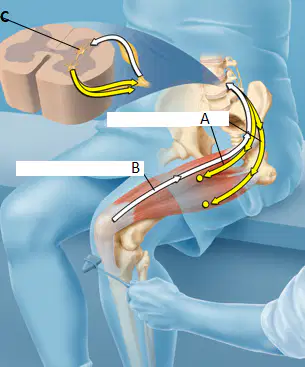
Label the part indicated by A.
Motor neuron
Sensory neuron
Interneuron
Photoneuron
Label the part indicated by B.
Motor neuron
Sensory neuron
Interneuron
Photoneuron
Label the part indicated by C.
Motor neuron
Sensory neuron
Interneuron
Photoneuron
Indicate which is part of the brain stem.
Midbrain
Pons
Medulla oblongata
All answer are correct.
Indicate which is part of the brain.
Cerebrum
Cerebellum
Brain stem
Sensory neuron
A physiological or psychological dependence on a substance such as alcohol or drugs.
(a)
The condition in drug addiction in which greater amounts of a drug are needed to achieve the desired affect.
(a)
A drug that increases the activity of the body or the activity of some part of the body.
(a)
What were the ways in which we studied the brain, before modern technology?
Disecting a dead brain
Brain injury patients
CT scan
MRI scan
Today scientists and doctors study the brain without surgery, using imaging technologies like:
MRI scans
PET scans
CT scans
All answer are correct
Which imaging technology uses magnetic flieds combined with radio waves to view structures of the brain?
Computer Tomography
Magnetic resonance imaging
Positron emission tomography
All answer are correct.
Which brain illness is associated with too high dopamine levels?
Schizophrenia
Parkinson’s disease
Depression
None of the answer are correct.
Stimulants cause:
more action potentials which make you feel happy, energetic and alert.
less action potentials which make you feel happy, energetic and alert.
more action potentials which make you feel sad, sleepy and tired.
None of the answer are correct.
A substance made in one cell or tissue causing change in another cell or tissue, somewhere else in the body.
Hormone
Gland
Hypothalamus
Pituitary gland
Organ that produces and releases chemicals that affect the activity of other tissues.
Hormone
Gland
Hypothalamus
Pituitary gland
Region of the brain that coordinates activities of the nervous and endocrine systems and that controls many body activities relates to homeostasis.
Hormone
Gland
Hypothalamus
Pituitary gland
Chemicals that stimulate other glands to release their hormones.
Releasing hormones
Gland
Hypothalamus
Pituitary gland
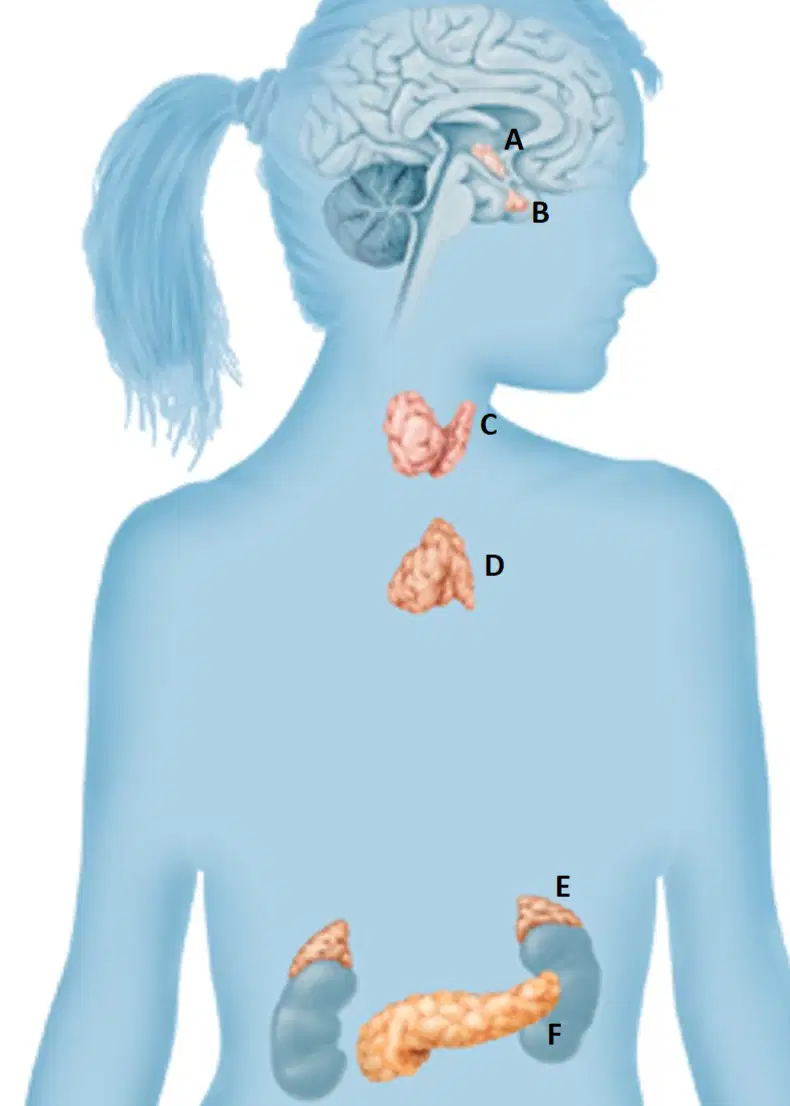
Which gland is indicated by A?
Hypothalamus
Pituitary
Thyroid
Thymus
Adrenal
Which gland is indicated by B?
Hypothalamus
Pituitary
Thyroid
Thymus
Adrenal
Which gland is indicated by C?
Hypothalamus
Pituitary
Thyroid
Thymus
Adrenal
Which gland is indicated by D?
Hypothalamus
Pituitary
Thyroid
Thymus
Adrenal
Which gland is indicated by E?
Hypothalamus
Pituitary
Thyroid
Thymus
Adrenal

