wayground logo

Free Printable Worksheets

Font size

S
M
L
XL
Worksheets

Unit 7 Quiz 3

Total questions: 40

Worksheet time: 23mins

Name
Class
Date
1.

SELECT ALL THAT APPLY: Which of the following must be true in order for organisms to be considered the same species?

a)

They must be able to mate

b)

They must be able to produce viable offspring

c)

They must have structural similaries

d)

They must have the same bone structure

2.
What happens when species produce too many offspring?
a)
Species share the limited resources 
b)
Species eat less so that all can survive
c)
Only those that are least fit can survive
d)
Only those that are best fit can survive
3.
When a population becomes divided by an event such as a new river forming, ____________ has occurred.
a)
Differentiation 
b)
Isolation
c)
Adaptation
d)
Separation
4.

Members of a species can breed with other members of the same species.

a)

True

b)

False

5.
___ are mistakes in the DNA that cause variation within a species.
a)
mutations
b)
adaptations
c)
speciations
d)
isolations
6.
Organisms with the most beneficial traits will survive.  This is commonly known as ___.
a)
theory of evolution
b)
variations
c)
survival of the fittest
d)
ecosystems
7.
Some female peacocks prefer males with large, colorful tales while other female peacocks prefer males with no tail at all. Females are beginning to only mate with the type of males with the tail they prefer. What type of reproductive barrier is this?
a)
behavioral isolation
b)
hybrid sterility 
c)
temporal isolation
d)
mechanical isolation 
8.
The flowers of pink tulips open in the morning, while the flowers of lavender tulips open in the early afternoon. The bees that pollinate these tulips cannot carry pollen back & forth between the two types of tulips because of their flowers being closed at different times of day. What type of reproductive barrier is this?
a)
behavioral isolation
b)
hybrid sterility 
c)
temporal isolation
d)
mechanical isolation 
9.
The term for the formation of new and distinct species over the course of evolution is...
a)
speciation
b)
biological species concept
c)
reproductive barrier
d)
natural selection
10.
What is a species? 
a)
A group of organisms that can mate with each other and produce fertile offspring. 
b)
A group of organisms that can mate and produce offspring even if those offspring are infertile.
c)
A group of organisms that genetically are very different from each other. 
d)
Indivual organisms that live in the same environment. 
11.
A flash flood carried a raft of Amazon ants away from their original population. There is enough distance between the two groups, that they will never meet in nature again. What type of reproductive barrier is this?
a)

behavioral isolation

b)

temporal isolation 

c)

gametic isolation

d)

geographic isolation 

12.
The climate of a certain area is cold, and snow is found on the ground most of the year. Equal numbers of two populations of rabbits are introduced into this climate by a group of scientists. One of the populations is brown and the other is white. Predict what will happen over several generations.
a)
There will be equal numbers of brown and white rabbits
b)
There will be more brown rabbits that white rabbits
c)
There will be more white rabbits than brown rabbits
d)
There is no way to predict what will happen to the rabbit population
13.
When has speciation occurred?
a)

When populations no longer look the same

b)

When populations no longer have the same frequency of alleles

c)

When populations are living in different environments

d)

When populations can no longer interbreed

14.

Genetic diversity is decreased through this process.

a)

Gene Flow

b)

Genetic Drift

15.

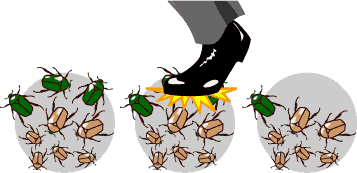
Someone steps on some bugs and randomly removes their alleles from the population. This is an example of

a)

gene flow

b)

genetic drift

c)

speciation

d)

allele frequency

16.

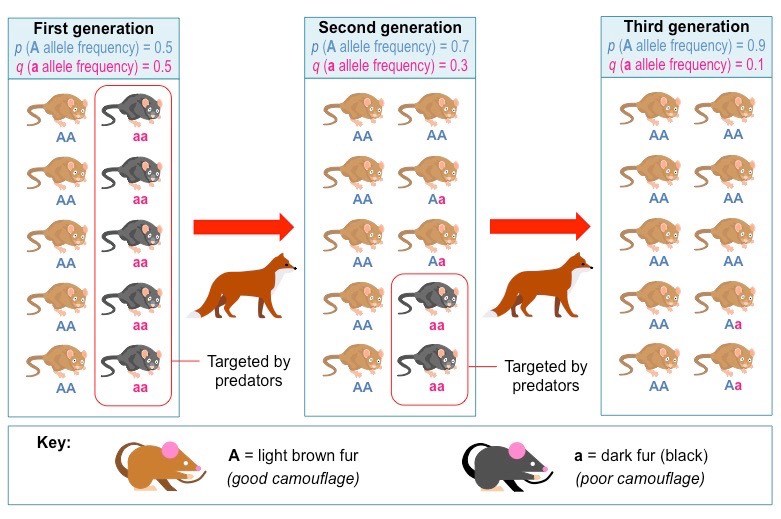
The allele frequencies of the mouse population in the picture are changing over time. Which is true?

a)

The population is evolving.

b)

The population is not evolving.

c)

The population will go extinct.

d)

The population's genetic variation is increasing.

17.

During microevolution, a(n) __________________ will become more or less common within a population.

a)

species

b)

allele

c)

ribosome

d)

fossil

18.

Which of the following means "genetic changes in a species over time"

a)

natural selection

b)

speciation

c)

evolution

d)

fitness

19.

The emergence of new rivers or streams is a type of ____________ isolation.

a)

Temporal

b)

Mechanical

c)

Behavioral

d)

Geographic

20.
The death of every member of a species
a)
The flu
b)
epidemic
c)
extinct
d)
population
21.

Speciation that caused by breeding occurring at different time of the day is called

a)

behavioral isolation

b)

temporal isolation

c)

ecological isolation

d)

habitat isolation

22.
Which is necessary for speciation to occur?
a)
adaptation
b)
mass extinction
c)
isolation
d)
acquired traits
23.

Who developed the Theory of Evolution by Natural Selection?

a)

Robert Hooke

b)

Thomas Malthus

c)

Watson and Crick

d)

Charles Darwin

e)

Gregor Mendel

24.

A forest fire ignites in the Sam Houston State Forest and kills many members of a population of pigmy rattlesnakes.

a)

Gene Flow

b)

Genetic Drift

25.
Genetic drift is change in the allele frequency of a population due to...
a)
random chance
b)
natural selection
c)
non-random mating (sexual selection)
d)
artificial selection
26.
Which of the following is an example of the bottle neck effect?
a)
Bald Eagles are hunted until near extinction, population recovers.
b)
Small group of iguanas floats to an island, starts a new population.
c)
Red fox pups are more likely to survive in a snowy environment if they are born white.
d)
Farmer chooses seeds from largest apples to plant next year.  This results in larger apples from year to year.
27.
Structures with the same parts have different functions; suggests that organisms share a common ancestry
a)
vestigial structures
b)
homologous structures
c)
adaptive radiation
d)
fossil
28.
Which layer is the youngest
a)
1
b)
2
c)
3
d)
4
29.
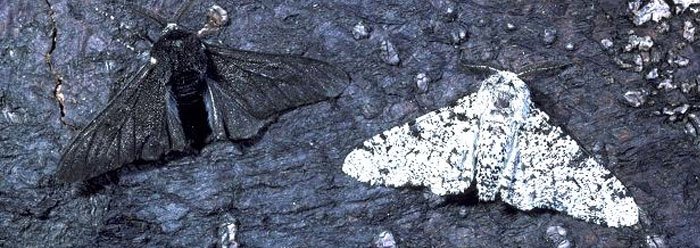
The trees these moths used to live on were white, but have been covered in soot from coal factories. Which moth will be more successful in this environment?
a)
Dark moth
b)
Light moth
c)
Both will be equally successful
d)
Neither will be successful
30.
a)

Stabilizing Selection

b)

Directional Selection

c)

Disruptive Selection

31.
a)

Directional Selection

b)

Stabilizing Selection

c)

Disruptive Selection

32.
a)

Stabilizing Selection

b)

Directional Selection

c)

Disruptive Selection

33.
a)

Directional Selection

b)

Stabilizing Selection

c)

Disruptive Selection

34.
The ability of an organism to survive and reproduce is known as...
a)
Adaptation
b)
Trait
c)
Fitness
d)
Variation
35.
the hind leg bones in a whale are examples of
a)
homologous structures
b)
analogous structures
c)
fossils
d)
vestigals
36.


Of all the places he visited, the ___________________ Islands influenced Darwin’s ideas about evolution the most.

a)

Galapagos

b)

Hawaiian

c)

Bora Bora

d)

Aleutian

37.

Scientists compare DNA from living organisms to identify _________.

a)

geographic isolation

b)

similarities between species

c)

a fossil's location

d)

natural selection

38.

Why are advantageous traits more likely to be passed onto offspring?

a)

because they are more likely to survive and reproduce

b)

because they come from recessive alleles

c)

because they come from dominant alleles

d)

because the trait is an acquired phenotype
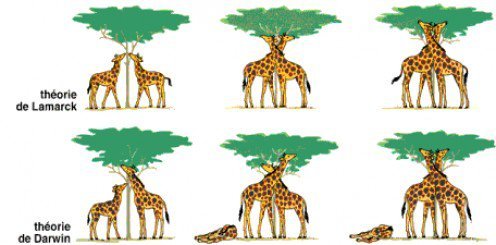
39.
What would happen if the Giraffes never evolve?
a)
they would survive
b)
They would thrive
c)
They would become extinct
d)
They will find another source of food
40.

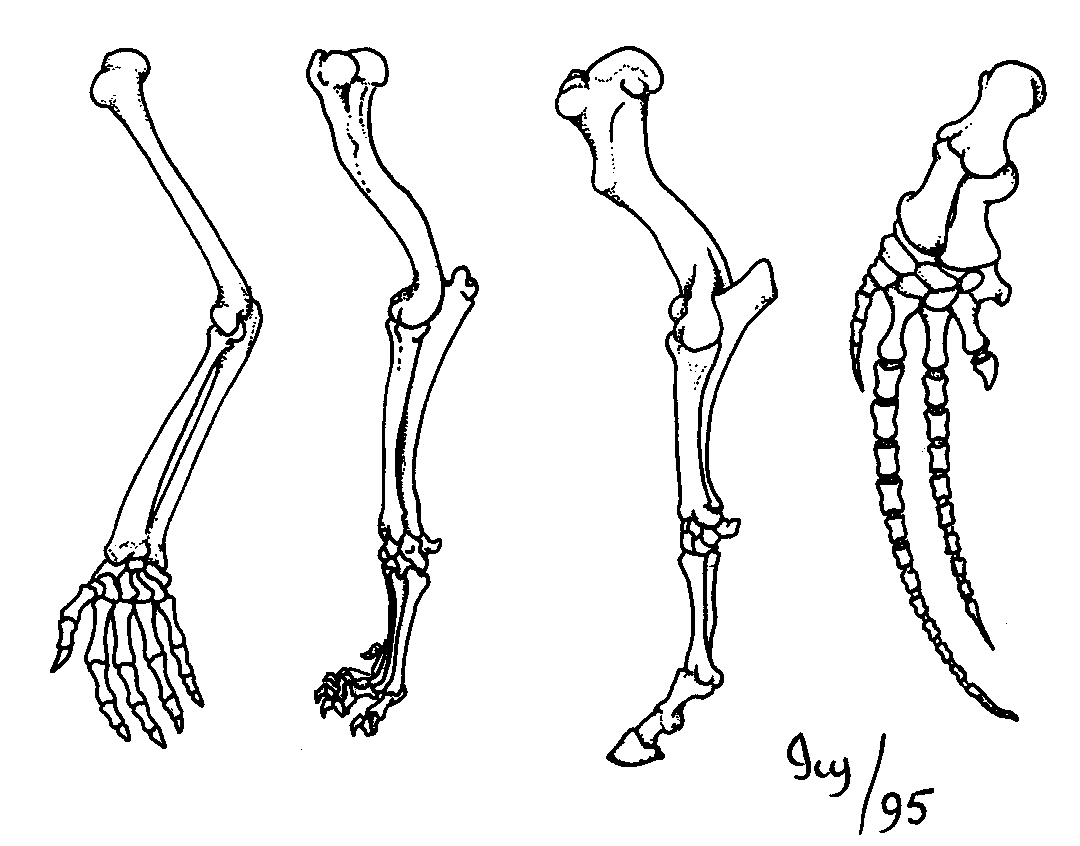
What type of structure does this image illustrate?

a)

Homologous structures

b)

Analogous structures

c)

Vestigial structures