
 Worksheets
BIOG 221 Exam 4
Total questions: 107
Worksheet time: 1hrs 27mins
Wernicke's area location
Frontal lobe
Parietal lobe
Temporal lobe
Occipital lobe
Broca's area location
Left frontal lobe
Left parietal lobe
Left temporal lobe
Left occipital lobe
Motor cortex location
At the back of the frontal lobe
At the back of the parietal lobe
At the back of the temporal lobe
At the back of the occipital lobe
Happiness
Amygdala and frontal lobe
Amygdala and parietal lobe
Amygdala and temporal lobe
Amygdala and occipital lobe
Language Understanding
Motor cortex
Broca's area
Hippocampus
Wernicke's area
Hypothalamus
Thirst and hunger
Motor cortex
Broca's area
Hippocampus
Wernicke's area
Hypothalamus
Speech production
Motor cortex
Broca's area
Hippocampus
Wernicke's area
Hypothalamus
Movement
Motor cortex
Broca's area
Hippocampus
Wernicke's area
Hypothalamus
Smell
Cerebellum
Brain Stem
Amygdala
Olfactory bulbs of limbic system
Hypothalamus
Long-term Memory
Motor cortex and frontal lobe
Broca's area and frontal lobe
Hippocampus and frontal lobe
Wernicke's area and frontal lobe
Hypothalamus and frontal lobe
Blood pressure regulation
Cerebellum
Brain stem: medulla oblongata
Amygdala
Olfactory bulbs of limbic system
Hypothalamus


What does the medulla do?
controls heart rate and breathing
controls sleep and wake cycles
takes in sensory information
controls voluntary movement

What does the temporal lobe do?
process touch
planning & abstract thinking
process sound and speech
allows you to see

What does the parietal lobe do?
sends motor commands
allows you to see
allows you to hear
integrates sensory information

What does the amygdala do?
controls heart rate
directs sensory information
regulates body temperature
processes emotion

What does the hippocampus do?
processes memories
processes pain
processes vision
processes hearing

What does the Frontal lobe do?
process vision
process sound
integrate sensory information
abstract thinking and planning
What bodily functions does the brain stem not control?
(Sousa, 2017, p. 18)
Heartbeat
Digestion
Memory
Body Temperature
Which brain part provides involuntary coordination of body movements?
Cerebellum
Frontal Lobe
Pons
Thalamus
Which brain function is the pons involved with?
Controlling heart rate
Receiving sensory information
Regulates body temperature
Controlling breathing
Which of the following is within the forebrain that regulates various
types of emotions?
A. Cerebral Cortex
B. Hypothalamus
C. Limbic System
D. Thalamus
What does the hippocampus do? (a)

Which cranial nerve controls the movement of the eyeball?
optic
oculomotor
vagus
trochlear

Tasting and swallowing
vestibulochelear
vagus
hypoglossal
glossopharyngeal

movement of the tongue talking- speech
accessory
vestibulochlear
hypoglossal
glossopharyngeal
The cells of the Nervous Tissue are called
Glial Cells
Neurons
Muscle Cells
Dendrites
The neuron has short, branched parts called
Axon
Dendrites
Nucleus
Nerve Cells
______ is composed of Nervous Tissue.
Lungs
Brain
Eyes
Heart
The neuron has a single long-part called the ___.
Dendrites
Nerve fibers
Axon
Nerve Endings
The central nervous system (CNS) includes...(select all)
Brain
Spinal cord
Nerves branching off the spinal cord
Intrinsic conduction system in the heart
The peripheral nervous system (PNS) includes...(select all)
Brain
Spinal cord
Nerves branching off the spinal cord
Intrinsic conduction system in the heart
The sensory division of the PNS conveys information
To the CNS
Away from the CNS
Towards the body
Towards the heart
The motor division of the PNS conveys information
To the CNS
Away from the CNS
Away from the body
Towards the heart
Which supporting cell has a star shape?
Astrocytes
Microglia
Oligodedrocytes
Ependymal
Which supporting cell removes debris and bacteria from the CNS?
Astrocytes
Microglia
Oligodedrocytes
Ependymal
Which supporting cell helps circulate cerebrospinal fluid and cushions the CNS?
Astrocytes
Microglia
Oligodedrocytes
Ependymal
Which supporting cell helps insulate nerve fibers in the CNS?
Astrocytes
Microglia
Oligodedrocytes
Ependymal
Which supporting cell helps insulate nerve fibers in the PNS? (select all)
Schwann cells
Satellite cells
Oligodedrocytes
Ependymal
Which supporting cell helps insulate nerve fibers in the PNS? (select all)
Schwann cells
Satellite cells
Oligodedrocytes
Ependymal

Identify this part of the nervous system
Central nervous system
Peripheral nervous system

Identify this part of the nervous system
Central nervous system
Peripheral nervous system
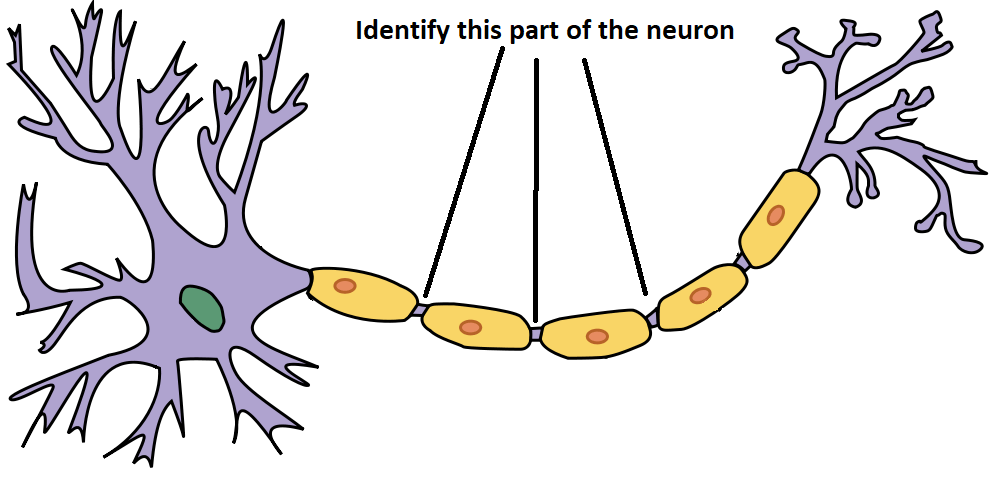
Nucleus
Cell Body
Axon
Node of Ranvier
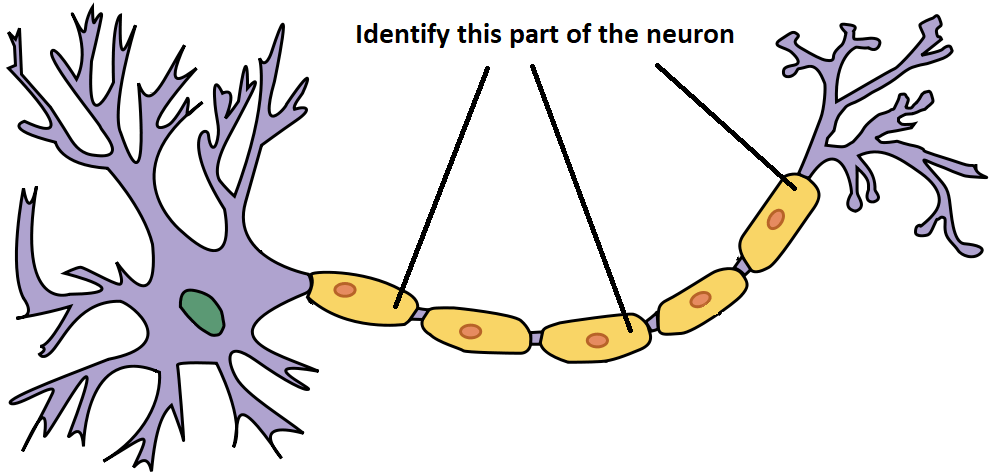
Dendrites
Axon Terminals
Myelin Sheath
Schwann Cells

Name the area labeled 1 of the gray matter
Pia mater
Ventral horn
Posterior (dorsal) horn
Lateral horns

Name the area labeled 2 in the gray matter
Ventral horns
Posterior (dorsal) horns
Lateral horns
Lateral column

Name the area labeled 1 in the white matter
Lateral horn
Lateral column
Ventral horn
Ventral column

Which letter identifies the spinal nerve?
(a)
Which letter identifies the gray matter?
(a)
Which letter identifies the dorsal horn?
(a)
Which letter identifies the dorsal root ganglion?
(a)


A neuron with many short dendrites and one long axon is a
multipolar neuron
bipolar neuron
unipolar neuron
Our conscious state is maintained by activity generated in the
cerebellum
reticular formation
limbic system
medulla oblongata
The outermost meninges layer is a thick, tough membrane called teh
dura mater
arachnoid
pia mater
subarachnoid layer
There are _____ pairs of cranial nerves, and _____ pairs of spinal nerves
12, 24
31, 12
12, 31
10, 12
A collection of spinal nerves that join together after leaving the spinal cord is called a
ganglion
nucleus
projection nerve
plexus
What is the function of receptors
keep a balance between internal/external
learned by being tricked
respond to the stimulus
learning by repetition
Which is the correct sequence of the components of a reflex arc
Receptors, spinal cord,sensory neuron, motor neuron, muscle
Receptors, muscle, sensory neuron, motor neuron, spinal cord
Receptors, sensory neuron, spinal cord, motor neuron, muscle
Receptors, motor neuron, spinal cord, sensory neuron, muscle
In a monosynaptic reflex arc, the afferent neuron carries
motor
sensory
In a monosynaptic reflex arc, the synapse happens in the:
Basal ganglia
Cerebral cortex
Spinal cord
Mechanoreceptors
In a(n) ________ reflex, a sensory neuron synapses directly on a motor neuron.
ipsilateral
contralateral
polysynaptic
monosynaptic

