
 Worksheets
A&P II
Total questions: 108
Worksheet time: 2hrs 3mins
Comparing plasma to interstitial fluid:
Na+ concentration is about 10 mM in plasma and interstitial fluid
The concentration of dissolved proteins in plasma is ~7%, significantly higher than interstitial fluid
The concentration of dissolved proteins is higher in interstitial fluid compared to plasma
K+ is higher in plasma, about 140 mM, compared to interstitial fluid, about 10 mM
The amount of sugar in the blood is normally between 70 and 100 mg/dL. Which of these answers is consistent with this range?
9 g/100mL
0.9 g/dL
9 g/dL
900 mg/L
Formed elements of the blood consist of:
electrolytes, nutrients, and organic wastes
antibodies, metalloproteins, and lipoproteins
red and white blood cells, and platelets
albumins, globulins, and fibrinogen
What is the normal intracellular Na+ concentration?
10 mM
10
140 mM
5 mM
What is true about the size and shape of a red blood cell?
Red blood cells are tiny, maybe 4 Aum in diameter, so that gases like oxygen are always close to the plasma membrane
Red blood cells are roughly 8 Aum from side to side, and are shaped as a biconcave disc. This means that hemoglobin is close to the plasma membrane facilitating diffusion of gas molecules to and from tissues
Red blood cells are roughly 8 Aum from side to side, and are shaped as a biconcave disc. This means that hemoglobin is close to the plasma membrane facilitating diffusion of salt, glucose, and metabolic substances to and from tissues
Red blood cells are roughly 8 Aum in diameter and are round. This maximizes the amount of hemoglobin that is carried which contributes to gas transport
1. The fluid outside of cells, including interstitial fluid and plasma:
2. Fluid outside of cells but NOT plasma:
3. Extracellular Na+ greater than 145 mM:
4. Any solution that makes cells shrink:
1. hypernatremia
2. extracellular fluid
3. hypertonic
4. interstitial fluid
1. interstitial fluid
2. hypertonic
3. extracellular fluid
4. hypernatremia
1. extracellular fluid
2. interstitial fluid
3. hypernatremia
4. hypertonic
1. hypertonic
2. hypernatremia
3. interstitial fluid
4. extracellular fluid
How much NaCl is required to make 1 L of 140 mM solution? Please give your answer in mol and g.
0.14 mmol/8.12 mg
140 mmol/8.12 g
56 g. 140 mmol.
140 mol. 8.12 kg.
Put the volumes in order from SMALLEST to LARGEST
100 L L mL uL dL
43521
45231
25341
12345
35124
Jennifer told us that she gives her cat subcutaneous injections to help with dehydration. What do you predict the composition of the injections to be, and why?
My best guess is that it has high Na+, K+, Ca2+. All of these are electrolytes and electrolytes are decreased during dehydration.
Since the cat is dehydrated it's most likely sterile water, similar to what we drink when we are dehydrated.
I suspect it's a high K+ solution because K+ is so important. That is what we worry about most when a person is dehydrated.
The injection is probably most like extracellular fluid, like a person would get for dehydration. For example, saline, a 140 mM NaCl solution. It may also contain some K+, maybe 5 mM, and Ca2+, around 2 mM.
During asthma minor irrational can result in airway constriction. What is the consequence of this? What is the bodies response?
Airway constriction reduces blood flow because airway resistance is increased. The response is to generate more force by the heart to generate more pulmonary blood flow.
Airway constriction increases the flux of air during breathing, meaning the air moves much faster. The response is to decrease respirator rate to reduce air flux.
Airway constriction reduces flux, flow, and driving force all while increasing resistance. The response is to increase flux, flow, and driving force.
Airway constriction reduces airflow because airway resistance is increased. The response is to generate more force, try to maintain airflow.
Jill goes outdoors in cold weather to get the mail. She doesn't wear a coat and begins to shiver right away. She continues to shiver once she returns inside. She stands next to the woodburning stove until she feels warm, and stops shivering. Is this a negative or positive feedback? Why?
It is a negative feedback because Jill began to shiver. This response, shivering, helps to increase body temperature and to return it to normal.
It is negative feedback because the variable, body temperature, is smaller than the setpoint.
It's positive feedback because Jill begain to shiver, and standing next to a hot wood stove, increased her body temperature.
It is not uncommon for a runner to lose 10% of body weight during a 10km (6.2 mile) running race. It definitely will influence performance. What is a reasonable estimate for the volume of fluid that the person lost? (FYI: 1 gallon of water weighs about 8 lbs, or 4kg)
1-2 ounces
10-20 gallons
1-2 gallons
1-2 pints
A transfusion of serum would differ from a transfusion of saline in that
The hematocrit would increase after serum transfusion because formed elements are a component of serum.
The plasma protein concentration of the blood would not change after serum transfusion, because serum has many proteins. A saline transfusion will reduce plasma protein concentration.
The number of red blood cells in the blood would decrease less with serum compared to saline.
Blood clotting is enhanced with serum because it contains fibrinogen.
What value is correct for cation concentration in red blood cells?
Ca2+ = 4 mM
Cl- = 80 mM
K+ = 139 mM
Protein = 7%
This WBC is sometimes called a polymorph due to the shape of the nucleus. It is granular, phagocytic, and releases cytotoxic enzyes to destroy pathogens. It's the most abundant leukocyte.
Lymphocyte
Neutrophil
Basophil
Eosinophil
Why does the hematocrit rise when a person is dehydrated?
An increase in plasma electrolyte concentration is recorded on the hematocrit.
Sweat is mainly water and when the water content of blood decreases the hematocrit is decreased.
Sweat is mainly water and when the water content of blood decreases the hematocrit is increased.
Edema occurs, meaning water moves from the circulation into the interstitial fluid.
Which of the leukocytes is large, agranular, and is roughly 20-40% of circulating white blood cells. It also provides defense aganist specific pathogens or toxins.
Lymphocyte
Neutrophil
Basophil
Eosinophil
What's the best definition for diabetes?
Uncontrolled or poorly controlled blood glucose concentration.
Inability to secrete insulin, or inadequate insulin secretion.
Insulin resistance.
High blood sugar.
Humans have 2 circulatory systems; systemic and pulmonary. The pulmonary circuit is all of the blood vessels that bring blood from the heart to the lungs, and back to the heart. The systemic circuit brings blood from the heart to the entire body, and back to the heart. You learned about resistance and flux in general terms. What must be true about these two blood flow circuits?
The forces for blood flow come from the heart, and therefore the forces are identical for each circuit.
The circuits are identical in resistance so that things remain balanced, so that each circuit contains 1/2 of the blood volume.
It requires more force to drive blood flow through the systemic circuit because it is longer, compared to the pulmonary circuit. A longer circuit will have more resistance to blood flow.
What is so special about hemoglobin?
It is produced by the liver and transports iron, which is necessary for oxygen binding.
It binds O2 with strong covalent bonds and transports it throughout the body, enzymatically releasing it where necessary.
It is stimulated by erythropoietin.
It is stimulated by erythropoietin.
It contains 4 heme molecules, a non-protein iron containing pigment that binds oxygen.
What is the osmotic concentration of a solution containing 100 mM NaCl and 100 mM glucose? Is it iso-, hypo-, or hyper- osmolar?
300 mOsm/L , iso-osmolar
200 mOsm/L, hypo-osmolar
300 Osm/L, hyper-osmolar
200 Osm/L, hyper-osmolar
What do colony-stimulating factors (CSF) do and when might they be used to treat disease?
CSF stimulates erythrocyte production by binding to reticulocytes. CSF is more potent compared to erythropoietin's.
CSF can stimulate production of basophils, eosinophils, neutrophils, monocytes, and lymphocytes. It could be used for leukemia treatment.
CSF can stimulate production of all formed elements except lymphocytes. They could be used to stimulate blood cell production after any treatment that lowers blood counts, for example, cancer treatments.
CSF stimulates production of lymphocytes and it might be used to stimulate the immune system after a viral infection.
The vascular phase of blood clotting
Lasts for 30 minutes, and is contraction of the smooth muscle fibers of the vessel wall.
Lasts about 3 minutes, and is quickly followed by the platelet phase which is triggered by Facor X.
Begins roughly 30 seconds after a bleed begins. This is helpful because bleeding flushes a wound...
Begins when collagen is exposed, platelets adhere, and endothelin is released.
What is the role of the liver in blood clotting?
The liver synthesizes the inactive clotting protein fibrinogen.
The liver synthesizes plasma proteins that are important for plasma osmolarity.
The liver synthesizes platelets, cell fragments that are essential for blood clotting.
The liver detoxifies the blood constantly.
The MW of NaCl = 58 grams/mol. The MW of KCl is 74 grams/mol. What weighs more, 1 mol of NaCl or 1 mol of KCL?
KCl
NaCl
Neither. They are both 1 mol.
What is the disease that involves a decreased ability to transport oxygen by the blood?
leukemia
leukemia
anemia
leukocytosis
What is the osmolarity of a solution of 140 mM NaCl?
280 mOsm/L
140 mOsm/L
320 mOsm/L
0.0140 Osm/L
What is true about red blood cell lifetime and turnover?
Macrophage identify red blood cells that are old, maybe 120 days. Iron is turned into bilirubin and excreted.
After about 120 days macrophage identify and recycle red blood cells. Heme and iron are recycled.
Red blood cells are derived from circulating stem cells, roughly 3 million per day.
After about 60 days macrophage, located in bone marrow, identify and consume red blood cells.
What is true about a person with a A+ blood type?
She has anti-Rh antibodies in her plasma.
She has Rh antigens on her red blood cells.
She has type-B antigens on her cells.
She is a universal donor.
Homeostasis
Refers to normal conditions, and variations outside of normal ranges always indicates pathology, or disease.
Most variables in the body are maintained through negative feedback.
Only requires positive feedback loops.
Is dynamic because set points change. For example, during a fever the setpoint for temperature is increased.
The kidney secretes erythropoietin when blood oxygen levels drop below the normal range.
Therefore the kidney is the control center, because it secretes erythropoietin which stimulates red blood cell synthesis.
Therefore the kidney is the sensor, because it senses the drop in oxygen, and makes the decision to secrete erythropoietin to help restore blood oxygen levels.
This is a classic example of a negative feedback loop.
Therefore, the kidney is the effector, because it does something in response to the stimulus.
Which cation has the largest chemical gradient?
K+ which is 140 mM inside of cells and around 5 mM outside of cells.
Calcium, which is 0.1 micromolar outside of cells and 2 or 3 mM inside of cells.
Calcium, which is 0.1 micromolar inside of cells and 2 or 3 mM outside of cells.
Na+ which is 140 mM outside of cells and 10 mM inside of cells.
Albumins
Are the most abundant plasma protein and are the major contributor of plasma osmolarity.
Account for ~30% of the plasma proteins. They function as immunoglobulins which attack foreign proteins, and also transport hormones.
Account for ~70% of the plasma proteins. They function as immunoglobulins which attack foreign proteins, and also transport apolipoproteins.
Account for ~70% of the plasma proteins and are major contributors of the osmotic pressure of formed elements.
What is the extracellular concentration of K+, Na+, and Ca2+?
4.5 mM, 140 mM, 3 mM
140 mM, 10 mM, 0.1 µM
140 mM, 4.5 mM, 2.5 mM
8 mM, 150 mM, 2 uM
Blood clotting is a complicated process that is essential for maintenance of life. Which part of the process begins with the activation of proenzymes that are already in the bloodstream (such as factor XII)?
The extrinsic pathway
The intrinsic pathway
The common pathway
Homeostasis
How is blood type determined?
Antigens are used to detect the antibodies in a blood sample. Anti-A antigens can detect A antibodies.
Antisera is a solution that contains antigens. For example, Anti-A antisera contains A antigens and if the blood sample reacts with it the sample is Type A.
Antisera is a solution that contains antibodies. Anti-B antisera will bind B antigens on red blood cells and cause clumping. This is a positive reaction for Type B blood.
If a blood sample contains anti A and anti B antibodies it must be type O, the most common.
What is thrombocytopenia?
It is a platelet count below normal that usually results from leukemia or an immune system problem
It is a platelet count that could result from decreased production of platelets
It is commonly associated with excessive bruising
These are ALL true
Antigens are __________, while the antibodies are found __________.
In the plasma; on the cell membrane of the RBC
On the cell membrane of the RBC; in the plasma
In the nucleus of the RBC; in the mitochondria
Produced in lymphocytes, in serum which is also called ground substance
Which of the leukocytes is phagocytic, granular, and is roughly 2-4% of circulating white blood cells?
Neutrophil
Basophil
Lymphocyte
Eosinophil
What do colony stimulating factors (CSF) do and when might they be used to treat disease?
CSF stimulates production of lymphocytes and might be used to stimulate the immune system after a viral infection
CSF stimulates erythrocyte production by binding to reticulocytes. CSF is more potent compared to erythropoietins
CSF can stimulate production of all formed elements except lymphocytes. They could be used to stimulate production after any treatment that lowers blood counts, for example, cancer treatments
CSF can stimulate production of basophils, eosinophils, neutrophils, monocytes, and lymphocytes. It could be used for leukemia treatment
Synthesis of plasma proteins occurs
In the kidney, except for antibodies, which are produced in plasma cells derived from lymphocytes
In the kidney, and decreased liver function may increase bleeding time because fibrinogen is lacking
In the liver, and during starvation albumins cannot be produced in sufficient quantity that sometimes results in edema, specifically swelling of the abdomen
In the pancreas. Decreased liver function may result in bruising because blood clotting is impaired
What is true about a person with a Rh-negative blood type?
She has Rh antigens on her red blood cells
There is a chance that she has anti-Rh antibodies in her plasma
If she has an Rh-negative baby that baby might have hemolytic disease of the newborn
She is a universal acceptor
She is a universal donor
Blood clotting is a complicated process that is essential for maintenance of life. Which part of the process begins with the activation of proenzymes that are already in the bloodstream (such as factor XII)?
The extrinsic pathway
The intrinsic pathway
The common pathway
The vascular phase
What is true about hemoglobin?
It is essential for oxygen transport and contributes to the hematocrit; the hematocrit is the % of blood that is hemoglobin
It is in red blood cells and is an intracellular protein
It is made of a single polypeptide unit that contains a single Heme molecule that binds oxygen
It is in plasma and it is an extracellular protein
What is the disease that involves either overproduction of red blood cells, or a decrease in plasma volume?
polycythemia
leukemia
leukocytosis
thrombocytosis
One can of coca cola contains 355 ml. How many deciliters is this?
0.035 dL
35.5 dL
3.55 dL
0.355 dL
What is the disease that involves a decreased ability to transport oxygen by the blood?
polycythemia
leukemia
leukocytosis
anemia
What is true about a person with a B+ blood type?
She has type-A antigens on her cells
She has anti-Rh antibody's in her plasma
She has Rh antigens on her red blood cells
She is a universal donor
She is a universal acceptor
If you have type A blood, your plasma holds circulating __________ that will attack __________
anti-B antibodies; type B rbcs
anti-A antibodies; type B rbcs
anti-A antibodies; type A rbcs
anti-B antigens; type O rbcs
Treatment with a colony stimulating factor is sometimes prescribed for bone marrow transplant patients. What of the following is the most likely reason for this treatment?
It increases red blood cell hemostasis
It increases lymphoid stem cell proliferation
It increases ALL leukocyte proliferation
It increases neutrophil, eosinophil, basophil, and monocyte production
Blood flows from the right atrium...
to the ventricles
to the pulmonary trunk moving through the pulmonary valve
to the ventricle, moving through the AV valve
to the right ventricle via the right AV vavle
What is true about red blood cell (rbc) lifetime and turnover?
Macrophage identify older rbc's and recycle components like iron that is turned into bilirubin and excreted
Red blood cells are derived from circulating stem cells, roughly 3 million per day
RBCs have a lifetime of 120 days. Then macrophage, located in the spleen or liver, identify and consume RBCs
After about 60 days macrophage identify and recycle rbc's
Convert 100 mg/dl to grams per liter
100 mg/dL = 1 g/L
100 mg/dl = 100 g/L
100 mg/dl = 5.6 mM
100 mg/dl = 56 mol/L
Blood flows from the left ventricle...
to the aorta via the aortic valve
to the aorta, moving through the left AV valve
to the vena cava, moving through the tricuspid valve
Blood flows from the right ventricle...
to the aorta, moving through the left AV valve
to the vena cava, moving through the tricuspid valve
to the aorta via the aortic valve
to the pulmonary trunk moving through the pulmonary valve
If you dissolve 1 mol of glucose into 1 L of water, and in a separate beaker dissolve 1 mol of NaCl in 1 L of water, which has a higher osmolarity?
neither, they are the same osmolarity, 300 mOsm/L
neither, they are the same osmolarity, 1 Osm/L
NaCl because it dissociates into 1M of Na+ and 1 mol of Cl-. Therefore the osmolarity is 2 Osm/L
Glucose because the MW is 180 g/mol and that is larger compared to NaCl which is just 58 g/mol. Therefore you are dissolving 180 grams of glucose into 1 L, and that contains many more 'particles' compared to NaCl which just weighs 58 grams
What gradient would influence the plateau phase of a cardiac action potential?
The Na+ concentration gradient that favors Na+ moving into the cell
The Na+ gradient that is 140 mM on the inside and 10 mM on the outside
The K+ gradient that is roughly 4.5 mM on the outside and 140 mM on the inside
The Ca gradient that is 2 mM outside and 0.1 uM inside
The coronary arteries
Receive blood from the aorta and perfuses the capillaries near heart muscle cells. That blood is returned to the heart by the vena cava
Receive blood from the carotid sinus and perfuses the capillaries near heart muscle cells. That blood is returned to the heart by the vena cava
Receive blood from the aorta and perfuses the capillaries near heart muscle cells. That blood is returned to the heart by the carotid sinus
Receive blood directly from the left ventricle because this is the highest pressure and they need blood for optimal heart contraction
End diastolic volume is
The volume of blood in the left ventricle, around 80 mL
The volume of blood in the left ventricle at the end of diastole. It's the maximum blood volume
The volume of blood in the left ventricle at the end of systole and it's the maximum blood volume
Increases at high heart rates
Lucy Loo has type AB+ blood. What's true? (select ALL true statements)
She's a universal donor
She has A, B, and RH factor antigens on her red blood cells
She has A, B, and RH factor antigens on her blood cells
She has A, B, and RH factor antibodies on her red blood cells
What is the antisera that was used in lab for blood typing?
It is a liquid that contains antibody's
It's a liquid that contains antigens
It's a special sauce that can do magical things
When you get a vaccine
Lymphocytes (B lymphocytes) make antibodies that are specific to this vaccine
Neutrophils are activated to fight infection and to create 'memory' to the vaccine
Basophils release histamine to destroy the foreign vaccine. This is part of the specific defense system
Your hematocrit increases because hematopoiesis is stimulated
The right and left side if the heart
Contract at identical times and hold identical volumes of blood
Contract one after the other, first left, then right
Hold different amounts of blood because one side is the pulmonary circulation (the right side) and one side is the systemic circulation (left side)
Have different resting membrane potentials. These are larger on the left side because it contracts more forcefully
The the blood clotting pathway factor X
Has a role in the intrinsic, extrinsic, and common pathways
Is essential for blood clotting and without it a person would have a severe bleeding disorder
Is synthesized by the liver
These are all true!
Your patient has high neutrophil count. What do you guess is the reason?
He is totally stressed
He has an infection, maybe bacterial or maybe viral
He has high blood glucose and this can interfere with immunity
He has an infection and it is definitely from bacteria
End Systolic Volume...
Is sometimes more than end diastolic volume
Increases when sympathetic tone increases
Is ALWAYS more than end diastolic volume
Is ALWAYS less than end diastolic volume
A stroke
Is the same as a heart attack and just means blood flow to the brain is interrupted
Occurs when blood pressure is so high that blood vessels burst. This might happen when lifting something very heavy and holding your breath
Happens when a blood clot blocks blood flow to the brain, or a blood vessel supplying blood to the brain bursts
Chordae tendinea...
Connect the AV valves to papillary muscles
Connect AV valves to trabeculae inside of the heart chamber
Actually push the valves closed when the ventricles contract so that blood can't move from atria to ventricles
Contract at the very start of ventricular systole
What gradient would influence the upstroke of a cardiac action potential?
The Na+ concentration gradient that favors Na+ moving into the cell
The Na+ gradient that is 140 mM on the inside and 10 mM on the outside
The K+ gradient that is roughly 4.5 mM on the outside and 140 mM on the inside
The Ca2+ gradient that is 2 mM outside and 0.1 uM inside
Which description of blood flow is correct?
Left ventricle> aorta>vena cava>right atrium>right ventricle>pulmonary trunk>pulmonary vein> left atrium
Left ventricle> aorta>vena cava>left atrium > right atrium>right ventricle>pulmonary trunk>pulmonary vein> left ventricle
Right ventricle> aorta>vena cava>left atrium>left ventricle>pulmonary trunk>pulmonary vein> right atrium
Aorta>pulmonary circulation> left atrium>left ventricle> pulmonary trunk> pulmonary artery> pulmonary vein> right atrium>right ventricle
The cardiovascular system is a closed system. Why is this relevant?
Because we need to know this to pass the test
Knowing that it is closed means that when the heart contracts pressure increases. If it was open that wouldn't happen as well
It just means that the heart is essentially like a balloon
It means that blood can only flow in 1 direction when pressure goes up
The ECG...
Is an electrical voltage that is measured at the skin surface that results from atrial myocytes and ventricular myocytes firing action potentials and also repolarizing
Is an electrical voltage that is measured at the skin surface that results from atrial myocytes and ventricular myocytes contracting and also relaxing
Is an electrical current that is measured at the skin surface that results from atrial myocytes and ventricular myocytes firing action potentials and also repolarizing
Is an awful thing that I can't understand
Does the heart spend more time in systole or diastole?
Diastole
Systole
I can't answer this because the heart has 4 chambers
What gradient would influence the plateau phase repolarization of a cardiac action potential?
The Na+ concentration gradient that favors Na+ moving into the cell
The Na+ gradient that is 140 mM on the outside and 10 mM on the inside
The K+ gradient that is roughly 4.5 mM on the outside and 140 mM on the inside
The Ca2+ gradient that is 2 mM outside and 0.1 uM inside
What artery carries deoxygenated blood?
Capillaries
Pulmonary
Aorta
Carotid sinus
End diastolic volume is...
The volume of blood in the left ventricle, around 80 mL
The volume of blood in the left ventricle at the end of diastole. It is identical to the volume of blood in the right ventricle
The volume of blood in the left ventricle at the end of diastole. This is greater then the volume of blood in the right ventricle becuase the pulmonary circulation holds less blood
The volume of blood in the left ventricle at the end of systole and it's the maximum blood volume
Chordae tendenae...
Pull the AV valves shut at the start of ventricular systole
Pull semilunar valves shut at the start of ventricular systole
Prevent AV valves from everting during ventricular systole
Prevent semilunar valves from everting during ventricular systole
What's the gradient the forces blood from the left ventricle to the aorta?
Bulk flow of blood through the circulation
Pressure created by ventricular systole
Chordae tendinea contracting and closing the AV valves
Pressure created by atrial systole
The ECG...
Is used to measure the timing of events in the heart
Is used to determine the strength of contraction of the heart
Can determine if a heart valve is leaky
Can shock a person to restore the heart rhythm
End diastolic volume is...
The volume of blood in the left ventricle, around 80 mL
The volume of blood in the left ventricle at the end of diastole. It's the maximum blood volume, approximately 200 mL
Decreases at high heart rates
The volume of blood in the left ventricle at the end of systole and it's the maximum blood volume
This WBC is sometimes called a polymorph due to the shape of the nucleus. It is granular, phagocytic, and releases cytotoxic enzymes to destroy pathogens. It's the most abundant leukocyte.
Basophil
Neutrophil
Lymphocyte
Eosinophil
What happens when venous return increases?
Nothing whatsoever. Homeostatic regulation accounts for regular variations in venous return
EDV increases, and that probably increases stroke volume because SV = EDV - ESV
It depends on if the venous return is to the right atria (pulmonary circuit) or the left atria (systemic circuit)
EDV decreases, and that probably increases stroke volume because SV = ESV - EDV
Contractility increases, which forces more blood out of the heart
Dave's heart rate is 72 beats per minute and his stroke volume is 80 ml. What is his cardiac output?
5.76 L/min
5 L/min
5760
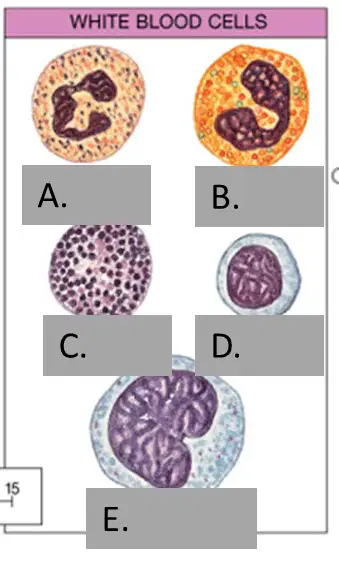
Identify the cell type that accounts for 2-8% of all WBCs, and that spends only 24 hours i n the blood stream before moving to peripheral tissues to become a tissue macrophage
A
B
C
D
E
Miguel Induran is a famous Spanish cyclist. His resting heart rate is 32 beats per minute! How does he maintain a resting cardiac output of 5L/min?
His sympathetic nervous system will release norepinephrine to increase his heart rate to a more normal rate, like 72 beats per minute
His stroke volume must be very large, probably because his heart is very strong
This is just a mystery. He is a freak of nature
He doesn't! His resting CO is 32bpm*80 ml = 2.56 L. Because he is such a good athlete his body needs less oxygen at rest
What values are correct for cation concentrations in plasma?
Na+ 140 mM
Na+ 0.14 M
Ca2+ 1 µM
Both 1 and 2 are true
The immune system identifies and attacks anything foreign. During a blood transfusion...
Surface antigens on your own red blood cells are not recognized by your own antibodies
Surface proteins on your own red blood cells are protected by glycoprotein
Foreign surface proteins on antibodies will be attacked by your lymphocytes
Surface proteins on the foreign red blood cells will be modified by your immune system to make them match
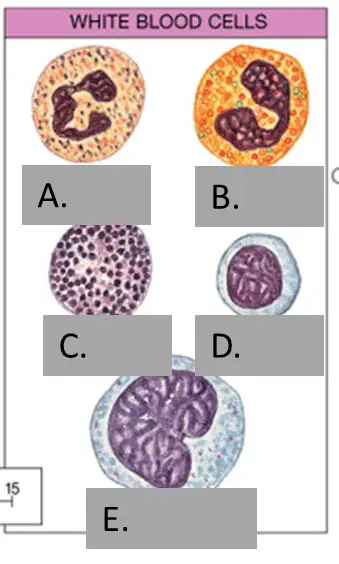
Select the call that best mathes this description: Sometimes these cells are called 'acidophils' because the granules stain with eosin, an acidic red dye. This cell type is important for destroying antibody-marked bacteria
A
B
C
D
E
What happens when venous return increases?
The atrial reflex is triggered which increases sympathetic tone, releasing epinephrine on the heart, and increases heart rate
The atrial reflex is triggered which increases parasympathetic tone, releasing epinephrine on the heart, and increases heart rate
The atrial reflex is triggered which increases sympathetic tone, releasing epinephrine and acetylcholine on the heart, and increases heart rate
The ventricular reflex is triggered which increases sympathetic tone, releasing epinephrine on the heart, and increases heart rate
Which artery has deoxygenated blood?
The iliac artery
The femoral artery
The pulmonary artery
None. All arteries carry oxygenated blood, by definition
What does erythropoietin (EPO) do?
It stimulates red blood cell production in the red bone marrow
It stimulates red blood cell production in the circulating plasma
It stimulates hematopoiesis
It stimulates hemolysis
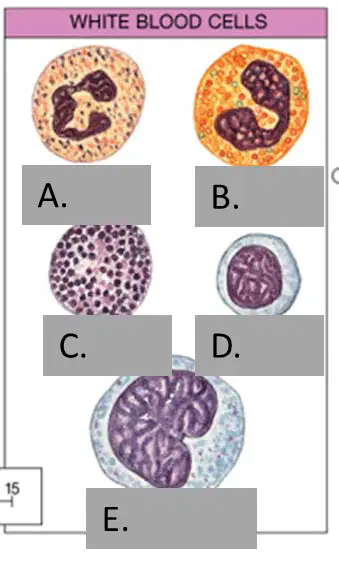
Select the cell type that gives rise to T and B cells
A
B
C
D
E
What is an aortic aneurysm and why is it dangerous?
An aneurysm is a type of muscular dystrophy and results in a weakening of an artery
An aneurysm is a broken blood vessel and it will interrupt blood flow to the brain
An aortic aneurysm is a bulge in a blood vessel that bursts, interrupting brain blood flow
An aneurysm is a bulging, or balloon-like bulge in a blood vessel. It is dangerous because it is a weak region of the blood vessel and it could burst
Which of the leukocytes is large, agranular, and is roughly 20-40% of circulating white blood cells. It also provides defense against specific pathogens or toxins.
Neutrophil
Basophil
Lymphocyte
Eosinophil
Which feature of WBCs makes them particularly important in tissue injury?
They stick to injured blood vessels
They undergo a fast rate of mitosis
They can squeeze out through blood vessel walls into tissues
They carry loads of oxygen
What is the disease that involves either too many or too few white blood cells? It is usually accompanied by swollen lymph nodes and fatigue.
Polycythemia
Leukemia
Leukocytosis
Thrombocytosis
A patient has surgery and her hematocrit dropped from 44 to 22. What happened?
Her spleen was removed, and red blood cells are made in the spleen. Therefore production of red cells is slower
Her bone marrow is no longer producing red blood cells for some unknown reason
It is likely that a significant amount of blood, about 50%, was lost. Plasma volume could have been replaced with isotonic saline infusion containing no red blood cells, and therefore her hematocrit dropped
During surgery a large amount of blood was lost. She porbably recieved a blood transfusion but these will not restore red blood cells, and therefore her hematocrit dropped
What is thrombocytopenia?
It is a platelet count below normal that usually results from leukemia or an immune system problem
It is a platelet count that could result from decreased production of platelets
It is commonly associated with excessive bruising
These are ALL true
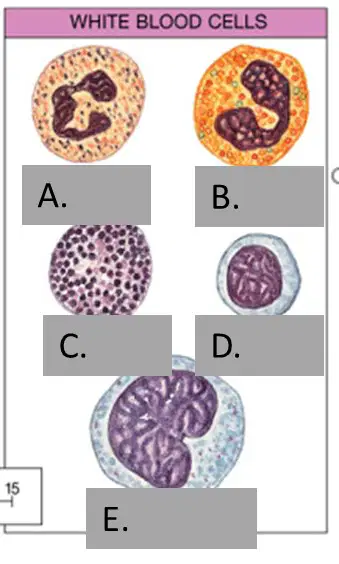
Select the cell type that migrates to injury sites and releases histamine, a compound that dilates blood vessels
A
B
C
D
E
The molecular weight of KCl is 74 grams per mol and 58 grams per mol for NaCl. The osmolarity for a 150 mM solution...
Can't be calculated
Is 74 mOsm/L for KCL and 58 mOsm/L for NaCl
Is the same for both, 300 mOsm/l
Is more for KCL because it weighs more
What is true about a person with a Rh-negative blood type?
She has Rh antigens on her red blood cells
There is a chance that she has anti-Rh antibodyâ s in her plasma
If she has an Rh-negative baby that baby might have hemolytic disease of the newborn
She is a universal acceptor
She is a universal donor
What is Hemostasis?
The normal breakdown of red blood cells. About 10% of RBCâ s undergo hemostasis in the
blood circulation
The presence of red blood cells in urine
The process of keeping blood flowing so that it does not clot
Blood clotting!
If your mother is type A blood, can you be type B?
Yes. A person's blood type is determined by either parent
Yes, if she had In Vitro Fertilization with donated embryos. Any embryo from her would have type A
Maybe. Sometimes the alleles get mixed up
For sure! That would mean that she is type AO and the father would be type BB or type BO
What happens when venous return increases?
Preload increases, which means the ventricular myocytes are stretched more resulting in a stronger contraction
Contractility increases which means that ventricular myocytes are stretched more and therefore contract more forcefully
The parasympathetic nervous is stimulated to help regulate cardiac output
Afterload increases, which means the ventricular myocytes are stretched more resulting in a stronger contraction
An antigen is ___________ and an antibody is ____________
An antibody-generating-substance found on red blood cells. And antibody is a globulin produce by lymphocytes that recognizes specific foreign antigens
An antibody-generating-substance found on blood cells. An antibody is a globulin produce by the liver that recognizes specific foreign antigens
A globulin produce by lymphocytes that recognizes specific foreign antigens and an antibody is a marker on red blood cells
An agglutinin and an agglutinogen
If you have type AB blood what antibodies are you likely to find in your plasma?
None!
Anti-B
Anti-A and Anti-B
Anti-A
Which component of blood contains more K+?
Plasma, it is usually more then ½ the blood volume and contains ~ 140 mM Na+ and 4.5 mM K+
Formed elements, they contain 140 mM K+ and 10 mM Na+
Plasma, it is both water and formed elements, which are mainly leukocytes, hemoblasts, and hemoglobins
Serum, which is plasma plus albumins plus formed elements
If you have 900 ml of ringer's solution, how many deciliters is that?
9
0.9
90
For heavens sake. I will not eat green eggs and ham. Not on a bus, not in a train, not in a car, and NOT before A&P lecture

