wayground logo

Free Printable Worksheets

Font size

S
M
L
XL
Worksheets

ANATOMY

Total questions: 108

Worksheet time: 1hrs 19mins

Name
Class
Date
1.
a)
Quadriceps
b)
Satorius
c)
Hamstring
d)
Gastronecmius
2.
The heart is________to the stomach
a)
superficial
b)
deep
c)
superior
d)
inferior
3.
Anterior means
a)
toward the front
b)
toward the back
c)
toward the middle
d)
toward the side
4.
The shaft of a hair is made of
a)
melanin
b)
sebum
c)
cartilage
d)
keratin
5.
The bone of the upper leg is the 
a)
femur
b)
humerus
c)
tibia
d)
metacarpal
6.
What part of a bone produces blood cells?
a)
articular cartilage
b)
yellow bone marrow
c)
red bone marrow
d)
periosteum
7.
The main purpose of the ____________ system is to break food particles into pieces that can be used.
a)
circulatory
b)
respiratory
c)
digestive
d)
skeletal
8.
What is responsible for delivering oxygen and removing carbon dioxide from the body?
a)
cell nucleus
b)
excretory system
c)
nervous tissue
d)
respiratory system
9.
Which of the following body systems work together for support, protection, and movement?
a)
respiratory and cardiovascular
b)
skeletal and muscular
c)
skeletal and integumentary
d)
digestive and respiratory
10.
My spinal cord helps _________ travel between my brain and the nerves in my body. 
a)
Memories
b)
Blood
c)
Waste
d)
Messages
11.
Arteries carry blood ______ from the heart.
a)
Away
b)
To
c)
Across
d)
Around
12.
The air I breathe in goes down my trachea to my ______?
a)
Heart
b)
Lungs
c)
Brain
d)
Stomach
13.
The food I eat goes down my esophagus to my __________.
a)
Bladder
b)
Kidney
c)
Stomach
d)
Big Toe
14.
a)
Quadriceps
b)
Satorius
c)
Hamstring
d)
Gastronecmius
15.
a)

Tricep

b)

Deltoid

c)

Hamstring

d)

Biceps

16.
a)

Latissmius Dorsi

b)

Erectors

c)

Deltoids

d)

Abdominal

17.
a)

Rectus Abdominal

b)

Oblique

c)

Erectors

d)

Pectoral

18.
a)
Trapezius
b)
Gluteals
c)
Deltoid
d)
Hamstring
19.
a)
Hamstrin
b)
Quadricep
c)
Tibialis Anterior
d)
Gastrocenmius
20.
a)

Gluteus Maximus

b)

Hamstring

c)

Quadricep

d)

External Oblique

21.
a)
Pectoral
b)
Tricep
c)
Bicep
d)
Deltoid
22.
a)

Rectus Abdominus

b)

External Oblique

c)

Pectorals

d)

Trapezius

23.
a)
Latissimius Dorsi
b)
Trapezius
c)
Triceps
d)
Erectors
24.
a)

Tibialis

b)

Gastronecmius

c)

Quadriceps

d)

Hamstring

25.

What bones is highlighted?

a)

Femur

b)

Humerous

c)

Skull

d)

Shin

26.
a)
mandible
b)
skull
c)
scapula
d)
spine
27.
a)
cranium
b)
ribs
c)
mandible
d)
vertebrae
28.
a)
rib
b)
spine
c)
scapula
d)
clavicle
29.
a)
ulna
b)
humerus
c)
radius
d)
vertebrae
30.
a)
ulna
b)
humerus
c)
radius 
d)
vertebrae
31.
a)
ulna
b)
radius
c)
humerus
d)
clavicle
32.
a)
tibia
b)
fibula
c)
radius
d)
calcaneus
33.
a)
metatarsals
b)
carpals
c)
tarsals
d)
metacarpals
34.
a)
metacarpals
b)
phelanges
c)
tarsals
d)
metatarsals
35.
Name the bone
a)
Patella
b)
Femur
c)
Radius
d)
Tibia
36.
Name the bone
a)
clavicle
b)
sternum
c)
humerus
d)
scapula
37.
Name the bone
a)
sternum
b)
scapula
c)
radius
d)
clavicle
38.
Name a muscle in the arm?
a)
Bicep
b)
Teres Major
c)
Soleus
d)
Abdominal
39.
_______ system
a)
Muscular
b)
Skeletal
c)
Bone
d)
Circulatory
40.
What muscle is in the shoulder?
a)
Sternocleidomastoideus
b)
Trapezius
c)
Deltoid
d)
Bicep
41.
This circular muscle surrounds the mouth
a)
Orbicularis Oris
b)
Orbicularis Oculi
c)
Zygomaticus Major
d)
Rectus Superioris
42.
This muscle aids in chewing by keeping food between the cheek and teeth, it is named based on location.
a)
Buccinator
b)
Masseter
c)
Zygomaticus Major
d)
Lateral Pterigoid
43.
This muscle is named for the chewing action it produces
a)
Buccinator
b)
Masseter
c)
Lateral Pterygoid
d)
Medial Pterygoid
44.
This muscle is named for its origin on the side of the head and it inserts on the mandible.
a)
Occipitofrontalis
b)
Temporalis
c)
Inferior Oblique
d)
Lateral Rectus
45.
This round muscle surrounds the eye and wrinkles your forehead like when you look confused
a)
Orbicularis Oris
b)
Orbicularis Oculi
c)
Medial Rectus
d)
Superior Oblique
46.
This muscle is located on either side of the neck and is named for its location, originating on the manubrium and clavicle  and inserting on the temporal bone.
a)
Sternocleidomastoid
b)
Temporalis
c)
Masseter
d)
Platysma
47.
a)
Orbicularis Oris
b)
Orbicularis Oculi
c)
Corrugator
d)
Frontalis
48.
a)
Orbicularis Oris
b)
Orbicularis Oculi
c)
Corrugator
d)
Occipitals
49.
a)
Temporalis
b)
Frontalis
c)
Occipitals
d)
Corrugator
50.
a)
Buccinator
b)
Zygomaticus Major
c)
Zygomaticus Minor
d)
Masseter
51.
a)
Masseter
b)
Buccinator
c)
Zygomaticus Major
d)
Zygomaticus Minor
52.
a)
Mentalis
b)
Platysma
c)
Sternoclidomastoid
d)
Risorius
53.
a)
Frontalis
b)
Occipitals
c)
Corrugator
d)
Obicularis Oculi
54.
The action of this muscle is to
a)
Extend the neck
b)
Extend the torso
c)
Pull the head toward the side
d)
Flex the Arm
55.
What is the origin of temporalis?
a)
angle of mandible
b)
the chin
c)
temporal fossa
d)
styloid process
56.
Which of the following is a suprahyoid muscle?
a)
sternohyoid
b)
omohyoid
c)
digastric
d)
thyrohyoid
57.
Which bone is not part of the axial skeleton?
a)
ribs
b)
sternum
c)
clavicle
d)
zygomatic bone
58.
Identify bone
a)
Occipital bone
b)
Parietal bone
c)
Temporal bone
d)
Sphenoid bone
59.
Identify bone
a)
Zygomatic bone
b)
Temporal bone
c)
Parietal bone
d)
Occipital bone 
60.
Identify bone.
a)
Zygomatic bone
b)
Nasal bone
c)
Maxillary bone
d)
Lacrimal bone
61.
What suture is shown by arrow C?
a)
Coronal suture
b)
Squamous suture
c)
Lambdoidal suture
d)
Sagittal suture
62.
Which of these is a flat bone?
a)
Vertebra
b)
Ethmoid bone
c)
Sphenoid bone
d)
Frontal bone
63.
Identify this tissue.
a)
Blood
b)
Spongy Bone
c)
Nervous tissue
d)
Compact Bone
64.
‘I am cartilage!’
a)
Chrondro-
b)
Cyte
c)
Costa-
d)
Osteo-
65.
Which of the following is a hole or opening in a bone for the passage of blood vessels and nerves?
a)
foramen
b)
process
c)
condyle
d)
protuberance
66.
Identify fossa
a)
anterior cranial fossa
b)
middle cranial fossa
c)
posterior cranial fossa
d)
temporal cranial fossa
67.
Identify projection
a)
external occipital protuberance
b)
mastoid process
c)
occipital condyle
d)
sella turcica
68.
Which part of the skull allows the passage of the medulla oblongata?
a)
jugular foramen
b)
carotid canal
c)
foramen magnum
d)
cribriform plate
69.
This is a sphenoid bone, so it is what type of bone?
a)
long
b)
short
c)
irregular
d)
flat
70.

A tissue that covers a surface, is one cell layer thick, and is composed of flat cells is

a)

simple squamous epithelium

b)

simple cubodial epithelium

c)

simple columnar epithelium

d)

stratified squamous epithelium

e)

transitional epithelium

71.

Epithelium composed of two or more layers of cells with only the deepest layer in contact with the basement membrane is known as

a)

stratified epithelium

b)

simple epithelium

c)

pseudostratified epithelium

d)

columnar epithelium

72.

Given these characteristics:

  1. capable of contraction
  2. covers all free body surfaces
  3. lacks blood vessels
  4. comprises various glands
  5. anchored to connective tissue by a basement membrane


Which of these are characteristics of epithelial tissue?

a)

1,2,3

b)

2,3,5

c)

3,4,5

d)

1,2,3,4

e)

2,3,4,5

73.

Which of these is true of adipose tissue?

a)

site of energy storage

b)

a type of connective tissue

c)

acts as a protective cushion

d)

functions as a heat insulator

e)

all of the above

74.

Blood is an example of

a)

epithelial tissue

b)

connective tissue

c)

muscle tissue

d)

nervous tissue

75.

Which of these statements about nervous tissue is NOT true?

a)

neurons have cell processes (extensions) called axons

b)

electrical signals (action potentials) are conducted along axons

c)

Dendrites contain the nucleus and control general cell function

d)

Neurons are nourished and protected by neuroglia

76.
Where is epithelial tissue found?
a)
glands
b)
covering body surfaces
c)
lines organs
d)
all of the above
77.
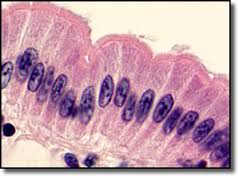
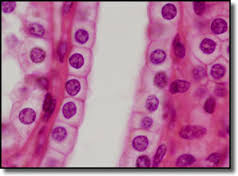
Which tissue is this?
a)
Simple Squamous
b)
Stratified Squamous
c)
Simple cuboidal
d)
Pseudostratified columnar
78.
Identify:
a)
Columnar
b)
Cuboidal
c)
Pseudostratified
d)
Transitional
79.
Identify:
a)
Pseudostratified
b)
Smooth Muscle
c)
Transitional
d)
Stratified Squamous
80.
Identify:
a)
Smooth Muscle
b)
Columnar
c)
Transitional
d)
Pseudostratified
81.
Identify:
a)
Columnar
b)
Cuboidal
c)
Transitional
d)
Simple Squamous
82.
Identify:
a)
Smooth Muscle
b)
Columnar
c)
Transitional
d)
Pseudostratified
83.
Identify:
a)
Pseudostratified
b)
Simple cuboidal
c)
Transitional
d)
Simple Squamous
84.
This type of epithelium has only one layer of cells
a)
Stratified epithelium
b)
Simple epithelium
85.

While doing work and running, you move your organs like hands, legs etc. Which among the following is correct?

a)

Smooth muscles contract and pull the ligament to move the bones.

b)

Smooth muscles contract and pull the tendons to move the bones.

c)

Skeletal muscles contract and pull the tendon to move the bones.

d)

Skeletal muscles contract and pull the ligament to move the bones.

86.

Which muscles act involuntarily?

(i) Striated muscles

(ii) Smooth muscles

(iii) Cardiac muscles

(iv) Skeletal muslces

a)

(i) and (ii)

b)

(ii) and (iii)

c)

(iii) and (iv)

d)

all are correct

87.

Fats are stored in human body as

a)

cuboidal epithelium

b)

cartilage

c)

adipose tissue

d)

bones

e)

ears

88.
Which of the following is NOT a type of connective tissue?
a)
Bone
b)
Cartilage
c)
Skin
d)
Blood
89.
This type of connective tissue forms strong rope like structures such as tendons and ligaments.
a)
Areolar
b)
Dense fibrous 
c)
Cartilage 
d)
Bone
90.
Name this tissue
a)
Bone
b)
Cartilage
c)
Blood
d)
Adipose
91.
Name this tissue
a)
Bone
b)
Cartilage
c)
Blood
d)
Adipose
92.
What tissue is this
a)
Bone
b)
Cartilage
c)
Blood
d)
Adipose
93.
What tissue is this
a)
Transitional epithelium
b)
Cartilage
c)
Dense Fibrous
d)
Areolar
94.
Attach muscles to bones
a)
Tendons
b)
Ligaments
95.
This type of dense connective tissue connects bone to bone at joints 
a)
Tendons
b)
Ligaments
96.

Name the tissue

a)

Skeletal

b)

Cardiac

c)

Smooth

97.
Name this tissue
a)
Skeltal
b)
Cardiac
c)
Smooth
98.
This type of muscle tissue is attached to bones wand helps control voluntary movement
a)
Skeletal
b)
Cardiac
c)
Smooth
99.
Which type(s) of muscle tissue have visible striations
a)
Only Cardiac Muscle
b)
Only Skeletal Muscle
c)
Only Smooth Muscle
d)
Skeletal and Cardiac Muscle
100.
What is this?
a)
Blood
b)
Bone
c)
Neuron
d)
Adipose
101.
Trochlear Nerve
a)
II
b)
IV
c)
V
d)
VIII
102.
Allows you to swallow your food
a)
Trigeminal
b)
Facial
c)
Glossopharyngeal
d)
Hypoglossal
103.
Sense of smell
a)
I
b)
II
c)
III
d)
VII
104.
Sight
a)
I
b)
II
c)
III
d)
IV
105.

Which bone contains the mental foramen?

a)

the maxillary bone

b)

the parietal bone

c)

the occipital bone

d)

the mandible

106.

The parietal and frontal bones are separated by the

a)

squamous suture

b)

lambdoid suture

c)

coronal suture

d)

maxillary bones

107.

The empty box on the bottom right of the screen is pointing to which small bone?

a)

the nasal bone

b)

the vomer

c)

the ethmoid bone

d)

the lacrimal bone

108.

The orange bone on the anterior side of the skull is termed the

a)

vomer

b)

maxilla

c)

mandible

d)

sphenoid