wayground logo

Free Printable Worksheets

Font size

S
M
L
XL
Worksheets

Unit 3 Exam

Total questions: 106

Worksheet time: 3hrs 31mins
Name
Class
Date
1.
What is a substance called if it speeds up a chemical reaction?
a)
reusable
b)
catalyst
c)
specific
d)
fragile
2.
Each enzyme only has 1 substrate that will fit its active site.  What is this called?
a)
reusablility
b)
denaturation
c)
specificity
d)
fragility
3.
With what 3 letters do enzymes typically end?
a)
-ose
b)
-ase
c)
-ese
d)
-tic
4.
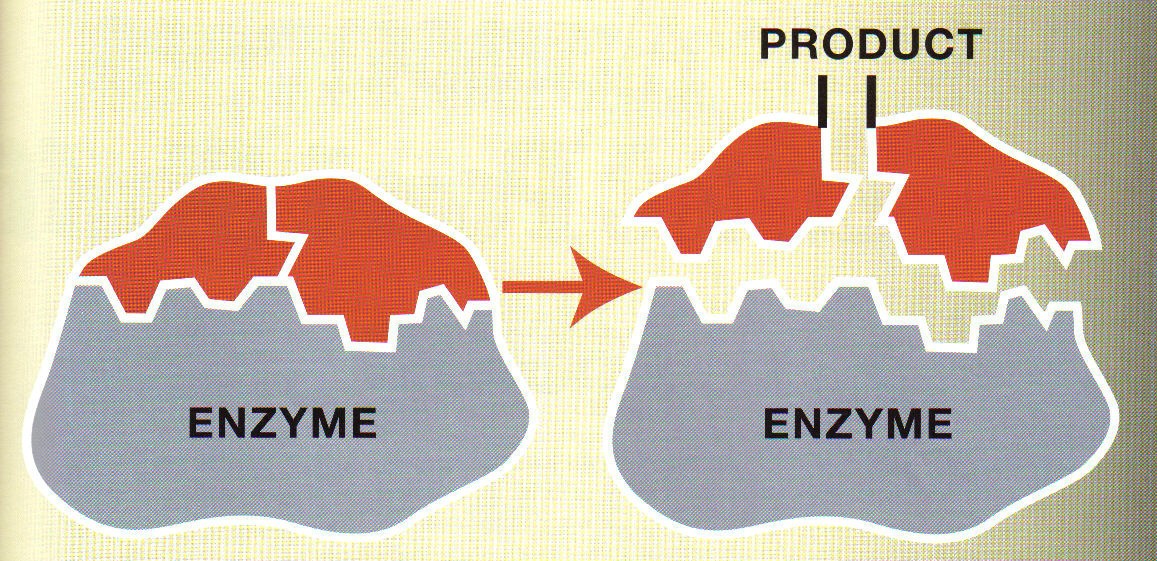
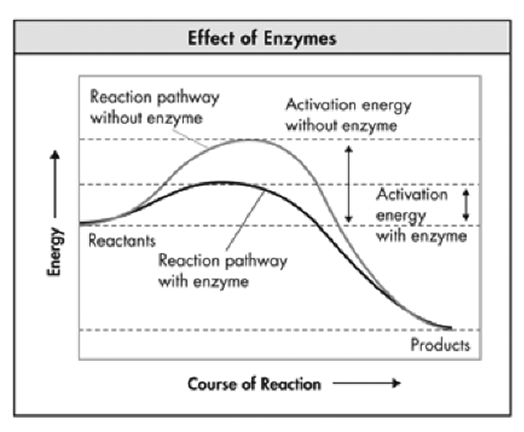
The graph shows how enzymes affect reactions in cells. Which statement best summarizes the information shown in the graph?
a)
Enzymes increase the energy of the reactants.
b)
Enzymes decrease the energy level of the products.
c)
Enzyme decrease the activation energy of the reaction.
d)
Enzymes reverse the direction of the reaction.
5.
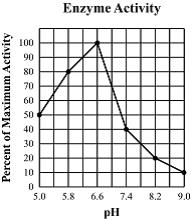
Which of the following conclusions can be drawn from this graph?
a)
The optimum pH of the enzyme is 6.6.
b)
The optimum pH of the enzyme is 5.8
c)
The enzyme’s activity increases as pH increases 5.0 to 9.0
d)
The enzyme’s activity is greater around pH of 8.0 .
6.
Any substance that is acted upon by an enzyme is called a(n)?
a)
Coenzyme
b)
Substrate
c)
Vitamin
d)
Polypeptide
7.
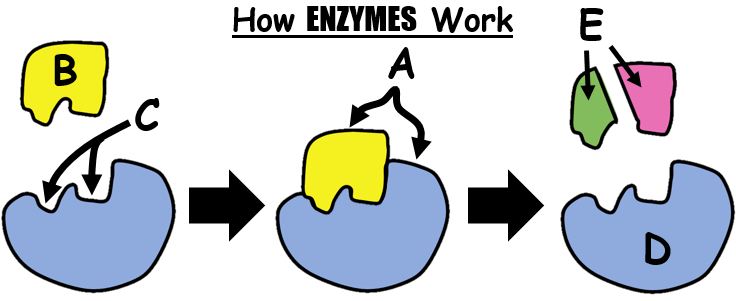
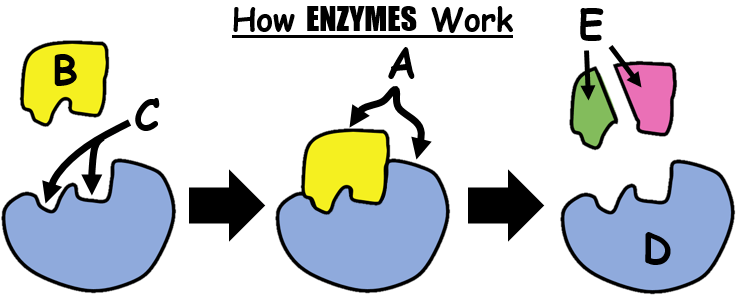
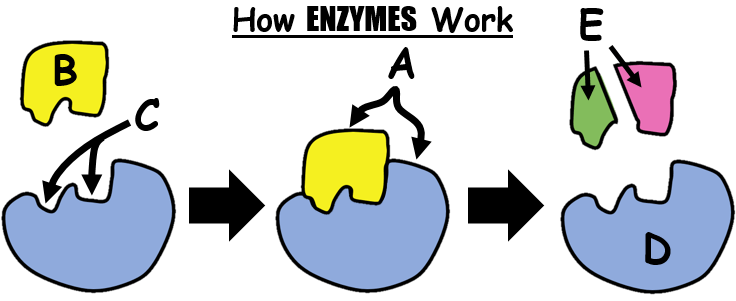
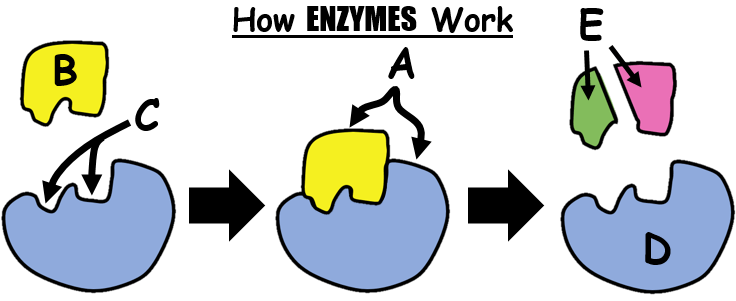
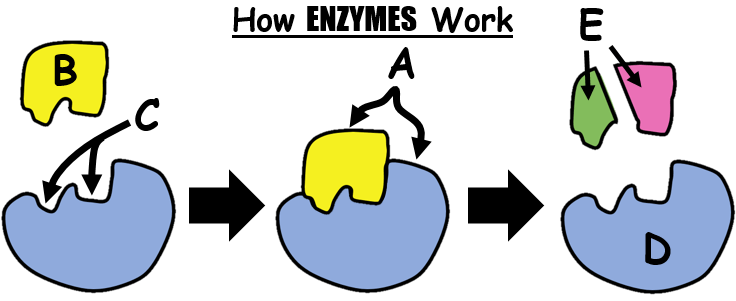
In the diagram, what is letter A? 
a)
product
b)
substrate
c)
enzyme-substrate complex
d)
active site
8.
Enzymes are...
a)
nucleic acids
b)
proteins
c)
lipids
d)
carbohydrates
9.
An enzyme speeds up a chemical reaction in the cell but can only be used once.  True or False? 
a)
true
b)
false
10.
What is the function of an enzyme?
a)
enzymes break themselves into small pieces
b)
enzymes slow down chemical reactions
c)
enzymes speed up chemical reactions
d)
enzymes combine products to form reactants 
11.
What happens when enzymes are heated to a high temperature?
a)
The enzymes die.
b)
The shapes of the enzyme are altered denature
c)
The enzymes' amino acid sequence changes.
d)
The enzymes remain the same
12.
Which of these is most likely an enzyme?  
a)
Sucrose
b)
Galactose
c)
Fructose
d)
Amylase
13.
Enzymes speed up reaction rates by changing...
a)
Activation Energy
b)
pH
c)
Hydrogen Bonds
d)
Kinetic Energy
14.
Letter D...
a)
active site
b)
enzyme
c)
substrate
d)
products
15.
Letter B...
a)
active site
b)
enzyme
c)
substrate
d)
products
16.
Letter C...
a)
active site
b)
enzymes
c)
substrate
d)
products
17.
Letter E...
a)
active site
b)
enzyme
c)
substrate
d)
products
18.
Which enzyme is most efficient in a basic solution?
a)
A
b)
B
19.

The most energy is stored in the bonds between which phosphate groups

a)

between ribose and the 1st phosphate group

b)

between the first and second phosphate group

c)

between the second and third phosphate group

20.
Which structures shown in the Figure make up the ADP molecule?
a)
A and B
b)
A, B and C
c)
A, B, C, and D
d)
C and D
21.
Which of the following can be compared to a battery in need of recharging?  (empty wallet)
a)
ADP
b)
ATP
c)
Ribose
d)
Adenosine
22.
What are the parts of the ATP molecule?
a)
adenine, thylakoids, stroma
b)
stroma, grana, chlorophyll
c)
adenine, ribose, phosphate groups
d)
NADH, NAHPH, FADH
23.
Which structures shown in the Figure make up the ATP molecule?
a)
A and B
b)
A, B and C
c)
A, B, C, and D
d)
C and D
24.
Which of the following results in the storage of energy in terms of the ATP/ADP cycle?
a)
The breaking of the bond between the 5-carbon sugar and the 1st phosphate group
b)
The addition of a phosphate group
c)
The removal of a phosphate group
d)
The addition of glucose 
25.
Where is the energy stored in ATP molecules
a)
In the Ribose Sugar
b)
In the Adenine group
c)
In the Phosphate bonds
d)
In the Bank
26.
What type of macromolecule is ATP/ADP?
a)
Carbohydrate
b)
Nucleic Acid
c)
Lipid
d)
Protein
27.
Which cellular organelle is responsible for manufacturing ATP?
a)
Ribosome
b)
Nucleus
c)
Mitochondria
d)
Chloroplast
28.
What is the difference between ATP and ADP?
a)
ADP powers movement, while ATP does not
b)
ATP has three phosphates; ADP has two
c)
ATP contains adenine and ribose, while ADP does not
d)
ATP has less energy than ADP
29.
Organisms that make their own food are called
a)
heterotrophs
b)
autotrophs
c)
homotrophs
d)
polytrophs
30.
Energy is released upon the conversion of 
a)
AMP to ADP
b)
ADP to ATP
c)
ATP to ADP
d)
ATP to AZP
31.
One way cells use the energy provided by ATP is to 
a)
carry out active transport
b)
carry out diffusion
c)
remove two phosphate groups
d)
carry out osmosis
32.
What is the function of ATP in living things?
a)
provides energy for cells
b)
stores genetic information
c)
provides structure in the nucleus
33.

True or False - ATP stores and releases energy

a)

True

b)

False

34.

True or False: Energy is stored in the bonds between the phosphate groups and released when a phosphate group is removed.

a)

True

b)

False

35.

An autotroph can

a)

not make its own food

b)

make its own food

c)

make plants

d)

make certain bacteria

36.

Which of the following are NOT example of autotrophs - select all that apply

a)

animal

b)

tree

c)

plant

d)

fungi

37.

Heterotrophs are considered

a)

producers

b)

consumers

38.

Heterotrophs cannot

a)

make their own food

b)

consumer other organisms

39.

Examples of heterotrophs are all of the following, except

a)

plants

b)

animals

c)

fungi

d)

humans

40.

Autotrophs are considered

a)

producers

b)

consumers

41.

Which gas do plants give off after photosynthesis?

a)

Oxygen

b)

Carbon

c)

Nitrogen

d)

Hydrogen

42.
Plants need ________from the air for photosynthesis
a)
oxygen
b)
soil
c)
carbon dioxide
d)
sugar
43.
The products of photosynthesis are
a)
water and carbon dioxide
b)
oxygen and water
c)
sugar and cabon dioxide
d)
oxygen and sugar (glucose)
44.
The main source of energy for all life comes from ____.
a)
the Earth
b)
the moon
c)
the sun
d)
the food we eat/make
45.

In which organelle of the plant cells does photosynthesis occur?

a)

Nucleus

b)

Chloroplast

c)

Mitochondria

d)

Vacuole

46.

In which organelle does cellular respiration occur in animal and plant cells?

a)

Chloroplast

b)

Nucleus

c)

Mitochondria

d)

Vacuole

47.
What is the purpose of cellular respiration?
a)
to break down food
b)
to create energy in the body
c)
to release energy from food
d)
there is none; it's a waste of time
48.
What is the correct equation for cellular respiration?
a)
6O2 + C6H12O6 -> 6CO2 + 6H2O + Energy
b)
6O2 + C6H12O6 + Energy -> 6CO2 + 6H2O
c)
6CO2 + 6H2O -> 6O2 + C6H12O6 + Energy
d)
6CO2 + 6H2O + Energy -> 6O2 + C6H12O6
49.

you breathe in oxygen for

a)

photosynthesis

b)

fermentation

c)

mitosis

d)

cellular respiration

50.

Cellular respiration is different from fermentation in that respiration needs...

a)

oxygen

b)

carbon dioxide

51.
Cellular Respiration's goal is to
a)
make water
b)
make ATP
c)
make glucose
d)
make  oxygen
52.
Which of the following is the correct equation for PHOTOSYNTHESIS?
a)
CO+ light + H2O --> O+ Sugar
b)
CO+ sugar + H2O --> O+ light
c)
O2 + light + H2O --> CO+ Sugar
d)
CO+ O2 + H2O --> Light+ Sugar
53.
Cellular respiration occurs in both plants and animals.
a)
true
b)
false
54.

The powerhouse of the cell is the...

a)

Mitochondria

b)

Golgi Apparatus

c)

Nucleus

d)

Chloroplast

55.
Glucose is...
a)
A product of photosynthesis and cellular respiration
b)
A reactant of photosynthesis and cellular respiration
c)
A product of photosynthesis and a reactant of cellular respiration
d)
A reactant of photosynthesis and a product of cellular respiration
56.
ATP is...
a)
A form of energy the cell can use that is produced by cellular respiration
b)
A kind of sugar produced in photosynthesis
c)
A battery
57.
Products are...
a)
Substances present at the beginning of a chemical reaction
b)
substances present at the end of a chemical reaction
58.
Reactants are...
a)
Substances present at the beginning of a chemical reaction
b)
substances present at the end of a chemical reaction
59.

Which of the following best describes a transition reaction that occurs in the breakdown of glucose?

a)

A series of reactions that convert citric acid to oxaloacetate

b)

A reaction that converts pyruvate to acetyl CoA with the release of carbon dioxide

c)

An optional reaction that transports pyruvate into the mitochondrion

d)

The reaction that converts glucose to glucose-6-phosphate in glycolysis

60.

Anaerobic cellular respiration:

a)

Utilizes an electron transport system

b)

Is also called fermentation

c)

Uses the same final electron acceptors as aerobic respiration

d)

only involves glycolysis

61.

Complete oxidation of glucose in aerobic respiration could potentially yield a net output of ___ ATPs

a)

32

b)

40

c)

38

d)

2

62.

In prokaryotes, in which direction are hydrogen ions pumped by the electron transport chain?

a)

To the intermembrane space of the mitochondria

b)

To the inside (cytoplasm) of the cell

c)

To the mitochondrial matrix

d)

To the outside of the plasma membrane

63.

During the catabolism of glucose, which of the following is produced only in the Krebs cycle?

a)

ATP

b)

NADPH

c)

NADH

d)

FADH2

64.

Which is the source of the energy used to make ATP by oxidative phophorylation?

a)

High-energy phosphate bonds

b)

The proton motive force

c)

Inorganic phosphate

d)

Oxygen

65.

Which of the following best defines chemiosmosis?

a)

The disruption of the inner mitochondrial membrane, which dissipates energy

b)

The movement of hydrogen ions through ATP synthase

c)

The series of reactions that regenerate NAD+

d)

The movement of electrons from one acceptor to another

66.

Which of the following is the purpose of fermentation?

a)

To make carbon molecule intermediates

b)

To make ATP

c)

To make NADH

d)

To make NAD+

67.

A product or products of glycolysis is/are

a)

both ATP and pyruvic acid (pyruvate)

b)

ATP

c)

pyruvic acid (pyruvate)

d)

Carbon dioxide

68.

The compound that enters the Kreb cycle is

a)

pyruvic acid

b)

oxaloacetic acid

c)

citric acid

d)

acetyl coenzyme A

69.

In which pathway is the most NADH generated?

a)

electron transport system

b)

Fermentation

c)

Krebs cycle

d)

Glycolysis

70.

In prokaryotes, in which direction are hydrogen ions pumped by the electron transport chain?

a)

To the intermembrane space of the mitochondria

b)

To the mitochondrial matrix

c)

To the inside (cytoplasm) of the cell

d)

To the outside of the plasma membrane

71.

Glycolysis followed by fermentation of a glucose molecule has the potential to produce a net number of ___ ATPs.

a)

40

b)

0

c)

4

d)

2

72.
Which organelle performs PHOTOSYNTHESIS?
a)
Chloroplast
b)
Mitochondria
73.
What is the ultimate ORIGINAL source of energy for living things
a)
Sugar
b)
Sun
c)
Moon
d)
Carbon Dioxide
74.
What are the products of photosynthesis?
a)
water and carbon dioxide
b)
oxygen and glucose
c)
oxygen and carbon dioxide
d)
oxygen and water
75.
What is the pigment in chloroplasts that performs photosynthesis?
a)
Chlorosynthesis
b)
Chlorophyll
c)
ADP
d)
Electron Transport
76.
Leaves look green because.....
a)
they eat their vegetables
b)
to blend into their environment
c)
they contain a molecule named chlorophyll
d)
they are sick
77.
What is the function of NADPH and ATP?
a)
They absorb light
b)
They power the light-dependent reactions
c)
They are light-reflecting pigments
d)
They are short term energy carriers
78.
After photosynthesis, plants store their energy as _________ .
a)
chlorophyll
b)
pigment
c)
glucose (sugar)
d)
Oxygen
79.
What gas goes into the plant before photosynthesis?
a)
Carbon Dioxide
b)
Carbon Monoxide
c)
Oxygen
d)
Nitrogen
80.

Where do the dark reactions (Calvin cycle) take place?

a)

thylakoid membrane

b)

lumen

c)

stroma

81.
What are the two products of the light reactions that are needed for the calvin cycle?
a)
NAD and NADPH
b)
NADP + and Glucose
c)
NADPH and ATP
d)
Oxygen and NADPH
82.
What is the main chemical compound that stores and releases energy?
a)
ATP
b)
Cytoplasm
c)
PTP
d)
Oxygen
83.
What do plants need for the photosynthesis process?
a)
a camera and tripod
b)
light, carbon dioxide, and water
c)
roots, flowers, and bees
d)
soil, air, and oxygen
84.
What is the main purpose of the light reactions?
a)
To provide the energy and electrons for the calvin cycle
b)
To capture energy and make sugar
c)
To reflect green light
d)
To make sugars
85.
What are the reactants of photosynthesis?
a)
carbon dioxide and oxygen
b)
water and oxygen
c)
carbon dioxide and water
d)
water and glucose
86.
The stacks of disks in the chloroplast are called:
a)
Lamellae
b)
Grana
c)
Stroma
d)
Thylakoid
87.
The interior space of the chloroplast is called:
a)
Lamellae
b)
Grana
c)
Stroma
d)
Thylakoids
88.
What is the main purpose of the light dependent reactions?
a)
To provide the energy for the calvin cycle
b)
To capture energy and make sugar
c)
To reflect green light
d)
To make sugars
89.

Light-absorbing compounds such as chlorophyll are called:

a)

thylakoids

b)

stomata

c)

pigments

d)

stroma

90.

Which color of light is NOT absorbed by the chlorophyll, causing many plants to look this color?

a)

blue

b)

green

c)

orange

d)

red

91.

The organelles found inside of plant and algae cells, where the photosynthesis reactions take place:

a)

vascular tissue

b)

mitochondria

c)

endoplasmic reticulum

d)

chloroplasts

92.

Plant cells have both mitochondria for cellular respiration and chloroplasts for photosynthesis.

a)

True

b)

False

93.

Plants, algae, and cyanobacteria produce their own food (carbohydrates) by photosynthesis. This can then become food for other organisms that eat plants. What is another name for a producer?

a)

autotroph

b)

heterotroph

c)

decomposer

d)

nutrient

94.

Match the following pictures to their description

a)

1.

allow CO2 to go in, and H2O & oxygen out

b)

2.

organelle containing thylakoids & stoma

c)

3.

absorb water and nutrients for the plant

d)

4.

attracts pollinators to disperse pollen

e)

5.

two parts of photosynthesis

95.

Which of the following is the correct description of photosynthesis?

a)

oxygen and water are the reactants, and CO2 and carbohydrates are the products

b)

CO2 and water are the reactants, and carbohydrates and oxygen are the products

c)

CO2 and carbohydrates are the reactants, and water and oxygen are the products

96.

Match the following

a)

1.

this process produces ATP (cell energy)

b)

2.

this process makes glucose and oxygen

c)

3.

this works like a rechargeable battery

d)

4.

this carries an electron (-) to reaction

97.

How many reactions are involved in the process of photosynthesis?

a)

1

b)

2

c)

3

d)

4

98.

Water and carbon dioxide are required by plants for photosynthesis.

a)

true

b)

false

99.

Photosynthesis is a process that produces glucose (sugar) and oxygen.

a)

True

b)

False

100.

Both plants and animals have chloroplasts.

a)

True

b)

False

101.

The is known as the energy molecule and has three phosphates. When the bond holding the third phosphate is broken it releases a burst of energy for the cell to use.

a)

ATP

b)

ADP

c)

NADP+

d)

NADPH

102.

Animals, fungi, and most types of bacteria cannot make their own food by photosynthesis. What are these organisms called?

a)

autotrophs/producers

b)

heterotrophs/consumers

103.

Match the following

a)

CO2

1.

Carbon dioxide

b)

O2

2.

Oxygen gas

c)

H2O

3.

Water molecule

d)

C6H12O6

4.

Glucose molecule

e)

ATP

5.

Energy molecule

(adenosine triphosphate)

104.

Match the following

a)

Water goes into the thylakoid and O2 comes out

1.

Light-dependent reaction

b)

CO2 goes into the stroma (fluid around thylakoid) and sugars come out

2.

Light-independent reaction

c)

ATP loses a phosphate

3.

ADP is formed (adenosine diphosphate)

105.

This image of the two reactions in photosynthesis shows which of the following?

a)

ADP and NADP+ from the light-independent reaction power the light-dependent reaction

b)

ATP and NADPH from the light-dependent reaction power the light-independent reaction

c)

ADP and NADPH from the light independent-reaction power the light-dependent reaction

106.

Which of the following are examples of primary productivity (producing food)? Choose all that apply.

a)

photosynthesis

b)

cellular respiration

c)

fermentation (anaerobic cellular respiration)

d)

chemosynthesis