wayground logo

Free Printable Worksheets

Font size

S
M
L
XL
Worksheets

Unit 9 Review

Total questions: 110

Worksheet time: 2hrs 50mins
Name
Class
Date
1.
Where the better adapted organisms survive to pass traits along to offspring.
a)
Evolution
b)
Natural Selection
c)
Extinction
d)
Artifical Selection
2.
Why are advantageous traits more likely to be passed onto offspring?
a)
Because they are more likely to survive and reproduce.
b)
Because they come from dominant alleles.
c)
Because they come from recessive alleles.
d)
Because the trait is an acquired phenotype.
3.
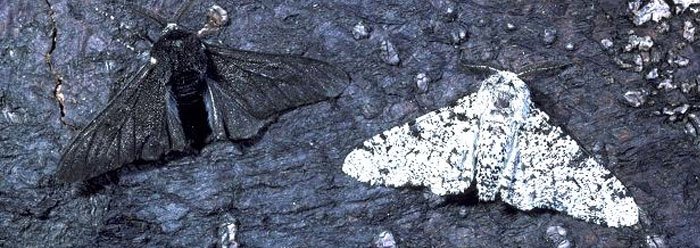
The trees these moths used to live on were white, but have been covered in soot from coal factories. Which moth will be more successful in this environment?
a)
Dark moth
b)
Light moth
c)
Both will be equally successful
d)
Neither will be successful
4.
Change over time
a)
Natural Selection
b)
Selective Breeding
c)
Homeostasis
d)
Evolution
5.
Which best describes mutations?
a)
Always helpful
b)
Always harmful
c)
Can be helpful or harmful
d)
Always neutral
6.
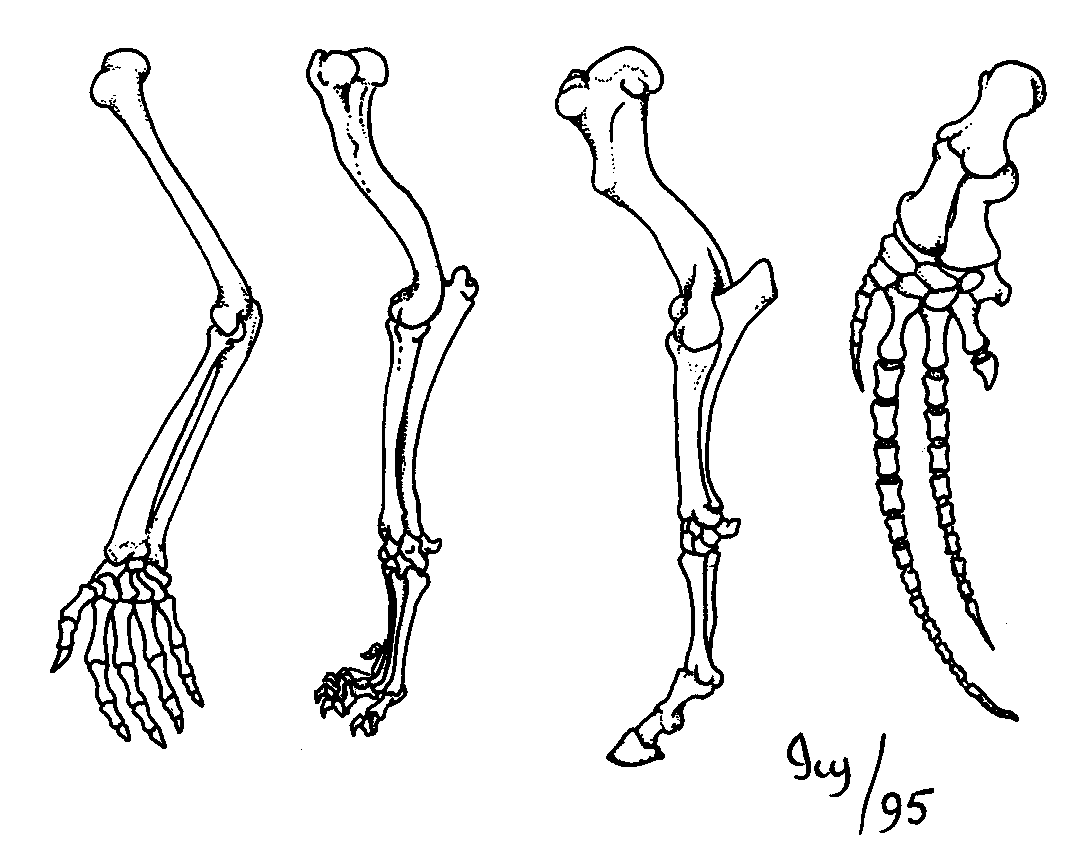
Structures with the same parts have different functions; suggests that organisms share a common ancestry
a)
vestigial structures
b)
homologous structures
c)
adaptive radiation
d)
fossil
7.
Study of embryos of various organisms to show a common ancestor because of similarities in development
a)
natural selection
b)
embryology
c)
speciation
d)
evolution
8.
The diagram shows fossils in different rock layers. Which of these statements about the age of these fossils is most likely correct?
a)
Fossil A and C are the same age
b)
Fossil B is older than fossil C
c)
Fossils A is older than fossil B
d)
Fossil D is older than fossil C
9.
What does Darwin's theory of evolution suggest?
a)
species change over time
b)
extinct species are not related to living species
c)
different species can interbreed
d)
animals that look alike are most closely related
10.
What type of structures are these?
a)
homologous
b)
vestigial 
c)
analogous
d)
fossil
11.

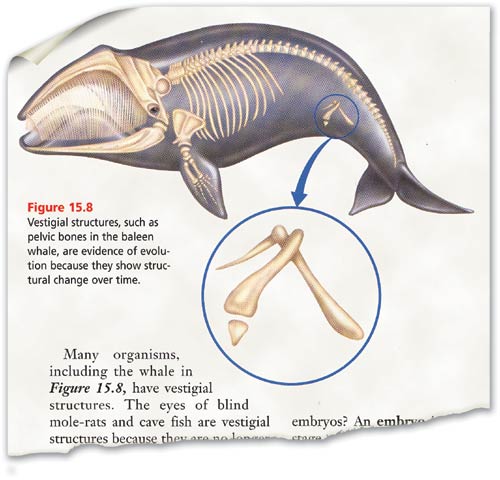
Whales are aquatic mammals that contain a pelvis (hip) bone. Even though it does not aid in its movement, the function must have been used by a common ancestor of the whale. Thus, the pelvis is referred to as a(n)

a)

vestigial structure

b)

analogous structure

c)

homologous structure

12.
A theory has significant evidence to support it.  True or False
a)
True
b)
False
13.
The ability of an organism to survive and reproduce in its specific environment 
a)
diversity.
b)
evolution
c)
adaptation
d)
 fitness
14.
Where humans have bred organisms together based on traits we like.
a)
Evolution
b)
Natural Selection
c)
Extinction 
d)
Artificial Selection
15.
Genetic differences between organisms of the same species
a)
Variation
b)
Adaptation
c)
Behavior
d)
Environment
16.
The difference in the physical traits of an individual from those of other individuals in a group is called a(n)
a)
change
b)
adaption
c)
species
d)
variation
17.
The long and sharp beak of a woodpecker is an example of:
a)
Natural Selection
b)
Selective Breeding
18.
An error in DNA copying that results in a new trait
a)
Homeostasis
b)
Mutation
c)
Natural Selection
d)
Selective Breeding
19.
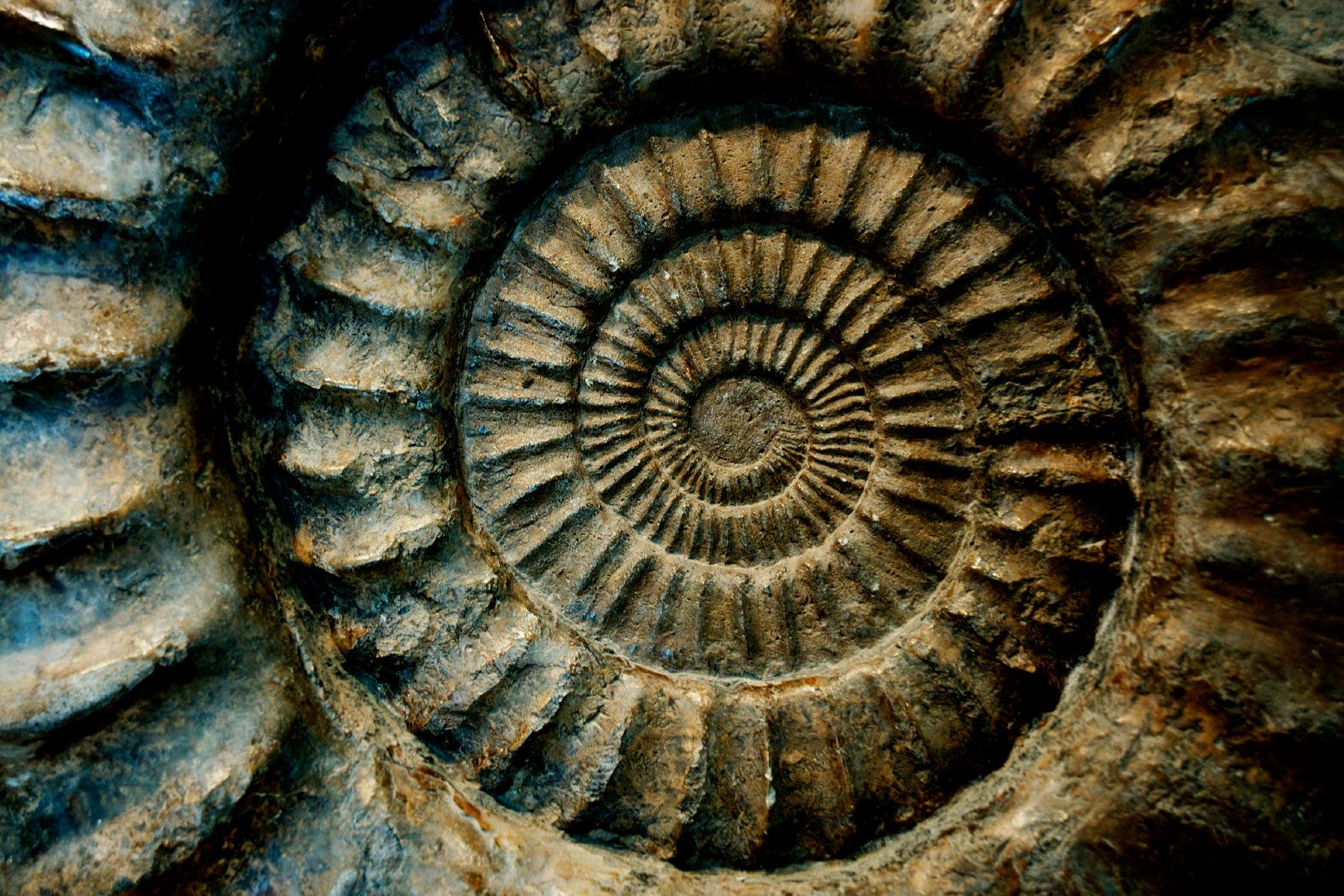
The preserved remains or physical evidence of an organism that lived in the past are called...
a)
evolutionary features
b)
fossils
c)
mutations
d)
variations
20.
What does this picture model?
a)
DNA structure of the horse
b)
Evolution of the horse
c)
Extinction of the horse
d)
Singular traite of the horse
21.
What most likely caused the finches on the Galapagos Islands to have beaks that were differnt from the finches living on the South American mainland?
a)
They were different types of food available on the island.
b)
The finches on the islands had to drink salt water.
c)
There were different types of predators living on the island.
d)
The finches on the mainland built different types of nests.
22.
What is it called when an organism is best adapted to its environment, it will survive and reproduce more successfully than other organisms less adapted?
a)
cloning
b)
evolution of all species
c)
natural selection
d)
selective breeding
23.

Which scientist visited the Galapagos Islands and came up with the theory of natural selection?

a)

Theodor Schwann

b)

Gregor Mendel

c)

Charles Darwin

d)

Rudolf Virchow

24.

Scientists have collected millions of fossils of different organisms, and have developed a timeline of life on Earth. What do we call this?

a)

Mutation

b)

Natural Selection

c)

The theory of evolution

d)

Fossil Record

25.

A physical or behavioral trait that helps an organism survive and reproduce in its environment is called a what?

a)

An adaptation

b)

A response to a stimulus

c)

A mutation

d)

Evolution

26.

What most likely caused the finches on the Galapagos Islands to have beaks that were different from the finches on the mainland?

a)

There were different types of predators on the island.

b)

There were different types of food available on the island.

c)

The finches had no water to drink.

d)

The finches on the mainland could not fly high enough.

27.

What do we call a change in a species over time?

a)

Adaptation

b)

Evolution

c)

Extinction

d)

Environmental influences

28.
Inherited trait that helps an organism survive is a(n) __________.
a)
Fossil
b)
Adaptation
c)
Ancestor
d)
Natural selection
29.
Survival of the fittest or when favorable adaptations reproduce faster is called what?
a)
Evolution
b)
Adaptation
c)
Natural selection
d)
Fossilization
30.
Which of the following is an example of a vestigial structure?
a)
the wings of a red-tailed hawk
b)
the hind limbs of a house cat
c)
the fins of sharks
d)
the tailbone of a human
31.
The environment around Manchester, England, changed during the Industrial Revolution.  How did this change affect peppered moths living in the area?
a)
Natural selection favored moths with dark wings because predators could not see them on the soot-colored trees.
b)
Natural selection favored moths with white wings that were easy for predators to see.
c)
Natural selection favored moths with white wings because predators could not see them on the soot-colored trees.
d)
Natural selection caused moths with white wings to become extinct.
32.
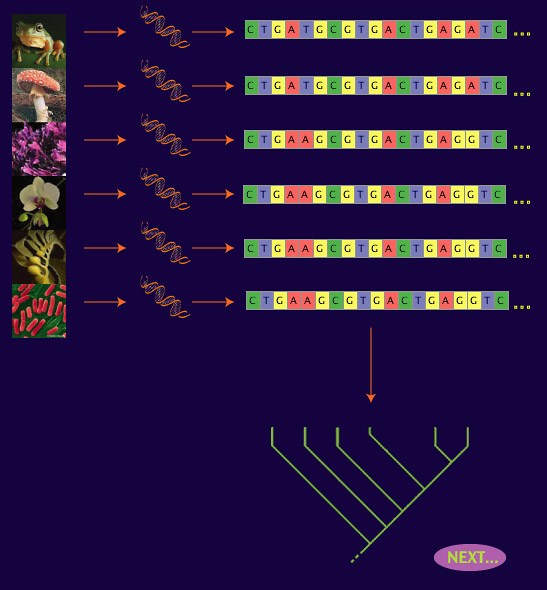
Two organisms that are closely related would have
a)
very similar DNA sequence
b)
exactly the same DNA sequences
c)
no proteins in common
d)
completely different DNA sequence
33.
All the individuals of a species that live in a particular area are called a
a)
variation
b)
population
c)
fossil
d)
group
34.
Who hypothesized that human populations are kept in check by war, famine, and disease?
a)
Darwin
b)
Hutton
c)
Malthus
d)
Lamarck
35.
Mutations are a change in what?
a)
DNA
b)
tRNA
c)
genotype
d)
phenotype
36.
A fossil of an extinct dinosaur is found and the anatomy of the fossil shows similarities to that of a bird. What could this mean?
a)
This is purely by chance and isn't significant
b)
The extinct dinosaur and modern bird share a common ancestor
c)
All dinosaurs evolved into birds and that's why there aren't any dinosaurs alive today
d)
Dinosaurs choose to fly, and evolved into birds to escape predation and capture food
37.
Which of the following are examples of evidence for evolution?
a)
Fossils and Cellular Structure
b)
Biological Structures 
c)
Genetics/DNA
d)
All of the Above
38.
True or False?
Generations of a species that are farther apart from each other look the most different.
a)
True
b)
False
39.
This is a group of organisms of the same species that live in a specific geographical area.
a)
Environment
b)
Evolution
c)
Biological diversity
d)
Populations
40.
This is the variation of living organisms.
a)
Biological diversity
b)
Evolution
c)
Environment
d)
Natural selection
41.
This is an ecological relationship in which two or more organisms depend on the same limited resource.
a)
Adaptation
b)
Competition
c)
Evolution
d)
Natural selection
42.

What is the process in which populations CHANGE gradually over time?

a)

evolution

b)

species

c)

variation

d)

competition

43.

Hibernation is an example of which type of adaptation?

a)

Behavioral Adaptation

b)

Physical Adaptation

44.

Beak shape, camouflage, and webbed feet are all examples of which type of adaptation?

a)

Behavioral Adaptation

b)

Physical Adaptation

45.

Select ALL the parts of Natural Selection.

a)

overproduction

b)

evolution

c)

variation

d)

selection

e)

competition

46.

Select ALL that show evidence of evolution.

a)

DNA

b)

mutations

c)

fossils

d)

skeletal structures

47.

Select ALL of the steps to forming a new species.

a)

variation

b)

adaptation

c)

division

d)

separation

48.

What do you call different structures with a similar function but NO common ancestor?

a)

Natural Selection

b)

Analogous Structure

c)

Vestigial Structure

d)

Homologous Structure

49.

Birds are eating all the green beetles. Because the brown beetles are surviving they reproduce more and make more brown beetles. This is called ___________

a)

Artificial Selection

b)

The Theory on the Origin of Species

c)

Natural Selection

d)

Mutation

50.

Darwin wrote that the organisms best suited to their environments will .....

a)

Increase in Number

b)

Go Extinct

c)

Mutate More often

51.

Which of the following do scientists not use as evidence for evolution?

a)

Fossils

b)

Vestigial Structures

c)

Embryology

d)

Radiation

52.

When we examine this whale fossil, we can see that the whale has a pelvic bone that doesn't seem to be used by the whale. What do scientists infer?

a)

The whale had an ancestor with legs

b)

The whale must use the pelvis for an unknown reason

c)

The whale was born with an extra bone and has a disorder

d)

The whale had an ancestor with wings

53.
Natural selection is
a)
survival of the fittest
b)
humans change
c)
two species are the same
d)
more animals survive
54.

Many different groups of organisms have wings, even though they do not share a recent common ancestor. This is because they evolved in environments with similar selective pressures. Wings are an example of a(n) ______________ structure.

a)

vestigial

b)

analogous

c)

homologous

55.
Which of the following would represent a sudden environmental change?
a)
Wildfire
b)
Global Warming
c)
Competition for food
56.
Where humans have bred organisms together based on traits we like.
a)
Evolution
b)
Natural Selection
c)
Extinction 
d)
Artificial Selection
57.

Genes that are beneficial to the species will....

a)

evolve a new species

b)

will not be passed down to its' offspring

c)

become more common over time

d)

cause the extinction of a species

58.

Individuals don't evolve! (a)   do!

59.

Which one does not increase variation?

a)

Gene flow

b)

Migration

c)

Mitosis

d)

Crossing Over

60.

Which of the following is not a principle of natural selection?

a)

Competition for resources

b)

Older organisms are more wise

c)

Variation via mutations

d)

Adaptations

61.

The goal for all species is to

(a)  

62.

When unrelated species evolve similar characteristics because they live in similar

environments

a)

Divergent Evolution

b)

Speciation

c)

Convergent Evolution

d)

Punctuated equilibrium

63.

Speciation is when a new species is created from a

(a)  

64.

A number of different species arise from one common ancestor

- New environments caused differences to evolve in populations

a)

Convergent Evolution

b)

Divergent Evolution

c)

Coevolution

d)

Gradualism

65.

Occurs when two populations of organisms form a specialized relationship and thus change in response to each other

a)

Convergent Evolution

b)

Punctuated equilibrium

c)

Coevolution

d)

Speciation

66.

similar structures that suggest evidence of common ancestry

a)

Analogous structues

b)

Homologous structures

c)

Vestigial structures

d)

Natural Selection

67.

similar structures that evolved independently in different organisms due to serving similar purposes

(a)  

68.

What is the study of chemical processes in living things?

a)

Biochemistry

b)

Paleontology

c)

Morphology

d)

Biogeography

69.

A giraffe has a long neck in order to better reach leaves to eat. This is an example of _____.

a)

an adaptation

b)

environment

c)

response

d)

stimulus

70.

The primary difference natural and artificial selection is

a)

In nature selection the “pressure” comes from the environment; In artificial selection the “pressure” comes from humans (or another species).

b)

In artificial selection the “pressure” comes from the environment; In natural selection the “pressure” comes from humans (or another species).

c)

Natural selections is when humans breed the animal; Artificial selection is when humans direct genes directly.

d)

They are different terms for the same concept.

71.
What is an example of a vestigial structure of a HUMAN?
a)
Femur
b)
Wisdom Teeth
c)
Brain
d)
Finger
72.

What type of selection is depicted in the picture?

a)

stabilizing

b)

directional

c)

disruptive

73.

Robins typically lay fours eggs. If more then four eggs are produced then the baby chicks are malnourished while smaller egg numbers result in no viable (able to live) baby chicks. This is an example of

a)

stabalizing

b)

disruptive

c)

directional

74.
What type of selection?
a)
Directional 
b)
Stabilizing
c)
Disruptive
75.
Which of the three graphs shows stabilizing selection?
a)
A
b)
B
c)
C
76.
Which of the three graphs shows disruptive selection?
a)
A
b)
B
c)
C
77.
Human babies don't do well if they are born too small. If they are too big complications can occur during birth. Baby size should then be selected for by which method?
a)
stabilizing
b)
directional
c)
disruptive
d)
Beyonce is having twins
78.
An extreme phenotype is favored causing the alleles to shift toward that phenotype
a)
Disruptive Selection
b)
Directional  Selection
c)
Stabilizing Selection
d)
Artificial Selection
79.
Genetic diversity decreases and individuals at the center of the curve have higher fitness.
a)
Disruptive Selection
b)
Directional  Selection
c)
Stabilizing Selection
d)
Artificial Selection
80.

What type of natural selection is this: When a group of deer migrated to a cold mountain, the thin-furred deer and average-furred deer died. The thick-furred deer survived and eventually the population became thicker-furred.

a)

Disruptive Selection

b)

Directional Selection

c)

Stabilizing Selection

81.
What is the advantage of having different shaped beaks?
a)
To look different from other species.
b)
To be able to eat the food readily available in the environment.
c)
To protect itself against predators.
d)
To protect itself against prey.
82.

Occurs when environmental conditions fluctuate between two opposite extreme values.

a)

Artificial selection

b)

Distruptive selection

c)

Directional selection

d)

Stabilizing selection

83.

Occurs when changing environment favors one extreme phenotype

a)

stabilizing selection

b)

Directional selection

c)

Disruptive selection

d)

Outbreeding

84.
Which answer best describes macroevolution?
a)
Largest-scale evolutionary changes via speciation or extiniction that occur over time
b)
A scientist who classifies organisms into groups and makes a hypothesis on whether they are a different species based on the evidence
c)
Identification of species by differences in their appearances
d)
AP biological trait evolves in two unrelated species as a result of exposure to similar environments
85.
Describes a patter of long, stable periods interrupted by brief periods of more rapid change
a)
convergent evolution
b)
coevolution
c)
punctuated equilibrium
d)
adaptive radiation
86.
The idea that evolution seems to occur in spurts of time.
a)
stabilizing selection
b)
directional selection
c)
disruptive selection
d)
puntuated equilibrium
87.
The hypothesis that evolution of a species occurs gradually over time as a slow and constant process is known as
a)
speciation
b)
punctuated equilibrium
c)
gradualism
d)
microevolution
88.
The evolution of an ancestral species into an array of species that occupy different niches
a)
convergent evolution
b)
coevolution
c)
speciation
d)
adaptive radiation
89.
A single species that has evolved into several different forms that live in different ways has undergone
a)
adaptive radiation.
b)
coevolution.
c)
punctuated equilibrium.
d)
mass extinction.
90.
What is convergent evolution?
a)
evolution toward similar traits in unrelated species
b)
evolution toward different traits in closely related species
c)
elimination of a species from Earth
d)
the rise of two or more species from one existing species
91.
Sharks and dolphins both have streamlined bodies that allow them to move through water efficiently, this is an example of which type of evolution?
a)
Divergent
b)
Coevolution
c)
Convergent
d)
Artificial
92.
In convergent evolution, organisms share physical similarities because they 
a)
have a common ancestor
b)
live in similar environments
c)
develop homologous structures
d)
are closely related 
93.
 What type of evolution is demonstrated in this photo?
a)
Coevolution
b)
Convergent evolution
c)
Punctuated evolution
d)
Gradualistic evolution
94.

Cichlid fishes in lakes of the East African Rift. The lakes in this area are believed to support and sustain about 2,000 different species of these fish, each with different ecological and morphological characteristics such as body size. These lakes form a fragmented landscape that bio-geographically isolates the different species of cichlid fish from one another, allowing them, and many of the organisms they live with, to evolve separately.

a)

Phyletic Speciation

b)

Adaptive Radiation

c)

Convergent Evoltion

d)

Co-evolution

95.
What is the most correct definition of evolution?
a)
Change over time. 
b)
Animals changing over time. 
c)
Organisms changing over time.
d)
Species changing over time. 
96.
Choose which scientist corresponds best with the statement: 
survival of the fittest
a)
Darwin 
b)
Lamarck
97.
Choose which scientist corresponds best with the statement: 
use or disuse
a)
Darwin 
b)
Lamarck
98.
Choose which scientist corresponds best with the statement: 
variations within populations
a)
Darwin 
b)
Lamarck
99.
Choose which scientist corresponds best with the statement: 
acquired characteristics are inherited
a)
Darwin 
b)
Lamarck
100.
Choose which scientist corresponds best with the statement: 
organisms overproduce
a)
Darwin 
b)
Lamarck
101.

Who would have stated "acquired traits" such as a giraffe needing a long neck so they stretch it over time

a)

Darwin

b)

Lamarck

102.
What book did Darwin  write?
a)
Evolution in Biology
b)
The Origin of Species
c)
The Giving Tree
d)
Discovering Argentina.
103.
Charles Darwin called the ability of an organism to survive and reproduce in its specific environment 
a)
diversity.
b)
evolution
c)
adaptation. 
d)
 fitness.
104.
Lamarck’s ideas about evolution include the concept that differences among the traits of organisms arise as a result of
a)
continual increases in population size.
b)
the actions of organisms as they use or fail to use body structures.
c)
an unchanging local environment.
d)
the natural variations already present within the population of organisms.
105.

Who is credited with the theory of evolution by natural selection?

a)

Darwin

b)

Mendel

106.

Darwin's ship?

a)

HMS Finch

b)

HMS Beagle

107.

Darwin collected what type of evidence on his voyage?

a)

Fossil & Specimen Evidence

b)

DNA & Biochemical Evidence

108.

Sent Darwin and essay with similar ideas as what Darwin proposed.

a)

Malthus

b)

Hutton

c)

Lyell

d)

Lamarck

e)

Wallace

109.

Wrote "Principles of Geology". Geologic events that occurred in the past will continue to occur in the future.

a)

Malthus

b)

Hutton

c)

Lyell

d)

Lamarck

e)

Wallace

110.

One of the first theories of evolution. Organisms can acquire traits over their lifetime.

a)

Malthus

b)

Hutton

c)

Lyell

d)

Lamarck

e)

Wallace