
Font size
 Worksheets
Speed, Velocity and Acceleration Test Review
Total questions: 54
Worksheet time: 55mins
speed of an object in a particular direction
motion
velocity
speed
acceleration
when an object changes its position compared to a reference point.
acceleration
speed
motion
reference point
total distance traveled divided by total time taken to travel that distance
velocity
motion
acceleration
average speed
the rate at which speed or velocity changes
acceleration
average speed
motion
reference point
Basic SI unit of length or distance is:
Meter
Seconds
Grams
Minutes
Which of the following choices is an example of VELOCITY?
35 mph
35 meters
35 mph EAST
35 minutes
The speed of an object at one instant of time is called:
Average Speed
Instantaneous Speed
Velocity
Acceleration
Steepness of a line on a graph:
Slope
Acceleration
Speed
Velocity
The rate at which velocity changes and can be seen by speeding up, slowing down, or changing direction:
Speed
Velocity
Acceleration
Slope
To calculate speed:
Speed = time + distance
Speed = time X distance
Speed = distance X distance
Speed = distance ➗ time

Using which point shows the object at REST?
from O to A
from A to B
from C to D
from D to E

What is happening at segment A?
no motion/object at rest
constant speed
deceleration


0-2 seconds using the distance vs. time graph.
Which scenario does not describe an example of acceleration?
A car increases its speed while turning to the left.
A car decreases speed while its driving straight ahead.
A car maintains a constant speed while turning to the right.
A car maintains a constant speed while driving straight ahead.
Which are the SI units for acceleration?
N
m/s
m/s squared
kg*m/s
Rebecca conducted an experiment with a radio controlled car. From rest, the car went 20 m/s and ended at 30 m/s in 2 seconds. What is the average acceleration?
5 m/s squared
10 m/s squared
15 m/s squared
20 m/s squared
Speed equals distance divided by
time
velocity
size
motion
A train that travels 100 kilometers in 4 hours is traveling at what average speed?
50 km/h
100 km/h
2 km/h
25 km/h

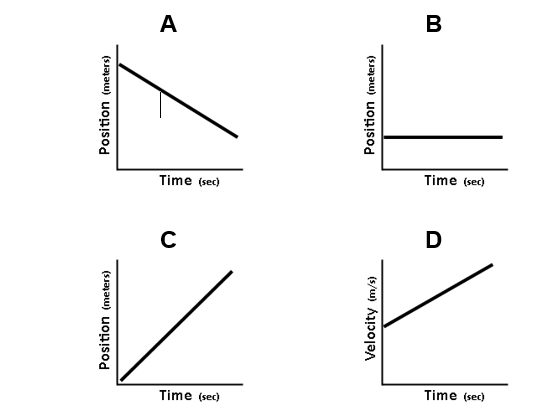
Using the graph, which person finished the race first?
Biker
Runner
Walker
All of these finished at the same time.

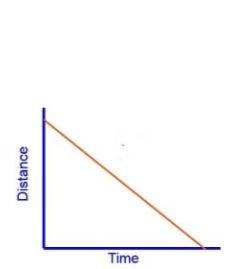
What is this line of this graph showing?
moving away from starting point at a constant speed
moving back towards the starting point at a constant speed
acceleration (getting faster)
deceleration (getting slower)
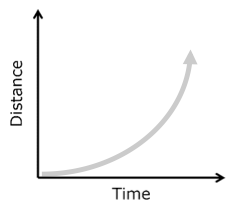


During which segment did the car travel back toward its starting position?
Segment A to B
Segment B to C
Segment C to D
Segment D to E
During which segment did the car travel the fastest?
Segment A to B
Segment B to C
Segment C to D
Segment D to E
What distance had the car traveled at 10 hours?
60km
50km
60
50


A runner races in the 100 meter dash. It takes her 10 seconds to finish. What is her average speed?
10 m/s
1000 m/s
100 seconds
10 seconds
Motion is
a word that rhymes with ocean.
an object's change in its speed to a reference point.
an object's change in position to a reference point.
an object's change in position to its rate of speed.
The best reference points are stationary (not moving).
true
false
What does it mean when a change in velocity is negative?
The object is speeding up.
The object is slowing down.
The object is changing direction.
The object is falling down.
If velocity is measured in kilometers/hour and time is measured in seconds, the unit of acceleration is
km/s/s
km/s2
km/h/s
km
Which of the following is not accelerating?
a ball being juggled
a woman walking at 2.5 m/s along a
straight road
a satellite circling Earth
a braking cyclist
When are you undergoing an acceleration in a car? (Choose all that are correct)
speed up
slow down
make turns
constant speed
Slowing down is called
Choose all that apply.
negative acceleration
velocity
speed
deceleration
To find acceleration, divide the change in speed by the
time
distance
speed
velocity
What two things do you need to find speed (select both)
distance
time
velocity
direction
24km/hr South is an example of
speed
direction
velocity
acceleration


In which situation is the acceleration of the car negative?
The velocity of a car was 45 km/h at 2:00 pm and at 4:00 pm the velocity of the car was 85 km/h.
The velocity of a car increased from 40 km/h to 75 km/h over 15 minutes.
The velocity of a car reduced from 60 km/h to 25 km/h over one minute.
The velocity of a car was 75 km/h over 4 hours.

What is this car doing?
Moving at a constant speed
Speeding up
Slowing Down
Stopped

