wayground logo

Free Printable Worksheets

Font size

S
M
L
XL
Worksheets

Topic 7: Genes & Heredity

Total questions: 64

Worksheet time: 2hrs 48mins

Name
Class
Date
1.

Heredity is....

a)

The passing of traits from parent to offspring

b)

What I get from grandpa when he goes back to King Kai

c)

A hidden trait

d)

The strongest trait

2.

Match the following

a)

bb

1.

Recessive

b)

BB

2.

Homozygous Dominant

c)

Bb

3.

Dominant

3.

A dominant trait is (a)  

Choose from the below words
A trait that always comes out
A trait that is always hidden
A mutation
An angry gene
4.

A recessive trait is

a)

A trait that always hides from the dominant trait

b)

A trait that always beats the dominant trait

c)

A trait that only happens in mom's side of the family

d)

None of these

5.

Gerry and his wife both have blue eyes, which is a recessive trait. Which is true about their baby?

a)

He's adopted

b)

The baby will not inherit their traits

c)

The baby will be blue eyed

d)

The baby will have brown hair

6.

A flower garden has 300 flowers, and 250 of them are purple flowers, and the other 50 are white flowers. Which of the following is true?

a)

He doesn't have enough pollen spreaders

b)

The purple flowers are dominant

c)

The white flowers will eventually overpower the purple

d)

He is using a soil that helps boost his plant growth rate

7.

True or false: You inherit 75% of your genes from mom, 25% from dad (a)  

Choose from the below words
True
False
8.

We use letters to describe genes: Blue Eyes = (bb) (a)  

Choose from the below words
Heredity
Alleles
Dominant Genes
9.

When your genes are expressed physically (how you look) we call that your: (a)  

Choose from the below words
Phenotype
Recessive Trait
Genetics
Genotype
10.

RR is: (a)  

Choose from the below words
Homozygous Dominant
Heterozygous
Homozygous Recessive
11.

Yy is: (a)  

Choose from the below words
Homozygous Dominant
Heterozygous
Homozygous Recessive
12.

Select the recessive traits:

a)

Brown Hair (HH)

b)

Brown Eyes (Bb)

c)

Blue Eyes (bb)

d)

Dimples (Dd)

e)

No Hitchhikers Thumb (hh)

13.

R - Red dominant Flower

r - purple recessive flower

How many purple flowers are there in this Punnett square?

14.

B - Brown eye dominant

b - blue eye recessive

how many blue-eyed off spring are in this Punnett square?

15.

Human body cells have 46 pairs of chromosomes. (a)  

Choose from the below words
true
false
16.

Sex cells have twice the number of chromosomes as body cells. (a)  

Choose from the below words
True
False
17.

Genes pass from parents to offspring on chromosomes. (a)  

Choose from the below words
true
false
18.

The two chromosomes in a pair have the same genes lined up in the same order, so each gene is found in the same place on each chromosome. (a)  

Choose from the below words
True
False
19.

A fertilized egg has twice the number of chromosomes as the body cells of the parent. (a)  

Choose from the below words
True
False
20.

How many chromosomes would be in a human sex cell if body cells have 46 chromosome?

21.

What does a filled in square represent? (a)  

Choose from the below words
Not affected Female
Not affected Male
Affected Male
Affected Female
22.
How many generations are shown in this pedigree?
23.
How many kids did the mother and father from the first generation have?
24.
What do half colored symbols represent?
a)
The individual is a carrier (heterozygous).
b)
The individual expresses the trait.
c)
The individual has both recessive alleles.
d)
The individual has both dominant alleles.
25.

What does an open circle represent? (a)  

Choose from the below words
Not Affected Male
Not Affected Female
Affected Male
Affected Female
26.
In the second generation-how many people are carriers of the trait?
27.
How many people in this whole pedigree have the trait/disease?
28.
How many females are in this pedigree?
29.

What is this? (a)  

Choose from the below words
Pedigree
Karyotype
Venn diagram
Punnett Square
30.

Which individual in the first generation is a carrier? (a)  

Choose from the below words
The male
The female
individual 1
None of the above
31.
How many people in the pedigree are carriers for the disorder? 
32.
How many affected females are deceased? 
33.
Which generation connects these two pedigrees? 
34.

A carrier is represented by what symbol?  (a)  

Choose from the below words
Clear 
Shaded 
Half Shaded
1:4 ratio 
35.

Offsprings are represented by (a)  

Choose from the below words
Horizontal Line 
Vertical Line 
36.
In the second generation-how many people have the disease or display the physical trait?
37.

What does a horizontal line between a square and a circle mean? (a)  

Choose from the below words
They are siblings
They are cousins
They are married ("together")
They are the children
38.

In which phase does crossing-over happen? (a)  

Choose from the below words
Prophase I
Prophase II
Metaphase I
Anaphase II
39.

What phase is this? (a)  

Choose from the below words
Prophase I
Metaphase II
Anaphase I
Telophase II
40.

What phase is this? (a)  

Choose from the below words
Metaphase I
Prophase II
Telophase I
Anaphase II
41.

What phase is this? (a)  

Choose from the below words
Metaphase II
Prophase I
Telophase I
Anaphase I
42.

What phase is this? (a)  

Choose from the below words
Telophase II
Anaphase II
Telophase I
Anaphase I
43.

What phase is this? (a)  

Choose from the below words
Prophase II
Telophase II
Telophase I
Prophase I
44.

What phase is this? (a)  

Choose from the below words
Prophase I
Metaphase I
Metaphase II
Prophase II
45.

Match the following

a)

Mitosis

1.

Makes skin cells

b)

Meiosis

2.

Makes gametes (sperm & egg)

c)

Asexual Reproduction

3.

1 parent

d)

Sexual Reproduction

4.

2 parents

46.

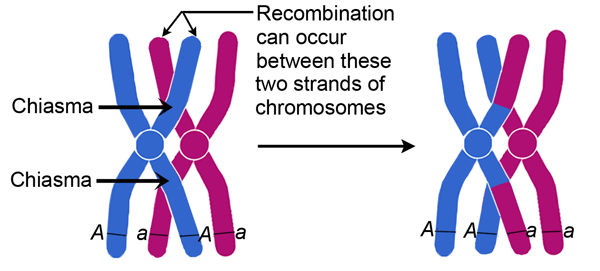
This image shows chromosomes during Prophase 1. Which of the following correctly describes the process shown?

a)

segregation of sister chromatids

b)

condensation and segregation of alleles

c)

mutationin which the DNA content of the gene is altered

d)

crossing over or recombination in which alleles are exchanged

47.

What phase is this? (a)  

Choose from the below words
Telophase I
Prophase II
Metaphase I
Anaphase II
48.

What phase is this? (a)  

Choose from the below words
Metaphase II
Prophase II
Telophase I
Anaphase I
49.

What phase is this? (a)  

Choose from the below words
Metaphase II
Prophase I
Telophase I
Anaphase II
50.

What phase is this? (a)  

Choose from the below words
Metaphase II
Prophase I
Telophase II
Anaphase I
51.

What phase is this? (a)  

Choose from the below words
Anaphase II
Telophase I
Telophase II
Anaphase I
52.

What phase is this? (a)  

Choose from the below words
Prophase II
Prophase I
Anaphase II
Anaphase I
53.

What phase is this? (a)  

Choose from the below words
Prophase II
Metaphase I
Anaphase II
Telophase II
54.

Mitosis make ​ (a)   , which are ​ (b)   to the parent cell. Meiosis makes ​ (c)   , which are ​ (d)   than the parent cell.

Choose from the below words
2 daughter cells
identical
4 daughter cells
different
55.
How many daughter cells are produced from meiosis ?
56.
Why do we need meiosis?
a)
To double the number of chromosomes going into sex cells
b)
To halve the number of chromosomes going into sex cells
c)
To triple the number of chromosomes going into sex cells
d)
To not change the number of chromosomes going into sex cells
57.

Are the cells in Mitosis identical or unique? (a)  

Choose from the below words
Identical 
Unique
It's random
58.

What do you call the type of reproduction in which two different sex cells combine, producing an offspring? (a)  

Choose from the below words
pollination
sexual reproduction
fertilization
asexual reproduction
59.

In ​ (a)   only one parent organism produces offspring.

Choose from the below words
asexual reproduction
sexual reproduction
pollination process
fertilization process
60.
What is an advantage of sexual reproduction?
a)
Allows genetic variation
b)
Only needs one parent
c)
Happens very quickly
d)
Offspring are exact copies of parent
61.

This is a form of (a)  

Choose from the below words
sexual reproduction
asexual reproduction
62.

This is a form of...

a)

sexual reproduction

b)

asexual reproduction

63.

This is a form of (a)  

Choose from the below words
sexual reproduction
asexual reproduction

64.

This is a form of...

a)

sexual reproduction

b)

asexual reproduction