
 Worksheets
3rd Quarter Review
Total questions: 55
Worksheet time: 28mins
Name
Class
Date
1.
What term is used to describe how far a motion is?
a)
distance
b)
speed
c)
displacement
d)
Acceleration
2.
Which term shows how fast a motion is?
a)
distance
b)
speed
c)
displacement
d)
Acceleration
3.
Which of the given terms is computed using the formula a=vf-vi/time?
a)
distance
b)
speed
c)
displacement
d)
Acceleration
4.
Which term is described by 10m north?
a)
distance
b)
speed
c)
displacement
d)
Acceleration
5.
What term is used to describe the change in position over an interval of time
a)
displacement
b)
motion
c)
distance
d)
time
6.
Which of the following is the formula used for solving speed?
a)
s= dt
b)
s=d/t
c)
s= t/d
d)
s= d/t/t
7.
Which of the following is described as the distance covered per unit time?
a)
acceleration
b)
speed
c)
displacement
d)
velocity
8.
Which term refers to describing a change in velocity or direction of a motion over a period of time?
a)
speed
b)
displacement
c)
velocity
d)
acceleration
9.
Which unit DOES NOT show velocity?
a)
200 m/s
b)
1,000 km/hr2
c)
8,000 mi/hr
d)
500 m/s
10.
Given the example 10 m, 20 m and 30 m, which term is being described?
a)
Distance
b)
Displacement
11.
Which of the following statement is true about the difference of scalar and vector quantity?
a)
Scalar shows direction only while vector shows both magnitude and direction.
b)
Scalar shows magnitude only while vector shows both magnitude and direction
12.
What is the difference between distance and displacement?
a)
Distance and displacement shows both magnitude and direction.
b)
Distance shows magnitude while displacement shows direction only.
c)
Distance shows direction only while displacement shows both magnitude and direction.
d)
Distance shows magnitude only while displacement shows both magnitude and direction.
13.
Which of the following shows magnitude and direction?
a)
distance, speed
b)
speed, velocity and acceleration
c)
displacement, velocity and acceleration
d)
distance and displacement
14.
What differs speed from velocity?
a)
Speed and velocity shows both magnitude and direction.
b)
Speed shows direction only while velocity shows both magnitude and direction
c)
Speed shows magnitude while velocity shows direction only.
d)
Speed shows magnitude only while velocity shows both magnitude and direction.
15.
Which pair is an example of speed vs. velocity?
a)
30 m and 30 s
b)
30 m, East and 30 m/s
c)
30 m/s and 30 m/s2
d)
30 m/s and 30 m/s, East
16.
Which of the following units is NOT used to all scalar quantities?
a)
meters/second
b)
miles/hour
c)
miles/hour2
d)
kilometer/hour
17.
Which statement is true about velocity and acceleration?
a)
Velocity and acceleration illustrates the magnitude and direction of the motion.
b)
Velocity and acceleration both is measured by meters, miles and kilometers.
c)
Velocity and acceleration both pertains to how fast the motion travel
d)
Velocity and acceleration both shows the time covered by the motion.
18.
Which of the following is NOT example of vector quantity?
a)
5 m/s2
b)
25 mi/h
c)
5 m/s south
d)
105 mi south
19.
Which frequency is audible for human beings?
a)
0 Hz
b)
0Hz-16Hz
c)
16Hz-20,000Hz
d)
Above 20,000 Hz
20.
What happens to the wavelength of sound with frequencies from 0 Hz to 15,999 Hz?
a)
As the frequency becomes low, the wavelength elongates.
b)
As the frequency becomes low, the wavelength becomes shorter.
c)
As the wavelength becomes longer, the frequencies become higher.
d)
As the wavelength becomes shorter, the frequencies become shorter.
21.
Why do we have different voices?
a)
Because we have different sizes of voice box.
b)
Because of the shape and size of mouth.
c)
Because of the amount of coming thru the voice box.
d)
Because we have different shape, size of larynx and mouth including the air we breathe as we speak.
22.
Which sentence best explains how people produce sound?
a)
Our larynx or voice box vibrates when air passes through our lungs.
b)
Our mouth moves through the help of our tongue and teeth that produces voice.
c)
The air on our lungs makes our voice.
d)
Our throat produces the voice.
23.
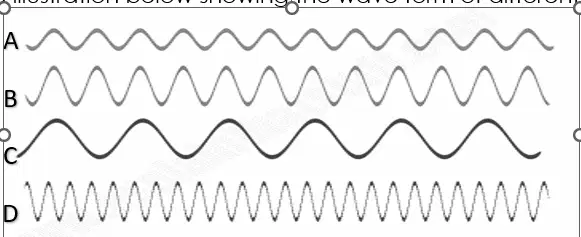
Which wave form shows a high-pitched sound?
a)
A
b)
B
c)
C
d)
D
24.
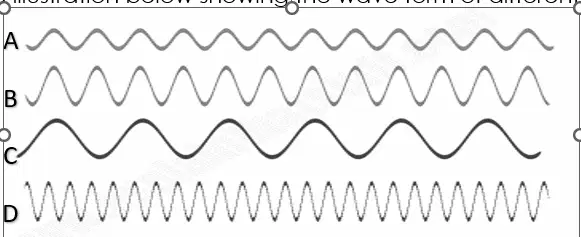
Comparing A and B, which shows a louder sound?
a)
A
b)
B
25.
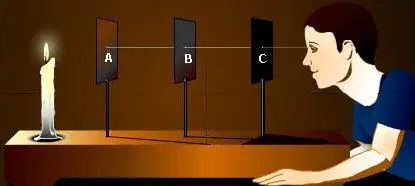
Study the illustration on the right, what can you infer about the travelling direction of light?
a)
Light is a particle.
b)
Light travels in straight line.
c)
Light needs medium to propagate.
d)
Light can travel through a vacuum.
26.
Which of the following statements are TRUE about the behavior of light?
I. Light can travel through a vacuum.
II. Light can travel in a straight line.
III. Light does not need a medium in order to propagate.
IV. Light will always travel in a straight line even if they contact with another surface.
a)
I, and II
b)
II and III
c)
I, II and III
d)
II, III, and IV
27.
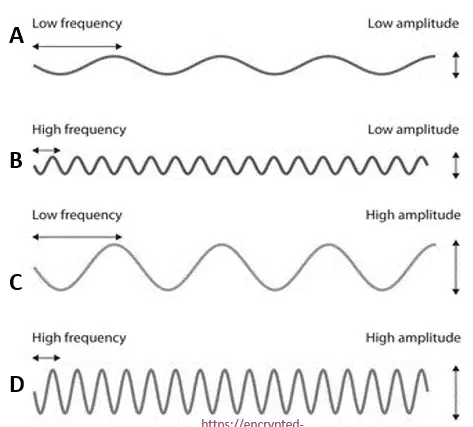
The amplitude of a light wave explains intensity of light. The higher the amplitude, the more intense the light is. Which of the given examples of waves shows a high intensity light?
a)
A & B
b)
B& C
c)
C & D
d)
A & D
28.
What happens to the wavelength of the waves produced if the frequency is high?
a)
The wavelength is shorter.
b)
The wavelength is longer.
c)
The wavelength the same with the frequency.
d)
The wavelength is the same in any given frequency.
29.
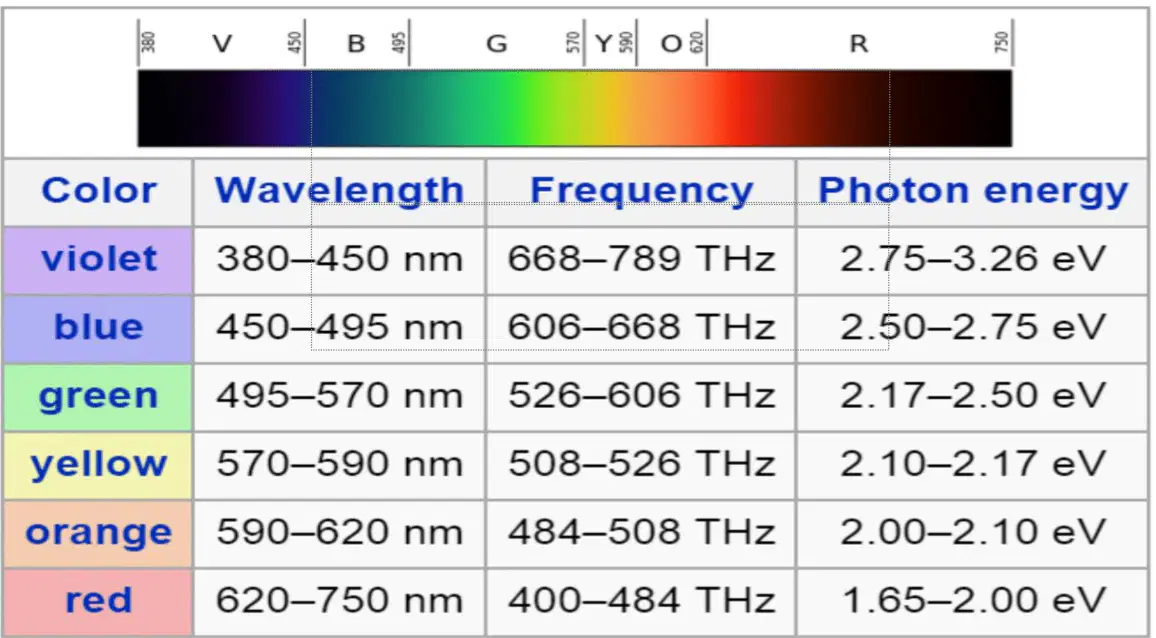
Given the wavelength and frequency of colors, which statement below is TRUE?
a)
Violet is a color that can reach further distances because of its high frequency.
b)
Green is a color that cannot reach further distances because of its low frequency.
c)
Blue has the highest frequency therefore considered to have the highest intensity.
d)
Red has the highest wavelength and enables to be perceived even in longer distances.
30.
Frequency is directly proportional to energy. Which among the colors has the highest carried energy?
a)
blue
b)
green
c)
red
d)
violet
31.
In which condition does heat transfer by radiation occurs?
a)
through electromagnetic waves
b)
through physical contact
c)
through movement of a fluid
d)
through sea water
32.
What will happen when you touch a piece of ice?
a)
energy does not flow
b)
energy flows everywhere
c)
energy flows from the ice to the finger
d)
energy flows from your finger to the ice
33.
Given the example hot air balloon, how does heat transferred?
a)
Thermal energy from the fire heats up the cold air making it lighter through the process of convection.
b)
Thermal energy from the fire warms up the cold air making it heavier through the process of convection.
c)
Thermal energy from the fire heats up the cold air making it lighter through the process of conduction.
d)
Thermal energy from the fire heats up the cold air making it lighter through the process of radiation.
34.
Radiation is method of heat transfer where thermal energy is transferred through electromagnetic waves. Which among the examples below suggests radiation?
a)
drying of clothes
b)
spoon in hot coffee
c)
pan and stove
d)
grilling of barbeque
35.
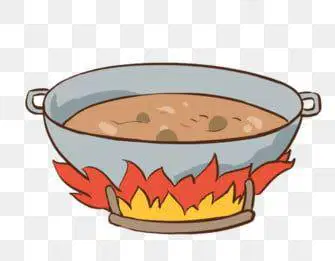
What method of heat travels through the pan?
a)
conduction
b)
dispersion
c)
convection
d)
radiation
36.
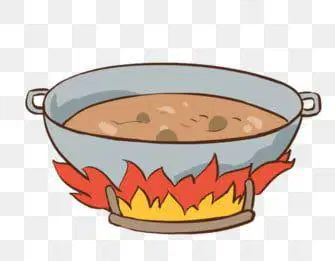
Heat travels from the fire to the soup. What method of heat transfer was shown?
a)
conduction
b)
dispersion
c)
convection
d)
radiation
37.
Which of the following situations show charging by friction?
a)
A rod charging away from the metal ball.
b)
A balloon rubbed on hair.
c)
An appliance plugged in electrical socket.
d)
A plastic placed over pieces of paper strips
38.
What will happen when two like charges are brought together?
a)
repel each other
b)
neutralize each other
c)
attract each other
d)
have no effect on each other
39.
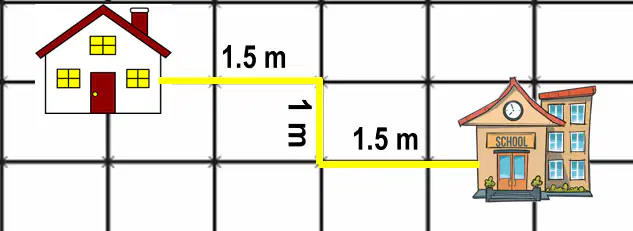
Which measurement illustrates the distances covered by motion?
a)
1.5 m
b)
1m
c)
1.5, 1m, 1.5m
d)
2m
40.
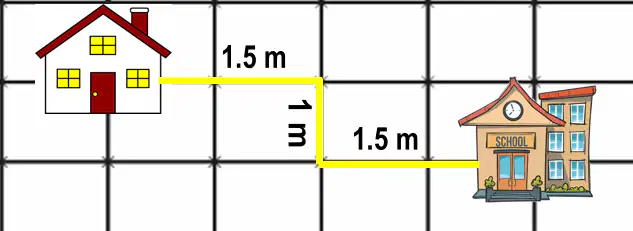
Which of the given describes the total distance covered by the motion?
a)
3 m
b)
4 m
c)
4.5 m
d)
3.5
41.
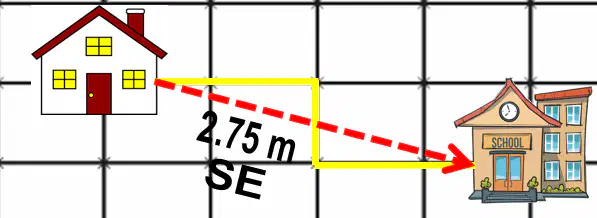
In which direction does the motion show?
a)
southeast
b)
southwest
c)
northeast
d)
northwest
42.
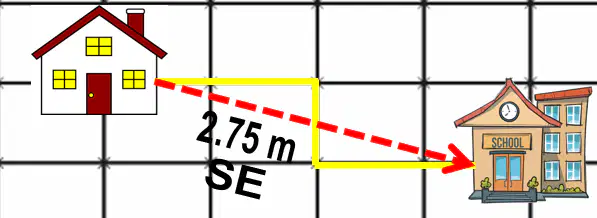
Which place is described as the point of reference of the motion?
a)
church
b)
mall
c)
park
d)
house
43.
What differs electromagnetic and mechanical waves?
a)
Electromagnetic waves require medium while mechanical waves don’t.
b)
Electromagnetic and mechanical waves both need medium to propagate.
c)
Electromagnetic and mechanical wave both don’t need medium to propagate.
d)
Electromagnetic waves does not need medium to propagate while mechanical waves need a medium to propagate.
44.
Which wave shows a longitudinal wave?
a)
needs a medium, perpendicular to the travel of the wave, up and down motion, rope
b)
does not need a medium, straight travel transverse through vacuum, gamma ray
c)
needs a medium, away from the source of the waves in circles, water
d)
needs a medium, parallel to the direction of the travel, back and forth motion, sound
45.
Which wave is an electromagnetic wave?
a)
needs a medium, perpendicular to the travel of the wave, up and down motion, rope
b)
does not need a medium, straight travel transverse through vacuum, gamma ray
c)
needs a medium, away from the source of the waves in circles, water
d)
needs a medium, parallel to the direction of the travel, back and forth motion, sound
46.
Which waves show a mechanical wave?
A. needs a medium, perpendicular to the travel of the wave, up and down motion, rope
B. does not need a medium, straight travel transverse through vacuum, gamma ray
C. needs a medium, away from the source of the waves in circles, water
D. needs a medium, parallel to the direction of the travel, back and forth motion, sound
a)
A & B
b)
B & C
c)
A, B & C
d)
A, C & D
47.
Marky is doing an experiment. He throws a piece of stone in a pond Does he observe a wave?
a)
Yes, he observes that when stone touches water it moves back and forth.
b)
Yes, he observes that when the stone touches the water, circular ripples are form
c)
No, he observed that when stone hits water it does not produce wave.
d)
No, he does not observe wave when the stone touches water.
48.
A pulse sent down a long string eventually dies away and disappears. What happens to its energy?
a)
The pulse does not carry energy.
b)
The energy disappears with the wave.
c)
The energy remains along the length of the string.
d)
The energy is transferred from the wave to the environment
49.

The figure at the left shows a boy creating a disturbance to create water waves. Which of the following statements is correct?
a)
The boat (as a particle) moves due to the win
b)
The boat (as a particle) moves parallel with the water waves.
c)
The boat (as a particle) moves due to the strong force of the water.
d)
The boat (as a particle) moves due to energy created by the disturbance of the wave.
50.
Which statement describes the energy of waves?
a)
Waves carry energy.
b)
Waves transfer energy.
c)
Waves transform energy.
d)
Waves transfer object not energy
51.
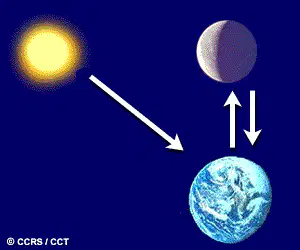
What can you infer about the direction of travel of light?
a)
Light travels straight to the moon and earth.
b)
Light travels curved to the moon and earth.
c)
Light travels diagonal to the moon and earth.
d)
Light travels circular to the moon and earth.
52.
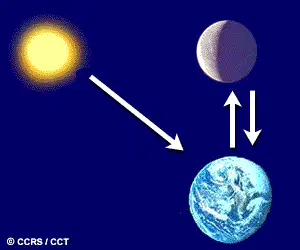
Which sentence explains the light we see from the moon at night?
a)
The moon has its own light.
b)
The moon gets its light from earth.
c)
The moon reflects back the light to the sun.
d)
The moon reflects back the light it gets from the sun and bounces it back to the earth
53.
What will happen when light pass through an opaque object?
a)
The light will pass through the object.
b)
The light will partially pass through the object.
c)
The light will not go through at all and stop at the object, no light will be seen anymore.
d)
The light will not go through but will form shadows where light scatters beside the opaque object.
e)
Option 5
54.
In which materials does light will pass straight through?
a)
face mirror
b)
stone
c)
drinking glass
d)
parchment paper
55.
a)
Option 1
100 %

