
 Worksheets
Matter Unit Review
Total questions: 61
Worksheet time: 1hrs 27mins
Substances are either elements or mixtures
True
False
The odor of a substance is a physical property
true
false
Smoke is a compound
true
false
a substance can be separated into simpler parts through differences n physical properties.
true
false
Colloids are mixtures.
true
false
The freezing of water is a chemical change
true
false
Homogeneous mixtures can be separated by physical changes.
true
false
Colloids and solutions scatter light
true
false
A fruit salad is a homogeneous mixture.
true
false
Color is a physical property
true
false
When a firecracker explodes, mass is lost
true
false
A suspension is a homogeneous mixture.
true
false
The breaking of a glass window is a physical change.
true
false
A(n) _____ is NOT homogeneous
suspension
element
compound
solution
the scattering of light by colloids is called _____.
the Tyndall effect
conservation
air pollution
suspension
Smoke is an example of a _____.
substance
solution
colloid
suspension
Three examples of physical changes are _____.
freezing of water, evaporation of gasoline, and rusting of a nail
boiling of water, bursting of a balloon, and melting of a candle
sawing of wood, crushing of a can, and toasting a marshmallow
burning of gasoline, rotting of an egg, and exploding of fireworks
The color of ink is a _____.
chemical property
physical property
chemical change
physical change
When two or more substances are combined so that each substance maintains its own properties, the result is a(n) _____.
chemical change
element
compound
mixture
When gasoline is burned in an engine, _____.
gasoline evaporates
new substances are formed
mass is lost
mass is gained
_____ is another name for a homogeneous mixture.
Suspension
Substance
Solution
Liquid
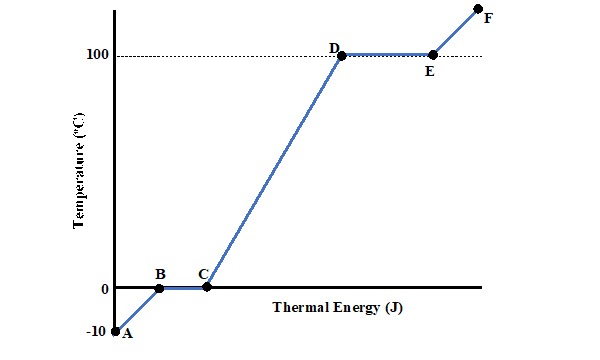
Between which two points is Heat of Vaporization?
A <----> B
B <----> C
C <----> D
D <----> E
E <----> F
Between which two points is Heat of Fusion?
A <----> B
B <----> C
C <----> D
D <----> E
E <----> F
Between which two points is the solid cooling?
A <---- B
B <----> C
C <---- D
D <----> E
E <---- F
Between which two points is the liquid cooling?
A <---- B
B <----> C
C <---- D
D <----> E
E <---- F
Between which two points is the gas heating up?
A ----> B
B <---- C
C ----> D
D ----> E
E ----> F
Between which points is water changing states of matter?
A <----> B
B <----> C
C <----> D
D <----> E
E <----> F
Between which points is water changing its temperature?
A <----> B
B <----> C
C <----> D
D <----> E
E <----> F
Between which two points is the solid melting?
A <---- B
B <----> C
C <---- D
D <----> E
E <---- F
Between which two points is the gas condensing?
A <---- B
B <---- C
C <---- D
D <---- E
E <---- F
Between which two points is the water boiling?
A <----> B
B <----> C
C <----> D
D <----> E
E <----> F
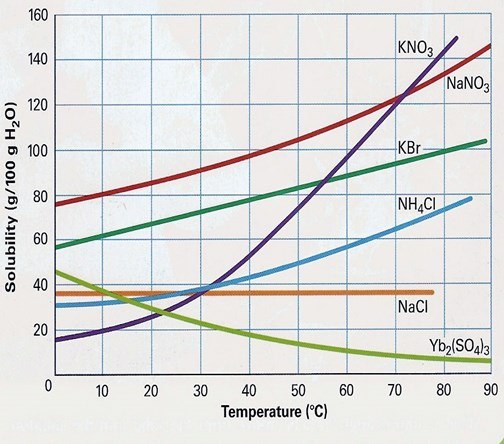
At 30'C, which substance has the lowest solubility?
KNO3
KBr
NaCl
Yb2(SO4)3
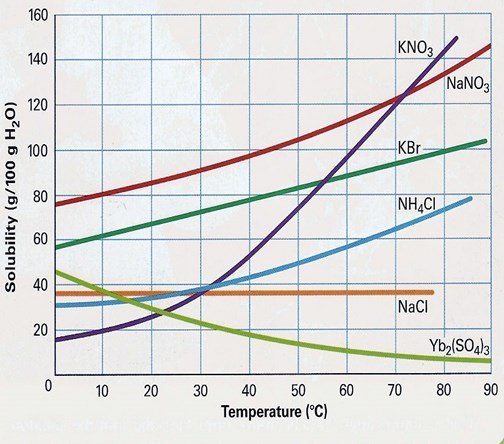
At which temperature do KBr and KNO3 have the same solubility?
60
55
50
Never
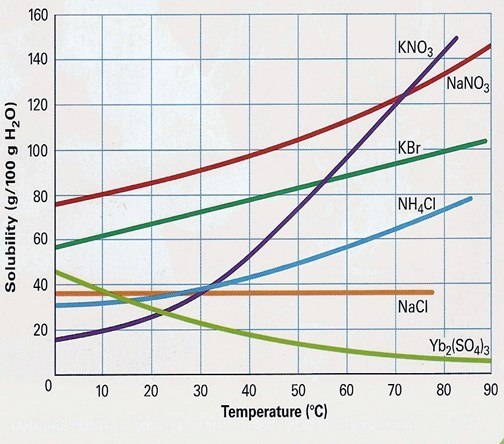
The solubility of Yb2(SO4)3 ________________ with added temperature.
increases
decreases
remains the same
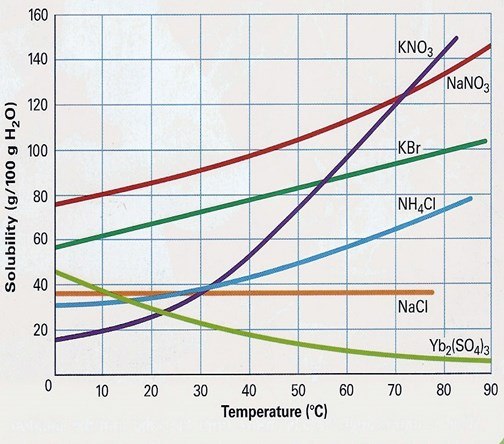
At 80'C, KBr's solubility is:
100
90
80
0
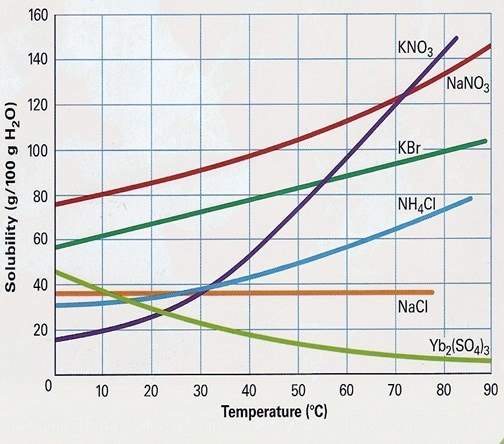
Determine the solubility for the substances at 55'C and arrange them in order from lowest to highest solubility.
NaCl, NH4Cl, KBr, NaNO3
NaCl, NH4Cl, NaNO3, KBr
NH4Cl, NaCl, NaNO3, KBr
NaNO3, KBr, NH4Cl, NaCl
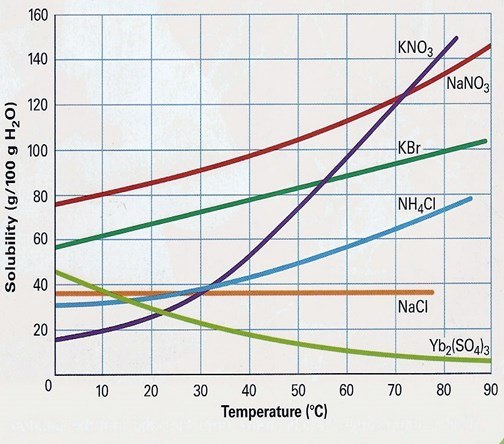
At 10'C, NaNO3's solubility is 80 g/100 g of H2O. Based on this information, what would the solubility be in 50 g of H2O.
40
80
160
16
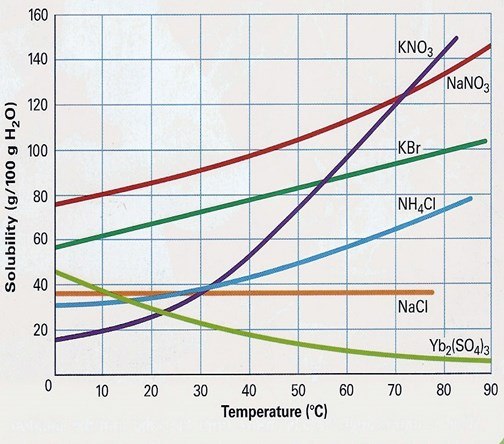
Identify if the following solution would be saturated, unsaturated, or supersaturated: 103 g KBr at 70'C.
Unsaturated
Saturated
Supersaturated
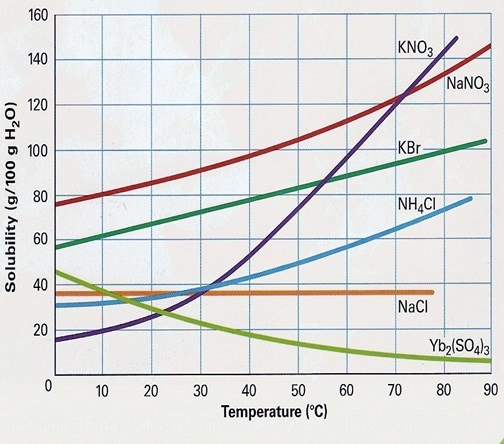
Identify how many grams of KNO3 is required to make a saturated solution at 40'C.
50 g
45 g
60 g
33 g
How could you change a saturated solution to an unsaturated solution?
Add solvent
Add solute
Water becomes __________ changing from a solid to a liquid
more dense & more kinetically charged
less dense & less kinetically charged
more dense & less kinetically charged
less dense & more kinetically charged
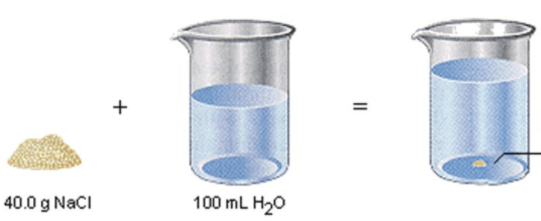
Identify the saturation associated with the product of this experiment.
Unsaturated
Saturated
Supersaturated
Identify a method to decrease the dissolving rate of a solution:
decrease the temperature
add KE
stir the solution
increase the temperature
Which of the following solutions are heterogenous?

Identify a solute, the solvent, and the solution in a carbonated drink (like soda).
Carbon Dioxide (dissolved in the drink)
Solute
Water
Solvent
The Carbonated Drink
Solution
Water is called the " " solvent.
(a)


