
Font size
 Worksheets
Genetics
Total questions: 51
Worksheet time: 49mins

Gene locus is the physical site or location of a specific (a) on a (b) .

We all have two alleles, or versions, of each gene. Being (a) for a particular gene means you inherited two identical versions. It's the opposite of a (b) genotype, where the alleles are different. People who have recessive traits, like blue eyes or red hair, are always homozygous for that gene.

Two identical alleles for a trait is known as
homozygous
heterozygous
mutation
codominance

A physical appearance is
genotype
heterozygous
phenotype
codominance

A mutation is harmful to an organism if it
changes the phenotype of an organism
changes the DNA segment
reduces the organism's chance of survival
makes the organism better able to avoid predators
What does Pp mean?
two dominant alleles
heterozygous alleles
two recessive alleles
two dominant and recessive alleles
What is the probability of producing a tall pea plant from a cross between two hybrid tall pea plants?
25%
50%
75%
100%
A purebred horse with white hair is crossed with a purebred horse with brown hair. Each of their offspring has both white and brown hair. Why does this occur?
several alleles work together to determine a trait
two alleles for hair are dominant
two alleles for hair are recessive
the alleles for fur color are neither dominant or recessive
What does a Punnett Square determine?
all of Mendel's discoveries about genetic crosses
all the outcomes of a genetic cross
only the recessive allele combinations
only the dominant allele combinations
Genotype is
stem height
feather color
physical appearance
genetic makeup
Factors that control traits are
purebreds
genes
recessives
parents
A mutation is
any change that is harmful
any change in a gene or chromosome
any change that is helpful
any change in the phenotype
If a homozygous black cat (BB) is crossed with a homozygous white cat (bb), what is the probability of having a cat with white fur?
100%
0%
75%
25%
A mother gives birth to a son, she then gives birth to a daughter. What is the likely hood that she will have another son?
75%
25%
50%
100%

The genotype for a yellow plant is...


What is a gene?
An entire chromosome.
A small part of DNA found in a chromosome that gives our body instructions to build for a specific trait that we have
Things that are sometimes refered to as XX and XY inside of our cell membranes
Kind of like a "flavor" because there are 23 kinds from each parent.
How many alleles does a person carry for a trait?
1
2
3
4
How many alleles does a child get from each parent for a trait?
1
2
3
4

On a pedigree, this symbol represents a ---
not affected female.
not affected male.
affected male.
affected female.

On a pedigree, this symbol represents a ----
not affected male.
not affected female.
affected male.
affected female.

How many individuals are there in the 3rd generation?
1
2
4
6

How are individuals III-2 and II-4 related?
Brother and sister
Dad and daughter
Uncle and niece
Grandfather and granddaughter
How many alleles does a child get from each parent for a trait?
1
2
3
4
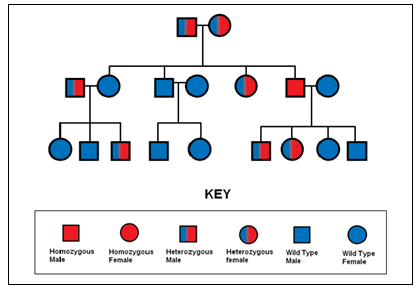
In a pedigree, which shape represents a male?
circle
square
On a pedigree, this symbol represents a ---
not affected female.
not affected male.
affected male.
affected female.
On a pedigree, this symbol represents a ----
not affected male.
not affected female.
affected male.
affected female.
How many individuals are there in the 3rd generation?
1
2
4
6
How are individuals III-2 and II-4 related?
Brother and sister
Dad and daughter
Uncle and niece
Grandfather and granddaughter

The trait this pedigree traces is recessive because it skips a generation and individuals can be carriers. What is the most likely genotype for person III-3?
GG
Gg
gg


If this pedigree shows a recessive disorder, what MUST the genotype of individual 4 be?
HH
Hh
hh

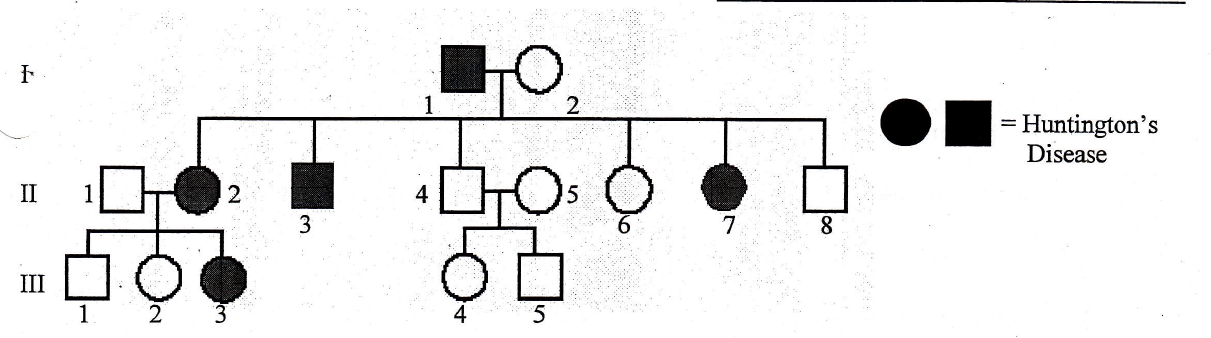


What is the correct genotype for individual I-2?


Generation 2 individuals 5 and 6 are
brother and sister.
cousins.
married.
not related.
What is the correct genotype for individual I-2?

