
 Worksheets
Review Chapter 35
Total questions: 16
Worksheet time: 8mins
According to the liquidity preference theory, an increase in the overall price level of 10 percent
increases the equilibrium interest rate, which in turn decreases the quantity of goods and services demanded
decreases the equilibrium interest rate, which in turn increases the quantity of goods and services demanded
increases the quantity of money supplied by 10 percent, leaving the interest rate and the quantity of goods and services demanded unchanged
decreases the quantity of money demanded by 10 percent, leaving the interest rate and the quantity of goods and services demanded unchanged
On the graph that depicts the theory of liquidity preference,
the demand-for-money curve is vertical
the supply-of-money curve is vertical
the interest rate is measured along the horizontal axis
the price level is measured along the vertical axis
According to liquidity preference theory, the opportunity cost of holding money is
the interest rate on bonds
the inflation rate
the cost of converting bonds to a medium of exchange
the difference between the inflation rate and the interest rate on bonds
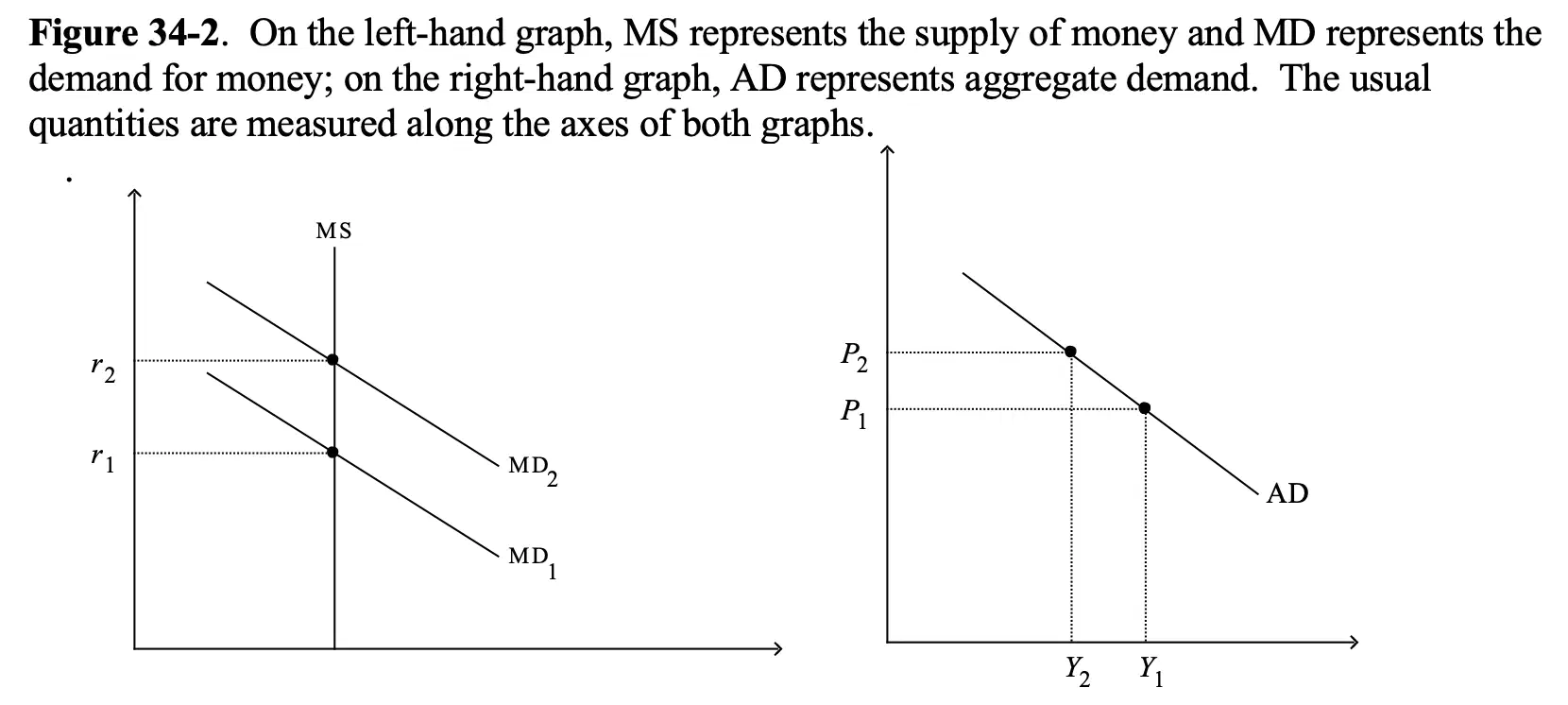
Refer to Figure 34-2. As we move from one point to another along the money-demand curve MD1,
the price level is held fixed at P1
the interest rate is held fixed at r1
the money supply is changing so as to keep the money market in equilibrium
the expected inflation rate is changing so as to keep the real interest rate constant
Fiscal policy refers to the idea that aggregate demand is affected by changes in
the money supply
government spending and taxes
trade policy
All of the above are correct
The marginal propensity to consume (MPC) is defined as the fraction of
extra income that a household consumes rather than saves
extra income that a household either consumes or saves
total income that a household consumes rather than saves
total income that a household either consumes or saves
If the MPC = 3/5, then the government purchases multiplier is
5/3
5/2
5
15
If the multiplier is 5, then the MPC is
0.05
0.5
0.6
0.8
Which of the following policy actions shifts the aggregate-demand curve?
an increase in the money supply
an increase in taxes
an increase in government spending
All of the above are correct
Government purchases are said to have a
multiplier effect on aggregate supply
multiplier effect on aggregate demand
liquidity-enhancing effect on aggregate supply
liquidity-enhancing effect on aggregate demand
An increase in government spending initially and primarily shifts
aggregate demand to the right
aggregate demand to the left
aggregate supply to the right
neither aggregate demand nor aggregate supply in either direction
Which of the following correctly explains the crowding-out effect?
An increase in government expenditures decreases the interest rate and so increases investment spending
An increase in government expenditures increases the interest rate and so reduces investment spending
A decrease in government expenditures increases the interest rate and so increases investment spending
A decrease in government expenditures decreases the interest rate and so reduces investment spending
An increase in the MPC
increases the multiplier, so that changes in government expenditures have a larger effect on aggregate demand
increases the multiplier, so that changes in government expenditures have a smaller effect on aggregate demand
decreases the multiplier, so that changes in government expenditures have a larger effect on aggregate demand
decreases the multiplier, so that changes in government expenditures have a smaller effect on aggregate demand
If a $1,000 increase in income leads to a $750 increase in consumption expenditures, then the marginal propensity to consume is
0.75 and the multiplier is 1 1/3
0.75 and the multiplier is 4
0.25 and the multiplier is 1 1/3
0.25 and the multiplier is 4
In the short run,
the price level alone adjusts to balance the supply and demand for money
output responds to changes in the aggregate demand for goods and services
changes in the money supply cause a proportional change in the price level
increases in the money supply shift the aggregate supply curve causing output to rise.
In the long run, changes in the money supply affect
prices
output
unemployment rates
All of the above

