
 Worksheets
NET1L - Lesson 8 (Network Layer Pt.1)
Total questions: 56
Worksheet time: 28mins
This is a Layer 3 (Network Layer) Device:
Router
Switch
Hub
Network Interface Card (NIC)
The Network Layer provides ________ to allow end devices to exchange data.
services
protocols
devices
structure
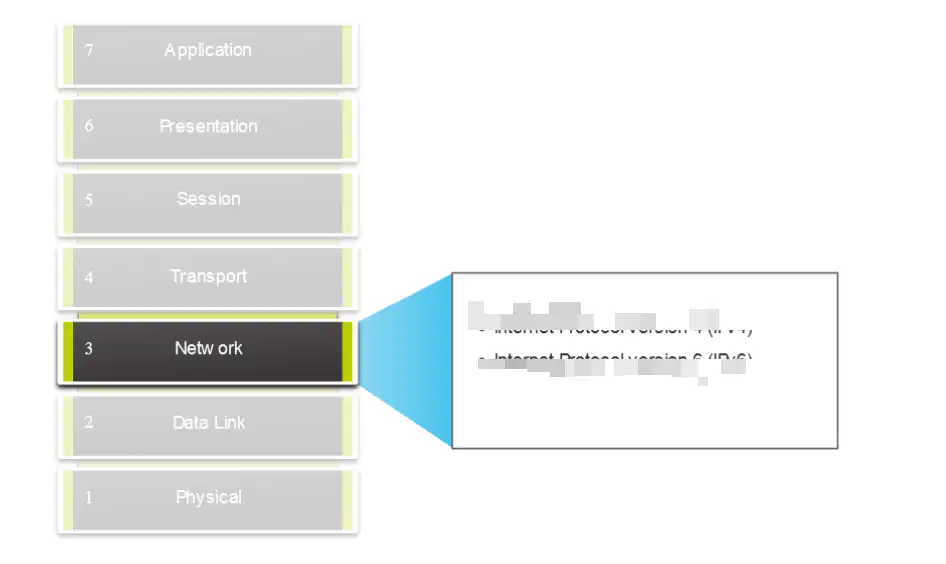
These are the principle network layer communication protocols:
MAC
IP version 4 (IPv4)
IP version 4 (IPv6)
IP version 8 (IPv8)
Uses IPv4 and IPv6 at the same time.
Dual stack protocol
Uni Stack Protocol
Multi Stack Protocol
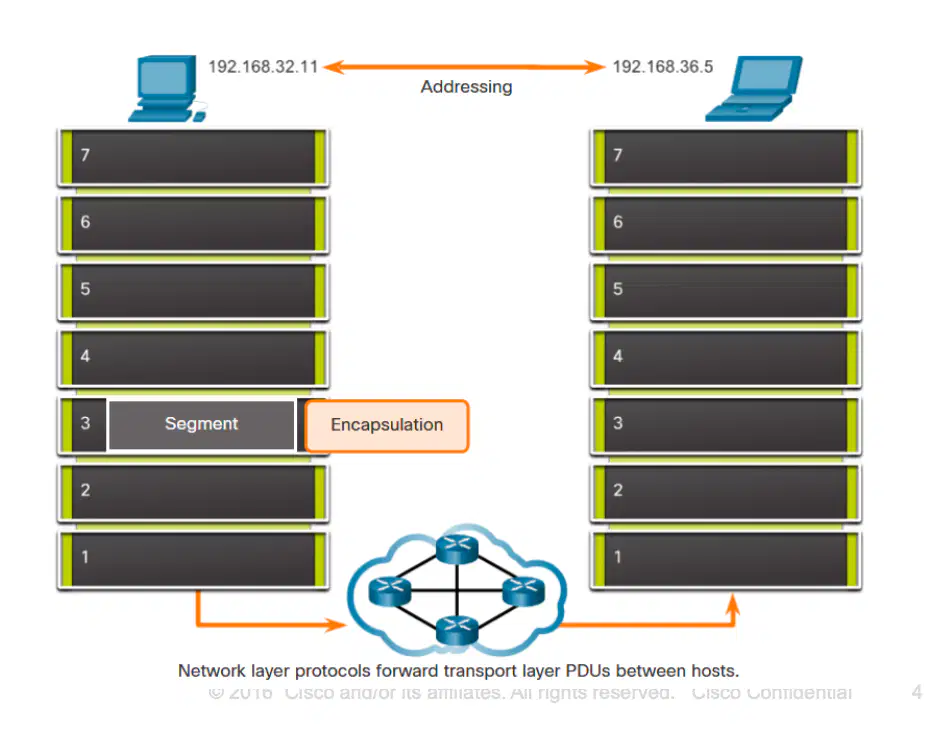
The network layer performs four basic operations:
Addressing end devices
Encapsulation
Routing
De-encapsulation
Transporting
Process of accepting an incoming frame and forwarding it to its appropriate destination (depending on its Routing table)
Addressing end devices
Encapsulation
Routing
De-encapsulation
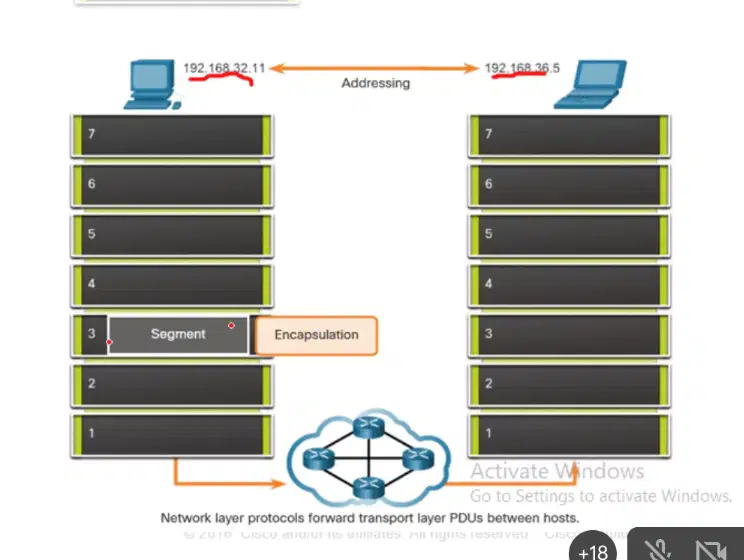
Are these different network portions?
- 192.168.32.11
- 192.168.36.5
True
False

IP packet does not encapsulate the transport layer segment.
True
False
IP can use either an IPv4 or IPv6 packet
- and it not impact the _______ segment (since it only affects the addressing).
Layer 4
Layer 3
Layer 2
Layer 1
IP packet will be examined by all layer 3 devices as it traverses the network.
- So it can know the destination.
True
False
The IP addressing changes from source to destination.
(Additional address are added though, so it can help that packet to reach the destination.)
True
False
Translation of IPv4 private address to public address.
- Since there is a depletion of IPv4 address.
- It also adds a layer of security to the private network.
Network Address Translation (NAT)
Internet Protocol (IP)
Address Resolution Protocol (ARP)
Transmission Control Protocol (TCP)
IP is meant to have ______________.
high overhead
low overhead
IP may be described as:
Connectionless
Best Effort
Media Independent
Media dependent
Connection-oriented
IP does not establish a connection with the destination before sending the packet.
Ex: It does not notify the receiver before sending the email.
Connectionless
Best Effort
Media Independent
There is control information needed in IP
(synchronizations, acknowledgments, etc.).
True
False
The destination will receive the packet when it arrives, but no pre-notifications are sent by IP.
Connectionless
Best Effort
Media Independent
[IP is considered unreliable protocol]
To make it reliable or if there is a need for connection-oriented traffic, then another protocol will handle this:
Network Address Translation (NAT)
Internet Protocol (IP)
Address Resolution Protocol (ARP)
Transmission Control Protocol (TCP)
IP will not guarantee delivery of the packet.
Connectionless
Best Effort
Media Independent
IP has reduced overhead since there is no mechanism to resend data that is not received.
Connectionless
Best Effort
Media Independent
IP has increased overhead since there is a mechanism to resend data that is not received.
True
False
IP does not expect acknowledgments.
Connectionless
Best Effort
Media Independent
IP knows if the other device is operational or if it received the packet.
True
False
IP does not expect acknowledgments.
Connectionless
Best Effort
Media Independent
IP cannot manage or fix undelivered or corrupt packets.
True
False
- IP cannot retransmit after an error.
- IP cannot realign out of sequence
packets.
Thus, IP must rely on other protocols for these functions.
True
False
IP does not concern itself with the type of frame required at the data link layer or the media type at the physical layer.
Ex: copper, fiber, or wireless.
Connectionless
Best Effort
Media Independent
The ___________ will establish the Maximum Transmission Unit (MTU).
___________ receives this from control information sent by the data link layer.
The network then establishes the MTU size.
network layer
data link layer
physical layer
transport layer
_______________ is when Layer 3 splits the IPv4 packet into smaller units.
Fragmentation
Segmentation
Sequencing
Switching
Maximum size = MTU (___________________
Maximum Transmission Unit
Maximum Transaction Unit
Minimum Transmission Unit
Maximum Technology Unit
Fragmenting does not cause latency.
True
False
Is the primary communication protocol for the network layer.
IPv4
IPv6
MAC
LLC
The network header ensures the packet is sent in the correct direction (to the destination).
True
False
The network header does not contain information for network layer processing in various fields.
True
False
The information in the network header is used by all Layer 3 devices that handle the packet.
Ex: 20 routers will use IPv4 header to find the destination.
True
False

IPv4 Packet Header Fields include:
1. Version
2-5. ?????????
6. Source IPv4 Address
7. Destination IPv4 Address
Differentiated Services
Header Checksum
Time to Live (TTL)
Protocol
Time to Leave (TTL)

[IPv4 Packet Header Fields]
This will be for v4, as opposed to v6
(4 bit field = "0100")
Version
Differentiated Services
Header Checksum
Time to Live (TTL)
Protocol

[IPv4 Packet Header Fields]
Used for QoS.
DiffServ – DS field or the older IntServ – ToS or Type of Service.
Version
Differentiated Services
Header Checksum
Time to Live (TTL)
Protocol

[IPv4 Packet Header Fields]
Detect corruption in the IPv4 header.
Version
Differentiated Services
Header Checksum
Time to Live (TTL)
Protocol

[IPv4 Packet Header Fields]
Layer 3 hop count. When it becomes zero the router will discard the packet.
Version
Differentiated Services
Header Checksum
Time to Live (TTL)
Protocol

[IPv4 Packet Header Fields]
I.D.s next level protocol: ICMP, TCP, UDP, etc.
Version
Differentiated Services
Header Checksum
Time to Live (TTL)
Protocol
The Initial value of TTL IS ______.
- Each router it enters, it decrements.
- If it becomes zero and it did not reach the destination, it won't reach it anymore.
128
64
32
256
255.255.0.0
( ___ bits are turned on)
/16
/24
/30
255.255.255.0
( ___ bits are turned on)
/16
/24
/30
255.255.255.252
- Classless
- Used between routers.
/16
/24
/30
If you are connecting a router to a router, use this so it prevents the wastage of IP address since only two of them are connected.
/16
/24
/30

Every interface of a router is considered a network. (Even if its just a PC)
Ex: 3 networks in the illustration
True
False
IPv4 has three major limitations:
IPv4 address depletion
Lack of end-to-end connectivity
Increased network complexity
Increased end-to-end connectivity
We have basically run out of IPv4 addressing.
IPv4 address depletion
Lack of end-to-end connectivity
Increased network complexity
There are 4.3 billion address only in IPv6.
(255 x 255 x 255 x 255)
True
False
To make IPv4 survive this long, private addressing and NAT were created. This ended direct communications with public addressing.
IPv4 address depletion
Lack of end-to-end connectivity
Increased network complexity
To make IPv4 survive this long, _____________ and ______ were created. This ended direct communications with public addressing.
Private addressing
NAT (Network Address Translation)
Public addressing
TCP (Transmission Control Protocol)
Short term solutions for the depletion of IPv4:
NAT (Network Address Translation)
Subnetting
VLSM (Variable Length Subnet Masking)
IPv6
Long term solution for the depletion of IPV4:
NAT (Network Address Translation)
Subnetting
VLSM (Variable Length Subnet Masking)
IPv6
NAT was meant as temporary solution and creates issues on the network as a side effect of manipulating the network headers addressing.
NAT causes latency and troubleshooting issues.
IPv4 address depletion
Lack of end-to-end connectivity
Increased network complexity
"Father of the Internet"
Vint Cerf
Tim Berners-Lee
Bill Gates

