
 Worksheets
Unit 202 revision #1
Total questions: 20
Worksheet time: 10mins

What is the force 'F' acting on the beam shown in figure 1 if it is in state of equilibrium?
2N
20N
40N
5N
What parts would you find within an alternator?
Slip-rings and brushes
Commutator and brushes
Brushes and a centrifugal switch
Commutator and a permanent magnet
The typical type of battery located within a cordless drill is
SELV
Alkaline
Lithium Ion
Nickel Cadmium
The typical voltage found within domestic installations in the UK is
400V
230V
110V
240V
Why is the A.C. voltage supply system used within the UK, rather than a D.C. voltage?
The electricity is cheaper
The D.C. batteries would need to be extremely large
AC voltage can be stepped up and down with transformers
The voltage is much larger.
Which formula can be used to calculate the total resistance in a parallel circuit:


What is the nature of the electrical charge found on the proton within the nucleus?
Negative
Positive
No charge
Changing
The right hand grip rule is used with:
Current carrying conductors
Cutting threads on conduit
DC motors only
When tightening a gland on MIMS cable
What are the S.I. units for Force?
Neutron
Tesla
Newton
Weber

Which is the correct formula for finding the resistance from this formula ?


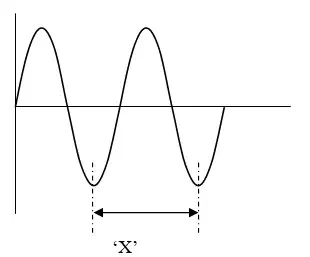
The correct name given to the horizontal distance ’x’ of the A.C. supply shown?
Wavelength
Period
Peak to peak
RMS
Current is measured using a:
Wattmeter
Voltmeter
Galvanometer
Ammeter
Flemming’s left hand rule is used for determining the:
Current direction, movement of the magnetic field and turns on the coil
Flux direction within the conductor, motion of the magnetic field and direction of the current
Current direction, motion of the conductor and magnetic field direction
Direction of movement of the solenoid, direction of the turns on the solenoid and current flow.
Which of the following tools uses the principle of leverage?
File
Saw
Chisel
Pliers

What is the meter marked ‘A’ measuring in this circuit?
The voltage in R2 and R3
The current in R2 and R3
The total current in the circuit
The voltage in R3
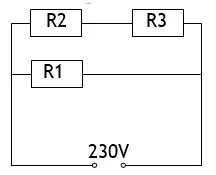
What would be the correct connection for a voltmeter if the voltage in R1 were to be measured in the circuit shown?
Between R2 and R3
Next to R1
Across the supply
Across R3
If a copper conductor heats up, does it?
Decrease in cross sectional area
Decrease in resistance
Increase in resistance
Stay the same
A 3kW bathroom shower consumes 3.6kW of power. The efficiency is:
83%
93%
108%
120%
30 μΩ could be expressed as
0.3 Ω
0.003 Ω
0.0003 Ω
0.00003 Ω
which of the following components uses N-type & P type silicon
Transistor
Solenoid
fuse
alternator

