
 Worksheets
Reconstruction Unit Review
Total questions: 80
Worksheet time: 59mins

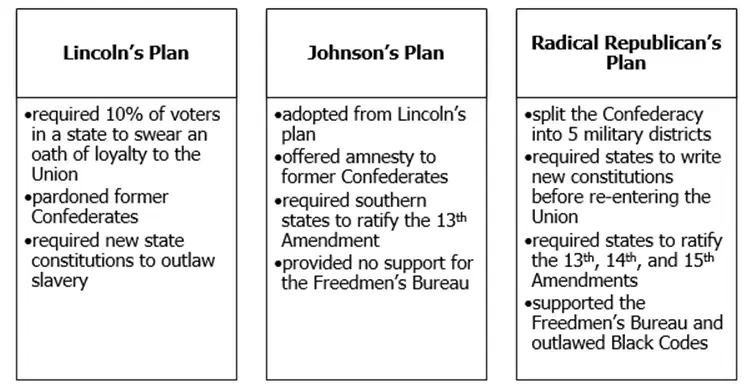
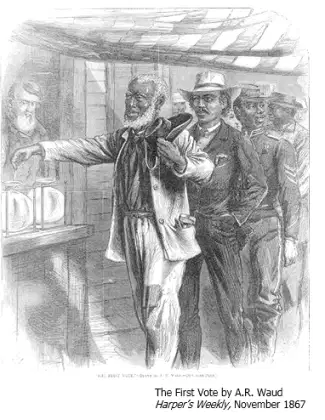
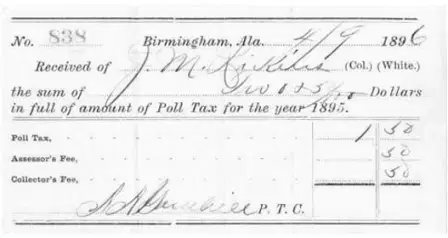
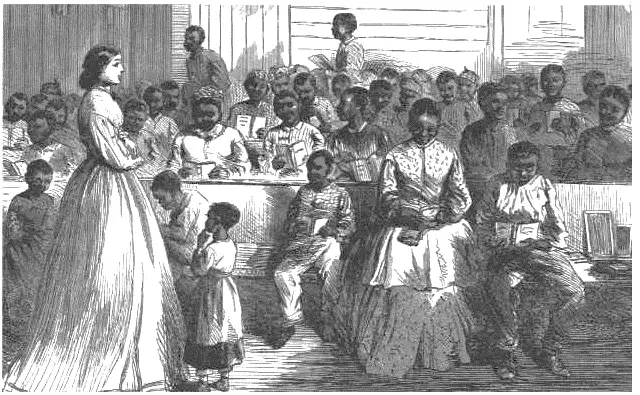
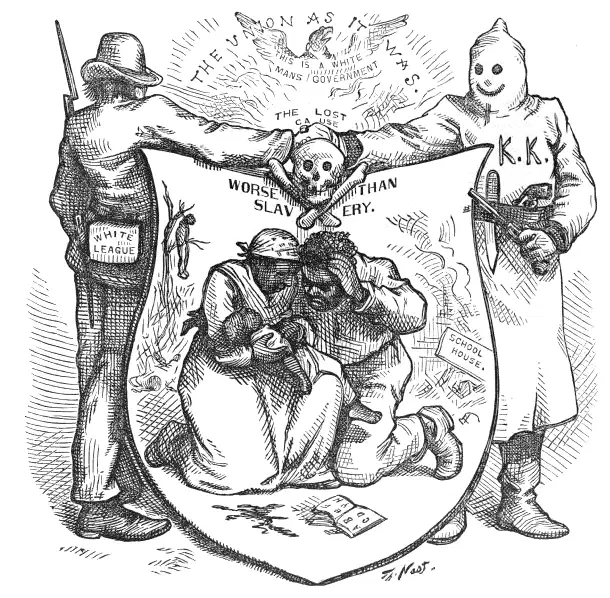

Which impact of Reconstruction is illustrated by this artist?
Freedmen exercised new voting rights guaranteed by the Civil Rights Act.
Freedmen were given free plots of land from their former owners’ plantations
Freedmen invested their savings in Southern manufacturing.
Freedmen purchased railroad tickets to travel west on the transcontinental railroad.

Which development occurred during Reconstruction to deal with these problems?
Most freedmen migrated to Northern cities while European immigrants went South.
Southern landowners sold most of their properties to Northern carpetbaggers.
Southern banks made loans to freedmen who bought land from their former masters.
Freedmen often became sharecroppers or tenant farmers on the properties of their former masters.

Which individual is described by these characteristics?
Andrew Johnson
Jim Crow
Hiram Rhodes Revels
Jefferson Davis
Which act of Congress overturned the Black Codes, affirmed the rights of the freedmen, and formed the basis for the Fourteenth Amendment?
Military Reconstruction Act
Freedmen’s Bureau Act
Civil Rights Act
Homestead Act
Why did Radical Republicans disagree with President Lincoln’s plan for Reconstruction?
Lincoln demanded that Southern states pay a large indemnity to the North for damages during the war
Lincoln wanted the Union army to remain in occupation of the South.
Lincoln gave the freedmen property confiscated from former plantation owners.
Lincoln would readmit Southern states to Congress after only ten percent took an oath of allegiance and ratified the 13th Amendment.

The “system” described in this excerpt developed because of —
the failure of Reconstruction to secure lasting rights for freedmen
the limitations of President Lincoln’s Emancipation Proclamation
the destruction of the South during the Civil War and military occupation
the lack of opportunities for African Americans in Northern cities
How did state governments during Reconstruction help the South’s economy?
They halted the growing of cotton on Southern farms.
They established free public schools and rebuilt roads.
They prohibited sharecropping and tenant farming.
They turned the South into the nation’s manufacturing center.
Which was an important problem faced by Southerners during Reconstruction?
how to educate and prepare millions of freedmen for freedom
how to defend damaged plantations from American Indian attacks
how to pay reparations demanded by the North for causing the war
how to pay the massive debt owed on Confederate war bonds
After the Civil War, the Freedmen’s Bureau was primarily used by the Radical Republicans in Congress as a way to —
train the freedmen to take positions as workers in Northern factories
help freed slaves by providing them with food, clothing and education
provide jobs for Northern carpetbaggers who hoped to make their fortunes in the defeated South
punish former Confederate officials for participating in the Civil War
The Fourteenth Amendment overturned which Supreme Court ruling?
Marbury v. Madison
Worcester v. Georgia
Plessy v. Ferguson
Dred Scott v. Sandford
What were Southerners called by others in the South who helped out with the Reconstruction plans?
carpetbaggers
freedmen
scalawags
abolitionists
What amendment abolished slavery in the entire United States?
12th Amendment
13th Amendment
14th Amendment
15th Amendment
What did Southerners called people from the North who came to the South during Reconstruction?
carpetbaggers
freedman
scalawags
radicals
Which of the following represents one way the southern states attempted to keep freed slaves at the lower levels of society after the Civil War?
Creation of the Freedmen's Bureau
Repeal of the Emancipation Proclamation
Passage of regulations known as the Black Codes
Voiding the 13th, 14th, and 15th Amendments
Which of the following was a major point of disagreement between President Andrew Johnson and the Radical Republicans in Congress?
Land ownership by former slaves
Creation of the Freedmen's Bureau
Johnson's policies for Reconstruction
Adoption of Black Codes in the South
The 13th, 14th, and 15th Amendments were added tot he U.S. Constitution after the Civil War. All three of these amendments were meant to establish and extend the -
rights of individual states
Black Codes of the South
civil rights of black citizens
Reconstruction Act of 1867
Which of these describes a result of the Thirteenth Amendment?
African Americans in the North could vote
State governments were required to protect individual rights.
Former Confederate officials were prohibited from holding elected office.
African Americans in the South could move elsewhere
The Thirteenth Amendment to the U.S. Constitution affected the lives of millions of African Americans by —
providing them with voting rights
guaranteeing their freedom of speech
providing them with access to the court system
guaranteeing their permanent freedom from slavery

What is the historical significance of this act?
It was the first time Congress voted to overrule a presidential veto.
It represented a shift in federal power after the impeachment of President Johnson.
It was the first time Congress passed a law that protected racial minorities.
It represented the failure of northern abolitionists to influence Reconstruction policies.
The Fifteenth Amendment was ratified in order to —
establish legal requirements for the education of former slaves
mandate fair labor contracts between African American workers and plantation owners
abolish the institution of slavery
protect the voting rights of African American men
Which of these prompted Congress to propose the Fourteenth Amendment?
The popular sovereignty provision in the Kansas-Nebraska Act
The positions taken in the Know-Nothing Party platform
The Black Codes enacted by southern states after the Civil War
The opposition by southern states to the Emancipation Proclamation
What was one long-term consequence of the sharecropping system?
Agricultural workers organized labor unions.
Many former slaves became trapped in a cycle of debt.
Many agricultural workers moved to cities to start small businesses.
Landowners sold property to pay wages to former slaves.
After the Civil War, southern states adopted Black Codes to —
punish plantation owners for the use of slavery
support Radical Reconstruction objectives in the South
promote the activities of the Freedmen’s Bureau
limit the impact of the Thirteenth Amendment

The measures in this list are examples of ways southern states weakened the effects of the —
Compromise of 1877
Thirteenth Amendment
Fourteenth Amendment
Fifteenth Amendment
How did the Freedmen’s Bureau most assist in the reconstruction of the South?
By dividing large plantations and redistributing the property to former slaves
By creating a militia to help enforce the voting rights of former slaves
By offering legal assistance and public schooling to former slaves
By petitioning the government to offer money to former slaves
How did southern states respond to the ratification of the Fifteenth Amendment?
By creating a segregated public education system
By shutting down all remaining offices of Freedmen’s Bureau
By imposing requirements designed to deny African Americans the right to vote
By forcing African Americans to work as tenant farmers and sharecroppers
How were former Confederate leaders treated under the Radical Reconstruction plan?
They were denied citizenship because it was believed they had started the war.
They were required to enlist in the U.S. Army for two years.
They were denied the ability to obtain political positions.
They were allowed to obtain federal loans to help restore the cotton industry.

What was an IMMEDIATE effect of this amendment?
Many plantation owners attempted to recapture former slaves.
Many plantation owners were forced to give land to former slaves.
Many former slaves became sharecroppers to earn a living.
Many former slaves were awarded money by former Confederate leaders.

Which of the following expresses a goal of the Reconstruction Acts of 1867?
To restore the Democratic Party to power in the South
To rebuild the plantation economy of the South
To protect the rights of African Americans in the South
To encourage former slaves to leave the South
Reconstruction policies stated Southern military leaders could NOT
move north
hold public office
return to their plantations
join the military
What right does the 15th Amendment ensure U.S. citizen regardless of race, color, or previous condition of servitude?
Freedom of speech
Freedom of press
right to vote (for men)
right to a trial by jury
Which two groups of people did NOT receive the full benefits of citizenship under the 14th and 15th Amendments?
African Americans and American Indians
American Indians and Women
Teenagers and Children
Immigrants and Women
Why was the Freedman's Bureau established?
To aid former slaves in the South
To gather taxes to rebuild the South
To help establish free and slave states in the new Western Territories.
To investigate and arrest persons involved in the Underground Railroad.
In this year, troops were removed from the South and Reconstruction was over.
1865
1880
1870
1877
Why did Southerners adopt Black Codes?
To help ensure enslaved African Americans gain farm land.
To ensure the removal of federal troops from the region.
To allow enslaved African Americans to use specific codes to communicate.
To limit the economic and physical freedom of former slaves.

What was the nickname given to the person in this illustration?
Carpetbagger
Jim Crow
Freedman
Confederate
Abraham Lincoln believed-
African Americans should remain enslaved
Southern states should have fewer rights than Northern states
preservation of the Union was more important than punishing the South
the United States should become two separate nations
Which amendment bans slavery in the U.S. and all of its territories?
14th
13th
19th
15th
What was the legacy left by Frederick Douglass?
Believed in reconciliation between the North and South during Reconstruction
Protested federal troops in the South during Reconstruction
Designed a plan where states could appoint representatives to Congress
Was a powerful voice for human rights and civil liberties for all
Which man fought for Constitutional amendments to guarantee voting rights?
Frederick Douglass
Abraham Lincoln
Robert E. Lee
Andrew Johnson
At the end of the Civil War, Robert E. Lee urged Southerners to-
continue fighting Union soldiers
move North to find work in factories and stores
reconcile with Northerners and reunite as Americans
state conflicts with federal troops stationed in the South
Which 2 statements are associated with the Civil Rights Act of 1866?
Any person born in the United States is a citizen with basic rights.
Sharecropping became popular in the Northern states
The use of federal troops was authorized for enforcement
Southern military leaders were allowed to run for government office
African Americans lost many of the rights they had gained because of-
reconciliation efforts
"Jim Crow" laws
Reconstruction policies
Lincoln Laws
Which amendment?
The child of two formerly enslaved African Americans is born in Georgia and is automatically a U.S. citizen
13th
15th
16th
14th
Which amendment?
Southern plantation owners pay a wage to all farm workers, including African Americans
14th
13th
15th
16th
Which amendment?
African Americans vote for their state representative to the federal government
13th
14th
15th
16th
Southerners resented Northern "carpetbaggers" because some of the "carpetbaggers"-
could now hold public office
took advantage of the South during Reconstruction
authorized the use of federal troops to enforce Reconstruction policies
participated in creating new Black Codes
At the end of Reconstruction, federal troops
were mainly Southern soldiers
lived and worked only in the North
supervised the South
were removed from the South

Which image shows an example of Black Codes?
1
2
3
4
Reconstruction ended as a result of (pick two answers)
the Black Codes
the Freedman's Bureau
the Compromise of 1877/the Great Betrayal
the removal of federal troops in the South
During Reconstruction, who supervised the South?
Southern military leaders
Federal troops
Members of the Freedman's Bureau
Northern "carpetbaggers"

Which sign would Frederick Douglass most likely hold?
1
2
3
4
Which two groups were affected by "Jim Crow" Laws?
African Americans
Women
American Indians
Carpetbaggers
What are the basic provisions of the 14th Amendment (pick 2)?
Grants citizenship
Bans slavery
Ensures the right to vote
Guarantees equal protection under the law
Abraham Lincoln's Plan for Reconstruction was called the ____ Plan.
25%
15%
100%
10%
This Supreme Court case of 1857 ruled that black person, free or a slave, could never be a citizen of the U.S.
Plessy v. Ferguson
Dred Scott
Marbury v Madison

