
 Worksheets
EOC Review 3
Total questions: 134
Worksheet time: 2hrs 34mins

What was the primary goal of discussions between these two leaders?
To recognize the independence of former satellite states
To reach a formal agreement on weapons control
To negotiate the reunification of Germany
To develop a global environmental-protection policy

How was the goal set forth in this excerpt advanced during President Nixon's administration?
By normalization of relations with China
By supporting the Arab coalition during the Yom Kippur War
By escalating the bombing of North Vietnam
By attacking enemy bases in Cambodia
One action that influenced the U.S. -Soviet Signing of SALT I treaty in 1972 was President Richard Nixon's -
opening of diplomatic relations with China
involvement in the Watergate scandal
support of Israel during the Yom Kippur War
withdrawal of military forces from Vietnam

Which statement correctly completes this time line?
The Centers of disease Control petitioned Congress to eliminate waste treatment plants.
The federal government created the Environmental Protection Agency to oversee environmental issues.
The automobile industry began researching alternative energy sources.
The president ordered the Public Health service to deal with environmental pollution

Which option completes this diagram?
President Richard Nixon's involvement in Watergate
The proposed ratification of Equal Rights Amendment
President Jimmy Carter's negotiation of Camp David Accords
The introduction of the Marshall Plan as official foreign policy

The incident illustrated by this cartoon increased cynicism toward the U.S. government because -
the press secretary failed to keep the public informed of national policy changes
the president directed a conspiracy to mislead the nation
the Supreme Court overruled federal statutes the defined confidentiality
Congress failed to pass legislation enforcing protection of privacy rights

Which of the following is most responsible for the differences shown on the table?
Robert L. Johnson's creation of a major television network.
Tim Berners-Lee's invention of the World Wide Web (internet)
Jeff Bezos' founding of Amazon.com
Michael Dell's use of just-in-time manufacturing.
What does President Bill Clinton's impeachment trial reflect about modern U.S. politics?
Congress conducts more thorough investigations of judicial nominees.
Campaign finances are monitored by regulatory agency.
Media outlets focus more on policy issues than on the actions of elected officials.
Elected officials face greater scrutiny of their personal lives.

These demonstrations led to-
a global energ crisis brought on by OPEC oil embargo
the bombing of a Marine barracks =, followed by retaliatory U.S air strikes
a U.S boycott of the Olympics in protest of events in Central Asia
a hostage crisis that severely damaged confidence in the Carter administration

How did this treaty contribute to the end of the Cold War?
By reducing tensions associated with the threat if the nuclear war
By providing an exchange of weapons for war hostages
By allowing secret weapons technologies to be shared
By establishing an official cease-fire

Line for gas such as the one in this photograph resulted from-
the dissolution of Standard Oil company
an oil rig explosion in the Gulf of Mexico
the construction of the trans-Alaska pipeline
an embargo by the Organization of the Petroleum Exporting Countries

Which course of action did President Carter propose in order to solve this problem for the next generation?
Contract with foreign nations to build wind tributes
Reduce federal spending on solar cell energy research
Drill fewer off shore wells to conserve marine life
Develop alternative energy sources
The Camp David Accords was-
peace treaty to end the Cold war
peace agreement negotiated by Carter between Israel and Egypt
agreement between the U.S and middle eastern nations to lift the oil embargo by OPEC
agreement to protect Middle Eastern countries from Soviet rule

What did congressional Republicans call this political plan?
The New frontier
The Great Society
The Return to Normalcy
The Contract with America
How did Steve Jobs influence business in the twenty-first century?
By opening stores that sold consumer goods at discounted prices
By developing popular devices that changed the way people used electronics
By improving the methods used for offshore drilling by oil companies
By designing automobiles that utilized technology to reduce gasoline usage
Why did the United States fight in the Persian gulf War?
Iraq needed help resisting a communist revolution.
Iraq supplied weapons to al-Qaeda terrorists.
Iraq invaded and occupied Kuwait.
Iraq finance the Soviet invasion of Afghanistan.


What was the overall goal of U.S. military intervention in Vietnam from 1964-1973?
Eliminating trade barriers between the United States and Southeast Asia
Isolating the Soviet Union by improving Chinese relations with the United States
Promoting economic growth in the Pacific region
Preventing communism from spreading throughout Southeast Asia

What happened as a direct result of these recommendations?
North Vietnamese leaders appealed for ceasefire.
U.S. military involvement in Vietnam escalated.
South Vietnamese leaders rejected military assistance.
Soviet ground troops were deployed to Vietnam.
During the time between the passage of Gulf of Tonkin Resolution and the start of the Tet offensive, what happened in the Vietnam War?
All U.S. Civilians were evacuated from Vietnam.
Peace talks between South Vietnam and North Vietnam were conducted in Paris.
The U.S. government deployed more troops to Vietnam.
South Vietnam surrendered to North Vietnam

Which term best completes this text box?
Hawk mentality
Credibility gap
Living-room war
Flexible response
The Cuban Missile Crisis occurred when
Cuba attempted to invade the U.S. with the Soviet Unions help.
the Soviet Union fired missiles at Cuba.
the U.S. learned that the Soviet Union had built missile launching pads in Cuba.
the Soviet Union fired missiles at the U.S. from Cuba
The ratification of the 26th amendment which lowered the voting age to 18 was a result of the
Fear of communism
reporting Watergate
reaction to Sputnik
participation in Vietnam War

Which event is commonly associated with the type of music described in this excerpt?
The March on Washington
The Freedom Rides
Woodstock
The California Grape Boycott

This amendment gained support based on the belief that people should have the right to vote if they are old enough to-
drive motorized vehicles.
serve as members of juries.
pay federal income taxes.
be drafted into the military.
How did press coverage of events during the Vietnam War affect the United States?
Film footage from the front lines increased congressional support for the war.
Reporting on military setbacks contributed to public disillusionment with the war.
Increased U.S. media presence overseas resulted in overwhelming international support for U.S. intervention .
Live presidential press conference led to a decline in partisan politics in Congress.
Literary movement that began in the late 1950s that often rejected the standard way of life in the U.S.; started in New York City and later spread to San Francisco
Beat Generation
Hippies
Counterculturists
Silent Majority
President Johnson’s domestic plan declaring a war on poverty and racial injustice; Examples--Medicare, Medicaid, Head Start Education project, and civil rights legislation in 1964 and 1965
Great Society
New Frontier
Square Deal
New Deal
The movements led by Dr. Martin Luther King and Cesar Chavez were similar in that both___
Both used civil disobedience to bring about social change
supported attempts to overthrow the federal government
boycotted agricultural crops
were elected to national office
What was the major goal of the American Indian Movement (AIM)?
To gain better understanding of the American-Indian point of view
to gain U.S. citizenship and representation
to relocate American Indians to urban areas
to end segregation of American Indians in public places
What did the Women's Liberation Movement see as its major goal in the 1960s?
guarantee equal pay for equal work
obtaining the right to vote for women
enabling women to stay home as as work
laws that would allow women to own their own property
Title _____ was passed to ensure equal opportunity in education
Title IX
Title X
Title XI
Title XII
President John F. Kennedy's promise to go to the moon by the end of the 60s during his inaugural address was said to gain public support for____
surpassing the Soviet Union in the space race
establishing a missile defense system
cooperating with Communists countries in space exploration
controlling the spread of nuclear weapons
Which book played a role in changing the attitudes about traditional gender roles in American society
The Feminine Mystique
The Jungle
How the Other Half Lives
Common Sense
How did the methods advocated by the Black Panthers to achieve their goals differ from those of Dr. Martin Luther King?
they considered the use of self defense to protect their own community
they formed a third political party
they were passionately anti-Communist
They used passive resistance only
What has been an impact of the Chicano Mural Movement on American society?
it increased appreciation for Mexican-American culture
it raised fears of increased bias against Mexican-Americans
it brought alarm of another culture influencing the United States
it expanded the constitutional rights of Mexian-Americans
A type of writing that sensationalized events of the Spanish American War to sell more newspapers
Yellow Journalism
Investigative Journalism
Journalism
Case study research
Which foreign policy made loans to Latin American countries?
Big Stick Policy
Platt Amendment
Dollar Diplomacy
Imperialism
Why did US senators resist joining the League of
Nations?
They were concerned they would have to
renegotiate trade deals
They feared US military leaders could be
prosecuted for war crimes.
They feared that the United States would be
drawn into costly foreign wars.
They were concerned that League members
would have to lower trade barriers.

What did the court hold to be unprotected speech
in this ruling upholding the Espionage Act during
World War I?
providing information about US troop strength
and locations to German agents
leaking schematic diagrams of a new American
tank design to the press
sending out political leaflets urging Americans
not to submit to the draft
hiding fugitives that were targeted for
deportation to Germany as spies
Why were the Espionage Act of 1917 and the
Sedition Act of 1918 used by President Woodrow
Wilson's administration during World War I?
to silence critics of the war effort
to put German Americans in camps
to remove communists from government
positions
to discourage congressional support for the war
effort

What was the outcome of the voyage of the USS Oregon in 1898?
increased US foreign aid to the developing countries in south america
increased US public support for the construction of a canal through central america
decreased US economic influence in the western hemisphere
decreased US naval presence in the caribbean sea

Which event is related to the territory shown on
the map?
The United States agreed to pay Colombia for
the rights to Panamanian holdings on the
isthmus
The United States backed a revolution in
Panama against Colombian rule
The United States sent marines into several
Central American countries
The United States received rights to build a
canal across Nicaragua

Which numbered territory did the United States gain by winning the Spanish American War?
1
2
3
4

The cartoon comments on tactics used to-
secure the southern border of California
protect shipping the lanes in the Great Lakes
create a defensive alliance with France
obtain control of the Panama Canal Zone

The cartoon depicts Woodrow Wilson calling on Congress to-
ratify the Treaty of Versailles
issue a declaration of war against Germany
authorize the use of funds to support Russian revolutionaries
enact trade sanctions against Germany

Which of the following is the best title for this list?
Issues Contributing to the Outbreak of World War I
Principal Reasons for U.S. entry into World War II
Consequences of the Twentieth-Century European Isolationism
Economic Rivalries Between Cold War Superpowers

How did these events affect the United States?
F) They increased public support for cuts in U.S. defense spending.
G) They prompted the end of Dollar Diplomacy in Latin America
H) They set a precedent of including territorial acquisitions in settlements.
J) They helped establish the United States as an imperial power similar to European nations

U.S. would collect debts for investors who worked with Latin America, acting as an “international police power.” Known as the Big Stick Policy.
Roosevelt Corollary
Open Door Policy
Boxer Rebellion
Dollar Diplomacy

After what event did the United States declare
war on Spain in 1898?
the Baltimore crisis
the Haymarket affair
the sinking of the USS Maine
the invasion of American Samoa
What was the primary reason for the establishment of the Open Door Policy?
to protect the United States trade in China
To gain control of the Panama Canal Zone
to encourage Chinese immigration to the United States
to improve relations with China
Which geographic factor played a role in the construction of the Panama Canal?
Workers faced heavy attacks by Panamanian nationalists
Heavy rains and mountainous terrain led to frequent mud slides
Cutting through the bedrock had to be done without heavy machinery
Similar elevations of the Atlantic and Pacific allowed for swift construction


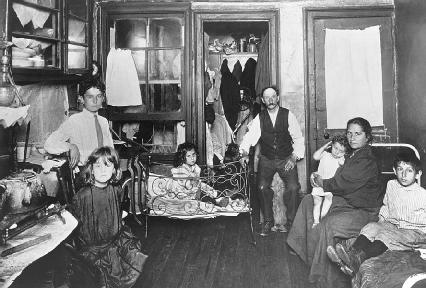
What is the main idea of the passage?
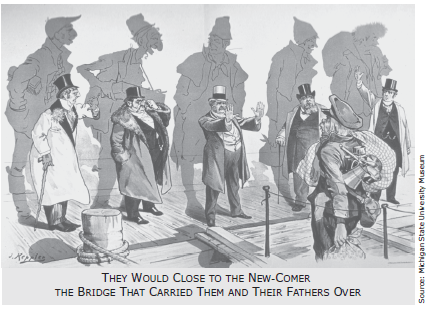
Tenement living had improved through the Gilded Age
Urban poor faced crowded and unhealthy conditions in tenement housing
The total number of immigrants in tenement housing was declining
Politicians were working to improve conditions of tenements
Nativists favored-
Americans over immigrants; America for Americans only!
The assimilation of immigrants into American society
The support of Native Americans
Open borders and allowing ALL immigrants into the United States
What would be a prime example of Americanization?
The Dawes Act selling Native American lands
The Homestead Act providing lands to settlers
The Chinese Exclusion Act prohibiting Chinese immigration
The children of immigrants learning English in school

The political cartoon is referencing-
Labor unions
Monopolies and trusts
Municipal corruption
Immigration quotas

Using the table, what was the most important impact of industrialization in the United States?
People moved from cities to rural areas.
The number of people living in cities continuously increased.
The urban population decreased.
Railroad mileage increased.
During the late 1800s, political bosses often-
participated in graft
denied voting rights to poor people
wasted money on building railroads
discriminated against the urban poor
What was a major impact of the Transcontinental Railroad?
It protected Native American rights and tribal lands
It only impacted a small strip of land in the American West
It led to the destruction of buffalo and the opening of the Great Plains to American settlers
It led to the Klondike Gold Rush

Which statement best completes the diagram?
The Chinese Exclusion Act was passed
Immigration quotas were instituted
Irish families immigrated to the United States
Political machines were instituted in urban areas

Why were these immigrants relieved to see the type of land they had expected?
They hoped to mine for gold
They wanted to work on the railroad
They planned on working in factories
They hoped to establish farms
In the late nineteenth century, the "bosses" of urban political machines often--
denied voting rights to the poor
accepted bribed in return for favors
wasted money on military spending
discriminated against migrant workers
During the late 1800s and early 1900s, prejudice against "New Immigrants" increased because these immigrants--
had job skills superior to those of most American workers
formed their own labor unions in order to receive higher wages
came from cultural background different from those of the majority of Americans
tried to replace American democracy with other forms of government
Nativists in California in the 1800s would most likely have supported the-
creation of settlement houses to aid new immigrants.
passage of the Chinese Exclusion Act.
continuation of the contract labor system.
assimilation of Native American Indians into mainstream culture.

Based on the graph, why did immigration increase between 1895 and 1905?
The Panic of 1893 had occurred.
Expanding industries provided jobs for immigrants.
Immigrants came in search of cheap land in the West.
World War I ended.

Based on the information on the graph, which statement is most accurate?
People who lived in urban areas were poor.
The percentage of urban population increased between 1850 and 1900.
By 1900, 30% of the population lived in rural areas.
Industrialization led to an increase in rural population in the late 1800s.

Based on the poster, which is an accurate statement?
Immigrants were encouraged to learn and speak English.
Granite City had laws prohibiting immigrants from moving there.
The people in the poster were native-born Americans.
Granite City encouraged diversity in its immigrant population.


According to the headline, how did the election of Barack Obama as President eliminate a racial barrier?
He is the first Hispanic elected president.
He is the first Hawaiian native elected president.
He is the first African American elected president.
He is the first president to have received fewer popular votes and still win.
How does the free enterprise system contribute to technological innovations?
Research at universities provides companies new ideas for new products.
Government economic planning determines the next generation of new technologies.
Lower taxes allow companies to use their higher profits for research into new technologies.
Consumers demand new products that perform better and more efficiently than previous products.
Which field of innovation has likely had the greatest effect on increased productivity and the improved standard of living in the United States during the latter half of the twentieth century?
Renewable energy
Robotic automation
Aerospace engineering
Information technology

Which of the following is the best title for the list above?
Places Americans Take Vacations
Influence of American Fast Food in the World
How American Ideas Change People
American Culture Influences the World

This poster for an American movie playing in Poland is an example of —
how Western movies are unpopular in many parts of Europe and Asia
how American popular culture influences the youth of other countries
the influence of foreign media on the American entertainment industry
the global diffusion of American culture through the entertainment industry

Which of the following individuals' accomplishments are listed in the box?
Dolores Huerta
Hillary Clinton
Sonia Sotomayor
Sandra Day O'Connor

Barack Obama described his 2008 election victory in this manner because the election as the first in which-
a minority candidate was elected president.
naturalized immigrants had access to multilingual ballots.
federal courts ordered voter recounts to stop.
religious beliefs played a significant role in the presidential campaign.

Which event prompted this speech by President Bush?
The attacks on the World Trade Center and the Pentagon.
The attack on the USS Cole.
The mail-bombing campaign of the Unabomber.
The bombing of a federal building in Oklahoma City.
What was the primary goal of the 2009 Affordable Care Act?
To eliminate state medical programs.
To expand access to health insurance.
To nationalize medical care for the elderly.
To ease restrictions on healthcare providers.

Which of the following directly completes this description?
North American Free Trade Agreement
Organization of Petroleum Exporting Countries
General Agreement on Tariffs and Trade
North Atlantic Treaty Organization
What is the primary aim of the USA PATRIOT Act of 2001?
To limit the amount of foreign investments in the United States.
To promote the growth of locally owned small businesses.
To prevent acts of terrorism against the United States.
To increase funding for military contracts.

How did these features affect New Orleans after Hurricane Katrina
Tornadoes gained momentum in open land areas.
Storm surges caused a massive shift in tectonic plates.
Mud slides trapped residents in the city.
Storm waters flooded the city after several levees broke.
One way the development of the internet has improved the quality of life in the United States is by-
decreasing the influence of advertising on consumers
increasing the ease of obtaining information
improving privacy protection for individuals
increasing the reliability of available information

The changes shown in these photographs most likely-
helped increase workplace safety
increased the supply of natural resources
altered the makeup of natural ecosystems
helped decrease energy consumption

Which marketing strategy is most clearly a result of the changing demographic patterns described above?
Television networks offer discount to toy companies for commercials played during Saturday morning cartoons.
Fast food chains partner with the film industry to advertise recent movies release with kid's meals.
Telecommunication companies spend increasing amounts of money on commercials that air on Spanish-language radio stations.
Department stores place large advertisements in Sunday newspapers.

According to the cartoonist, one important result of the election of President Barack Obama in 2008 was that
public facilities in the South were finally integrated
the executive branch of government gained power over the legislative branch
a racial barrier in government had been broken
racial discrimination was legally eliminated in the United States

During the Cold War, what bill did the U.S. Congress pass to provide financial assistance to western European countries?
Truman Doctrine
Open Door Policy
Marshall Plan
Domino Theory

What policy implemented in the Cold War said the U.S. would give military aid to a country that needed to resist communism?
Marshall Plan
Truman Doctrine
Domino Theory
Open Door Policy
During the Cold War, what policy did the U.S. follow to stop the spread of communism?
Open Door Policy
Big Stick Policy
Containment Policy
Dollar Diplomacy
Which individual/group contributed to the Red Scare by accusing American citizens of being communist spies?
McCarthy/HUAC
NAACP/Farm Workers Union
Nativists/Muckrakers
Philanthropists/Entrepreneurs

What happened as a result of the launch of Sputnik in 1957?
It started the space race between the USSR and U.S.
The U.S. government started NASA.
U.S. began to spend more money on math and science to maintain national security.
All of the above

During what Cold War event did the U.S. bypass a Soviet blockade in Germany without provoking a military conflict?
Berlin Airlift
Vietnam War
Watergate Scandal
Bataan Death March

During the Cuban Missile Crisis, what did President J.F. Kennedy do when he heard that the Soviet Union was constructing nuclear missile sites in Cuba.
He launched a nuclear missile at the Kremlin in Moscow.
He gave into the demands of the Soviet & Cuban government.
He ordered a naval blockade around Cuba to prevent Soviet ships from bringing the necessary materials.
He declared war on the Soviet Union & Cuba.

What legislation helped American soldiers get an education and buy homes in the suburbs during the Cold War?
Interstate Commerce Act
Federal Housing Authority Act
Social Security Act
GI BIll
What was the name of the rapid increase of population following the end of WWII called?
Baby Boom
Columbian Exchange
Great Migration
Demographic Shift
What theory caused the U.S. to enter the Vietnam War in order to stop the expansion of communism across Southeast Asia?
Marshall Plan
Domino Theory
Open Door Policy
Dollar Diplomacy
The Ho Chi Minh Trail was
a secret path which was used by the Viet Cong in Saigon.
a supply line for the Vietcong which ran through neutral countries.
the route that the Americans took when they left South Vietnam.
a supply line used by South Vietnam.
After the Vietnam War
South Vietnam stayed independent but communist.
both countries were reunited.
the Americans had to pay for most of the damage.
all of the above.
Where was the United States Navy allegedly attacked in 1964?
Gulf of Thailand
Gulf of Tonkin
Pearl Harbor
South China Sea
The United States experience in the Vietnam War supports the idea that the outcome of a war
is determined mainly be technological superiority.
is dependent on using the greatest number of soldiers.
is assured to countries dedicated to democratic ideals.
can be strongly affected by public opinion.
In the ____________________, United States soldiers killed at least 450 women, children, and elderly men, shocking the American public.
My Lai Massacre
Attack on Sai Pan
Tet Offensive
Attack on Khe Sanh
US troop reduction in Vietnam; transfer of combat operations from American to South Vietnamese troops
Domino Theory
Kent State University
Tet Offensive
Vietnamization
What parallel line divides North and South Korea?
17th
48th
15th
38th
The term "Great Society" came to represent
the glamorous image fo the Kennedy Administration
the antion's anti-communist agenda
Michael Harrington's affluent society
the domestic programs of the Johnson Administration
Why did Kennedy expand the space program?
to bolster the nation's prestige and power in the face of several foreign policy setbacks
in order to install nuclear weapons in space
to fulfill his campaign promise to put a man on the moon
to shift the focus away from his domestic policy failures
The purpose of Medicaid was to provide health care to which group of Americans?
The elderly
Immigrants
Republicans
Low-income individuals and families

What was a govt. sponsored creation of infrastructure and US military moved more efficiently?
GI Bill of Rights
National Interstate and Defense Highways Act
Marshall Plan
Truman Doctrine
The Guilded Age started in and ended in .
1901, 1914
1865, 1877
1878, 1900
1890, 1915
This time period in US History consisted of economic growth and prosperity, rise of the automobile, and the beginning of the Harlem Renaissance.
1901-1914
1946-1960
1920-1929
1961-1973
This time period in US History lasted from 1890-1915 and included the Spanish American War, the annexation of Puerto Rico, and Cuban independence from Spain.
Imperialism
The Gilded Age
WWI
Western Expansion
This time period consisted of social activism and political reform across the United States, and lasted from 1901-1914.
Imperialism
The Gilded Age
The Roaring Twenties
The Progressive Era
Which of the following was a goal of the Dawes Act of 1877?
Push Native Americans to adopt an agricultural lifestyle
Lure Native Americans to migrate to the frontier
Entice Native Americans to move to urban areas
Give Native Americans jobs in the federal bureaucracy

When did it happen?

When did it happen?

When did it happen?

When did it happen?

