
Font size
 Worksheets
LCA #4 Review
Total questions: 101
Worksheet time: 1hrs 22mins
What are the 3 components of ATOMS ?
Proton
Mass
Electron
Element
Neutron
The ___________ is Positively (+) Charged
Electron
Proton
Neutron
Element
The __________ has the same number of Protons but different number of Neutrons.
Ion
Element
Isotopes
Atom
The _____________ has different numbers of Protons and Electrons.
Ion
Element
Atom
Isotopes
The Atom that has EQUAL number of Protons and electrons is called ___________ atom.
Neutrally charged
Positively charged
Negatively charged
Element
The _____________ has no charge.
Electron
Element
Neutron
Proton
The ___________ is Negatively (-) Charged.
Proton
Electron
Atom
Neutron

This is called a __________ .
Positive Ion
Negative Ion
Neutron

This is called a ____________ .
Neutron
Electron
Negative Ion
Positive Ion

What is the mass number of this atom?
7
14
21
28
How many neutrons does C-13 have?
6
7
12
13

How many valence electrons does this atom have?
19
20
39
8
1

Which electron(s) are involved in chemical reactions?
green
blue
pink
Which statement is true?
Cations are negatively charged ions.
Anions are positively charged ions.
Cations are positively charged electrons.
Anions are negatively charged ions.
If a potassium atom lost one electron, what would be the symbol for that ion?


Where are metals located on the periodic table?
Right side of periodic table
Left side of periodic table
zig-zag line of periodic table
none of the above
Chose all properties of metal:
Brittle
Shiny
Malleable
Good Conductors
Ductile
Chose all properties of
non-metal:
Brittle
Dull
Malleable
Good Conductors
Insulator
Chose all properties of
metalloids:
can be Brittle
can be shiny
can be Malleable
Semi-conductor
can be Insulator
How are ions formed?
Gaining or losing protons
Gaining or losing neutrons
Gaining or losing electrons
Gaining of losing mass
What type of bonds share electrons?
hydrogen
covalent
ionic

What type of bond is shown in the image?
Hydrogen
Ionic
Covalent
Which has a lower pH?
acids
bases
Which has a higher amount of OH- ions?
acids
bases
What type of reactions absorb energy?
Endothermic
Exothermic
Valence electrons are found
outermost energy level
innermost energy level
some where in the electron cloud
Ionic or covalent?
CH4
covalent
ionic
Ionic or covalent?
CaCl2
ionic
covalent
what is the name of CCl4?
carbon tetrachloride
monocarbon tetrachloride
tetracarbon monochloride
carbon chloride
What is the name of the compound SO2
Monosulfate oxide
Sulfur Dioxide
Monosulfur dioxide
What is the name of the compound P2O5
Pentaphosphorus dioxide
Phoshphide dioxide
Diphosphorus pentoxide
What is the name for MgF2 ?
magnesium fluoride
manganese Phosphide
magnesium(III) fluoride
magnesium fluoride(II)
three hydrogen (H)
one sulfur (S)
four oxygen (O)


Each family has similar:
Properties & Reactivity
Protons & Neutrons
Reactivity & Size
Properties & Neutrons
Na+ and Cl- create...
Na2Cl
NaCl2
Na2Cl2
NaCl
Potassium and Sulfur create...
KS
KS2
K2S
K2S2
What does the Law of Conservation of Mass say? It says,
"During a chemical reaction, mass is neither _______ or destroyed."
burned
created
melted
Balance this equation:
H2 + Cl2 ---> HCl
It is balanced.
H2 + Cl2 ---> 2HCl
3H2 + Cl2 ---> 6HCl
H2 + 3Cl2 ---> 6HCl
_Al +_HCl --> _H2 +_AlCl3
__P4 + __O2 --> __P2O3
Nuclear power plant uses ____ for fuel.
steel
coal
uranium
hydrogen
What nuclear process occurs in the sun?
fission
fusion
endothermic
atomic bomb
Which pH value indicates the most basic solution?
7
8
3
11
Which is the most likely pH for a solution of a weak acid?
1
5
11
14
When the pH of a solution becomes more basic, the number on the pH scale
decreases
increases
stays the same
triples
Which property is not associated with an acid?
dissolves metals
turns blue litmus red
has a bitter taste
Tastes bitter.
Acids
Bases
Salts
All
Turns red litmus blue.
Acids
Bases
Salts
All
Which chemical tastes sour?
Acid
Base

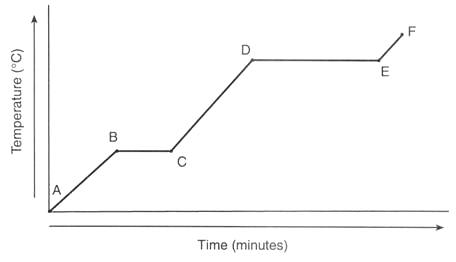

Given the heating curve of a solid being heated at a constant rate, what is the boiling point of this substance?
20°C
50°C
110°C
170°C

Given the heating curve of water, what is happening to potential and kinetic energy during segment CD?
the potential energy and kinetic energy both increase
the potential energy increases while the kinetic energy decreases
the potential energy is constant while the kinetic energy increases
the potential energy increases while the kinetic energy is constant

At approximately what temperature does the solubility of sodium chloride, NaCl, match the solubility of potassium dichromate, K2Cr2O7?
60 ºC
30 ºC
50 ºC
83 ºC

25 grams of NaCl are dissolved in 100 mL of water at 60 C. How many more grams need to be dissolved for the solution to be saturated?
13 grams
25 grams
6 grams
38 grams
How many grams of K2Cr2O7, are soluble in 50 g of water at 90ºC?
70 grams
35 grams
140 grams
105 grams


If we continuously heat a liquid, what happens to the temperature of when it starts to boil (during a phase change)?
The temperature stays the same
The temperature increases
The temperature decreases

What happens when two forces act in the same direction?
the forces add together
the forces cancel each other out
the stronger force takes over
A student inflates a balloon with helium then places it in the freezer. The student should expect
the balloon's volume to increase
the balloon's volume to decrease
the balloon's moles to increase
the balloon's moles to decrease


Lola wants to measure her average speed when biking around her neighborhood. What information does Lola need to gather?
bike weight and total time traveled
distance traveled and direction
distance traveled and total time traveled
bike weight and direction

Which of the following statements about the car's motion is true?
The total time for the car trip was 50 minutes.
The car returned to where it had started the trip at the end of the trip.
The car did not slow down during the trip.
The car did not travel at a constant speed during the entire trip.
What is acceleration?
an increase in speed
a decrease in speed
a change in direction
all of these are examples

Describe the object's motion from A to B (TWO Answers):
Speeding Up
Slowing Down
Constant Speed
Not Moving
Describe the object's motion from B to C:
Speeding Up
Slowing Down
Constant Speed
Not Moving
Describe the object's motion from C to D:
Speeding Up
Slowing Down
Constant Speed
Not Moving
Describe the object's motion from D to E:
Speeding Up
Slowing Down
Constant Speed
Not Moving
Describe the object's motion from E to F (TWO Answers):
Speeding Up
Slowing Down
Constant Speed
Not Moving


How do these waves compare?
wave 2 has a higher frequency than wave 4
all have the same frequency
all have the same wavelength
wave 3 has a longer wavelength than wave 4
What type of waves are usually found in space?
Mechanical
Electromagnetic
happens when a wave bounces back after hitting a barrier
reflection
refraction
diffraction
interference
a reflected sound wave
refraction
diffraction
echo
resonance
the bending of a wave as the wave passes from one medium to another at an angle
refraction
transmitted
reflection
echo

If I moved the waves closer together, what would happen to the frequency?
decrease
increase
no effect
applesauce
When frequency increases, happens to wavelength?
decreases
increases
no effect

According to the data table, which material has the greatest density?
Material A
Material B
Material C
Material D

As you look from left to right (radio waves to gamma waves), what happens to wavelength?
Wavelength decreases
Wavelength increases
Wavelength is not affected
Which of the following wave types have a shorter wavelength/higher energy than our visible light?
gamma rays
microwaves
infrared waves
x-rays

This octopus' skin _______ the wavelength of blue light, and ________ all others.
reflects; absorbs
reflects; transmits
transmits; absorbs
transmits; reflects

Which diagram shows the lowest wavelength?
A
B
C
D

If these were sound waves, which diagram shows the loudest sound?
A
B
C
D

Which diagram represents a sound wave with the lowest pitch?
A
B
C
D

