
 Worksheets
Question Bank for Grade 8 Science
Total questions: 173
Worksheet time: 5hrs 14mins
How many protons are present in Hafnium (Hf) with a mass number of 178?
72 protons, 178 neutrons, 106 electrons
72 protons, 106 neutrons, 72 electrons
178 protons, 250 neutrons, 72 electrons
106 protons, 72 neutrons, 196 electrons

An atom of an element has 36 protons, 36 electrons, and a mass number of 84? How many neutrons?
36
72
48
8
What types of particles are found in the cloud surrounding the atom's nucleus?
positively and negatively charged particles
negatively charged particles only
neutral and positively charged particles
positively charged particles only

What is the mass number of a potassium (K) atom that has 20 neutrons?
18
19
20
39
Which of the following is the best description of an electron?
No charge and the same mass as a proton
negative charge and much less mass than a proton
positive charge and much more mass than a neutron
negative charge and the same mass of a neutron

An atom has 25 protons, 30 neutrons, and 25 electrons. What is the charge of the nucleus?
+55
-25
+25
-30

Tin (Sn) is a soft, white metal. Which statement accurately describes an atom of tin?
tin atoms have five valence electrons
tin atoms have 68 electrons
tin atoms have 50 protons
tin atoms have 119 neutrons

Atoms of a certain element have 11 protons and 1 valence electron. Which statement is correct?
the element is sodium and it is not reactive
the element is fluorine and it is highly reactive
the element is fluorine and it is not reactive
the element is sodium and it is highly reactive
What characteristic of an atom always determines it's identity?
number of neutrons
number of protons
number of valence electrons
location of valence electrons

Which characteristic of calcium is most closely related to its chemical reactivity?
20 protons in each calcium atom
calcium's density is 1.54 g.cm3
2 valence electrons in each atom of calcium
one calcium atom has an atomic mass of 40.078 amu

Which two elements are in the same period?
F and Cl
Sn and Rb
K and Ba
Se and Te

Which element is similar to phosphorus but has a greater atomic mass?
nitrogen (N)
sulfur (S)
arsenic (As)
silicon (Si)
Which is the organic compound?
silane, SiH4
urea, CH4N2O
ammonium sulfide, (NH4)2S
sodium chloride, NaCl
Which process is the best example of a physical change in the digestive system?
saliva converting starch molecules into simple sugar
digestive enzymes breaking down proteins into smaller parts
intestinal bacteria converting lactose into simple sugars
teeth grinding an almond into smaller pieces in the mouth
6 CO2 + 6 H2O → C6H12O6 + 6 O2
How many oxygen atoms in total are present in the reaction?
10
21
12
18
6 CO2 + 6 H2O → C6H12O6 + 6 O2
How many carbon atoms in total are present in the reaction?
6
18
12
10

Which liquid is the least dense?
Oil
Water
Syrup
Plastic bottle

an imaginary line that an object spins or revolves around
equator
hemisphere
axis
latitude
the orbiting of an object around another object
Solstice
Revolution
Rotation
Equinox
When the Northern Hemisphere is tilted toward the sun it is the
Summer Solstice
Vernal Equinox
Winter Solstice
Autumnal Equinox
When the Northern Hemisphere is tilted away from the sun it is the
Summer Solstice
Vernal Equinox
Winter Solstice
Autumnal Equinox

The moon phase cycle repeats about every
365 days
20 days
29 days
15 days
When the moon is lined up exactly between the sun and Earth, it is called a ______ ______.
The luminosity of a star describes its ______________.
brightness
temperature
age
color
As the _________ of a star increases, luminosity increases.
size
distance
age
composition


If the amount of food or resources available increases, the carrying capacity for an animal.....
Stays the same
Increases
Decreases
Fluctuates

Which side is steeper?
The left side of the hill
The right side of the hill

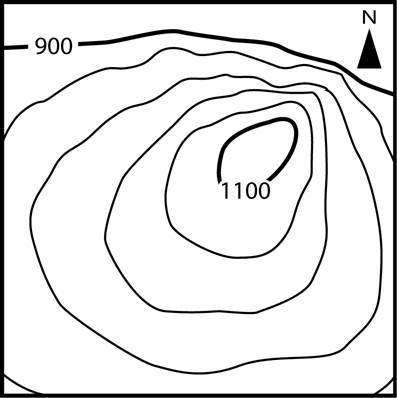
The steepest slope on this hill can be found on the side that is facing which direction?

Which two areas on the map are steepest?
A and C
C and D
A and B
B and D

Which area of this topographic map indicates a mountain peak?
A
B
C

What is the most likely profile of this topographic map?


What causes day & night?
Earth's rotation on the equator
Earth's revolution around the Sun
The Moon's rotation around the Sun
Earth's rotation on its axis

Y = day
Y = night


In the summer, many people enjoy going to the beach. The photograph shows a beach in Argentina, which is located in the Southern Hemisphere. Which diagram shows the position of Earth when it is summer in Argentina?


In winter, the axis of the earth is pointed away or toward the sun?
towards
up
down
away


Visible part of the moon is on the right side:
Waxing
Waning
Visible part of the moon is on the left side:
waxing
waning
Visible part of the moon is growing larger:
waxing
waning
Visible part of the moon is shrinking.
waxing
waning

At which position would the people on Earth see a full moon?
1
3
5
7

The model shows Earth in several positions relative to the Sun. In which position is it winter in North America?
Position 1, because North America receives the most direct sun.
Position 2, because North America is tilted toward the Sun.
Position 3, because North America is parallel to the Sun.
Position 4, because North America is tilted away from the Sun.


Look at the diagram of phases of the Moon. What phase does Day 14 represent?
waxing moon
new moon
full moon
waning moon

What moon phase will be observed after the waning crescent?


What will the phase of the moon be in the diagram?
new moon
waning gibbous
first quarter
full moon

What phase of the moon is shown in the picture?
first quarter
new moon
full moon
last quarter

What moon phase is shown in the picture?
first quarter
new moon
last quarter
full moon

Where would the Sun need to be in this diagram to cause these phases of the moon?
At the Bottom
At the Left
At the Top
At The Right


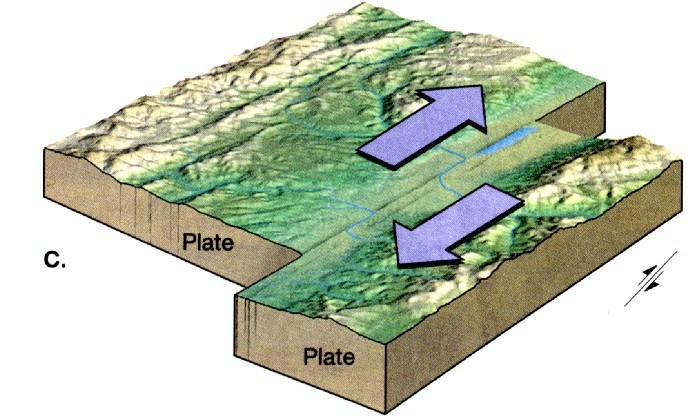
The San Andreas fault is a transform fault. The map below shows a student's approximation of where the fault line crosses through the United States. Students were asked to make maps predicting which way land would most likely move over thousands of years.






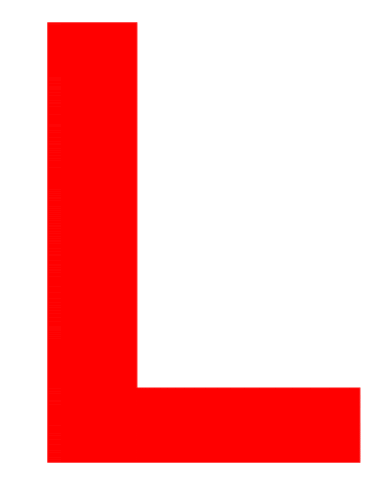

What would the weather be like in a low-pressure system area?
Hot, sunny and windy
Cloudy with precipitation
Partly cloudy with wind
Bright wind and warm air


Area M
Area X
Area P
Area Z

The H-R diagram classifies stars based on what factors?
Temperature and luminosity
Number of planets
What constellation they're in
Temperature and fusion

Our sun is what kind of star?
Blue giant
Red giant
Main sequence
White dwarf
What season is the southern hemisphere experiencing when the northern hemisphere is experiencing summer
Fall
Winter
Spring
Summer
Earth experiences seasons as it revolves around the sun because of its
shape
tilt
speed
mass

New Moon
Crescent
Quarter
Gibbous
Full Moon
Where would the Sun need to be in this diagram to cause these phases of the moon?
At the Bottom
At the Left
At the Top
At The Right

What would the moon look like 15 days after this one?
Full Moon
New Moon
Waning Crescent
Waxing Crescent
About how long does it take for the moon to go from new moon to full moon?
1 day
7 days
14 days
1 month
What phase of the moon is shown in the picture?
first quarter
new moon
full moon
last quarter


the mother moves forward, and the daughter moves backward with a greater acceleration
both move forward, but the mother moves with greater acceleration
the mother moves backward, and the daughter moves forward with a greater acceleration
both move backward, but the daughter moves with a greater acceleration
The diagrams show forces acting on a toy car as it moves to the right. Which diagram shows the toy car that will most likely accelerate to the right based on these conditions?


A large rock is motionless on a flat sidewalk. Which statement best explains why the rock remains motionless?
there are no forces acting on the rock
the only force acting on the rock is directed toward the sidewalk
the forces acting on the rock are all balanced
the sidewalk exerts an unbalanced force on the rock
A pitcher throws a ball toward a player holding a softball bat. The player uses the bat to hit the ball. The bat applies a 10 newton force to the ball. Which statement correctly describes the reaction force between the bat and the ball?
the reaction force is the force that causes the ball to move toward the bat
the reaction force is the force applied to the bat by the player holding the bat
the reaction force is the force that pulls the ball toward the ground
the reaction force is the force of the ball on the bat


moving at a constant speed
accelerating
moving toward the north
stopped

A ball at the top of a hill has ________ ________ because if pushed it will roll down the hill.
Mechanical Force
Unbalanced Energy
Potential Energy
Unbalanced Force
When a student runs and kicks a ball, they have applied an ___________ force to move the ball.
Balanced
Magnetic
Spring
Unbalanced
Standing in line is an example of a ________ ________ since you are not moving forward, backward, or sideways.
negative acceleration
balanced force
unbalanced force
1st law of motion
Which is newtons 3rd law
for every thing there is reaction
for every reaction there is a unusual action
For every reaction there is an equal and opposite reaction
for every reaction there is an good action
Which is newtons 2nd law
Acceleration is a change in speed
Acceleration is a change in action
Acceleration is a change in name
Acceleration is a change in velocity
Newton's third law states that any action will have a(n) _______ and ______ reaction
equal and same
equal and opposite
equal and equal to
What are the appropriate units to describe acceleration?
m/p
m/h
m/s
m/s square
The tendency of objects to resist a change in motion is called:
Friction
Inertia
Gravity
Velocity

Which statement best describes the motion of the object plotted in the graph?
The object accelerated because the distance traveled increased at a steady rate.
The object traveled at a constant speed because of forces acting on the object.
The object accelerated because it traveled in the same direction throughout the investigation.
The object slowed down as it traveled uphill because of the forces acting on the object.

Students make a model using a globe and a flashlight.
Which answer choice best explains the change from daytime to nighttime on Earth?
The sun stops sending light to Earth at night.
Earth moves farther away from the sun at night.
The tilt of Earth causes less light to reach Earth at night.
Earth rotates and causes different parts of Earth to experience night.

The diagram shows Earth in its orbit around the sun when very little light is visible at Earth's South Pole.
Which statement is true when Earth is in the position shown?
It is August in the Northern Hemisphere.
It is April in the Southern Hemisphere.
It is summer in the Northern Hemisphere.
It is winter in the Southern Hemisphere.
The number of hours of daylight is greater in the Southern Hemisphere than in the Northern Hemisphere.
Spring begins earlier in the year in the Southern Hemisphere than it does in the Northern Hemisphere.

A skater pushes off a wall and skates backwards for a few meters before stopping.
Which statement best describes an action-reaction force pair in this situation?
The wall pushes on the skater when the skater pushes on the wall.
The wheels slow down, and the skater stops.
The skater exerts a force on the wall, and the wheels exert a force on the floor and begin to turn.
The friction of the floor decreases when the wheels roll on the floor.

A steel ball is at one end of a box that is moving forward as shown. The box suddenly stops.
According to Newton's first law, what happens to the steel ball just after the box stops?
Because of friction, the ball continues rolling forward at the same speed.
Because of friction, the balls rolls forward at a constant speed.
Because of inertia, the ball continues rolling forward at the same speed.
Because of inertia, the ball rolls forward at an increased speed.
A student pushes a 51.5 kilogram bookshelf across a smooth floor with a net force of 67N. What is the approximate acceleration of the bookshelf?


The diagram shows a duck swimming in a stream in the opposite direction the stream is flowing. The duck pushes against the water, so the water pushes the duck forward with 20 newtons of force. The water also exerts 15 newtons of resistive force against the duck.
Which statement best describes the resulting motion of the duck?
The duck will stop moving.
The duck will stop and then start moving again.
The duck will continue moving in its current direction.
The duck will move in the direction that the stream is flowing.
A toy truck is at rest on the floor. Which statement describes the forces acting on the toy truck?
The forces are balanced so motion occurs.
The forces are balanced so no motion occurs.
The forces are unbalanced so motion occurs.
The forces are unbalanced so no motion occurs.

A student investigates the motion of a toy vehicle. The student graphs 40 seconds of data from the investigation.
Which statement best describes the motion of the toy vehicle during the first 30 seconds of the investigation?
The vehicle was traveling at a constant speed.
The vehicle was accelerating at a constant rate.
The speed of the vehicle was increasing.
The acceleration of the vehicle was increasing.

Students create a table that lists processes observed in nature.
Which process describes only a physical change?
Process 1
Process 2
Process 3
Process 4

The model shows an area near a lake. Community leaders are planning new laws to help protect the lake from pollution. One proposed law will make it illegal to dump trash on the shore of the lake, but the law still allows trash to be placed in the area labeled "Flow-through wetland".
Which statement about the proposed law is supported by the model?
The proposed law will protect the lake because plant roots between the wetland and the lake will stop pollution from entering the lake.
The proposed law will not protect the lake because animals that live in or near the lake will add pollution to the lake.
The proposed law will not protect the lake because groundwater will carry pollution from the wetland directly into the lake.
The proposed law will protect the lake because the high elevation of the water table will block pollution from entering the lake.
Which statements correctly compare metals and nonmetals?
Metals tend to be good conductors of thermal energy.
Nonmetals tend to be good insulators of thermal energy.
Metals are dull and brittle.
Nonmetals are shiny and malleable.
Metals are good insulators of electricity.
Nonmetals tend to be good conductors of electricity.
Metals cannot be stretched into thin wires.
Nonmetals can be stretched into thin wires.

An image of the Earth-moon-sun system is shown.
The moon remains in orbit around Earth because of the force of --
Earth's rotation
the moon's rotation
Earth's gravity
the sun's gravity

A student model convection currents in a laboratory activity.
How are the convection currents in the student's model different from the convection currents in Earth's atmosphere and oceans?
The warm air in Earth's atmosphere and the warm water in Earth's oceans sink instead of rise.
The heat source for Earth's atmosphere and oceans is the sun, which heats from above instead of below.
Convection cells in Earth's atmosphere and oceans flow in the same direction instead of opposite directions.
Cold air in Earth's atmosphere and cold water in Earth's oceans are less dense than warm air and warm water instead of being more dense.

The graph shows the distance an object traveled in 11 seconds.
Which answer choice best describes the movement of the object between the times of 0 and 6 seconds on the graph?
Moving at a constant speed
Accelerating
Moving toward the north
Stopped

The diagram shows a model of an atom. The model has four different symbols on it. Each symbol represents a different role for one of the particles within the atom.
In this model, which particle determines the reactivity of this atom?
Particle W
Particle X
Particle Y
Particle Z
Barium sulfate, BaSO4 , is a white crystalline solid that is insoluble in water. It is used by doctors to diagnose problems with the digestive system. Barium hydroxide, Ba(OH)2 , is also a white crystalline solid and is used in wastewater treatment.
How many more oxygen atoms are represented in the formula for barium sulfate than in the formula for barium hydroxide?
(a)
A student viewed the moon through binoculars one week after a new moon. Which image shows the phase of the moon that the student observed?


The spectral classes of four stars are shown in comparison with a Hertzsprung-Russell diagram.
Based on the information, which star is most like the sun?
Star 1
Star 2
Star 3
Star 4
A student learns that the sun is classified as a medium-size star and that many stars are much bigger and brighter. However, the student observes that other stars look very dim, even through a telescope.
Why do other stars look much dimmer than the sun?
The sun appears yellow, which is more visible than other colors.
The sun is much closer to Earth than other stars are.
Other stars are made up of different gases than the sun is.
As light from other stars travels through space, it gets reflected.

The Himalayan mountains are shown on the map.
Four students were asked to identify the geological process that caused this mountain range to form.
Student 1 - Two continental plates converging
Student 2 - An earthquake in a subduction zone
Student 3 - A tectonic plate moving over a hot spot
Student 4 - Movement at a transform fault boundary

The weather map shows air pressures in millibars.
Which set of conditions best describes the weather at the area of lowest air pressure?
Bright sun with no wind
Partly cloudy with no wind
Mostly sunny with light winds
Overcast skies with strong winds

