
 Worksheets
Review 1 Grade 5 Science
Total questions: 142
Worksheet time: 3hrs 17mins
Process of binding and hardening of sediments into hard rock
Cementation
Compaction
Decomposition
Deposition
Process by which overlying pressure from rocks and soil reduces the size or volume of sediments
Compaction
Decomposition
Deposition
Erosion
The process by which dead plants and animals decay or rot
Decomposition
Deposition
Erosion
Evidence
Process by which weathered and eroded material is deposited by wind, water, and ice
Deposition
Erosion
Evidence
Fossil fuels
The movement of weathered material by wind, water, or ice (e.g. glaciers)
Erosion
Deposition
Cementation
Compaction
Facts or other information supporting a claim or proposition
Evidence
Model
Process of formation
Fossil fuels
Fuels formed over millions of years from the remains of ancient plants and animals; examples include coal, petroleum (oil) and natural gas
Fossil fuels
Organism
Decomposition
Deposition
A physical structure on Earth that occurs naturally
Landform
Model
Organism
Process of formation
a picture, idea, or object that represents an object, a system, or process and is used to help with understanding; models have advantages and limitations
Model
Organism
Process of formation
Weathering
A living thing that grows, reproduces, responds to its environment, and can function on its own
Organism
Fossil fuels
Process of formation
Weathering
The method by which a substance or object is formed
Process of formation
Weathering
Weathering
Deposition
The Moon is a planet.
True
False
The Earth, Sun, and Moon have gravity.
True
False
Out of the Earth, Sun, and Moon, the Earth has the most gravity of the three.
True
False
Out of the Earth, Sun, and Moon, the Sun has the most gravity of the three.
True
False
The Earth and Moon are both made of rock.
True
False
The Sun is made of gas.
True
False
The Sun and Moon are not planets.
True
False
The Sun is a natural satellite of the Earth.
True
False
The Earth is the only planet that can support life.
True
False
The Moon is a natural satellite of the Earth.
True
False
The Earth orbits the Sun.
True
False
The Sun is a star.
True
False
The Moon revolves around the Earth.
True
False
The Earth makes one full rotation on its axis every 24 hours.
True
False
The Earth has a very thin atmosphere.
True
False
The Moon has a very thin atmosphere.
True
False
The Sun and Moon are both made of gas.
True
False
Jupiter is the smallest planet.
True
False
Mercury, Venus, Earth, and Saturn are all inner planets.
True
False
Jupiter, Saturn, Uranus, and Neptune are made of gas.
True
False
In order for electricity to flow through a circuit, the circuit must be a closed, complete:
Path, so that the electricity can make a complete circle.
Donut, because circuits get hungry.
Wire, made out of rubber.
Solar panel, because circuits only work with the sun.

The circuit on the left is not complete (the light is off) because:
the switch is closed
the switch is open
the battery is missing
the battery is in backwards
The circuit on the right is complete (the light is on) because:
the switch is closed
the switch is open
the battery is hot
the battery is red

How many light bulbs would be ON with this complete circuit?
1
3
2
4

How many light bulbs would be ON if the wire of this circuit was cut where the scissors are?
1
3
2
0

How many light bulbs would be ON if the wire of this circuit was cut where the scissors are?
1
3
2
0

Circuit "A" is broken, because:
the switch is open
the switch is closed
the switch is black
the switch is not there
Circuit "B" is working (it flows), because:
the switch is open
the switch is closed
the switch is black
the switch is not there
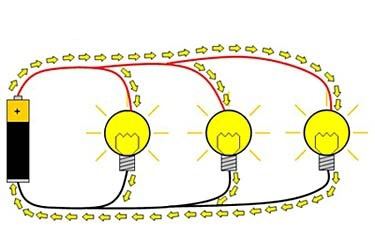
What type of circuit is shown in the picture?
Series Circuit
Broken Circuit
Parallel Circuit
Open Circuit

What is missing from this circuit? Why would the light bulbs be off?
The battery, there is no power for the circuit to work.
The switch is open, so the circuit is broken.
The third light bulb, that is needed to complete the circuit.
The wires are not connected properly.

This steel paperclip would allow electricity to flow through it because:
it is a conductor
it is an insulator
it is friendly
it breaks the circuit

This rubber ducky would block the flow of electricity, because:
it is a conductor
it is an insulator
it is yellow
it completes the circuit

True or False: A wooden block would allow electricity to flow through it because wood is a great conductor of electricity.
True
False

True or False: A steel nail would allow electricity to flow through it because steel is a great conductor of electricity.
True
False
Which one of these is a good conductor of electricity?
Paper Tube
Wax String
Metal Wire
Hot Tacos
Energy waves bouncing off the surface of an object and returns energy back to the source.
Reflection
Refraction
Lens
The bending or redirection of energy waves as they pass from one substance to another.
Reflection
Refraction
Lens
A clear piece of curved glass or plastic that bends passing light to focus or spread the light rays.
Reflection
Refraction
Lens

Figure 1 demonstrates light travels in
zig zags
circles
a straight line
random bursts
Figure 2 demonstrates
Refraction
Reflection
Light travels in a straight line
Rewind
Figure 3 demonstrates
Refraction
Reflection
Light travels in a straight line
Rewind
Lenses in glasses, binoculars, telescopes, etc will cause
Rewind
Reflection
Refraction
Reverse
Smooth shiny objects will cause
Rewind
Reflection
Refraction
Reverse
Refractions will cause the object to look
the same
smaller & straight
larger & bent
a different color
Light is a type of energy that can be sensed with the
ears
eyes
nose
none of these
Fossil Fuels are
pieces of rock that have been compacted many times
rock that contains 50% plant and animal remains
metamorphic rock
fuels that form from the remains of plant and other organisms that were buried and altered over million of years
Fossil Fuels (choose ALL that apply)
considered nonrenewable resources
cause pollution in the atmosphere
are renewable resources
oil, coal and natural gas
This fossil fuel is formed from the remains of small organisms that lived in the ocean AND is a thick, black liquid
natural gas
coal
oil
steam
The ADVANTAGES of Fossil Fuels include: (Choose ALL that apply)
low cost
produce a lot of energy
cause air pollution
high cost
Coal is formed from
rocks
a factory
remains of small organisms that lived many millions of years ago in our oceans
plant remains along with heat and pressure
The flame on your stove is an example of
coal
petroleum
natural gas
oil
The four factors that contribute to the formation of fossil fuels are
energy, sunlight, food and water
natural gas, oil, and coal
organic matter, high temperatures, time and pressure
plastic, medicine, cosmetics and jewelry
What conditions are needed to form coal?
Heat and pressure
Heat
Moisture and pressure
Cool and moist
Which event began the formation of oil?
the mixing of sea water with minerals
the buildup of sea shells
the eruption of a volcano
the death of anciet marine (ocean) animals


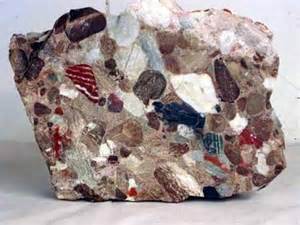
The process of layers become stuck together like glue forming sedimentary rocks
sticking
pressuring
cementation
deposition

What are the three fossil fuels?
solar, oil
coal and oil
coal, oil, natural gas

Which of the following is NOT a fossil fuel.
coal
carbon dioxide
petroleum oil
natural gas

Heat and _____________ transformed living things into fossil fuels.
pressure
air
gas
water

Fossil fuels are a _______________________.
renewable resource
unknown resource
nonrenewable resource
new resource
What is the other name for coal?
lignite
propane
natural gas
petroleum
What is the other name for oil
propane
natural gas
petroleum
lignite
What is the other name for natural gas?
petroleum
oil
propane
lignite
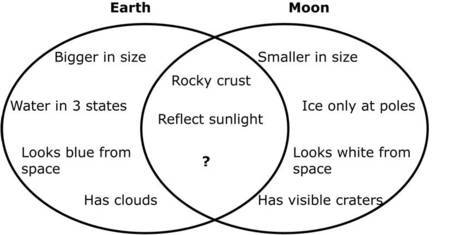
Which of the following characteristics could be placed in the center part of the diagram?

The Sun, Earth, and the Moon share the same similarities in their
Shape (Sphere)
Color
Size

Which of the listed characteristics describe both Earth and the moon?


The model shows all of the following EXCEPT –
Which of the characteristics best describes both the Earth and Moon?
Experiences high and low tides
Has 100% oxygen in the atmosphere
Has severe storms
Has craters
What characteristic do the Earth and Moon share that makes them different from the Sun?
Spherical shape
Rotate on an axis
Rocky crust and surface
Found in our Solar System
Among the Earth, Sun, and Moon, what makes the Earth unique? Only the Earth –
can generate energy
lacks an atmosphere
is made mostly of rock
contains water in liquid form
The moon is visible from the night sky because it-
is close to the Earth.
reflects light from the Sun.
has many surface craters.
is smaller than the Earth.
An astronaut weighs less on the moon than he does on Earth. What is the cause of this change?
The gravity of the moon is the same as on Earth.
The gravity of the moon is less than on Earth.
The gravity of the moon is stronger than on the Earth.
The gravity of the moon changes the mass of the astronaut.
A rock is taken from the surface of the moon and brought to Earth. What is different about this rock on Earth?
Its mass
Its Shape
Its length
Its weight
Which of the following can be found on both Earth and the moon?
Hills
Thick atmosphere
Thunderstorms
Oceans
How does an animal's structures help it survive in its environment?
helps it hide from predators
helps it catch and eat food
helps it locate prey
All of these are correct.

Maple trees and Pine trees grow in different environments. The structures of the leaves on these trees help them survive in their environments. What is the main difference between the maple tree leaf and the pine tree leaf?
The maple leaf is better at conserving water than the pine tree leaf.
The pine tree leaf is better at conserving eater than the maple tree leaf.
The maple tree leaf does not go through photosynthesis.
The pine leaf does not not make its own food.


A cactus can live in the desert because of this adaptation:
wide flat leaves to catch water
shallow roots to soak up the sunlight
thick, waxy leaves to store water
tendrils to reach sunlight

A Bittern bird and the Key deer both live in Florida. The bird blends with its environment in the tall sawgrass and stands still when it feels threatened. It then points its head into the air to imitate the sawgrass. The Key deer lives in the forest. It is brown and stands still when it senses danger. What adaptations are similar between these two animals?
They both blend in with their environment and they don't move.
They both huddle together in other groups of animals to blend in.
They both use their small size to hide from predators.
They both use their speed to escape predators.
Which of the following characteristics are most likely found on animals that live in a cold tundra?
sharp teeth
webbed feet
smooth, moist skin
a thick coat of fur
Which adaptation would best help an animal survive the heat of a hot desert climate?
a long, sticky tongue to catch insects
green scales to help it blend in with the environment
sharp teeth for catching prey
sleeping during the day and hunting at night


Which of the following would occur first as a result of a drought?

