
Font size
 Worksheets
Q4 Week 6 - Chemistry Review
Total questions: 62
Worksheet time: 2hrs 33mins
Choose all the items that are elements.
NaCl (table salt)
Sulfur
O2
Water
Air
Choose all of the items that are compounds.
NaCl (table salt)
Sulfur
O2
H2O
Air
Choose all of the items that are mixtures
NaCl (table salt)
Sulfur
O2
tap water
Air
Which element is similar to Li?
Be
K
Which element is similar to Mg?
Ca
B
Which element is similar to B?
C
Al
Which element is the least reactive?
Li
Ne
B
C
Students in Mrs. Clark's science class are investigating a substance that has the following properties
-shiny
-bends easily
-hard, not easily broken
Based on these properties how would you classify the substance?
metal
nonmetal
metalloid
Rows in the periodic table are called (a)
Columns in the periodic table are called (b)
Elements in the periodic table are sorted by:
Increasing atomic number
Increasing atomic mass
Alphabetical order
Increasing number of valence electrons
Isotopes are atoms of the same element with a different number of:
Protons
Electrons
Valence electrons
Nucleus
Neutrons
Physical or chemical?
Physical
Chemical

Physical or chemical?
Physical
Chemical

Physical or chemical?
Physical
Chemical
Which of these is an element?
Salt (NaCl)
Water (H20)
Oxygen (O)
Carbon Dioxide (CO2)
Which of these is a compound?
Aluminium (Al)
Carbon Dioxide (CO2)
Nitrogen (N)
Sand
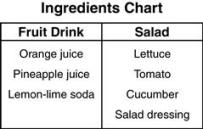
Using the information in the chart, which statement is the BEST description of the drink and salad?
Which of the following is classified as a pure substance?
Lemonade
Fruit punch
ketchup
Helium
Which one of these is considered a SOLUTE?
Salt
Water
Salt Water
From the diagram in the previous slide which is solvent?
Salt
Water
Salt Water
Which one of these is considered a SOLUTE?
Salt
Water
Salt Water
From the diagram in the previous slide which is solvent?
Salt
Water
Salt Water
From the diagram in the previous slide which is solution?
Salt
Water
Salt Water
Which solution fits these properties?
1.Has a lot of solute in it
2.Can dissolve a little more solute
(use lowercase letters only)
(a)
Which solution fits these properties?
1.Has a lot of solute in it
2.Can dissolve a little more solute
(use lowercase letters only)
(a)
Define the term insoluble.
Can dissolve in water.
Cannot dissolve in water.
Partially dissolves in water.

Which factor affecting solubility is shown in the picture?
temperature
height
stirring
particle size

Which factor is shown in the picture?
temperature
particle size
stirring
use of spoon
Why do sugar particles dissolve faster in hot water?
water particles move slow
water particles move fast
water particles settle down
water particles stay on top
How does particle size affect solubility?
bigger particles dissolve faster
smaller particles can occupy the space in water faster
bigger particles spread faster than smaller particles
What are the factors that affect solubility?
rate of stirring
particle size
temperature
all of these
Which of the following does not affect solubility of solutes?
Tempearture
Color
Size particles
Kind of solute


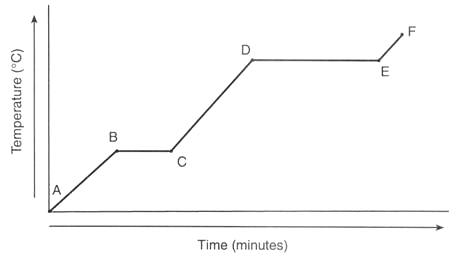
What state/phase is the object likely from points A to B?
Solid
Liquid
Gas
Plasma

Is the substance gaining or losing energy?
Gaining
Losing

Use the graph below to answer this question. Which phase change is taking place if the substance is losing energy from point C to point B?
melting
freezing
evaporation
condensation

How can you determine the melting or freezing point of a substance when looking a phase change graph?
The graph flattens out at the melting/freezing point
The graph slants upwards at the melting/freezing point
The graph slants downwards at the melting/freezing point

Which solute is the most soluble at 10 ⁰C?
KI
NH3
KClO3
NH4Cl

How many grams of SO2 can dissolve at 50 ⁰C?
5 g
10 g
20 g
39 g
The (a) contains all of the protons and neutrons.
A neutrons charge is (a) .
The mass of an electron is (a)
The mass of a proton is (a)
The mass of a neutrons is (a)

What does the Bohr Model represent?
The structure of molecules
The structure of the Solar System
The structure of an atom
The structure of East Hills
What is a valence electron?
Electrons in the first energy shell
Electrons in the second energy shell
Electrons in the outer shell
Total number of electrons
Match the terms to each definition.
Abbreviation of element name
Chemical Symbol
Sum of protons and neutrons
Mass Number
Atom identity equal to number of protons
Atomic Number
Equal to the atomic number
Proton
Added to protons to get mass number
Neutron
What is the atomic number of Fe?
62
56
65
26

