Wayground logo

Free Printable Worksheets

Font size

S
M
L
XL
Worksheets

Chemistry Final Review

Total questions: 80

Worksheet time: 3hrs 56mins

Name
Class
Date
1.

BaF2

a)

Barium (II) Fluoride

b)

Barium Fluorine

c)

Barium Fluoride

d)

Barium difluoride

2.
Ca+2P-3
a)
PCa
b)
P2Ca3
c)
CaP
d)
Ca3P2
3.
The correct chemical formula for magnesium phosphide is
a)
MgP
b)
Mg₂P₃
c)
Mg₃P₂
d)
Mg₃(PO₄)₂
4.
The name of FeCl₂ is
a)
iron chloride
b)
iron (II) chloride
c)
iron (I) chloride
d)
iron dichloride
5.
What is the correct formula for aluminum phosphide?
a)
Al₃P₃
b)
AlP
c)
AlPO₄
d)
AlPO₃
6.
What is the formula for manganese(III) oxide?
a)
MgO
b)
Mg2O3
c)
MnO
d)
Mn2O3
7.
Name the following ionic compound: Cr(NO2)3
a)
chromium nitrite
b)
chromium nitride
c)
chromium III nitride
d)
chromium III nitrite
8.

Ions are formed when atoms...

a)

lose or gain electrons

b)

lose electrons

c)

gain electrons

d)

gain neutrons

9.

Ions are formed because atoms want to obtain the stable arrangement of a noble gas.

a)

True

b)

False

10.

In general, metal atoms lose electrons forming _____ ions, non-metal atoms gain electrons forming _____ ions.

a)

negative, positive

b)

negative, negative

c)

positive, negative

d)

positive, positive

11.

Many ionic compounds are soluble in water.

a)

True

b)

False

12.
Elements combine to form __________.
a)
compounds
b)
atoms
c)
positive ions
d)
negative ions
13.
What part of an atom is involved in chemical bonding?
a)
protons
b)
neutrons
c)
electrons
d)
nucleus
14.
How many valence electrons does nitrogen have?
a)
3
b)

2

c)
5
d)
1
15.
Compounds made from only nonmetals are _________________ compounds.
a)
ionic
b)
covalent
c)
metallic
d)
chemical
16.
A covalent bond involves a __________ of electrons.
a)
sharing
b)
borrowing
c)
exchanging
d)
switching
17.
A __________ is a number written to the right of a chemical symbol and slightly below it.
a)
subscript
b)
coefficient
c)
chemical formula
d)
compound
18.
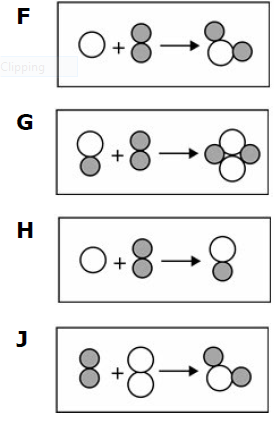
Which of the following models best demonstrates a balanced chemical equation?
a)
F
b)
G
c)
H
d)
J
19.

How many atoms in all are in a molecule of serotonin?

C10H12N2O

a)
22
b)
24
c)
25
d)
4
20.

Which type of chemical reaction has two or more reactants to make one product?

a)

combustion

b)

single displacement

c)

double displacement

d)

synthesis

e)

decomposition

21.

Identify the following chemical reaction.

2 NaBr + 1 Ca(OH)2 ----> 1 CaBr2 + 2 NaOH

a)

Synthesis (or combination)

b)

Decomposition

c)

Single displacement

d)

Double displacement

22.

Identify the following chemical reaction.

3 HBr + 1 Al(OH)3 ----> 3 H­2O + 1 AlBr3

a)

Synthesis (or combination)

b)

Decomposition

c)

Single displacement

d)

Double displacement

23.

Identify the following chemical reaction.

Pb + FeSO4 ----> PbSO4 + Fe

a)

Synthesis (or combination)

b)

Decomposition

c)

Single displacement

d)

Double displacement

24.

What reaction has the following general formula:

A + B --> AB

a)

Synthesis

b)

Decomposition

c)

Single Replacement

d)

Double Replacement

e)

Combustion

25.

Which chemical reaction always starts with a hydrocarbon that reacts with oxygen and produces carbon dioxide and water?

a)

Decomposition

b)

Synthesis

c)

Combustion

d)

Single Replacement

26.
In a chemical reaction, everything to the right of the arrow is called ______________.
a)
Products
b)
Yields
c)
Molecules
d)
Reactants
27.
Coal contains carbon and other elements. Carbon dioxide forms when coal burns in the presence of oxygen. Which of these is the best evidence that a chemical reaction occurs when coal burns?
a)
The shape of the coal changes
b)
Oxygen is present
c)
A new substance is produced
d)
Coal is made up of more than one element
28.

Which of the following is an element?

a)

potassium chloride (KCl)

b)

water (H2O)

c)

carbon (C)

d)

calcium carbonate (CaCO3)

29.

Which of the following is a compound?

a)

zinc (Zn)

b)

magnesium (Mg)

c)

sodium chloride (NaCl)

d)

potassium (K)

30.

MgCl2 represents a chemical

a)

Element

b)

Chemical Formula

c)

Subscript

d)

Coefficient

31.
In chemical reactions, what does the principle of conservation of mass mean?
a)
Matter is not created or destroyed.
b)
The total mass of the reactants is greater than the total mass of the products.
c)
The total mass of the reactants is less than the total mass of the products.
d)
Matter is not changed.
32.

How many atoms of Hydrogen are in the following formula?

3C2H6

a)

3

b)

6

c)

9

d)

18

33.

What are the coefficients that will balance the skeleton equation below?

__Na + __F₂ → __NaF

a)

1, 2, 1

b)

2, 1, 2

c)

1,1,1

d)

2,2,2

34.

What are the coefficients that will balance the skeleton equation below?

__Na + __MgF₂ → __NaF + __Mg

a)

2,1,1,2

b)

1,2,1,2,

c)

2, 1, 2, 1

d)

1,2,2,1

35.

What are the coefficients that will balance the skeleton equation below?

__Sn + __HF → __SnF₂ + __H₂

a)

2,1,1,2

b)

1, 2, 1, 1

c)

2,1,2,1

d)

1,2,1,2

36.

What are the coefficients that will balance the skeleton equation below?

__Fe +__O₂ → __Fe₂O₃

a)

3,4,2

b)

4, 3, 2

c)

2,3,4

d)

4,2,3

37.

What are the coefficients that will balance the skeleton equation below?

__CS₂ + __O₂ → __CO₂ + __SO₂

a)

3,1,2,1

b)

3,1,1,2

c)

2,1,1,3

d)

1, 3, 1, 2

38.

What are the coefficients that will balance the skeleton equation below?

__MgS + __O₂ → __MgO + __SO₂

a)

3,2,2,3

b)

2,3,2,2

c)

2,3,2,3

d)

3,2,2,1

39.

What are the coefficients that will balance the skeleton equation below?

__CH₄ + __O₂ → __CO₂ + __H₂O

a)

2,1,2,1

b)

2,1,1,2

c)

1,2,1,2

d)

1,2,2,1

40.
What precipitate forms when you mix lead (II) nitrate with sodium chloride?
a)
sodium nitrate 
b)
lead (II) chloride 
c)
sodium lead
d)
chloride nitrate 
41.
Which is the correct net ionic equation for the reaction of AgNO3 and CaCl2?
a)
Ca2+(aq) +  2Cl- (aq) → CaCl(s)
b)
Ag+(aq)  +  Cl- (aq) → AgCl(s)
c)
Ag +  Cl  →  AgCl
d)
Ag+  +  Ca2+   →Ag2Ca (s)
42.
Which of the following does NOT form a precipitate?
a)
Pb(NO3)2(aq) + 2KI(aq) →
b)
Sr(NO3)2 (aq) + K2SO4(aq) →
c)
AgNO3(aq) + Na2S(aq) →
d)
 Pb(NO3)2(aq) + AgNO3(aq) →
43.
What are the spectator ions in the reaction of sodium chloride with silver nitrate?
a)
silver and nitrate
b)
sodium and chloride
c)
sodium and nitrate
d)
silver and chloride
44.
In this equation,
CuCl2 + NaOH  → Cu(OH)2 + NaCl
Which product is insoluble?
a)
copper(II) hydroxide
b)
sodium chloride
c)
sodium hydroxide
d)
copper(II) chloride
45.
Which of these results in the formation of a precipitate?
a)
AgNO3(aq)  +  NaOH(aq)→
b)
BaNO3(aq)  +  CaCl2(aq)→
c)
NaNO3(aq)  +  KOH(aq)→
d)
More than one of these form precipitates
46.
Which of these results in formation of a precipitate?
a)
BaNO3(aq)  +  NaCl(aq)→
b)
KNO3(aq)  +  LiOH(aq)→
c)
Zn(NO3)2(aq)  +  NaOH(aq)→
d)
NaNO3(aq)  +  Ba(OH)2(aq)→
47.
What are the spectator ions in this reaction?
CuCl2(aq) + NaOH(aq) → Cu(OH)2(s) + NaCl(aq)
 
a)
Cu2+ and OH1-
b)
Na2+ and Cl2-
c)
Na1+ and Cl1-
d)
Na1+ and OH1-
48.
What is the mass in grams of 5.90 mol C8H18?
a)
.0512 g
b)
19.4 g
c)
673 g
d)
389 g
49.
How many moles are in 19.82 g Mg? 
a)
1.226mol Mg
b)
481.7mol Mg
c)
1.000mol Mg
d)
 0.8156 mol Mg
50.

Determine the molar mass for carbon tetrachoride (CCl4)

a)

153.823 g/mol

b)

118.37 g/mol

c)

189.35 g/mol

d)

47.464 g/mol

51.

What is the molar mass of Al2S3?

a)

150.17 g/mol

b)

59.05 g/mol

c)

138.23 g/mol

d)

75.27 g/mol

52.

Find the mass of 11.37 mol of BaO. Round to the nearest whole number.

a)

1,354 g

b)

1,740 g

c)

17.40 g

d)

1,684 g

53.

Determine the amount of moles in CuBr that are in 276.9 g of the compound.

a)

3.2 mol

b)

1.7 mol

c)

2.1 mol

d)

1.9 mol

54.

Determine the number of moles of Mg3P2 that are in 583 g of the compound.

a)

2.9 mol

b)

6.1 mol

c)

4.3 mol

d)

1.7 mol

55.
N2 +  3H2 → 2NH3 
How many moles of hydrogen are needed to react with 2 moles of nitrogen?
a)
6
b)
2
c)
3
d)
1
56.
For the Balanced Reaction: 3 Mg + 1 Fe2O3 → 3 MgO + 2 Fe; What is the Ratio of moles of MgO to moles Fe?
a)
3mol Mg / 2 mol Fe
b)
2 mol Mg/ 3 mol Fe
c)
1 mol Fe/ 2 mol Fe
d)
3 mol MgO / 2 mol Fe
57.
Cl2 + 2KBr → Br2 + 2KCl
How many grams of potassium chloride (KCl) can be produced from 356 g of potassium bromide (KBr)?
a)
749 g
b)
223 g
c)
479 g
d)
814 g
58.
CH4 + 2 O2 → CO2 + 2 H2O
How many moles of carbon dioxide are produced from the combustion of 110 g of CH4?
a)
13.7 mol
b)
2.75 mol
c)
6.11 mol
d)
6.85 mol
59.
B2H6 + 3O2 -->2 HBO2 + 2 H2O
 What mass of O2 will be needed to burn 36.1 g of B2H6?
a)
13.8 g O2
b)
3.86 mol of O2
c)
125.2 g O2
60.

A student measures the pressure and volume of an empty water bottle to be 1.4 atm and 2.3 L. She then decreases the pressure to 0.65 atm. What is the new volume?

a)

2.1 L

b)

5.0 L

c)

8.2 L

d)

3.9 L

61.

A student inflates a balloon with helium then places it in the freezer. The student should expect

a)

the balloon's volume to increase

b)

the balloon's volume to decrease

c)

the balloon's moles to increase

d)

the balloon's moles to decrease

62.

Three gases are mixed together in a container with a total pressure of 4.8 atm. If two of the gases have pressures of 1.2 atm and 1.5 atm, what is the pressure of the third gas?

a)

2.5 atm

b)

1.8 atm

c)

2.1 atm

d)

1.3 atm

63.

If a hairspray can is heated, what can be expected of the pressure of the gas inside the can?

a)

The pressure will increase

b)

The pressure will decrease

c)

The pressure will remain constant

d)

The pressure will equalize

64.
Which of the following would increase the (gas) pressure of a system?
a)
Increase the Temperature
b)
Pump in more gas
c)
Decrease the volume
d)
All of these
65.
In order to convert to Kelvin, you add ______ to the Celsius measurement.
a)
372
b)
273
c)
237
d)
732
66.
What about gases can be measured?
a)
Pressure and Volume
b)
Temperature, Volume, and Pressure
c)
Volume and Temperature
d)
Pressure, Temperature, Volume, and Moles
67.
What is 50 °C in Kelvin?
a)
223
b)
323
c)
100
d)
50
68.
Charles' Law States...
a)
As Pressure goes up volume goes down
b)
As Pressure goes up temperature goes up
c)
As Volume goes up temperature goes up 
d)
As Pressure goes down volume goes down 
69.
Calculate the volume that a 0.323-mol sample of a gas will occupy at 265 K and a pressure of 0.900 atm.
a)
7.18 L 
b)
7.81 L
c)
4.63 L
d)
4.36 L
70.

Pressure is

a)

defined as the mass that an object exerts when at rest.

b)

not a measurable in gases.

c)

defined as the number of moles of substance divided by the mass of the substance.

d)

created by the force of the gas particles impacting the walls of the container.

71.
2 KClO3 → 2 KCl + 3 O2
How many moles of oxygen are produced when 6.7 moles of KClO3 decompose completely?
a)
6.7 mol
b)
1.0 mol
c)
10.1 mol
d)
4.5 mol
72.
2Na + 2H2O → 2NaOH+ H2
How many grams of hydrogen are produced if 120 g of Na are available?
a)
5.2 g
b)
2.6 g
c)
690 g
d)
45 g
73.
What is the measured amount of a product obtained from a chemical reaction?
a)
mole ratio
b)
theoretical yield
c)
percentage yield
d)
actual yield
74.
2 CO (g) + O2(g) → 2 CO2 (g)
In the formation of CO2 from CO and oxygen, how many Liters of CO2 are produced by the reaction of 8 mols of O2 with an excess of carbon monoxide?
a)
0.178 L
b)
358.4 Liters
c)
704 grams
d)
0.36 grams
75.
CH4 + 2 O2 → CO2 + 2 H2O
How many moles of carbon dioxide are produced from the combustion of 110 g of CH4?
a)
13.7 mol
b)
2.75 mol
c)
6.11 mol
d)
6.85 mol
76.

N2 + 3H2 → 2NH3

What is the mole ratio between N2 and NH3 in the above reaction?

a)

1 moles NH3 / 2 moles N2

b)

2 moles NH3 / 1 moles N2

c)

2 moles N2 / 3 moles NH3

d)

1 moles N2 / 3 moles NH3

77.
4NH3 + 5O2-->4NO + 6H2O
What is the total number of moles of H2O produced when 12 mole of NH3 is completely consumed?
a)
15
b)
18
c)
20
d)
24
78.
6CO2 + 6H2O --> C6H12O6 + 6O2 
What is the total number of moles of water needed to make 2.5 moles of C6H12O6?
a)
2.5
b)
6
c)
12
d)
15
79.
2H2   +   O2  →  2H2O
How many moles of water can be produced if 8 moles H2 are used?
a)
4 moles
b)
8 moles
c)
16 moles
d)
2 moles
80.

Given the reaction: 4Al + 3O2 --> 2Al2O3

How many moles of Aluminum oxide, Al2O3, can you produce if you have 2 moles of Al?

a)

3 mole

b)

2 mole

c)

1 mole

d)

0.5 mole