wayground logo

Free Printable Worksheets

Font size

S
M
L
XL
Worksheets

Solutions and Solubility

Total questions: 85

Worksheet time: 2hrs 8mins

Name
Class
Date
1.

A simple solution consists of two parts, a

a)

Acid and Base

b)

Solute and Solvent

c)

Two different liquids

d)

Solute and Precipitate

2.

If you increase the temperature of a substance, its solubility generally

a)

Decreases

b)

Stays the same

c)

Increases

d)

Lowers

3.

The solubility of gases tend to __________ when you increase temperature.

a)

Increase

b)

Decrease

c)

Stays the same

d)

Dissolve

4.

The polarity of water allows it to dissolve many substances, giving water the name

a)

Universal Solution

b)

Universal Solute

c)

Universal Solvent

d)

Dr. Dissolver

5.
What is a substance that is dissolved in another substance? 
a)
solution
b)
solute
c)
solvent
d)
compound
6.
What is a solvent?
a)
The substance that does the dissolving in a solution.
b)
The substance that is being dissolved in a solution.
c)
The mixing of different substances.
d)
The process in which neutral molecules lose or gain electrons
7.
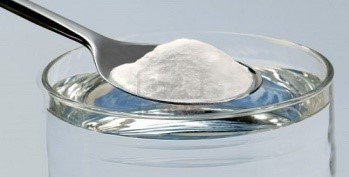
In the above picture, a powder is about to be poured into the liquid. Which of the following should be done to make this powder dissolve faster?

a)
stir the powder in the liquid
b)
freeze the mixture
c)
add more powder to the liquid
d)
store the mixture in a dark place
8.
Another name for a homogeneous mixture is 
a)
an element.
b)
a solution.
c)
a compound.
9.
Kool-Aid - Powder, sugar, and water
Identify the solvent 
a)
water
b)
powder
c)
sugar
d)
powder and sugar
10.
When a Koolaid mix in water is dark in color and very sweet it is a __________ solution.
a)
concentrated 
b)
Diluted
11.
The concentration of a mixture can be increased in which of the following ways?
a)
Heating the mixture
b)
Adding more water “solvent”
c)
Adding more powder “solute”
d)
Stirring the mixture
12.
How many grams of K2Cr2O7, are soluble in 100 g of water at 95 ºC?
a)
83 grams
b)
75 grams
c)
40 grams
d)
12 grams
13.
How does a solution become supersaturated?
a)
dissolve lots of solvent in it.
b)
dissolve a little solute in it. 
c)
dissolve more solute than you should be able to. 
d)
dissolve a super amount of solvent in it. 
14.
When 50 grams of KCl is dissolved in 100 grams of water at 50 ºC, the solution can be correctly described as:
a)
supersaturated
b)
unsaturated
c)
saturated
15.

What is the molarity of a solution containing 4 moles of KCl in 2.5 L of solution?

a)

1.6 M

b)

0.63 M

c)

10 M

d)

2.6 M

16.

What volume is needed to make a 2.45 M solution of KCl using 0.50 mol of KCl?

a)

4.9 L

b)

0.20 L

c)

1.2 L

17.

How many moles of NaCl are needed to make 5.25 L of a 0.25 M solution?

a)

1.3 mol

b)

21 mol

c)

0.048 mol

18.

How many grams of KCl would be dissolved in 5.50 L of a 0.250 M solution of KCl? *molar mass of KCl = 74.55 g/mol*

a)

1.48 g

b)

103 g

c)

1640 g

d)

3.39 g

19.
What is the molarity of a solution which contains 22.41 grams of NaCl in 50.0 mL of solution?
a)
0.488 M
b)
7.67 mol
c)
7.67 M
d)
0.00767 M
20.
If an electrical current can run through a solution, it is said to contain
a)
magic
b)
nonelectrolytes
c)
electricity
d)
electrolytes
21.
Which technique could increase or speed up the rate of dissolving?
a)
Allowing the mixture to settle
b)
Stirring the mixture
c)
Adding more powder
d)
Adding more water
22.
Oil molecules are nonpolar. What kind of solvent is required to remove an oil stain?
a)
saturated
b)
unsaturated
c)
polar
d)
nonpolar
23.

____________ is the process whereby particles of a solvent completely surround the particles of a solute, disperse them throughout the solvent particles, and hold them in solution.

a)

solvation

b)

immisciblation

c)

dissolution

d)

saturation

24.

Which one of the following should be increased in order to increase the solubility of a gas?

a)

Temperature

b)

Pressure

25.

Which of these is NOT a factor that affects solvation?

a)

agitation/stirring

b)

increasing temperature

c)

increasing surface area

d)

adding dye

26.

What does "like dissolves like" mean?

a)

polar solvents dissolve in polar solutes

b)

polar solutes dissolve in polar solvents

c)

non-polar solvents dissolve in polar solutes

d)

non-polar solutes dissolve in polar solvents

27.

Compared to pure water, a NaCl solution would have a:

a)

higher boiling point and higher freezing point

b)

lower boiling point and lower freezing point

c)

higher boiling point and lower freezing point

d)

lower boiling point and higher freezing point

28.

When making Kool-Aid, the Kool-Aid powder would be the _________ and the water would be the ____________.

a)

solute; solvent

b)

solvent; solute

c)

solution; solvent

d)

solvent; solution

29.

The molarity (M) of a solution is equal to the

a)

number of grams of solute/liter of solvent

b)

number of grams of solute/liter of solution

c)

number of moles of solute/liter of solvent

d)

number of moles of solute/liter of solution

30.

What occurs when NaCl(s ) is added to water?

a)

The boiling point of the solution increases, and the freezing point of the solution decreases.

b)

The boiling point of the solution increases, and the freezing point of the solution increases.

c)

The boiling point of the solution decreases, and the freezing point of the solution decreases.

d)

The boiling point of the solution decreases, and the freezing point of the solution increases.

31.
Which sweet tea would you expect to taste the sweetest?
a)
1M
b)
3M
c)
3.1M
d)
2.5M
32.
A lab student adds salt to water.  What is the solvent?
a)
salt
b)
water
c)
the mixture that forms when salt and water are mixed
33.

The drawings below represent beakers of aqueous solutions. Each o represents a dissolved solute particles.Which solution is most concentrated?

a)

A

b)

B

c)

C

d)

D

e)

E

34.

The drawings below represent beakers of aqueous solutions. Each o represents a dissolved solute particle.Which solution is least concentrated?

a)

A

b)

B

c)

C

d)

E

e)

F

35.

By adding water to a concentrated solution, you are making it more

a)

Concentrated

b)

Dilute

c)

Acidic

d)

Basic

36.

What happens when you try and mix a polar and a non-polar substance?

a)

They mix evenly

b)

They mix, but unevenly

c)

They don't mix

d)

They explode

37.
Which types of compounds dissolve easily in water?
a)
Polar and Nonpolar
b)
Polar and Ionic
c)
Nonpolar and Ionic
d)
Covalent and Nonpolar
38.

Ionic compounds can ________________ in water, while covalent compounds can ___________________________ in water.

a)

completely dissociate, partially dissociate

b)

never dissociate, never dissociate

c)

partially dissociate, partially dissociate

d)

not enough information

39.

When ionic compounds dissolve in water, the ions

a)

dissociate and are free to conduct electricity

b)

dissolve and tightly hold on to their electrons

c)

are resistant to electrical impulses

d)

none of these

40.
Colligative properties depend on the _____ of solute particles in solution.
a)
type
b)
number
c)
pH
d)
nature
41.
The freezing point of a solution is ____ the freezing point of the pure solvent.
a)
the same as
b)
lower than
c)
higher than
d)
no relation to
42.
The boiling point of a solution is ______ the boiling point of the pure solvent.
a)
higher than
b)
the same as
c)
lower than
d)
higher or lower than
43.
Colligative properties depend on the _________ of the solute but not the __________ of the solute.
a)
 concentration; identity
b)
identity; concentration
c)
reactivity; nature
d)
nature; reactivity
44.

____________ is the process whereby particles of a solvent completely surround the particles of a solute, disperse them throughout the solvent particles, and hold them in solution.

a)

solvation

b)

immisciblation

c)

dissolution

d)

saturation

45.

Table salt (NaCl) dissolves into water because...

a)

table salt is ionic and water is ionic

b)

table salt is ionic and water is polar.

c)

table salt is nonpolar and water is nonpolar too.

d)

table salt is ionic and water is nonpolar.

46.
Contains the maximum amount of dissolved solute
a)
unsaturated solution
b)
supersaturated solution
c)
saturated solution
47.
This solution would be considered
a)
Unsaturated
b)
Supersaturated
c)
Saturated
d)
Undefined
48.
This graph represents a(n) ___ solution
a)
saturated
b)
supersaturated
c)
unsaturated
d)
undefined
49.
What is a solvent?
a)
The substance that does the dissolving in a solution.
b)
The substance that is being dissolved in a solution.
c)
The mixing of different substances.
d)
The process in which neutral molecules lose or gain electrons
50.
This is the part of a solution that dissolves
a)
Solute
b)
Solvent
c)
Solution
d)
Mixture 
51.
salt water is a 
a)
compound
b)
element
c)
heterogeneous mixture
d)
solution
52.
Another name for a homogeneous mixture is 
a)
an element.
b)
a solution.
c)
a compound.
53.
Kool-Aid - Powder, sugar, and water
Identify the solvent 
a)
water
b)
powder
c)
sugar
d)
powder and sugar
54.
When a certain amount of solvent cannot hold any more solute it is called a ________ solution.
a)
Diluted
b)
Saturated
55.
This type of mixture contains two or more substances that are visibly distinguishable. 
a)
homogeneous
b)
heterogeneous
c)
solution
d)
colloid
56.
The image shown is an example of a ___________.
a)
solution
b)
mixture
c)
gas
d)
plasma
57.
Olive Oil
a)
Heterogeneous  mixture
b)
Homogeneous mixture
58.
Which is an example of a solution?
a)
Chex Mix
b)
Mixed fruit
c)
Juice
d)
milk and cereal
59.
In this mixture, which of the following will be the solute?
a)
The water in the glass
b)
The glass that holds the final mixture
c)
The solution containing both powder and water
d)
The powder on the spoon
60.

Which of the following is NOT TRUE about Heterogeneous Mixtures?

a)

They will settle out over time

b)

Individual particles are often distinguishable

c)

Solutions are a type of heterogenous mixture

d)

Emulsions, Suspensions, and Collides are types of Heterogeneous Solutions.

61.
When materials combine to form a mixture, they
a)
A. keep their original properties.
b)
B. react to form a new substance with new properties.
c)
C. combine in a specific ratio.
d)
D. always change their physical state.
62.
How does a solution become supersaturated?
a)
dissolve lots of solute in it.
b)
dissolve a little solute in it. 
c)
dissolve more solute than you should be able to. 
d)
dissolve a solvent in it. 
63.
What does it mean to dilute a solution?
a)
lower the concentration of solute per solvent
b)
increase the concentration of solute per solvent
64.

Solubility refers to the ____ of solute that can dissolve in a certain volume or mass of solvent, at a certain temperature.

a)

Mean

b)

Range

c)

Amount

d)

Mode

65.
What is the universal solvent?
a)
salt
b)
sugar
c)
water
d)
ice
66.
How many grams of K2Cr2O7, are soluble in 100 g of water at 95 ºC?
a)
83 grams
b)
75 grams
c)
40 grams
d)
12 grams
67.
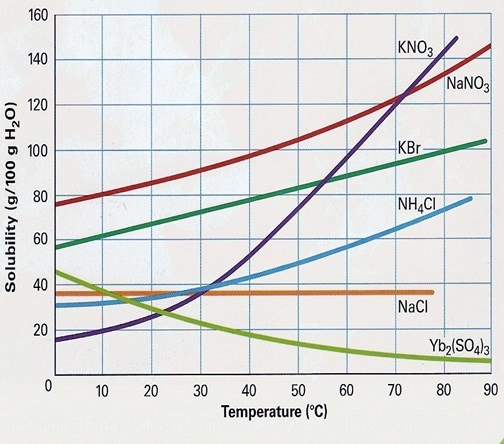
Which substance is MOST soluble at 0 ºC?
a)
KI
b)
NaNO3
c)
NaCl
d)
Ce2(SO4)3
68.
When 50 grams of KCl is dissolved in 100 grams of water at 50 ºC, the solution can be correctly described as:
a)
supersaturated
b)
unsaturated
c)
saturated
69.
When 20 grams of KNO3 is dissolved in 100 grams of water at 80 ºC, the solution can be correctly described as:
a)
supersaturated
b)
saturated
c)
unsaturated
70.
The amount of solute actually dissolved in a given amount of solvent.
a)
dilution
b)
concentration
c)
saturated solution
d)
supersaturated mixture
71.
__________ are made up of solutes and solvents.
a)
Solutions
b)
Suspensions
c)
Heterogeneous Mixtures
d)
Pure Substances
72.

Which substance is least soluble at 0 ºC?

a)

KI

b)

KNO3

c)

KClO3

d)

Ce2(SO4)3

73.

How many grams are soluble in 100 g of water at 100 ºC?

a)

300 grams

b)

250 grams

c)

100 grams

d)

50 grams

74.

Which solute is most likely a gas?

a)

NH3

b)

NaNO3

c)

KCl

d)

NaCl

75.

When 40 grams of NaCl is dissolved in 100 grams of water at 90 ºC, the solution can be correctly described as:

a)

supersaturated

b)

saturated

c)

unsaturated

76.
Which solute does not increase in solubility as temperature rises?
a)
NH3
b)
NaNO3
c)
KNO3
d)
NaCl
77.
You can make a solution more concentrated by adding __________.
a)
solute
b)
solvent
c)
water
78.
Solution where more solute can still be dissolved at the given temperature. 
a)
Saturated
b)
Unsaturated
c)
Supersaturated
d)
Homogeneous solution
79.
A solution of potassium chlorate, KClO3, has 20 grams of the salt dissolved in 100 grams of water at 70 ºC. Approximately how many more grams of the salt can be added to the solution before reaching the saturation point?
a)
10 grams
b)
30 grams
c)
80 grams
d)
60 grams 
80.

Identify how many grams of KNO3 is required to make a saturated solution at 40'C.

a)

50 g

b)

45 g

c)

55 g

d)

33 g

81.
If I dissolve sugar in water, what is the solute?
a)
Water
b)
Hydrogen
c)
Sugar
d)
Carbon
82.
What will allow more solute to be dissolved in a solvent.
a)
adding more solute
b)
stiring
c)
cooling solution
d)
heat
83.

If I dissolve carbon dioxide in water, what is the solvent?

a)

Carbon Dioxide

b)

There is no solvent

c)

Oxygen

d)

Water

84.

Define the term insoluble.

a)

Can dissolve in water.

b)

Cannot dissolve in water.

c)

Partially dissolves in water.

85.

If I dissolve carbon dioxide in water, what is the solute?

a)

Carbon Dioxide

b)

There is no solvent

c)

Oxygen

d)

Water