
 Worksheets
Econ Exam #2
Total questions: 68
Worksheet time: 34mins
Barter is the direct exchange of goods and services for:
any kind of money
other goods and services
either goods or money
commodity money
foreign currency
An important function of commercial banks is to _____.
print new currency
issue fiat money
mint coins
redeem currency for precious metals
make loans
Exchange is necessary in an economy if:
output is to be produced.
output is to be consumed
individuals are self-sufficient.
families are self-sufficient.
labor is specialized
The reserve ratio is the ratio of:
Federal Reserve member banks to nonmember bank
Federal Reserve nonmember banks to member banks.
Federal Reserve member banks to all U.s Banks
a banks total deposits to its reserves
a banks reserves tp its total deposits
Banks want to minimize their holdings of excess reserves because:
they will be penalized by the Federal Reserve System if excess reserves are too high.
required reserves are also minimized when banks minimize their holdings of excess reserves.
the money multiplier becomes too large if the excess reserves are high.
they want to borrow more on the federal funds market.
excess reserves earn no intrest
Banks help to overcome the problem of asymmetric information by
lending to a single rich borrower and not diversifying their portfolio.
acquiring expertise in evaluating the credit histories of borrowers.
threatening borrowers.
offering only one type of loan.
providing information to lenders.
In the federal funds market, _____.
banks make loans to the Fed
banks make short-term loans to other banks
banks make long-term loans to other banks
the Fed makes short-term loans to private borrowers
the Fed makes long-term loans to commercial banks
On a bank's balance sheet, the value of its assets must equal the value of its:
net worth only.
liabilities only.
revenues plus costs.
the value of its liabilities plus net worth.
revenues minus costs.
Suppose a bank has $8,000 in checkable deposits and the required reserve ratio is 0.2. If actual reserves equal $3,000, then excess reserves equal:
1600
1400
2400
5000
zero
Suppose the First National Bank acquires $500,000 in new deposits and the required reserve ratio is 12 percent. Which of the following is true?
Required reserves on the new deposits are $12,000.
Excess reserves on the new deposits are $500,000.
Required reserves on the new deposits are $60,000.
Excess reserves on the new deposits are $12,000.
Total reserves on the new deposits are $440,000.
The least liquid of the assets listed below is:
real estate
currency
travelers checks
oil
checkable deposits
To maximize its profit, a bank will:
minimize the number transactions it engages in.
maximize required reserves
minimize excess reserves.
maximize excess reserves.
minimize required reserves.
When a customer deposits $1,000 in a bank, the deposit is:
an asset of the Federal Reserve.
included in M1 if it is currently in the bank's vault.
a liability to the customer.
an asset to the bank if it is currently in the bank's vault.
a liability for the bank as the bank owes it to the customer.
Which of the following is an asset to a bank?
Checkable deposits
Transaction deposits
Credit cards
loans
Borrowings from the Fed
Which of the following is true of banks?
Banks reduce the opportunity cost of holding idle cash.
Banks act as intermediaries between the government and private investors.
Banks can reduce risk by lending to rich borrowers.
Banks reduce the transaction costs of borrowing and lending money.
Banks can reduce risks by extending more loans.
Banks differ from other types of businesses because banks:
earn profits
combine economic resources to produce services.
can go out of business.
can create money
are regulated by the government.
If r is the required reserve ratio, which of the following is the simple money multiplier?
r
1/(1-r)
1-r
1/r
2r
If the Fed purchases government securities in the open market, _____.
the money supply will decrease
the money supply will increase only if the seller of those securities is a commercial bank
the money demand will increase immediately
the money demand will decrease immediately
the money supply will increase through the commercial banking system regardless of who the seller is
Money expansion stops when new reserves introduced into the banking system have been converted into:
excess reserves.
securities.
deposits.
required reserves.
loans.
Suppose the reserve requirement is 15 percent. Which of the following is true?
The simple money multiplier is 15.
The simple money multiplier is 1/15.
The simple money multiplier is 30,000.
The simple money multiplier is 1/30,000.
The simple money multiplier is 1/0.15.
Suppose the reserve requirement ratio is 20 percent. Assuming no bank holds excess reserves and nobody withdraws cash, a $10,000 injection of new reserves by the Fed can create:
$2,000 in new checkable deposits.
$10,000 in new checkable deposits.
$50,000 in new checkable deposits.
$500,000 in new checkable deposits.
$5,000 in cash.
Suppose you bank at Bank A and you write a check to your friend, who banks at Bank B. After the check clears, _____.
both Bank A's and Bank B's assets increase
both Bank A's and Bank B's assets decrease
Bank A's assets increase and Bank B's assets decrease
Bank A's assets decrease and Bank B's assets increase
there is an increase in the Federal Reserve's assets
The banking system creates money in the sense that it:
prints money.
creates excess reserves from loans.
creates loans from excess reserves.
creates required reserves from loans.
creates loans from required reserves.
The actual money multiplier is smaller than the simple money multiplier because:
the actual multiplier affects M2 rather than M1.
cash withdrawals reduce the amount banks can lend out.
the actual multiplier affects the amount of excess reserves each bank holds.
the size of the simple multiplier depends on the volume of deposits unlike the actual multiplier.
the actual multiplier uses a different measure of reserve requirements.
The extent of money expansion will be:
greater if banks hold on to excess reserves.
greater if private individuals hold on to cash.
greater if banks hold on to excess reserves but less if private individuals hold on to cash.
less if banks hold on to excess reserves but greater if private individuals hold on to cash.
less if banks hold on to excess reserves or private individuals hold on to cash.
The money expansion process continues until there are no more:
required reserves in the banking system.
demand deposits in the banking system.
excess reserves in the banking system that banks are willing to lend.
liabilities in the banking system.
assets in the banking system.
The table below shows the balance sheet of Countybank. If the required reserve ratio is 10 percent, this bank alone can now increase its lending by _____.
Cash
$1,000
Checkable deposits
$1,000
$1,000
$10,000
$0
$90
$900
The table below shows the balance sheet of Eubank which holds no excess reserves. Assume that the required reserve ratio is 10%. If a student deposits $10,000 in cash into his checkable deposit account, then Eubank will have _____ in excess reserves.
Assets
Liabilities and Net Worth
Deposits at the Fed
$40,000
Checkable deposits
$500,000
Cash
$10,000
Net Worth
$20,000
Loans
$300,000
Securities
$150,000
Fed Stock
$20,000
$10,000
$1,000
$9,000
$60,000
$6,000
An increase in the money supply leads to a(n)
decline in interest rates, an increase in investment, and an increase in aggregate demand.
decline in interest rates, a decrease in investment, and an increase in aggregate demand.
decline in interest rates, an increase in investment, and a decline in aggregate demand.
increase in interest rates, an increase in investment, and an increase in aggregate demand.
decline in interest rates, a decline in investment, and a decline in aggregate demand.
If the Fed decreases the money supply, gross domestic product:
increases by the same amount as the increase in the interest rate.
decreases by a greater amount than the decrease in investment because of the multiplier.
decreases by the same amount as the decrease in investment.
decreases by a greater amount than the decrease in investment because of the multiplier.
decreases by a lesser amount than the decrease in investment because of the multiplier.
If the Fed purchases U.S. government securities, gross domestic product:
increases because the resulting increase in the interest rate leads to a decrease in investment.
increases because the resulting decrease in the interest rate leads to an increase in investment.
decreases because the resulting increase in the interest rate leads to a decrease in investment.
decreases because the resulting increase in the interest rate leads to an increase in investment.
decreases because the resulting decrease in the interest rate leads to an increase in investment.
If the Fed sells U.S. government securities in the open market, gross domestic product:
increases because the resulting increase in the interest rate leads to a decrease in investment.
increases because the resulting decrease in the interest rate leads to an increase in investment.
decreases because the resulting increase in the interest rate leads to a decrease in investment.
decreases because the resulting increase in the interest rate leads to an increase in investment.
decreases because the resulting decrease in the interest rate leads to an increase in investment.
For a given money demand curve, an increase in money supply:
drives up the real interest rate.
lowers the opportunity cost of holding money.
decreases the quantity of money demanded.
drives down the price level in an economy.
contracts the total output produced in an economy.
An increase in the nominal interest rate, other things constant, will:
shift the money demand curve to the right.
shift the money demand curve to the left.
increase the quantity of money people choose to hold.
decrease the quantity of money people choose to hold.
have no impact on the money demand curve.
Suppose an individual can earn 3 percent interest on an annual term deposit. His opportunity cost of holding $100,000 in cash instead of investing in the term deposit will be:
$3,300
$330.
$1,000.
$6,000.
$3,000.
The Fed purchases of long-term assets to stabilize financial markets, reduce long-term interest rates, and improve the investment environment are called:
structural adjustments.
financial strengthening.
quantitative easing.
inflation targeting.
stress testing
The Fed seeks a target rate of inflation of around _____.
1 percent
2 percent
3 percent
4 percent
5 percent
Which of the following is not an activity of the Fed?
Making loans to the public
Clearing banks' checks
Lending funds to the federal government
Purchasing U.S. government securities
Holding deposits of the U.S. Treasury
A decrease in stock prices will _____ the net wealth of households and _____ consumption.
reduce; increase
reduce; decrease
reduce; not change
increase; increase
A firm's level of investment depends on the market interest rate:
only when the firm has to borrow funds to invest in new equipment.
only when the firm has to borrow funds to buy stocks and bonds.
only when the firm already has sufficient funds and could lend them.
because the interest rate represents the opportunity cost of investing in capital.
A technological change that positively affects business expectations will:
cause a rightward shift of the investment demand curve.
cause a leftward shift of the investment demand curve.
cause an upward movement along the investment demand curve.
cause a downward movement along the investment demand curve.
An economy’s investment demand curve shows the inverse relationship between the quantity of investment demanded and the market interest rate, other things held constant.
True
false
An increase in income in other countries, other things equal, would cause U.S. _____.
exports to decrease and imports to increase
imports to decrease and exports to decrease
imports to increase and exports to remain unchanged
imports to remain unchanged and exports to increase
An increase in the U.S. price level, other things constant, will _____.
increase U.S. exports and decrease U.S. imports
increase U.S. exports and leave U.S. imports unchanged
decrease U.S. exports and increase U.S. imports
decrease U.S. exports and leave U.S. imports unchanged
Identify the correct statement.
During a recession, investment increases while consumption decreases.
During a recession, investment is constant while consumption increases.
Annual variations in investment are larger than annual variations in consumption.
Annual variations in investment are smaller than annual variations in consumption.
Historically, consumption spending in the United States has _____.
fluctuated greatly with changes in the level of income
remained approximately constant as a percentage of income
decreased as a percentage of income
varied inversely with the inflation rate
Exports minus imports equals net exports.
True
false
If incomes in the United States increase, other things equal, then U.S. _____.
imports increase and exports remain constant
exports increase and imports decrease
imports decrease and exports decrease
imports remain constant and exports increase
If investment increases by $100 and, as a result, gross domestic product (GDP) ultimately increases by $200, the multiplier equals _____.
1
2
3
4
In an economy without a government and without international transactions, aggregate expenditure at each level of income is equal to:
consumption plus saving.
planned investment plus saving.
disposable income plus the price level.
consumption plus planned investment.
Purchases of existing commodities, such as gold and precious gems, are considered investment spending by economists.
True
False
The aggregate demand curve of an economy illustrates the relationship between:
interest rates and income levels.
the price level and real gross domestic product (GDP).
the price level and interest rates.
income levels and real gross domestic product (GDP).
The aggregate demand curve of an economy:
is downward sloping.
first declines and then becomes positively sloped.
is horizontal.
is vertical.
An adverse supply shock would shift:
only the short-run aggregate supply curve outward.
only the long-run aggregate supply curve inward.
only the short-run aggregate supply curve inward.
both the long-run and the short-run aggregate supply curves inward.
An economy’s potential level of output can be altered by changes in:
the expected price level.
aggregate demand.
real GDP.
its stock of capital.
An expansionary gap generally creates inflationary pressure in an economy.
True
False
Given the aggregate demand curve, a beneficial supply shock will:
increase potential output and the price level.
decrease potential output and the price level.
increase potential output and decrease the price level.
decrease potential output and increase the price level.
Given the aggregate demand curve, an increase in the supply of a productive resource will:
increase the output level but leave the price level unchanged.
decrease both the output and price levels.
increase the price level and decrease the output level.
decrease the price level and increase the output level.
If resource prices are "sticky" downward and a recessionary gap develops in an economy, the short-run aggregate supply curve will:
shift leftward to return the economy to its potential output.
shift rightward to return the economy to its potential output.
become a horizontal straight line.
not shift rightward to return the economy to its potential output.
If resource prices are flexible, the long-run aggregate supply curve is vertical.
True
False
If the rate of increase in the price level exceeds the rate of increase in nominal GDP, real GDP declines.
True
False
In constructing the short-run aggregate supply curve, we define the short run as the period in which:
the price level is constant.
output is fixed.
profit is constant.
the costs of some resources are fixed.
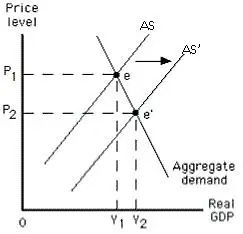
In the figure given below, when aggregate supply is AS, the equilibrium output and price level will be Y2 and P2 , respectively.
True
False
In the long run, the price level in an economy is determined solely by:
the long-run aggregate supply curve.
the aggregate demand curve.
the amount of cyclical unemployment in the economy.
the short-run aggregate supply curve.

The figure below shows the determination of the equilibrium price level and real GDP in an aggregate demand–aggregate supply model. If the economy is at point H, there is a(n):
expansionary gap of $300 billion.
recessionary gap of $300 billion.
recessionary gap of $10 billion.
expansionary gap of $20 billion.
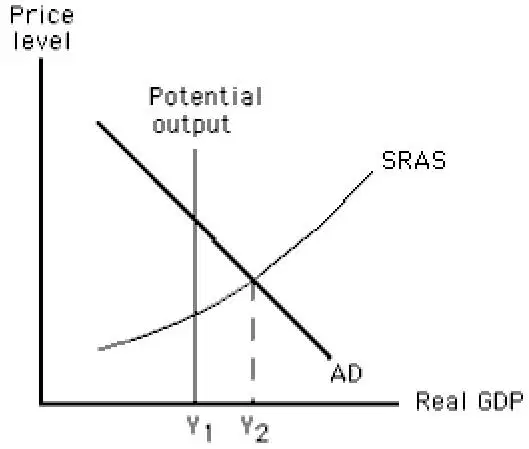
The figure below shows the short-run aggregate demand and supply curves of an economy. In this figure, the distance between Y1 and Y2 represents:
an expansionary gap.
a recessionary gap.
a cost-push inflation.
the natural rate of unemployment.
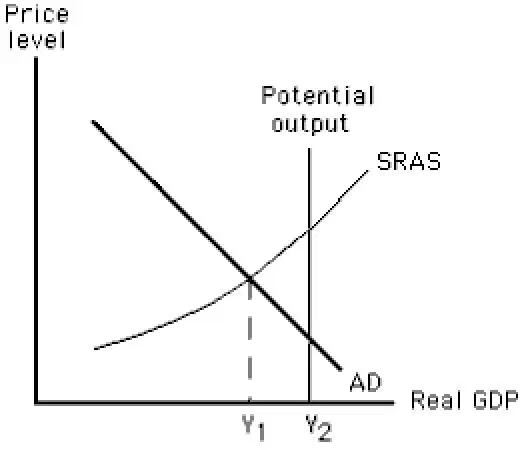
The figure below shows the short-run equilibrium in an aggregate demand–aggregate supply model. In this figure, the distance between Y1 and Y2 represents:
an expansionary gap.
a recessionary gap.
the potential output.
seasonal unemployment.
The main effect of a decrease in the stock of capital is a(n):
rightward shift of the short-run aggregate supply curve.
rightward shift of the aggregate demand curve.
leftward shift of the long-run aggregate supply curve.
leftward shift of the aggregate demand curve.

