
Font size
 Worksheets
Biol 1010 Final
Total questions: 126
Worksheet time: 10hrs 26mins
Sunlight
Tree
River
Insects
Grass
Temperature
TRUE or FALSE?
Each biome also has a characteristic set of organisms that are adapted to living there.
true
false


Which ocean zone allows plants to grow??
midnight zone
photic zone
twilight zone
intertidal zone


The greenhouse effect is caused by
more heat arriving at the Earth from the sun
the Earth releasing more heat at night
gases in the air trapping heat released by the Earth


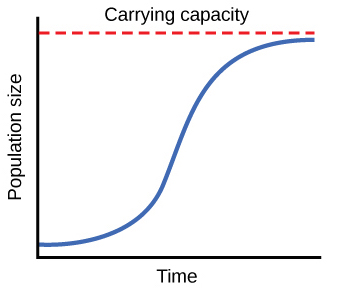
What point on the graph represents the carrying capacity?
A
B
C
D
A population is...
All members of one species in one area
All members of all species that live in one area
All of the living and nonliving things in an area
None of these

What is happening at the 'A' on the graph?
the population overshoots above the carrying capacity
the population stops growing
growth begins to slow down due to limited resources
growth is speeding up due to an abundance of resources

Tracks organisms that tend to live long lives (low death rate and high survivorship rate); toward the end of their life expectancies, however, there is a dramatic increase in the death rate.
Type I
Type II
Type III
Type IV
Describes organisms with a high death rate (or low survivorship rate) immediately following birth. Examples include bacteria, fishes, and invertebrates.
Type I
Type II
Type III
Type IV
What does IPM stand for?
Integrated Pest Management
Insect Pest Management
Individual Pest Management
Which of the following is an example of biological control?
Bees pollinating crops
Integrated pest management
Ladybugs eating aphids
The application of glyphosate
Biodiversity, aka biological diversity, usually refers to
the same species in a general location
the number of different species in a given area
the number of animal species in a given area
the number of plant species in a given area
a species that is not native to a particular region and has no natural predators and little competition
consumer species
producer species
invasive species
adapted species

The primary causes of extinction (and endangerment and threatened status) is...
polar ice cap melting
global warming
habitat loss and degradation
burning of fossil fuels

In which type of interaction does one animal eat another for energy and nutrients?
Competition
Parasitism
Predation
Mutualism

What term describes organisms striving for the same limited resources?
Competition
Predation
Mutualism
Commensalism

Orchid vines are skinny and grow on the trunk of trees to get more light and space with no negative effect.
Mutualism
Commensalism
Parasitism
Competition

As you go up the levels of the trophic pyramid, which of the following is true?
There are more organisms and more energy
There are more organisms and less energy
There are less organisms and more energy
There are less organisms and less energy

Which group is not represented in the food web?
producers
primary consumers
secondary consumers
decomposers

What do the arrows in the food chain indicate about the flow of energy in an ecosystem?
Energy is continuously recycled by the organisms in an ecosystem.
Energy flows in one direction in an ecosystem, from producers to consumers.
More of the available energy in an ecosystem is given to large animals than to small animals.
Organisms at the end of the food chain receive more energy than those at the beginning.

In this energy pyramid, which organism would most likely be in level 2?
bird
fox
caterpillar
tree

What is the role of a producer?
Gain energy from eating other organisms
Breaking down dead stuff
Use sunlight to make food
Keep other species from overpopulating
How much energy is available to be passed on to the next trophic level in an ecosystem?
700%
20%
5%
10%

In the energy pyramid here, which organisms have the most energy available?
Top Predator
Herbivores
Carnivores
Producers

A food pyramid represent the relative amount of energy in trophic levels. Which of the following correctly shows a food pyramid?
A
B
C
D

Which trophic level has the least amount of energy? 1-producers, 2-primary consumers, 3-secondary consumers, 4-tertiary consumers
1
2
3
4

The owl receives energy from which organisms?
grasshopper and mouse
rabbit and butterfly
mouse and rabbit
butterfly and frog
Why are advantageous traits more likely to be passed onto offspring?
Because they are more likely to survive and reproduce.
Because they come from dominant alleles.
Because they come from recessive alleles.
Because the organism knew it needed that trait, survives, and passes it on.
Mutations are a change in what?
DNA
tRNA
protein
rRNA
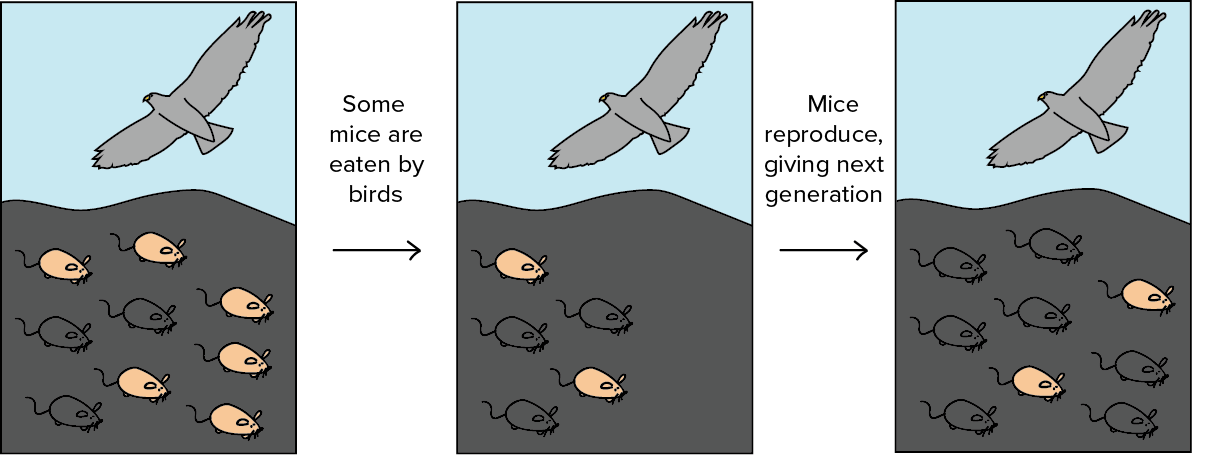
Which of the following statements about gene flow is TRUE?
Gene flow is a result of individuals that breed in an old location
Gene flow is a result of migrating individuals that breed in a new location
Gene flow is not a result of migrating individuals that breed in a new location
None of the statements are true
A population is
a group of similar species in different areas
a group of the same species in the same geographic area.
a group of several species in the same geographic area
a group of several species along with their abiotic factors in a small area.
Northern elephant seals have reduced genetic variation probably due to the effects humans inflicted on them in the 1890s. Hunting reduced their population size to as few as 20 individuals at the end of the 19th century. What evolutionary concept is displayed in this example?
Bottleneck Effect
Founder Effect
Directional Selection
Frequency Dependent Selection
A volcano erupts in northwest Washington state that kills a large percentage of conifer trees. After 50 years of growth the conifer trees remain in small numbers due to the natural disaster.
Natural Selection
Gene Flow
Genetic Drift
There are 2 herds of Caribou in Northwestern Montana, one male Caribou strays from one herd to mate with a female in the other herd. What mechanism of evolution is this?
Natural Selection
Gene Flow
Genetic Drift
Female peacocks select the males with the most spots on the male’s tails to breed with. Males with less spots don’t reproduce with females as much as males with many spots.
Natural Selection
Gene Flow
Genetic Drift
Which of the following is a postzygotic barrier?
A new river forms and splits two populations, causing ______________ speciation
Sympatric
Allopatric
Extreme
Convergent
A speciation in which new species evolve from a single ancestral species while inhabiting the SAME geographic region.
Sympatric speciation
Allopatric speciation
Complex speciation
Divergent speciation
when the organism develops different courtship rituals which do not attract main population this is a part of ____________ speciation.
Allopatric
Sympatric
Simple
Temporal
The emergence of a mountain range is an event that would lead to _______________ speciation
Allopatric
Sympatric
Temporal
Behavioral


Which of the following is the best definition for MEIOSIS?
the process of two haploid cells uniting
the counting of chromosomes within a diploid cell
a two-step process that reduces the number of chromosomes in half such that there is only one copy of all the chromosomes
the equational division of a cell into two identical copies

In which stage of MEIOSIS does crossing over occur? (The exchange of genetic material between chromosomes in a tetrad.)
Anaphase I
Metaphase I
Prophase I
Telophase I
In Anaphase I, the _________ are separated by the pulling of the spindle fibers to opposite poles of the cell.
homologous pairs of chromosomes
sister chromatids
centromeres
centrosomes
At the start of Meiosis II, which of the following is NOT true?
There are two cells.
The cells are haploid.
The chromosomes are paired up as homologues.
DNA is present as two sister chromatids joined at the centromere.
In Metaphase II, _________ line up on equatorial plane.
homologous pairs of chromosomes
single chromosomes (made up of 2 sister chromatids)
tetrads
centrosomes
In Anaphase II, the _________ separate.
Homologues
Sister Chromatids
Tetrads
Centrioles
How many cells are formed at the end of Meiosis II?
2
3
4
8
Alternant or different genes that code for the same trait are called?
chromosomes
segments
alleles.
homozygous.
Which of the following alleles is homozygous (purebred) recessive?
TT
Tt
tt
ts
If a strand of DNA had bases in the following order - ATCCGTC, what would be the transcribed mRNA sequence?
TAGGCAG
UAGGCAG
TUGGCUG
None of the above are correct
Which enzyme is responsible for adding the free nucleotides to the replicating DNA?
DNA Helicase
DNA Ligase
DNA polyermase
RNA Polymerase

The following diagram shows the steps of gene expression. Once mRNA editing step is finished, what does the final transcript consist of?
amino acids
exons
introns and exons
introns
amino acids
monosaccharide

Which organelle controls what goes in and out of the cell?
nucleus
nucleolus
cell membrane
nuclear membrane

What organelle is represented by this image?
rough endoplasmic reticulum
smooth endoplasmic reticulum
ribosome
nucleus
The jelly-like material inside the cell
ribosomes
lysosome
granum
cytoplasm
Which organelle contains DNA and controls the cell?
Cell membrane
nucleus
nucleolus
lysosme
Proteins are produced at this organelle.
golgi body
ribosome
cytoskeleton
cilia
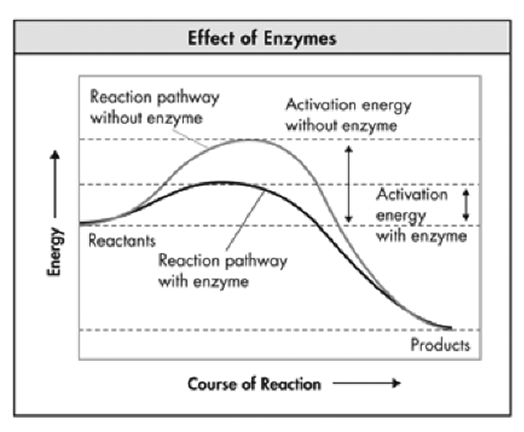

water moves from low to high concentration


the diffusion of particles from an area of high concentration to an area of low concentration
the diffusion of particles from an area of low concentration to an area of high concentration
Where does the Citric Acid cycle and electron transport take place?
mitochondria
chloroplast
cytoplasm
nucleus
What happens in the electron transport chain?
ATP synthase allows hydrogen ion to pass through it to form massive amounts of ATP
pyruvic acid is formed from breaking down glucose
CO2 is released and H2O and ATP
glucose is broken down and ATP is formed
Which of the following equations represents the overall chemical reaction for photosynthesis?
6O2+ 6H2O → C6H12O6+ 6O2
C6H12O6 + 6H2O→ 6O2+ 6O2
6CO2+ 6H2O→ C6H12O6+ 6O2
6O2 + 6H2O→ C6H12O6 + 6CO2
The organic molecule that is the cell's primary form of energy?
Glucose
ATP
ADP
GMP
Choose the statement that best describes light reaction.
It converts CO2 to sugar molecule
It converts light energy to chemical energy of ATP and high energy electrons.
It takes place in the stroma
These are barriers that occur before a zygote has formed
Prezygotic Barriers
Postzygotic Barriers
Hybridization
Chromosomal Mismatch

