wayground logo

Free Printable Worksheets

NEW

Font size

S
M
L
XL
Worksheets

PS M9 Behavior and Properties of Waves

Total questions: 33

Worksheet time: 2hrs 42mins
Name
Class
Date
1.

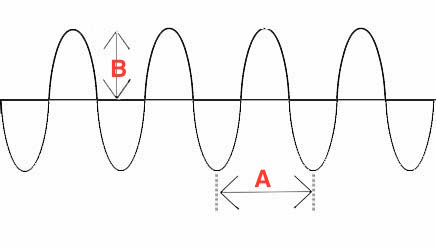
What property of this wave is represented by the letter "A"

a)

amplitude

b)

crest

c)

trough

d)

wavelength

2.
What property of the wave is represented by the letter "B"?
a)
amplitude
b)
crest
c)
trough
d)
wavelength
3.
The highest point on a wave is:
a)
the crest
b)
the trough
c)
the top
d)
the coast 
4.
The lowest point on a wave is the:
a)
Amplitude
b)
Crest
c)
Trough
d)
Wavelength
5.
The number of wavelengths that pass a point each per second is:
a)
frequency
b)
period
c)
longitudinal 
d)
transverse wave 
6.
The type of waves that require medium to pass:
a)
Mechanical Waves
b)
Electromagnetic Waves
7.
Which vocabulary term is used to identify the distance between points C & G?
a)
Amplitude
b)
Crest
c)
Frequency
d)
Wavelength
8.
A mechanical wave cannot travel through...
a)
a vacuum(empty space).
b)
water.
c)
air. 
d)
glass.
9.
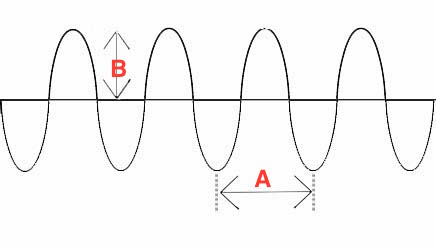
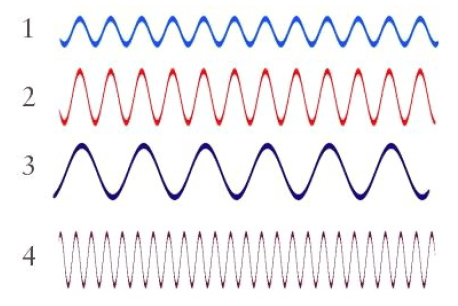
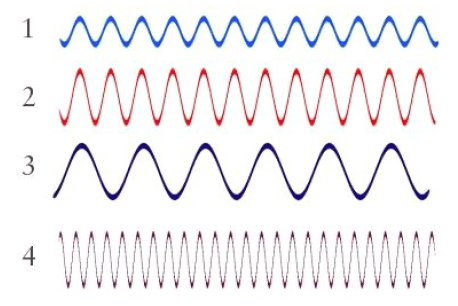
Which wave in the diagram has the greatest frequency?
a)
1
b)
2
c)
3
d)
4
10.
Which wave in the diagram has the greatest wavelength?
a)
1
b)
2
c)
3
d)
4
11.
crest to crest or trough to trough
a)
crest
b)
trough
c)
amplitude
d)
wavelength
12.
regular disturbances that carry energy through matter or space
a)
crest
b)
energy
c)
wave
d)
trough
13.

What is transferred by a wave?

a)

energy

b)

matter

c)

particles

d)

mass

14.

A wavelength is the distance between which 2 points?

a)

B and G

b)

A and C

c)

C and F

d)

A and H

15.

Which image represents a longitudinal wave?

a)

A

b)

B

16.

What is represented by B?

a)

Compression

b)

Transversal

c)

Amplitude

d)

Rarefaction

17.

Sound waves are which type of waves?

a)

transverse

b)

seismic

c)

longitudinal

d)

frequency

18.

Which can a electromagnetic wave go through that a mechanical wave cannot?

a)

a vacuum(empty space).

b)

water.

c)

air.

d)

glass.

19.

Light is an example of what kind of wave?

a)

Mechanical

b)

Electromagnetic

20.

Which image represents a transverse wave?

a)

A

b)

B

21.

What is represented by A?

a)

Compression

b)

Transversal

c)

Amplitude

d)

Rarefaction

22.
Which of the figures represents reflection?
a)
A
b)
B
c)
C
d)
D
23.

The diagram shows a series of wave fronts approaching an opening in a barrier. Point P is located on the opposite side of the barrier. The wave fronts reach point P as a result of

a)

resonance

b)

refraction

c)

reflection

d)

diffraction

24.
The bouncing off of light rays from the surface of an object such as a mirror or other shiny surface is called:
a)
mirror
b)
laser
c)
reflection
d)
refraction
25.
This shows the phenomenon known as....
a)
reflection
b)
refraction
c)
mirrors
d)
focal point
26.
A reflected sound wave
a)
frequency
b)
pitch
c)
echo
d)
rarefaction
27.
Refraction is the bending of a wave disturbance as it passes from one _________ into another.
a)
glass
b)
medium
c)
area
d)
boundary
28.
Why do we see objects as white?
a)
They absorb all light
b)
They reflect all light
c)
They absorb some light and reflect some light
29.
The color you see is the color that is ___.
a)
reflected
b)
absorbed
30.
A leaf is green, what does this tell you about the light that is being absorbed?
a)
no light is being absorbed
b)
green is being refracted and all the colors are being absorbed.
c)
green is being absorbed and all the other colors are reflected
d)
green is being reflected and all the other colors are being absorbed
31.
The passing of a wave through a material
a)
absorption
b)
transmission
c)
reflection
32.

The more energy a wave has, the greater its ____

a)

speed

b)

amplitude

c)

wavelength

33.
Prisms separate light into the colors of the rainbow using what behavior of waves?
a)
Reflection
b)
Refraction
c)
Absorption
d)
Transmission