
Font size
 Worksheets
eBAJA 2024 Team Selection Exam
Total questions: 80
Worksheet time: 47mins
What is the definition of "High Voltage" in automotive engineering?
Voltage in the range of 30 to 1000 VDC RMS
Voltage in the range of 60 to 1500 VDC
Voltage in the range of 30 to 1000 VAC RMS or 60 to 1500 VDC
Voltage in the range of 30 to 1500 VAC RMS
What is the maximum voltage allowed between any two terminals of the Low Voltage system in a vehicle?
10V DC
15V DC
10V AC
15V AC
What is the maximum voltage allowed between any two terminals of the tractive system in a vehicle?
30V DC
30V AC
60V DC
60V AC
What is the function of the tractive system in a vehicle?
To control the speed of the vehicle
To provide power to the accessories in the vehicle
To provide power to the motor that propels the vehicle
To regulate the temperature of the vehicle's battery
What type of DC-DC converter should teams use in their vehicle?
Optoisolated marine grade
Optoisolated automotive grade
Non-isolated automotive grade
Non-isolated industrial grade
Where should the HV-rated cut-off switch be located in the vehicle's tractive system?
Between the DC-DC Converter and the motor controller
Between the tractive system Accumulator(s) and the DC-DC Converter
Between the tractive system Accumulator(s) and the motor controller
Between the charging system and the tractive system Accumulator(s)
What happens to the safety appliances and auxiliaries when the HV-rated cut-off switch and GLV ignition/master switch are on?
They are also turned off
They continue to work irrespective of the kill switch position
They only work when the kill switch is activated
They work only when the vehicle is moving
What is the function of the HV-rated cut-off switch in a vehicle's tractive system?
To control the speed of the vehicle
To provide power to the safety appliances and auxiliaries
To provide power to the motor that propels the vehicle
To regulate the temperature of the vehicle's battery
What happens to the reverse light and reverse alarm when the Kill switch is activated?
They continue to work
They are turned off
They may or may not work, depending on the design of the vehicle
None of the above
What happens to the Brake Light when the Kill switch is pressed?
It is turned off
It continues to work
It works only when the Kill switch is deactivated
It works only when the vehicle is moving
Which of the following is a requirement for the angle between the LDB members and the RRH vertical members?
The angle must be less than 20 degrees.
The angle must be greater than or equal to 20 degrees.
The angle must be exactly 20 degrees.
There is no specific requirement for the angle.

Which of the following describes the height requirements for the SIM members in relation to the inside seat bottom, as shown in Figure ?
The SIM members must be below 203 mm (8 in.) at all positions between points S and D.
The SIM members must be between 203 mm (8 in.) and 356 mm (14 in.) at all positions between points S and D.
The SIM members must be above 356 mm (14 in.) at all positions between points S and D.
The height requirements for the SIM members do not vary between points S and D.
Which of the following describes the required total weld length of a gusset, in relation to the circumference of the primary material used?
The total weld length should be equal to the tubing circumference.
The total weld length should be half the tubing circumference.
The total weld length should be twice the tubing circumference.
The total weld length should be four times the tubing circumference.
Which of the following describes the minimum thickness required for the material used for plate gussets, as compared to the thickness of the primary material used?
The thickness of the plate gusset must be less than the thickness of the primary material.
The thickness of the plate gusset must be equal to the thickness of the primary material.
The thickness of the plate gusset must be greater than or equal to the thickness of the primary material.
There is no specific thickness requirement for the plate gusset material.
Which of the following describes the criteria for determining whether tubes need to be sleeved when joined at an angle?
Tubes must be sleeved when joined at any angle, regardless of the degree.
Tubes need not be sleeved when joined at an angle greater than 5 degrees.
Tubes need not be sleeved when joined at an angle less than 5 degrees.
Tubes need to be sleeved when joined at an angle less than or equal to 5 degrees.
Which of the following describes the minimum length requirement for a linear weld used to secure a sleeve inside a joint, including the butt joint and the rosette welds?
A) The minimum length requirement for the linear weld is 50 mm (2.0 in.).
B) The minimum length requirement for the linear weld is 76 mm (3.0 in.).
C) The minimum length requirement for the linear weld is 102 mm (4.0 in.).
D) There is no specific minimum length requirement for the linear weld.
What is the mandatory type for both the Kill Switches in a vehicle's tractive system?
"PUSH TO ENERGIZE" type
"PUSH TO KILL" type & "ROTATE TO ENERGIZE" type
"PUSH TO KILL" type & "ROTATE TO DE-ENERGIZE" type
"ROTATE TO KILL" type
Which of the following describes the requirements for the primary roll cage members and bracing?
The primary roll cage members and bracing can be made from any material.
The primary roll cage members and bracing must be made from circular steel tubing with an outside diameter of 25 mm (1.0 in) and a wall thickness of 3 mm (0.120 in.).
The primary roll cage members and bracing must be made from steel with a carbon content of at least 0.18%.
The primary roll cage members and bracing must be made from circular steel tubing with an outside diameter of 25 mm (1.0 in), a wall thickness of 3 mm (0.120 in.), and a carbon content of at least 0.18%.
What is the minimum clearance required between the driver's helmet and any two points among the members that make up the top of the roll cage?
76 mm (3 in.)
102 mm (4 in.)
152 mm (6 in.)
203 mm (8 in.)
What are the minimum requirements for Bolted Roll Cages?
i.)The radius of the flange must be at least 25 mm (1.0 in.) larger than the outer radius of the frame tube.
ii )The gap between the faces of the flanges (before being tightened) must be no greater than 0.07 mm (0.003 in).
iii) Pin Joints are permitted.
all the above
None of the above
i & ii
ii & iii
What is the type of battery chemistry allowed in the Tractive system?
Lithium Polymer
Lead-Acid
Nickel-Metal Hydride
Lithium Ion
What is the limit on the charging voltage of the Tractive system's charging system?
30 VDC
60 VDC
100 VDC
120 VDC
What is the limit on the capacity of the Tractive Battery chemistry?
60 Ah
120 Ah
180 Ah
No limit on capacity
What is the requirement for reinforcing frame members that need to be drilled for mounting fasteners or routing accessories?
Reinforcement is not necessary.
Frame members should be reinforced with a bolt-on sleeve.
Frame members should be reinforced with a weld-in sleeve.
Frame members should be replaced with thicker material.
What is the function of an anti-submarine belt?
To prevent the driver from steering out of control.
To provide additional support to the driver's back.
To prevent the driver from sliding forward in the seat during a collision.
To positively locate the buckle and prevent the driver from riding under the lap belts.
What are the requirements for driver restraint systems?
The material of shoulder and lap belts shall be of Nylon or Dacron polyester and in new or like-new condition, 51 mm in width, and free from injurious defects.
The material of shoulder and lap belts shall be of Nylon or Dacron polyester and in new or like-new condition, 76 mm in width, and free from injurious defects. Anti-submarine belts shall meet the same conditions but have a minimum width of 51 mm.
The material of shoulder and lap belts shall be of Nylon or Dacron polyester and in new or like-new condition, 76 mm in width, and free from injurious defects. Anti-submarine belts are not requ
The material of shoulder and lap belts shall be of Nylon or Dacron polyester and in new or like-new condition, 76 mm in width, and free from injurious defects. Anti-submarine belts shall meet the same conditions but have a minimum width of 76 mm.
What is the standard that the e-kit components (excluding the charger) must follow?
ISO 9001
IEC 60529 IP67
ASTM A36
ANSI/ASME B18.2.1
What is the maximum power allowed in the tractive system?
9 kW
10 kW
8 kW
7 kW
The location of the Accumulator(s) container(s) should be (a) and easily accessible for inspection in case of any failures in the functioning of the kit.
What materials are not permitted to be used for building the Accumulator(s) Containers or as a structural member?
Wood and Steel
Rubber and Steel
Wood and Rubber
Aluminum and Steel
What is the requirement regarding the placement of Accumulator(s) containers?
It must be placed in the cockpit area.
It must be placed ahead of the firewall.
It must be placed behind the firewall.
It can be placed anywhere in the vehicle.
Which type of shoulder harness is allowed in the driver restraint system?
Over-the-shoulder
“Y”-type
Both A and B
None of the above

What is the maximum and minimum position for the shoulder belt mounting point (A) with respect to the driver's shoulders?
No higher than the driver's shoulders and no lower than 102 mm (4.0 in.) below the shoulders
No higher than 102 mm (4.0 in.) above the driver's shoulders and no lower than the driver's shoulders
No higher than 76 mm (3.0 in.) above the driver's shoulders and no lower than 127 mm (5.0 in.) below the shoulders
No higher than 203 mm (8.0 in.) above the driver's shoulders and no lower than 152 mm (6.0 in.) below the shoulders
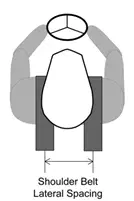
What is the allowable lateral spacing range for shoulder belts according to the given requirement?
Between 76 mm and 127 mm
Between 127 mm and 178 mm
Between 178 mm and 229 mm
Between 229 mm and 280 mm
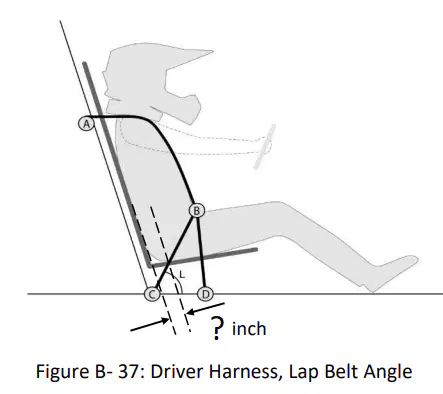
In a side view, the lap belt must be at a minor angle (angle “L” or angle BCD) of between 45 degrees and 80 degrees to the horizontal. This requirement means that the centerline of the lap belt at the seat bottom will be approximately --------inches forward of the bottom of the seat back.
(a)
Which of the following is true regarding the securing of anti-submarine belts?
Anti-submarine belts should be secured with eyebolts.
Anti-submarine belts should not be secured with eyebolts.
Anti-submarine belts can be secured with any type of bolt.
Anti-submarine belts can only be secured with carabiners

Which of the following statements is true about the seat back angle for an upright seating position?
It is less than 65 deg.
It is greater than 90 deg.
It is between 65 deg and 90 deg.
It is exactly 65 deg.
What is the minimum fastener diameter for seat mounting points?
4.0 mm
6.5 mm
8.0 mm
10.0 mm
The fire extinguisher mounting bracket shall be affixed to the RRH via steel tabs with a minimum thickness of --------------- mm thick.
(a)
Which strength grades should threaded fasteners meet or exceed?
SAE Grade 5
Metric Grade 8.8
AN/MS specifications
All of the above
How far apart should the two transponders be mounted?
100 mm
200 mm
300 mm
400 mm
In what scenarios is it required to protect tractive system parts by a fully triangulated structure?
When the tractive system parts have clearance from the ground < 150mm
When the tractive system parts have clearance from the ground < 250mm
When the tractive system parts have clearance from the ground < 350mm
When the tractive system parts have clearance from the ground < 450mm
What are the acceptable grades for the fire-resistant insulating material used in the firewall?
UL94-V0 and FAR25
UL94-V1 and FAR50
UL94-V2 and FAR75
UL94-V3 and FAR100
Which of the following is a requirement for the TSAL (Traffic Signal Aircraft Warning Light)?
It must be a rectangular beacon type with a blue flashing light.
It must be a round beacon type with a red flashing light.
It must be a round beacon type with an amber flashing light (>350 Lumens per unit, IP65 rated) with a frequency of 2Hz-5Hz.
It can be any shape and color as long as it is visible in all directions.
What is the recommended placement for the TSAL (Traffic Signal Aircraft Warning Light)?
It should be placed on top of the BLC (Building Line Control).
It should be placed on the side of the BLC to avoid interference.
It should be placed at the bottom of the BLC for better visibility.
It should be fitted behind the BLC in the middle to ensure visibility from all directions.
The BAJA vehicle must be capable of carrying one (1) person
190 cm tall weighing 113 kg
75 inches tall weighing 250 lbs
170 cm tall weighing 113 kg
67 inches tall weighing 250 lbs
Baja roll cage Primary members are
ALC, CLC, DLC & FLC
RRH, RHO, SIM & RLC
LDB, USM & RLC
RRH, FBM & BLC
Secondary members must be steel tubes having a minimum wall thickness of -------- and a minimum outside diameter of -----
0.036 inches & 1.2 inches
0.89 mm (0.037 in) & 25.4 mm (1.0 in)
0.89 mm (0.035 in) & 25.4 mm (1.0 in)
0.88 mm (0.035 in) & 25.8 mm (1.0 in)
Lateral cross members cannot be less than----
215 mm (8.4 in.) long.
210 mm (8.2 in.) long.
203.5 mm (8 in.) long.
200 mm (7.8 in.) long.
The RRH is substantially vertical but may incline by up to ------ degrees from vertical
(a)
The minimum width of the RRH measured 14 above the inside seat bottom should be a minimum of ----- inches.
(a)
The angle between the LDB members and the RRH vertical members must be greater than or equal to
15 deg
30 deg
25 deg
20 deg
Which standard of insulated tools is recommended to be used while working on the Accumulator(s) or the tractive system according to the guidelines mentioned?
IEC 60900
500V VDE
ANSI
None of the above
What type of cables are required for GLV and what should be the minimum voltage rating for their insulation?
Single-stranded aluminum, multi-core cables rated for at least 30 VDC.
Multi-stranded copper, single core cables rated for at least 60 VDC.
Single-stranded copper, multi-core cables rated for at least 60 VDC.
Multi-stranded aluminum, single core cables rated for at least 30 VDC.
What type of fuses are required, and what should be the maximum time delay for instant blow/trip fuses?
Slow blow/trip fuses with a time delay of less than 500 Ms.
Instant blow/trip fuses with a time delay of less than 500 Ms.
Slow blow/trip fuses with a time delay of more than 500 Ms.
Instant blow/trip fuses with a time delay of more than 500 Ms.
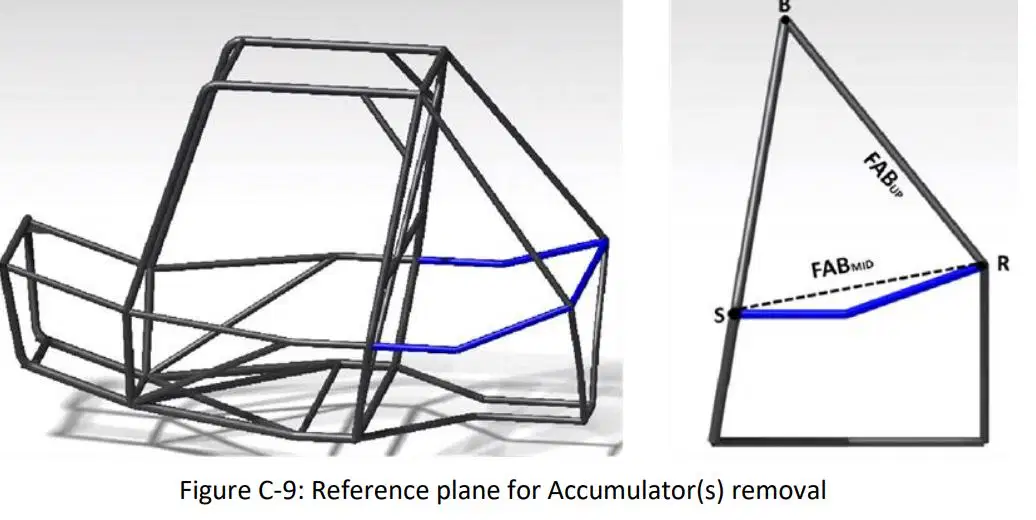
What is the requirement for the path of removal of Accumulator(s) when the container is placed above the SR plane, and what is the maximum allowed vertical motion during the removal process?
The path of removal should be completely below plane S-R, and vertical motion of Accumulator(s) should be limited to 10 inches or less.
The path of removal should be completely above plane S-R, and vertical motion of Accumulator(s) should be limited to 10 inches or less.
The path of removal should be completely above plane S-R, and vertical motion of Accumulator(s) is not restricted.
The path of removal should be completely below plane S-R, and there is no restriction on vertical motion during the removal process.
What is the recommended size for the number punch used to stamp the signature on the roll cage?
4 mm (0.16 inch)
6 mm (0.25 inch)
8 mm (0.31 inch)
10 mm (0.39 inch)

What is the maximum angle allowed between FBMUP and the vertical?
Less than 45 deg
Exactly 45 deg
Less than 20 deg
Exactly 20 deg

What is the maximum allowable height of the knees above the SIM member when viewed from the side?
76mm (3in)
100mm (4in)
50mm (2in)
There is no restriction on the height of the knees above the SIM member when viewed from the side.

What is the minimum clearance required between the driver's chest or upper body/torso and the steering wheel?
200mm
220mm
240mm
210mm
PMSM rotor is made up of
field winding
Permanent magnet
sillicon steel
None of the above
synchronous motor is
not a self starting machine
self starting machine
PMSM stator has
2phase winding
3phase winding
1phase winding
None of the above
PMSM working principle is
ohm's law
Ampire circuital law
magnetic locking
lai law
What is the angle between the steering axis and the vertical in the plane of the wheel?
Castor
Camber
Steering axis inclination
Kingpin inclination
What is a condition called when the vehicle will try to move away from its normal direction and to keep it on the right path there is need to steer a little?
Understeer
Oversteer
Reversibility
Irreversibility
On what principle does the braking system in the car work?
Frictional force
Gravitational force
Magnetic force
Electric force
Which of the following is the need of the gearbox?
To vary the speed of the vehicle
To vary the torque of the vehicle
To vary the power of the vehicle
To vary the acceleration of the vehicle
Increase of torque in a vehicle is obtained by decreasing power.
True
False
What is Suspension System?
provides the optimal use of the fuel
ensures the optimal riding comfort and controllability
allows the car drives automatically
all are incorrect
Under steering is the condition where the vehicle takes a turn with _______________
Larger turning radius
Smaller turning radius
Rear wheels will take larger turn compared to front wheels
Rear wheels will take smaller turn compared to front wheels
What are the requirements for a stable vehicle
I. Higher Centre of gravity position
II. Responsive steering system
III. Uniform distribution of load
all the above
i, ii
ii, iii
i, iii
A vehicle (take mass as 800 kg and velocity 30 Km/hr) collides with a stationary wall. What is the impact force in KN if 0.5 sec is the collision time?
13.3
12.3
16.6
18.9
What will the vehicle’s stopping distance be if a braking force of 16000 N is applied? The mass of the vehicle is 800 kg and the velocity is 60 km/hr
6.9 mts
7.9 mts
8.9 mts
9.9 mts
Which of the following terms are not related to a disk brake system?
Callipers
Piston
Brake shoes
Bleeding
A stopping vehicle experience__________
Forward shift of mass
Mass concentration at C.G
Loss of traction on front wheels
Backward shift of mass
______________ is the property required by material used to fabricate roll case.
Brittle
Hard
Toughness
Creep
Which of the following increases exponentially with increase in speed of the vehicle?
Drag
Kinetic energy
Braking force
Engine RPM
Factor of safety is defined as.
Ultimate stress / Yield stress
Yield stress / Working stress
Lateral Stress / yield stress
Ultimate stress / working stress
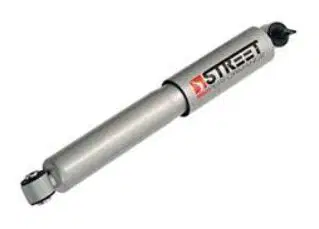
Name this component
strut
shank
shock

