
Font size
 Worksheets
AP Bio Unit 4 Review 2023
Total questions: 61
Worksheet time: 35mins
Hormones belong to the lipid family. Due to this trait, it only makes sense that their receptors...
must be on the surface of the cell.
can be inside the cell because they can cross the membrane.
do not exist.
are difficult to locate.
Cell signaling is similar in all organisms. This conserved trait would support the theory of
adaptive evolution
common ancestry
decent with modification
divergent evolution
Cells in animal adrenal glands secrete adrenaline to prepare muscles for exertion in the case of a threat. This is an example of __________ signaling.
autocrine
juxtacrine
paracrine
endocrine
Animal cells have structures called gap junctions to allow ligands to move directly from one cell to another. An example of this would be found in cardiac muscle tissue that allows the cells to beat in unison. This is an example of ___________ signaling.
autocrine
juxtacrine
paracrine
endocrine
Quorum sensing is used by bacteria to determine when they decide to initiate toxin production. Since the signals only move to nearby cells, this is an example of ___________ signaling.
autocrine
paracrine
juxtacrine
endocrine
Which statement describes the relationship of the ligand and the receptor?
The ligand fits into a site on the receptor molecule like a lock and a key.
The recptor fits into a site on the ligand molecule like a lock and a key.
The ligand and receptor are antagonistic in nature.
The ligand can bind with any surface receptor that is present.
What is the name of the signaling molecule in cell signaling?
substrate
receptor
ligand
channel
What is the name of the signaling molecule in cell communication?
ligand
receptor
operon
inhibitor
Choose the correct order of communication.
reception, response, transduction
transduction, reception, response
response, transduction, reception
reception, transduction, response
Long distance signals involving hormones are ________ signals.
paracrine
synaptic
endocrine
Phosphorylation cascades are often used for
reception
responses
amplification
termination
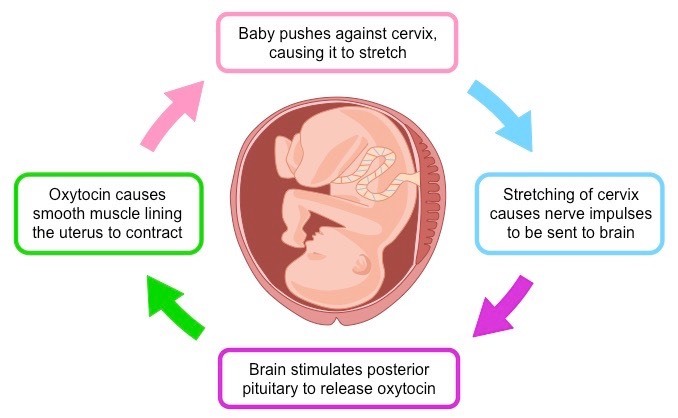
What type of feedback loop is shown?
negative
neutral
positive
Consider this pathway: epinephrine--> G protein-coupled receptor --> G protein --> adenylyl cyclase --> cAMP. Identify the second messenger.
cAMP
G protein
GTP
adenylyl cyclase
G protein-coupled receptor

Which of the following would NOT result in the inhibition of this pathway?
A change in the shape of the receptor
The presence of a competitive ligand
Increase in hormone concentration
Loss of second messenger production

Which part of the signaling pathway could consist of protein modification, second messenger production, amplification or a phosphorylation cascade?
Reception
Transduction
Response
All of these

The B-adrenergic receptor is important because...
It serves as the only ligand receptor
It produces a secondary messenger
It is the ligand that activates the pathway
It is the target molecule that stimulates gene expression

If MNK1 remained in its active state permanently, what would be the result?
c-Myc would be unable to translate growth genes
Cell growth and division will stop
The phosphorylation cascade will stop
Cell division will increase, leading to tumor formation

When GAP is unable to release a phosphate, what result occurs?
Genes that lead to cancer are activated
Normal signaling continues
GTP is activated by GEF
Genes that lead to tumor suppression are activated

Which of these explains why this pathway involves a negative feedback loop in a normal cell?
As ERK increases, it inhibits RAS, stopping transduction
As ERK increases, it increases RAS, continuing transduction
Grb2 is removed from the receptor, stopping transduction
RAS mutates, causing signal transduction to stop

This type of cell signaling will only be effective...
over long distances (endocrine)
when cells are in direct contact (juxtacrine)
when responding to its own ligands (autocrine)
if cells are nearby (paracrine)

Which receptor is responsible for the signaling pathway that leads to apoptosis?
Delta/Serrate/Lag-2
Frizzled
TGF-B RI/RII
Ptch

Which of these is an accurate response to increased glucose levels in the blood?
Alpha cells release glucagon from the pancreas
Liver breaks down glycogen and releases glucose
Blood glucose levels rise back to homeostatic levels
Beta cells in the pancreas release insulin

cAMP is an example of a...
secondary messenger
ligand
receptor protein
target cell

Which of these shows the cell cycle phases in their correct order AND correctly paired with their functions?
G1-growth, M-division, G2-DNA checkpoints, S-DNA replication
G1-growth, S-DNA replication, G2-prepare to divide, M-division
M-division, G1-growth, S-DNA replication, G2-prepare to divide
S-Interphase, G2-growth, M-division, G1-DNA replication

Which phase of mitosis occurred between panels C and D?
Metaphase
Telophase
Synthesis
Anaphase

In what phase of mitosis is this cell?
Prophase
Metaphase
Anaphase
Telophase

Which of these graphs represents the amount of DNA present in a normal cell throughout the cell cycle?
A
B
C
D

p53 is a gene that codes for a CDK inhibitor that slows the cell cycle. What would be the result of a mutation in the p53 gene?
No cell division
Decreased CDK/Cyclin complexes
Activated DNA repair
Tumor formation

Which of the following is NOT a result of a cell unable to perform apoptosis?
Increased health and fitness due to the removal of the cellular death process
Continued growth of cancerous cells
Potential for additional, unnecessary tissues
Proliferation of cells infected with a virus in spite of immune response

Which of these is NOT part of interphase?
G1
S
M
G2

If ATP were unavailable, what would be the effect on this pathway?
Protein kinase A would not be produced
GDP would not bind to the transmembrane protein
The hormone would not bind to the transmembrane protein
The secondary messenger would not be produced

Which of these correctly describes a chromatid?
long stringy genetic material that exists in interphase
homologous chromosome pairs seen in meiosis
one half of a duplicated chromosome
stringy tubule that pulls genetic matter across a cell
Phosphorylation cascades are often used for
reception
responses
amplification
termination
This type of cell signaling will only be effective...
over long distances (endocrine)
when cells are in direct contact (juxtacrine)
when responding to its own ligands (autocrine)
if cells are nearby (paracrine)
Which of these is an accurate response to increased glucose levels in the blood?
Alpha cells release glucagon from the pancreas
Liver breaks down glycogen and releases glucose
Blood glucose levels rise back to homeostatic levels
Beta cells in the pancreas release insulin
Which of these shows the cell cycle phases in their correct order AND correctly paired with their functions?
G1-growth, M-division, G2-DNA checkpoints, S-DNA replication
G1-growth, S-DNA replication, G2-prepare to divide, M-division
M-division, G1-growth, S-DNA replication, G2-prepare to divide
S-Interphase, G2-growth, M-division, G1-DNA replication
In what phase of mitosis is this cell?
Prophase
Metaphase
Anaphase
Telophase
Which of these graphs represents the amount of DNA present in a normal cell throughout the cell cycle?
A
B
C
D
Which of the following is NOT a result of a cell unable to perform apoptosis?
Increased health and fitness due to the removal of the cellular death process
Continued growth of cancerous cells
Potential for additional, unnecessary tissues
Proliferation of cells infected with a virus in spite of immune response
If ATP were unavailable, what would be the effect on this pathway?
Protein kinase A would not be produced
GDP would not bind to the transmembrane protein
The hormone would not bind to the transmembrane protein
The secondary messenger would not be produced
Vertebrate immune responses involve communication over short and long distances. Which of the following statements best helps explain how cell surface proteins, such as MHC proteins and T cell receptors, mediate cell communication over short distances?
The proteins receive electrical signals from nerve cells.
The proteins leave the cell and travel in the bloodstream to other cells.
The proteins interact directly with proteins on the surfaces of other cells.
The proteins bind to molecules secreted by cells located in other parts of the body.

The epinephrine signaling pathway plays a role in regulating glucose homeostasis in muscle cells. The signaling pathway is activated by the binding of epinephrine to the beta-2 adrenergic receptor. A simplified model of the epinephrine signaling pathway is represented in Figure 1. Based on Figure 1, which of the following statements best describes the epinephrine signaling pathway?
It involves the opening and closing of ion channels.
It involves enzymes activating other enzymes.
It involves changes in the expression of target genes.
It involves protons moving down a concentration gradient.

Classify the image by their type of communication.
Direct Contact (Animal Cell)
Direct Contact (Plant Cell)
Long Distance / Endocrine Signaling
Local Signaling / Paracrine
Local Signaling / Synaptic Signaling

Classify the image by their type of communication.
Direct Contact (Animal Cell)
Direct Contact (Plant Cell)
Long Distance / Endocrine Signaling
Local Signaling / Paracrine
Local Signaling / Synaptic Signaling
What is direct contact communication in animal cells called?
Gap Junctions
Plasmodesmata
Endosymbiosis
Spongebob / Patrick Junction

What is the stage of signal transduction labeled A?
Transduction
Response
Reception
Endocrine
What is direct contact communication in plant cells called?
Gap Junctions
Plasmodesmata
Endosymbiosis
Spongebob / Patrick Junctions
What is the role of enzymes in signal transduction?
To act as secondary messengers
To bind to receptors and initiate signal transduction
To amplify the signal by catalyzing the conversion of inactive molecules into active ones
To transport signals from the cell membrane to the nucleus
Anaphase
chromosomes line up at the center of the cell.
involves the cell preparing to divide
sister chromatids of each chromosome separate and are pulled toward opposite poles of the cell
final stage of mitosis
separated sister chromatids arrive at opposite poles of the cell and begin to decondense, forming chromatin again
Which of the following statements best describes negative feedback in homeostasis?
It amplifies the changes in a system to maintain equilibrium
It reduces the output of a system to bring it back to its set point
It maintains a steady state by enhancing the response of a system
It initiates a response to an external stimulus to restore balance
It is a rare phenomenon that occurs only in a few physiological systems
Glucagon, released from the pancreas, attaches to receptors in the liver, resulting in the breakdown of glycogen stores and an increase in blood sugar
autocrine signalling
juxtacrine signalling
paracrine signalling
endocrine signalling
How do bacteria sense local population density?
quorum sensing
bacteria sensing
signal sensing
population sensing
Feedback loops are important because they allow organisms and the environment to
change based on new inputs
fall apart
change based on new outputs
maintain balance
When glucose levels in the blood rise, your brain sends a signal to your pancreas. The pancreas releases insulin, which opens channels in cell membranes to allow glucose to enter the cell, lowering blood sugar levels. This is an example of a:
Positive Feedback Loop
Negative Feedback Loop
Adjacent plant cells have narrow channels called plasmodesmata that pass through the cell walls of the connected cells and allow a cytoplasmic connection between the cells.
Which of the following statements best describes a primary function of plasmodesmata?
They allow the movement of molecules from one cell to another, enabling communication between cells.
They prevent the cell membrane from pulling away from the cell wall during periods of drought.
They eliminate the need to produce signaling molecules and eliminate the need for cells to have receptors for signaling molecules.
They increase the surface area available for attachment of ribosomes and thus increase protein synthesis.
A researcher examining a root tip observes a plant cell with condensed sister chromatids, kinetochores with attached microtubules, and individual chromosomes that are aligned at the equatorial plate of the cell. Which of the following best describes what the next process will be in the cell?
Homologous chromosomes (each with two sister chromatids) will move toward opposite poles of the cell.
Paired chromatids will separate, and the new daughter chromosomes will move toward opposite poles of the cell.
The nuclear envelope will break down, and the spindle will begin to form.
The chromatin will decondense, and the daughter cell will enter interphase.

