
Font size
 Worksheets
Topic 1 IB Biology Review
Total questions: 69
Worksheet time: 35mins

The diagram shows a prokaryotic cell. What are the structures labelled Y and Z?
Y: Nucleus, Z: 70S Ribosome
Y: Nucleoid, Z: 80S Ribosome
Y: Nucleus, Z: 80S Ribosome
Y: Nucleoid, Z: 70S Ribosome
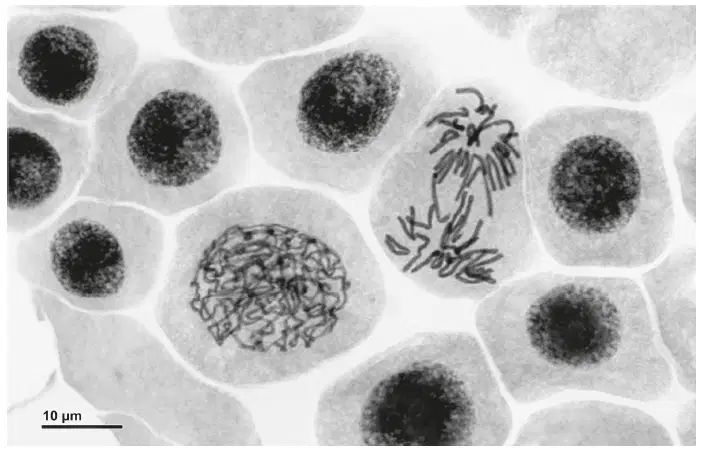
The micrograph shows some onion (Allium cepa) cells undergoing mitosis. What is the mitotic index, taking into account all visible nuclei?
0.1
0.2
0.4
0.6
A cell contains chloroplasts, plasma membrane and 80S ribosomes. What type of cell could it be?
Bryophyte
Lymphocyte
Prokaryote
Neuron
More than 90 % of cellular cholesterol is located in the cell’s plasma membrane. What is the main role of cholesterol in the plasma membranes of mammalian cells?
To regulate membrane fluidity
To increase membrane solubility
To increase membrane permeability
To regulate membrane temperature
What is/are required for facilitated diffusion?
I. A concentration gradient
II. ATP
III. A channel protein
I only
I and III only
II and III only
I, II and III

In the chimpanzee (Pan troglodytes), the haploid number of chromosomes is 24. How many sister chromatids are present in the G2 phase of a somatic cell, such as a cell in the bone marrow of the chimpanzee?
12
24
48
96
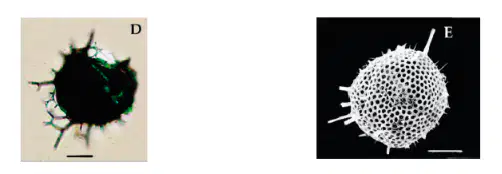
The images of the radiolarian, a single-celled marine organism, were produced using a light microscope (left) and a scanning electron microscope (right). What is a reason for the difference in quality of these images?
Light cannot pass through the specimen.
Higher magnification can be achieved with the electron microscope.
The resolution of the electron microscope is higher.
Samples are stained with methylene blue when viewed with the light microscope.

In an experiment on osmosis, red blood cells were immersed in a salt solution for two hours. The micrographs show the appearance of these cells before and after immersion in the salt solution. What explains the observed changes?
The salt solution was hypertonic and entered the red blood cells.
The salt solution was hypotonic and disrupted the membranes of the red blood cells.
The salt solution was hypertonic and water moved into it from the red blood cells.
The salt solution was hypotonic and mineral salts were lost from the red blood cells.

Pasteur used swan-necked flasks and a nutrient broth to demonstrate that spontaneous generation of organisms does not occur on Earth. Some students performed a similar experiment using two swan-necked flasks, one containing broth which had been previously boiled and another containing broth which had not been boiled. The flasks were left in the school laboratory and observed after one week.
What is the evidence against the spontaneous generation theory?
Microorganisms died in flask F due to high temperatures.
No microorganisms grew in either flask.
Microorganisms grew in flask G.
No microorganisms grew in flask F but many grew in flask G.
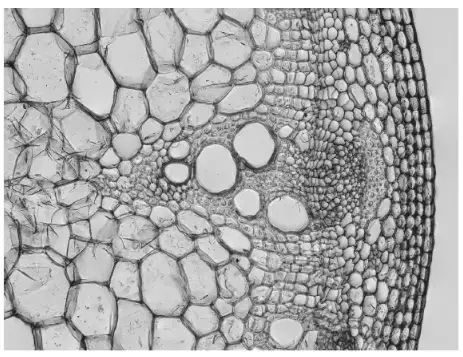
The micrograph of a section through a plant stem shows at least ten different types of cells. What explains the differences between these cells?
Only one gene is expressed in each cell type.
Different genes are expressed in each cell type.
Only useful genes remain in the DNA of each cell type.
Changes in the DNA sequence take place when these cells develop.
Which feature(s) allow(s) transport of glucose in blood plasma?
I. It is hydrophobic.
II. It is polar.
III. Its solubility is low at 37 °C.
I only
II only
I and II only
II and III only
Which features of phospholipids give them their amphipathic properties?
Basic phosphate groups and acidic lipids
Acidic phosphate groups and basic lipids
Hydrophobic phosphate groups and hydrophilic fatty acids
Hydrophilic phosphate groups and hydrophobic fatty acids
How is facilitated diffusion in axons similar to active transport?
They both require the energy of ATP.
They both move substances against a concentration gradient.
They both use sodium–potassium pumps.
They are both carried out by proteins embedded in the axon membrane.
How do both mitochondria and chloroplasts provide evidence for the endosymbiotic theory?
They have double membranes.
They have 80S ribosomes similar to prokaryotes.
They contain the same DNA as the nucleus of the cell.
They exist together in eukaryote cells for their mutual benefit.
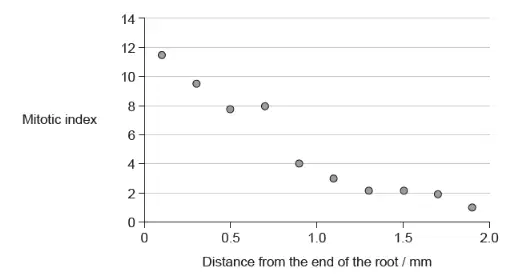
The graph shows the mitotic index in the roots of lentil plants at different distances from the end of the root. What can be deduced from the graph?
As the distance from the end of the root increases, more cells are undergoing mitosis.
At 0.5 mm from the end of the root, most of the cells are in prophase.
There were fewer cells observed at 1.5 mm than at 0.5 mm.
As the distance from the end of the root increases, the percentage of cells in interphase increases.
Which of the following is NOT true of all cells?
They contain genetic material
They are surrounded by membranes
They have their own energy systems
They contain a nucleus

Which of the following is the equation used to calculate the actual size of a specimen?
size of image / magnification
magnification / size of image
magnification * size of image
Which of the following examples go against cell theory?
striated muscle cells
fungal hyphae
red blood cells
giant algae
What limits cell size?
Amount of nutrients available
Number of organelles
Surface area to volume ratio
Availability of oxygen

Which of the following is the cause of cell differentiation in multicellular organisms?
The amount of DNA in the cell
The amount of RNA in the cell
The use of mitochondrial DNA
The expression of different genes
Which of the following diseases depends on controversial stem cells for treatment?
Parkinson's disease
Stargardt's disease
Alzheimer's disease
Multiple sclerosis

Identify the organelle in the micrograph.
Rough Endoplasmic Reticulum
Mitochondria
Cell membrane
Nucleus

Identify the organelle in the micrograph.
Rough Endoplasmic Reticulum
Chloroplast
Mitochondria
Free Ribosomes

Identify the organelle in the micrograph.
Rough Endoplasmic Reticulum
Mitochondria
Cell membrane
Nucleus
Which sequence has the cells arranged according to their ability to differentiate, starting from the least able?
bone marrow, neuron, embryonic, umbilical
neuron, bone marrow, umbilical, embryonic
umbilical, embryonic, bone marrow, neuron
embryonic, umbilical, bone marrow, neuron
When compared to other body cells, which characteristic of stem cells is the most important for therapeutic uses?
Less differentiation
Less excretion
Lower rate of reproduction
Lower rate of metabolism
Which characteristic of stem cells makes them useful for treating Stargardt’s disease?
They can differentiate into retinal cells.
They are readily available from especially created embryos.
They transport white blood cells to the eyes.
They divide by binary fission so provide sufficient cells.

The image shows part of a mammalian cell. What is the specialized function of this mammalian cell? REMEMBER, you can enlarge the picture by clicking on it.
Locomotion
Absorption
Reception of stimuli
Gas exchange

The Davson–Danielli model of membrane structure proposed that membranes were composed of a phospholipid bilayer that lies between two layers of globular proteins, as shown in this diagram. What evidence supported this model?
An electron micrograph that showed two dark lines with a lighter band in between
Freeze-fracture electron microscopy
Evidence that all membranes are identical
The hydrophobic regions of protein would be in contact with water

What part of the plasma membrane is fluid, allowing the movement of proteins in accordance with the fluid mosaic model? Make sure to click on the picture.
A
B
C
D

In the diagram, which structure is an intrinsic or integral protein?
A
B
C
D
What is a role of cholesterol in animal cells?
It increases body fat.
It controls membrane fluidity.
It lines the inner wall of capillaries.
It is a constituent of bile.
Which evidence falsifies the Davson–Danielli model?
I. The presence of globular proteins within the phospholipid bilayer
II. Non-polar amino acids cause proteins to remain embedded in membranes
III. Membrane proteins remain in a fixed position inside a membrane
I only
I and II only
II and III only
I, II and III
The cell membrane model proposed by Davson–Danielli was a phospholipid bilayer sandwiched between two layers of globular protein. Which evidence led to the acceptance of the Singer–Nicolson model?
The orientation of the hydrophilic phospholipid heads towards the proteins
The formation of a hydrophobic region on the surface of the membrane
The placement of integral and peripheral proteins in the membrane
The interactions due to amphipathic properties of phospholipids
How is facilitated diffusion in axons similar to active transport?
They both require the energy of ATP.
They both move substances against a concentration gradient.
They both use sodium–potassium pumps.
They are both carried out by proteins embedded in the axon membrane.
A human organ is being prepared for transplant. In what type of solution must it be bathed?
A hypertonic solution
A hypotonic solution
Pure water containing no solutes
A solution with the same osmolarity as the organ tissue

Which graph best represents the relationship between the concentration of chloride ions in the external environment of a cell and the rate at which the chloride ions move by facilitated diffusion into the cytoplasm of the cell?
A
B
C
D

The diagram shows a section through a membrane. What are the modes of transport in the diagram?
I: Simple Diffusion, II: Osmosis
I: Active Transport, II: Facilitated Diffusion
I: Simple Diffusion, II: Facilitated Diffusion
I: Facilitated Diffusion, II: Active Transport
By which process do potassium ions move through potassium channels in axons?
Active transport
Exocytosis
Facilitated diffusion
Simple diffusion
Which process(es) occur(s) by osmosis?
I. Uptake of water by cells in the wall of the intestine
II. Loss of water from a plant cell in a hypertonic environment
III. Evaporation of water from sweat on the skin surface
I only
I and II only
II and III only
I, II and III

The table shows concentrations of potassium ions and sodium ions inside and outside human cells. What explains these concentrations?
Potassium ions diffuse in and sodium ions diffuse out.
Sodium ions diffuse in and potassium ions diffuse out.
Active transport pumps sodium ions in and potassium ions out.
Active transport pumps sodium ions out and potassium ions in.
Neural pathways in living brains can now be mapped by tracking the movement of water molecules inside axons. What keeps water molecules inside axons?
Plasma membrane
Hydrogen bonding
Pump proteins
Synapse
How does potassium move across the membrane of a neuron during repolarization?
Simple diffusion
Facilitated diffusion
Endocytosis
Active transport
The salt concentration inside an animal cell is 1.8 %. The salt concentration in the surrounding medium becomes 5 %. What will be the likely response?
The cell will gain water from the medium.
The cell will lose salt to the medium.
The cell will remain unchanged.
The cell will shrink from loss of water.

A dialysis membrane was set up to model digestion and absorption in the small intestine. What is a limitation of this model?
There can be no active transport.
Maltose will pass through the membrane.
Lipase should be present with protein.
The membrane is not permeable to starch.
How do both mitochondria and chloroplasts provide evidence for the endosymbiotic theory?
They have double membranes.
They have 80S ribosomes similar to prokaryotes.
They contain the same DNA as the nucleus of the cell.
They exist together in eukaryote cells for their mutual benefit.
Which statement is evidence for the endosymbiotic theory?
Chloroplasts contain 70S ribosomes.
Protein synthesis occurs in the cytoplasm.
Organic molecules can be synthesised abiotically.
RNA is self-replicating.

The electron micrograph shows a section through a cell. Which feature of the cell in the micrograph is consistent with the endosymbiotic theory?
X has a single membrane.
Y has a double membrane.
X contains 70S ribosomes.
Y contains 80S ribosomes.
Which statement provides evidence for endosymbiosis?
Early prokaryotes contributed to a large increase in oxygen in the atmosphere.
Eukaryotic mitochondria and chloroplasts have their own circular DNA.
Certain groups of ancient prokaryotes developed mechanisms to carry out aerobic respiration.
Experiments by Miller and Urey produced simple organic molecules in abiotic conditions.

Apparatus was set up as shown to collect data. The graph shows the results after 47 minutes of data collection. What causes the rates to differ?
I. Different concentration gradients at the start
II. Diffusion of sugar is initially greater in Y than in X
III. The systems are reaching equilibrium over time
I only
II only
I and III only
II and III only
Pasteur carried out a series of experiments that provided strong evidence against a widely supported theory. What was this theory?
Endosymbiosis
Spontaneous generation
Conservative replication of DNA
Evolution
What is evidence for the endosymbiotic theory?
RNA can catalyze metabolic reactions.
Meteorites contain organic molecules.
Amino acids can be synthesized from inorganic compounds.
Mitochondria possess their own DNA.

The statement relates to Pasteur’s experiments. What did this statement suggest?
Mold evolved by endosymbiosis.
Oxygen is required for anaerobic respiration.
Cells can only be formed by division of pre-existing cells.
Nutrients are a requirement for mold growth.

A tissue sample was examined under the microscope in order to determine a mitotic index. The number of cells in each stage of the cell cycle was determined and the data were entered into a table. What is the mitotic index?
0.125
0.25
0.75
1.00
How many chromosomes are there in a cell during anaphase of mitosis, if the diploid number of the cell is 20?
10
20
40
80

In the micrograph, which letter points to a cell in anaphase?
A
B
C
D

Students examined micrographs and counted cells in the different stages of mitosis as well as those cells with no visible chromosomes. The table shows their results. What is the mitotic index?
0.2
0.4
0.6
0.7

The table shows the number of cells in various stages of the cell cycle in four samples of ovarian tissue from different patients. Which tissue sample A, B, C or D has the highest mitotic index?
A
B
C
D

What explains the appearance of the cell in the micrograph?
The cell is dying.
The DNA is replicating.
The cell is in metaphase.
The cell is in telophase.
Which processes are involved in the development of cancer?
I. Mutations occur in oncogenes.
II. Oncogenes prevent cancer.
III. Oncogenes affect cell cycle regulatory proteins.
I and II only
I and III only
II and III only
I, II and III

The diagram represents the nucleus of a cell 2 n = 8 in late prophase of mitosis. Which diagram represents a cell from the same species in anaphase II of meiosis?


How does mitosis produce two genetically identical nuclei?
By separation of homologous chromosomes
By separation of sister chromatids
By division of the cytoplasm into two equal cells
By division of the nuclear membrane into two equal parts

The concentrations of cyclins rise and fall in cells at certain times. What times are these?
Day and night
Seasons of the year
Stages of mitosis and interphase
Developmental stages in the life cycle

The image shows cells in the different stages of mitosis. Which cell is in telophase?
A
B
C
D
What occurs during meiosis but not mitosis?
Spindles are formed from microtubules.
Chromosome number is conserved.
Homologous chromosomes pair up.
Centromeres split.

Which diagram(s) represent(s) processes used in asexual reproduction?
I only
I and II only
II only
I, II and III

When during the cell cycle does DNA replication take place?
A
B
C
D

The graph shows the survival probabilities for current smokers and for those who never smoked among women 30 to 80 years of age. What can be deduced from this graph?
There is a correlation between smoking and cancer.
Smoking reduces life expectancy.
Smoking causes cancer.
70 % of smokers survive to 80 years old.

Which mitotic phase is labeled X in the micrograph of an onion (Allium cepa) root tip?
Prophase
Metaphase
Anaphase
Telophase

