
 Worksheets
Pre-AP Biology Unit 1 Practice Test- Central Dogma
Total questions: 64
Worksheet time: 57mins
Name
Class
Date
1.

DNA is a polymer made of:
a)
Nucleotides
b)
Ribosomes
c)
Purines
d)
Pyrimidines
2.

Which of the following best describes a DNA molecule?
a)
double helix
b)
contains ribose
c)
made of amino acids
d)
contains Uracil
3.
Which organelle is DNA usually found in?
a)
cell membrane
b)
vacuole
c)
ribosome
d)
nucleus
4.

In a molecule of double-stranded DNA, the amount of Adenine present is always equal to the amount of
a)
cytosine
b)
guanine
c)
thymine
d)
uracil
5.
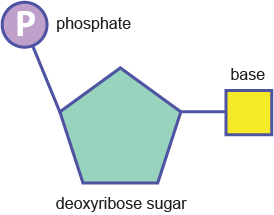
Nucleotides are made up of a sugar, phosphate, and..?
a)
nitrogenous base
b)
nucleic acid
c)
cholesterol
d)
fatty acid
6.
What does DNA stand for?
a)
Deoxyribonucleic acid
b)
Denitrogenous acid
c)
Deribonucleic acid
d)
Diribonucleic acid
7.
Guanine bonds with ______________.
a)
Adenine
b)
Guanine
c)
Cytosine
d)
Thymine
8.

What determines the code, or information, of a DNA molecule?
a)
the shape (structure) of the nitrogen bases
b)
the order (sequence) of the nitrogen bases
c)
the color of the nitrogen bases
d)
the frequency (number) of nitrogen bases
9.
Which 2 molecules form the sides (backbone) of the DNA ladder?
a)
deoxyribose sugar and adenine
b)
deoxyribose sugar and a hydrogen bond
c)
deoxyribose sugar and the nucleus
d)
deoxyribose sugar and phosphate
10.
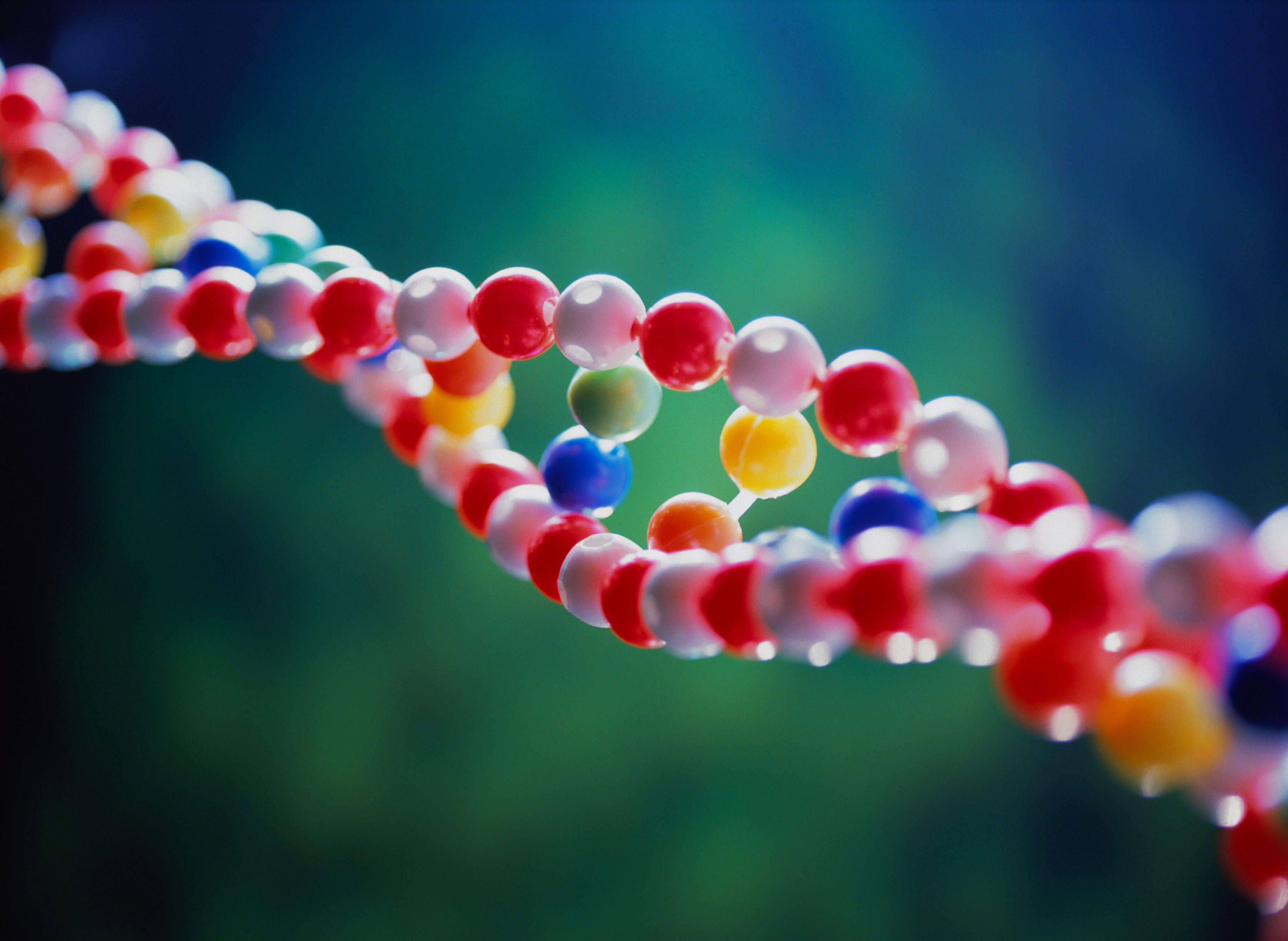
Why is DNA important?
a)
it is very small and very complicated
b)
it's in everything
c)
it serves as the blueprint for traits of all living things
d)
because we eat it every day for energy
11.
What are the three components of a nucleotide?
a)
sugar, hydrogen, nitrogen base
b)
sugar, oxygen, nitrogen base
c)
sugar, phosphate, nitrogen base
d)
sugar, phosphate, protein
12.
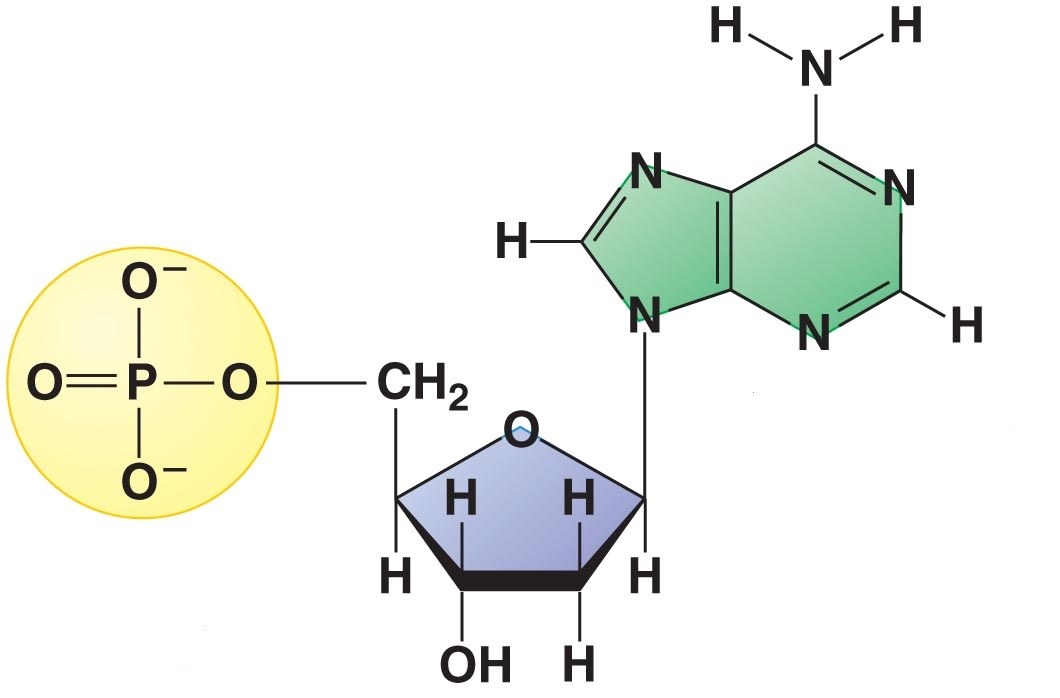
Name this structure
a)
double helix
b)
nucelotide
c)
twisted ladder
d)
hydrogen bond
13.
Which shows the correct complementary base pairing for DNA?
a)
C-A, T-G
b)
A-G, C-T
c)
C-G, U-A
d)
T-A, G-C
14.
Nucleotides are made up of a sugar, phosphate, and..?
a)
nitrogenous base
b)
nucleic acid
c)
cholesterol
d)
fatty acid
15.
Which of the following units are repeatedly joined together to form a strand of DNA?
a)
amino acids
b)
nucleotides
c)
fatty acids
d)
polysaccharides
16.
Which of the following Base Pair Rules is incorrect for DNA?
a)
A-T
b)
A-U
c)
C-G
d)
G-C
17.
Which shows the correct complementary base pairing for RNA?
a)
C-A, T-G
b)
A-G, C-T
c)
C-G, U-A
d)
T-A, G-C
18.

DNA codes for...
a)
bases
b)
proteins
c)
amino acids
d)
phosphates
19.
a change in the nucelotide-base sequence of a gene or DNA molecule
a)
nucleotide
b)
DNA
c)
RNA
d)
mutation
20.
Which RNA bases would pair with TACGAA in transcription?
a)
AUGCUU
b)
ATGCTT
21.

A segment of DNA is called a
a)
chromosome
b)
gene
c)
amino acid
d)
protien
22.

The purpose of transcription is to ____________.
a)
Stop mutations
b)
Make a new strand of DNA
c)
Create a chain of amino acids (protein)
d)
Make a strand of mRNA
23.

The purpose of translation is to ____________.
a)
Stop mutations
b)
Make a new strand of DNA
c)
Create a chain of amino acids (protein)
d)
Make a strand of mRNA
24.

Three nucleotide bases on a strand of mRNA are a(n) ____.
a)
mutation
b)
chromosome
c)
codon
d)
anticodon
25.
Which process is used to make mRNA from the DNA in the nucleus?
a)
transcription
b)
translation
c)
replication
26.
Where does transcription take place?
a)
nucleus
b)
cytoplasm
c)
ribosome
27.
One difference between DNA and RNA is that....
a)
Only RNA has the base Uracil
b)
only RNA contains the base Thymine
c)
only RNA contains the base Cytocine
d)
only RNA contained the base Guanine
28.
what does mRNA do?
a)
carry info from genes to ribosomes
b)
carry amino acids to ribosomes
c)
help with RNA splicing
d)
make up ribosomes
29.
A triplet of mRNA is called a
a)
codon
b)
anticodon
c)
amino acid
d)
peptide bond
30.
Where does transcription take place?
a)
nucleus
b)
ribosome
c)
cytoplasm
d)
smooth ER
31.

DNA codes for...
a)
cholesterol
b)
proteins
c)
fatty acids
d)
a sandwich
32.
Where does transcription take place?
a)
nucleus
b)
cytoplasm
c)
ribosome
33.
What is the building block of proteins?
a)
Monosacchrides
b)
Polysaccharides
c)
amino acids
d)
Triglycerides
34.
Does the order of amino acids in a protein matter?
a)
YES!
b)
NO!
35.
Which is a difference between DNA and RNA
a)
RNA is double stranded
b)
RNA is not made of nucleotides
c)
RNA contains Uracil instead of Thymine
d)
RNA does not contain a sugar
36.
what does mRNA do?
a)
carry info from genes to ribosomes
b)
carry amino acids to ribosomes
c)
help with RNA splicing
d)
make up ribosomes
37.
Which of the following sequences of processes correctly reflects the central dogma?
a)
A. protein synthesis, transcription, translation
b)
A. protein synthesis, translation, transcription
c)
A. transcription, translation, protein synthesis
d)
A. translation, transcription, protein synthesis
38.
What is the term for making an RNA copy of DNA?
a)
Transription
b)
Translation
c)
Folding
d)
Coding
39.

The process represented in the diagram produces a molecule that is complementary to the template strand of DNA. What type of molecule is produced?
a)
New DNA
b)
Polypeptide
c)
Messenger RNA
d)
Carbohydrate
40.
In order for DNA instructions to move from the nucleus to the ribosomes in the cytoplasm of a cell, an RNA copy of a DNA strand must be made. This process, which takes place in the cell nucleus, is called
a)
translation
b)
mutation
c)
DNA replication
d)
transcription
41.
This cannot leave the nucleus
a)
DNA
b)
RNA
c)
Both
42.
The central dogma states that information flows from
a)
RNA to DNA to polysaccharide
b)
DNA to RNA to proteins
c)
RNA to DNA to proteins
d)
DNA to polysaccharides to RNA
43.
I include the bases guanine, cytosine, and adenine.
a)
DNA
b)
RNA
c)
Both DNA and RNA
44.
I am a nucleic acid.
a)
DNA
b)
RNA
c)
Both DNA and RNA
45.
There 3 types of
a)
DNA
b)
RNA
46.
Which molecule brings the amino acid to the ribosome?
a)
DNA
b)
mRNA
c)
tRNA
d)
rRNA
47.
mRNA stands for
a)
my RNA
b)
messenger RNA
c)
mitosis RNA
d)
mutated RNA
48.
Translation takes place in the
a)
ribosome
b)
chloroplast
c)
nucleus
d)
mitochondria
49.
Brings the amino acids to the ribosome
a)
mRNA
b)
tRNA
c)
rRNA
d)
DNA
50.
What would be the tRNA anticodon for the mRNA codon CAG?
a)
GTC
b)
GUC
c)
CUG
d)
CAG
51.
What is the term for a three-nucleotide sequence that codes for an amino acid?
a)
base
b)
codon
c)
amine
d)
serine
52.
Which phrase best describes translation?
a)
converts mRNA into a polypeptide
b)
catalyzes bonds between amino acids
c)
produces RNA from DNA molecules
d)
recycles tRNA molecules for reuse
53.
The job of tRNA is to
a)
carry amino acids to the ribisomes
b)
carry ribisomes to the ER
c)
carry glucose to mitochondria
d)
carry mRNA out of the nucleus
54.
The codon is located on the
a)
DNA
b)
mRNA
c)
tRNA
d)
rRNA
55.
What would happen if we did not have start codons?
a)
Polypeptide chains would continue to grow
b)
Amino acids would bind to tRNA
c)
Protein synthesis wouldn't occur
d)
mRNA would form a double strand
56.
What is the transcribed mRNA strand for CATTAA
a)
GUAAUU
b)
GTAATT
c)
AUGGUU
d)
CATTAA
57.
Identify the complementary DNA strand: ATTACGAT
a)
GAAGTGCA
b)
TAATGCTA
c)
TCTUCAAA
d)
CGGCACG
58.
What is the monomer of DNA and RNA?
a)
amino acids
b)
nucleotides
c)
fatty acids
d)
monosaccharide
59.
Transcribe the following sequence of DNA into RNA:
AAG CTT TGC
AAG CTT TGC
a)
TTC GAA ACG
b)
UUC GAA ACG
c)
TTC GUU UCG
d)
UUC GUU UCG
60.
Protein synthesis takes place in two parts:
a)
Transcription then translation
b)
Replication then transcription
c)
Translation then transcription
d)
Replication then translation
61.
Which molecule brings the amino acid to the ribosome?
a)
DNA
b)
mRNA
c)
tRNA
d)
rRNA
62.
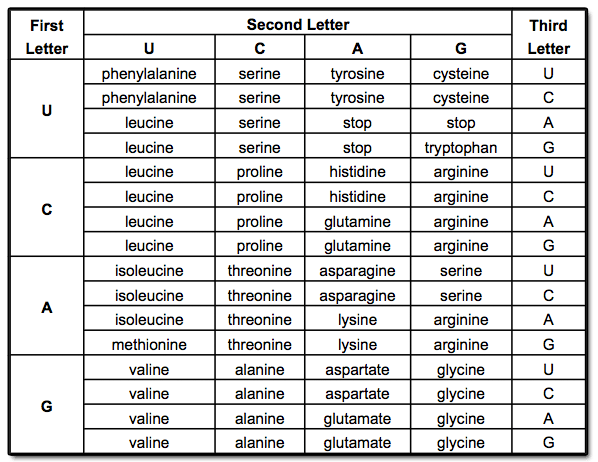
What is the correct amino acid sequence for the mRNA code AUGCCAGUAUGA
a)
Met-Pro-Ala-Val
b)
Met-Pro-Val
c)
Tyr-Gly-His
d)
Tyr-Gly-Arg-His
63.
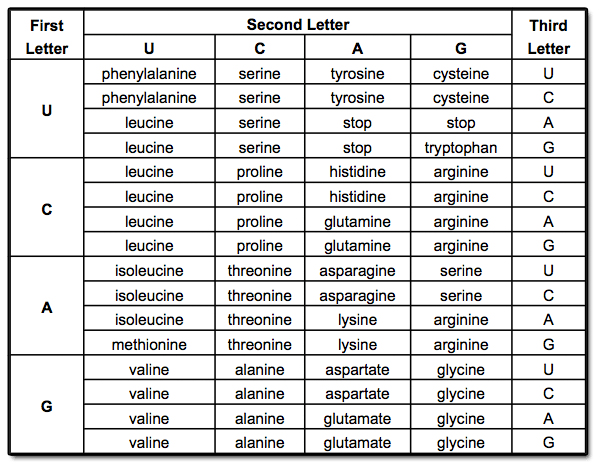
What amino acid is represented by the codon UUA?
a)
Phenylalanine
b)
Tyrosine
c)
Leucine
d)
Stop codon
64.
A ___ is a portion of a DNA molecule that contains the information necessary for the building of a protein.
a)
Amino acid
b)
Codon
c)
Chromosome
d)
Gene
100 %

