
 Worksheets
Unit 3: Enzymes, ATP, and Energy Flow
Total questions: 60
Worksheet time: 2hrs 26mins
Enzymes are an example of
lipids
carbohydrates
protein
nucleic acid
Each enzyme only has 1 substrate that will fit its active site. What is this called?
reusable
catalyst
fragile
specific

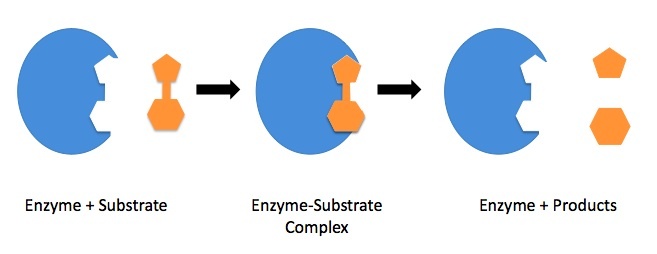
In the diagram, what is letter A?
product
enzyme-substrate complex
substrate
active site

Letter D...
enzyme
active site
substrate
products

Letter B...
substrate
active site
enzyme
products

Letter C...
products
substrate
enzymes
active site

Letter E...
active site
products
substrate
enzyme
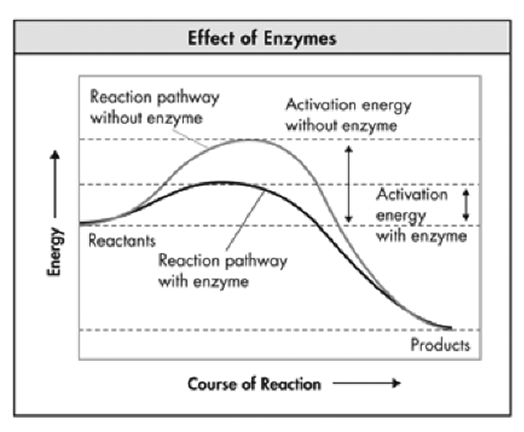
An enzyme speeds up a reaction by
raising the activation energy
lowering the activation energy
releasing energy
absorbing energy.
What happens when enzymes are heated to a high temperature?
The shape of the enzyme are changed and it denatures
The enzymes die
The enzymes' amino acid sequence changes
The enzymes remain the same
What happens to an enzyme when it is denatured?
Activation energy is lowered
It becomes stronger
It loses its shape
Activation energy is raised
Absorbs energy
endothermic reaction
exothermic reaction
Releases energy
endothermic reaction
exothermic reaction
Substances that are changed during a chemical reaction
reactants
products
Which suffix (word ending) is used in the names of most enzymes?
-ase
-in
-ine
-ose
Each enzyme produced by the body is
open - meaning it is able to catalyze a reaction with any molecule.
immature - meaning it cannot catalyze a reaction until many years later.
incomplete - meaning it requires other parts before it is able to bind to a molecule.
specific - meaning it is only able to catalyze a rection with a certain molecule.
Which of the following two factors affect an enzyme's operation the most?
amount of light and temperature
blood glucose and pH
temperature and pH
amount of light and pressure
Why are enzymes needed for life?
They speed up all the chemical reactions in living things.
They are the main proteins that make up our body structure.
The provide energy to all living things.
They provide genetic information.
What is activation energy?
the energy from the sun
the energy produced by an enzyme
the energy needed to get a reaction going
none of these

Which labeled part is the substrate?
letter A
letter B
letter D
letter E
In the lock-and-key model of enzyme action, the __________ fits into the __________ of the enzyme.
product; substrate
active site; product
substrate; active site
active site; substrate
Chemical reactions
proteins that speed up chemical reactions
Changing substances by breaking and forming bonds (includes hydrolysis and dehydration reactions)
the capacity for doing work
the energy needed to start a chemical reaction
Enzymes can be reused over and over again.
True
False

What does A represent?
Ribose
Adenine
Phosphate groups
high energy bonds

What is the molecule called?
ATP
ADP
DNA
Nitrogenous base

What part of ATP does B represent?
Nitrogenous base
Adenine
Ribose
Phosphate groups
How many phosphate groups does ADP have?
1
2
3
4
How is energy released from ATP?
add a phosphate
remove a phosphate
eat food
break off ribose

What does C represent?
phosphate group
high energy bond
ribose
adenine


All of the following are parts of an ATP molecule except:
Adenine
Ribose
Ribosomes
Phosphates
What is the substance that is produced in a chemical reaction
catalyst
solution
product
reactant

What is this an example of?
Food chain
Food web
Energy pyramid
Energy web
Which of the following is a primary consumer in a food chain?
predators
herbivores
carnivores
omnivores
Organisms that obtain energy by feeding on other organisms
Producer
Consumer
Decomposer
Organisms that break down wastes and dead organisms and return the raw materials to the environment
Producer
Consumer
Decomposer
A food _______ consists of many overlapping food ________.
web, chains
chain, webs
pyramid, webs
web, pyramids

In the food web above, what organism is missing from this food chain:
Grass --> Slug --> ________ --> Hawk
Vole
Frog
Insect
Thrush

In the energy pyramid, what is the bottom level composed of?
Producers
First-Level Consumers
Second-Level Consumers
Third-Level Consumers

In this food web, the gray fox is a...
Primary Consumer
Secondary Consumer
Both a Primary Consumer and a Secondary Consumer
Producer

Which is an apex predator in this food web?
Hawk
Snake
Frog
Bird
When energy is passed in an ecosystem from one trophic level to the next, only ___ percent of the energy will be passed on.
1
10
100
50

In the food chain pictured, what type of organism is the bird?
producer
primary consumer
secondary consumer
tertiary consumer


As you work your way up the energy pyramid, what happens to the energy?
It increases
It decreases
It stays the same
Nothing
Deep sea vent bacteria get their energy from
eating other bacteria.
releasing sulfur.
photosynthesis.
chemosynthesis.

If a disease strikes the snake population in the food chain shown, what will be the initial effect on the populations of hawks and rabbits?
The populations of hawks and rabbits will decrease.
The populations of hawks and rabbits will increase.
The population of hawks will increase. The population of rabbits will decrease.
The population of hawks will decrease. The population of rabbits will increase.

