
 Worksheets
Frequently tested Civics EOC topics/vocab
Total questions: 83
Worksheet time: 54mins
What term for the distribution and balancing of power among different branches of government so that no one branch is able to dominate the others?
checks and balances
common good
democracy
legislative branch

This image is most closely related to which thinker?
Montesquieu
Locke
Beccaria
Hobbes
Which answer choice describes separation of powers?
The president has the power to veto (deny) laws.
The president vetoes a law that takes away citizen rights.
6. John Locke said that the purpose of government was to?
a. protects life, liberty and property
b. fight wars against evil kings
c. to provide roads, bridges and parks
d. to protect life, liberty and the pursuit of happiness
According to John Locke, which agreement did individuals enter into when forming their own society?
constitution
social contract
Mayflower Compact
English Bill of RIghts
What is "Thomas Paine's Common Sense"
A publication created by Thomas Paine to encourage Americans to advocate for freedom from Britain.
A publication that focused on freedom.
An article focused on freedom for Irish Rebels.
An article focused on the love Americans had for England.
A pamphlet published by Thomas Paine in 1776 to convince the American colonists to support becoming independent from England.
Common Law
Mayflower Compact
Common Sense
Magna Carta

Consent of the governed is based on which Enlightenment idea?
Rousseau's Divine Rights
John Locke's Social Contract
Montisquieu's Separation of Powers
Madison's individual liberty Madison's individual liberty
This document, signed in 1620, was the first of colonial self government.
English Bill of Rights
Magna Carta
Mayflower Compact
This document, signed in 1215, was the first to establish limited government.
Petition of Rights
Magna Carta
Declaration of Independence
Which right was established by Magna Carta in 1215?
the right to vote in elections
the right to choose the monarch
the right to freedom of speech
the right to a trial by jury

The signing of the Magna Carta was important because...
It limited the powers of the King for the first time.
It provide for separation of powers.
It provided for separation of church and state.
It showed the dukes that the King was ultimate power.
In English history, the Magna Carta (1215) and the English Bill of Rights (1689) both reinforced the concept of
self-government
religious freedom
limited monarchy
freedom of speech
A pamphlet published by Thomas Paine in 1776 to convince the American colonists to support becoming independent from England.
English Bill of Rights
Common Sense
Mayflower Compact
Magna Carta
A government document that expanded the powers of the English Parliament and expanded the rights of the people, as well as further limited the rights of the king; written by the members of the English Parliament in 1689
Common Sense
English Bill of RIghts
Cato's Letters
Mayflower Compact
An agreement between indviduals that created a government that would provide order and protect the rights of the colonists; written by a group of English Puritans in Massachusetts in 1620.
English Bill of Rights
Mayflower Compact
Magna Carta
Cato's Letters
Which Enlightenment thinker argued that all people were born equal and had natural rights to life, liberty, and property?
Jean-Jacques Rousseau
Thomas Hobbes
Baron de Montesquieu
John Locke
Consent of the governed is based on which Enlightenment idea?
Rousseau's Divine Rights
John Locke's Social Contract
Montisquieu's Separation of Powers
Madison's individual liberty Madison's individual liberty

What is the significance of the English Bill of Rights to the US Constitution?
the Declaration of Independence was modeled after it the Declaration of Independence was modeled after it
it served as a model for America’s Bill of Rights
it was the first official written set of laws for England
it was necessary in the development of the Preamble
Living under a system of written laws that are clear and fair, and where the law applies to everyone, even government leaders.
Rule of Law
Due Process
Common Law
Statutory Law
Which statement describes the impact of the rule of law?
State of nature
Checks and balances
Separation of powers
Transparency of institutions
Which MAJOR principle is included in the U.S. Constitution?
Rule of law
Right to trial
Confederalism
Capitalism
What is the term for the idea that those who govern must follow the laws, meaning no one is above the law?
rule of law
elastic clause
separation of powers
veto power
What is the 15th amendment?
powers reserved to the states
president and vice president voted for separately
grants citizenship to former slaves
suffrage will not be restricted by race
What is the 19th Amendment?
It gave women the right to vote.
It gave Native Americans the right to vote.
It gave immigrants the right to vote.
It gave African Americans the right to vote.
What is women's suffrage?
The right of women not to vote.
The right of women to drive.
The right of women to vote.
The right of women to not drive.
The 24th Amendment...
gave women the right to vote.
eliminated the use of literacy tests.
outlawed poll taxes.
allowed for the popular election of US Senators.

Which amendment applies to this cartoon?
15th
19th
14th
26th
Which amendment banned poll taxes?
19th
15th
24th
26th

The case Brown v. Board of Education was famous because the court ruled that it is illegal to...
Segregate schools
Allow children to attend white schools
Allow children to work on schools
Keep schools equal
What was being violated when blacks wanted to attend white schools?
2nd Amendment
13th Amendment
14th Amendment
16th Amendment
The first major test case of the 14th amendment was Plessy versus Ferguson where the Supreme Court said what was ok?
all races should be equal
slavery
segregation ("separate but equal")
sharecropping
Which principle was the focus of the U.S. Supreme Court decision in Miranda v. Arizona (1966)?
freedom of expression
self-incrimination
freedom of speech
right to a jury trial
In Plessy v. Ferguson (1896), the U.S. Supreme Court established the general principle that
states could use poll taxes and literacy tests to establish voting requirements
states could not prevent blacks from voting just because their grandparents had been slaves.
states could require separate accommodations on trains, in schools and the like, for blacks and whites as long as the accommodations were equal
Congress could take away a state's seats in the U.S. House of Representatives if the state refused to allow blacks to vote in Congressional elections.
Two important Supreme Court cases, Tinker v. Des Moines Independent School District and Hazelwood School District v. Kuhlmeier, involved the First Amendment rights of students. Which of the following statements is true?
Tinker expanded First Amendment rights for students while Kuhlmeier limited First Amendment rights for students.
Both cases expanded First Amendment rights for students.
Both cases limited First Amendment rights for students.
Kuhlmeier expanded First Amendment rights for students while Tinker limited First Amendment rights for students.
During an arrest, police must inform people of their "Miranda rights" to remain silent. What basic freedom is this meant to protect and how does it affect those arrested?
The protections against self-incrimination; it informs them that speaking to law enforcement could incriminate them.
The protection of due process, it prevents convicted offenders from receiving cruel and unusal punishment.
The right to freedom of assembly, it precents law enforcement from asking them questions without the presence of an attorney.
The right to freedom of speech, it provides them with the ability to speak to their attorneys without fear of incrimination.
One way the executive branch checks the legislative branch is . . .
the President can veto laws passed by Congress
Congress can impeach the President and can override a veto.

Interest groups hire _____ to meet with members of the government and discuss the group’s issues and concerns.
representatives
activists
lobbyists
advocates

__________ is the spreading of ideas, information, or rumor for the purpose of helping or injuring an institution, a cause, or a person.
Advertising
Brainwashing
Publicity
Propaganda
government regulation of the economy and higher taxes for the rich?
How do interest groups influence the government?
by running for state and federal political office
by lobbying government officials for a particular issue
by recruiting foreign leaders to vote in favor of certain laws
by holding public officials accountable for their actions in a court of law

Bias
Symbolism
Propaganda
What is a technique used in commercials where politicians use something to represent ideas.
bias
symbolism
propaganda
simile

When a disagreement is settled between two people, what type of law is this?
Criminal
Civil
What is Judicial Review?
The courts can review laws and declare them unconstitutional
Judges have a review system for some court cases
The courts have the ability to reverse a decision
Marbury v. Madison (1803) established?
The Supreme Court can now “check” the other branches of government with Judicial Review
The Supreme Court can NOT check the other branches by using Judicial Review.
What is the power of judicial review?
Power to stop the judicial branch from doing something unwise
Grants more powers to the judicial branch of government
Power to declare laws and executive actions unconstitutional
Power to review a decision of a lower court
What is naturalization?
The process to become a citizen if you are not one
A person who is born as U.S. citizen
A process for becoming a citizen if your parents are citizens
What type of service project would help promote the common good?
Throwing a party
Going to visit your Grandma
Going to the movies with friends
Planning a beach clean up
Which of the following is a Responsibility of Citizenship?
Petitioning the government
Jury Duty
Helping elderly people
Paying Taxes

To be a naturalized citizen, a person must--
be 18 years or older
be a resident of the U.S. at least 5 years
all of these
pass a citizenship test

If a person is born in the U.S. they are considered a--
natural-born citizen (citizen by birth)
naturalized citizen
Who are the Federalists?
People who supported the Constitution
People who were against the Constitution
People who wanted to add the Bill of Rights to the Constitution
People who supported the Articles of Confederation
Federalists wanted....
a weak central (national) government
a strong central (national) government
a Bill of Rights
strong state government
The Antifederalists wanted
a strong central (national) government
weak state government
weak central (national) government
to deny the Bill of Rights
Did the Antifederalists support adding the Bill of Rights to the Constitution?
no
yes
Which group feared that the president might behave like a king?
Federalists
Anti-Federalists
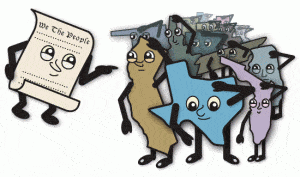
Anti-Federalists were in favor of:
States Rights and the protection of individual rights.
A strong Central Government.
A Monarchy (King & Queen) to rule over the country.
a powerful National Government

Which amendment give you the right of Religion, Assembly, Speech, Petition and Press?
First Amendment
Second Amendment
Third Amendment
Fourth Amendment
Which is NOT protected by the 1st Amendment Right of freedom of speech?
intentionally spread lies and call it freedom of speech
Yell fire in a crowded room
Print false information knowing it was false to hurt someone
to say things that are threatening harm in any way
all of these

The rule of law :
the Constitution is the supreme law of the land and no one is above the law.
The Constitution is the supreme law of the land and the Supreme Court upholds the Constitution.
the Supreme Court is the supreme law of the land and no one is above the law.
the Bill of Rights is the supreme law of the land and immigrants are not accountable for violating it.
Which of the following is an obligation of citizenship?
being informed about issues
volunteering for public service
voting in elections
paying taxes
Something that citizens are required to do or they will be punished is called a . . .
petition
duty/obligation
responsibility
common good
SS.7.C.2.2
Which is considered a citizenship responsibility rather than an obligation?
obeying the law
paying taxes
attending civic meetings
registering for Selective Service
SS.7.C.2.2
Which of these is a legal obligation of U.S. citizenship?
to reside in the United States
to save money for retirement
to vote in Presidential elections
to serve on a jury when summoned

