
 Worksheets
Midterm Thermodynamics
Total questions: 60
Worksheet time: 50mins
25 °C in kelvins
298.45 K
248.15 K
298.15 K
Calculate the heat transfer to the environment if the system produce a work of 45 kJ and receive 9 kJ in the way of heat. The enthalpy difference of the system is equal to 55 kJ.
1
91
19
A 7.50 liter sealed jar at 18 °C contains 0.125 moles of oxygen and 0.125 moles of nitrogen gas. What is the pressure in the container?
7.38 atm
0.796 atm
0.684 atm
0.398 atm
What does R stand for
Ideal gas constant
Real gas constant
Temperature constant
Ideal gas law
Which of the following equations represents the Ideal Gas Law?


The study of how thermal energy is transformed into another types of energy is _________________________.
Thermodynamics
Power
Temperature
The mathematical equation of the first law of thermodynamics is __________________.
ΔU=W
ΔU=Q
ΔU=Q - W
The thermal energy entering the system from outside is called ________________.
Work
Heat
Power
To find the change in thermal energy, we need to use ____
ΔU = 𝑚𝐶∆𝑇
ΔU = ∆𝑇
ΔU = 𝐶∆𝑇
A kettle on fire receives 8000 J, the kettle kept shaking with 500 J work. Find the change in the kettle's thermal energy?
500 J
7500 J
8000 J
A saw used to cut a 1 Kg copper pipe, this caused 1°C raise in the pipe's temperature, how much work did the pipe receive from the saw? (Ccopper=385 J/(°C.Kg))
385 J
673 J
836 J
Heat transferred is completely used for work in the ....
Isobaric process
Isothermal process
Isohoric process
terrific process
No change in internal energy is observed in.....
isolated system
isobaric process
isothermal process
isohoric process
The first law of thermodynamics states that the heat transferred to or from the system is equal to the change in the internal energy of a system plus ...
work done on the system
work done by the system
work done by the external forces
negative work done by the system
On a gas has been noticed a decrease in the volume by 0.2 m3 at a constant pressure of 1 atm during the addition of 12 000 J of heat. The change in the internal energy of the gas is:
-12 000 J
32 000 J
8 000 J
- 18 000 J
80 J of heat is extracted from a gaseous system, whose change in internal energy is 50 J. Then the amount of external work done on the gas is:
- 130 J
- 30 J
30 J
130 J
1000 J of energy were extracted from a gas sample while the gas did 300 J of work on the environment. The change in the internal energy of the gas is:
1300 J
-700 J
-300 J
-1300 J
The internal energy change in a system that has absorbed 2000 J of heat and on the gas a work of 500J has been done by the external forces is
1500 J
-1500 J
2500 J
-500 J
Work done by the gas in an isothermal process when the volume decrease is:
negative
positive
zero
cannot be known
In the formula of The First Law of Thermodynamics, the ''Q'' represent:
Change in internal energy
Energy transferred as heat
Work done on or by the system
In the formula of The First Law of Thermodynamics, the ''W'' represent:
Work done on or by the system
Change in internal energy
Energy transferred as heat
No work is done on or by the system
Isothermal
Adiabatic
Isovolumetric
Isolated System
Internal energy is used exclusively for work.
Isovolumetric
Adiabatic
Isothermal
Isolated System
Heat transferred is completely used for work.
Isothermal
Isovolumetric
Adiabatic
Isolated system
No change in internal energy.
Isovolumetric
Isothermal
Adiabatic
Isolated System

To turn the water to steam, heat is being transferred from ______.
stove to kettle
steam to water
kettle to stove
steam to stove
The first law of thermodynamics applies the conservation of energy principle to systems where heat transfer and doing work are the methods of ---
isolating heat
creating energy
reacting to force
transferring energy
The first law of thermodynamics states that the change in internal energy of a system equals ----
the net heat transfer input minus the net work output
the net heat transfer input plus the net work output
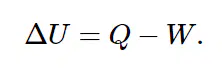
What does the symbol U represent?
total work done by the system
change in internal energy of the system
change in temperature of the system
total energy of the system
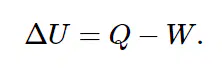
If Q is positive, ---
there is a net heat transfer out of the system;
there is a net heat transfer into the system;
there is net work done by the system;
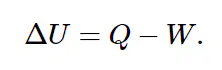
If W is positive, then ---
there is net work done on the system.
there is heat transfer within the system.
there is total kinetic energy isolation.
What do Heat and Work have in common?
both involve force through a distance
both are organized processes
both can cause a temperature increase
When the temperature increases, internal energy...
decreases
increases
doesn`t change
none of them
when the heat leaves the systme...
the heat is positive
the heat is negative
the heat is zero
none of them
if the volume of the gas increases,...
work is positive
work is negative
work is done on the gas
none of them
which one is the work formula in Isobaric process
W=P.ΔV
W=T.ΔV
W=V.ΔP
Which one is the work expression in isobaric process?
W=n.P.ΔT
W=V.ΔV
W=n.R.ΔT
W=T.ΔV
Which one is the work in isovolumetric process?
W=0
W=n.R.ΔT
W=n.R.ΔT
W=n.R.T.ln(ViVf)
What is the work in ishothermal process?
W=P.ΔV
W=n.R.ΔT
W=0
W=n.R.T.ln(ViVf)
Which one is the first law of thermodynamics?
Q=ΔU+W
W=ΔU+Q
ΔU=Q+W
Q=ΔU+W
The system does 500 joule work as it absorbs 1200j heat. What is the internal energy change?
700 joule
1700 joule
-700 joule
-1700 joule
Which is an example of decreasing entropy in a closed system?
Boiling water
Freezing water
Cells in a body coming together
Ice melting

The comparison of the amount of energy or product produced to the amount of energy or product put im
Conservation
Misplacement
Transfer
Efficiency
Do molecules generally move faster at 45 C or 106 C?
45 C because molecules have more energy than in 106C
106 C because molecules have more energy than in 45C
106 C because molecules have less energy than in 45C
45C because molecules have less energy than in 106 C
When you place the metal in boiling water, heat flows from the _________ to the _______.
metal to the boiling water
bottom of the metal to the top half of the metal
bottom of the water to the top of the water
boiling water to the metal
DON'T RUSH, YOU HAVE TIME.
Water droplets condensing on the inside of a window on a cold day. Is this process exothermic or endothermic?
Gases condense to form liquids. Gases are moving faster than liquids, the air around the window has a higher temperature/kinetic energy. Releasing energy to get water droplets, which is is Exothermic
Gases condense to form liquids. Gases are moving faster than liquids, the air around the window has a higher temperature/kinetic energy. Releasing energy to get water droplets, which is is Endothermic
Gases condense to form liquids. Gases particles are moving slower than liquids. Releasing energy to get water droplets, which is is Endothermic
Gases condense to form liquids. Gases particles are moving slower than liquids. Releasing energy to get water droplets, which is is Exothermic
DON'T RUSH, YOU HAVE TIME.
Frying an egg on a skillet. Referring to the egg, would the Enthalpy change be positive or negative?
Skillet is absorbing heat energy from the egg. Absorbing energy is Endothermic. Endothermic has a positive Enthalpy
Egg absorbing heat energy from the skillet. Absorbing energy is Endothermic. Endothermic has a positive Enthalpy
Egg absorbing heat energy from the skillet. Releasing energy is Exothermic. Exothermic has a positive Enthalpy
Egg absorbing heat energy from the skillet. Releasing energy is Exothermic. Exothermic has a negative Enthalpy

The diagram shows the pressure-volume relationship for a fixed mass of an ideal gas that undergoes a cycle XYZ.
In which part(s) of the cycle is external work done on the gas?
Y → Z only
Y → Z and Z → X only
X → Y and Z → X only
X → Y only

The diagram shows the pressure–volume (PV) relationship for a gas.
Which of the following area(s) is/are equal to the work done by the gas as it expands?
area I
area II
area I + area II
area I – area II
Internal energy is the...
sum of the random distribution of heat and potential energies of the molecules of the system
sum of the kinetic and potential energies of the molecules of an object
sum of the kinetic and potential energies of an object
sum of the random distribution of kinetic and potential energies of the molecules of the system
The heat absorbed by melting a solid is known as
latent heat of solid
latent heat of fusion
latent heat of liquid
latent heat of vaporisation
What happens to the temperature of a substance during a phase change?
Increases
Remains constant
Decreases
Increases or Decreases

