
NEW
Font size
 Worksheets
Biology EOC Review Day 2
Total questions: 50
Worksheet time: 40mins
In some ecosystems, wolves have been eliminated due to their threats to humans. How can the reintroduction of wolves benefit the ecosystem?
It can eliminate weak animals from a prey population, thereby decreasing competition for natural resources
It can eliminate the most fit animals among the prey population, which will cause an increase in birth rates of the prey
It can cause the prey population to migrate to other areas, resulting in more fit prey.
It can cause the prey population to better blend in with their environment.

A population with massive emigration.
A population with unlimited resources.
A population with too many predators.
A population reaching carrying capacity.

AATCATGGA
Having freckles is dominant over not having freckles. If two individuals heterozygous for freckles have a child, what is the probability the child will have freckles?
0%
25%
50%
75%
Which statement best describes natural selection?
As the weather changes, organisms that are able to find shelter need less energy to live.
Organisms that eat only plants need less food than organisms that eat animals.
Organisms better adapted to their environment are more likely to reproduce and pass on their traits to their offspring.
Small organisms are more likely to survive than larger organisms.
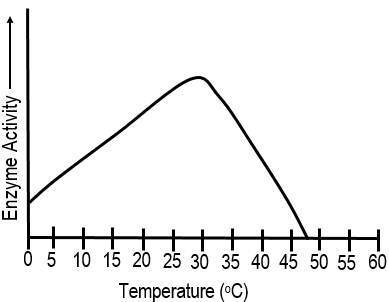
Based on the graph, at what temperature does this enzyme work best?
25 C
30 C
35 C
47 C

How are meiosis and fertilization a benefit to sexually reproducing organisms?
All offspring will have the most desirable traits from each parent.
All offspring will have traits that are identical to their siblings but different from their parents.
All offspring will have unique genetic variations and sets of alleles.
All offspring will have the same probability of acquiring mutations in their genes.
Which statement describes the offspring produced from asexual reproduction?
All of the offspring are identical to each other.
All of the offspring are unique to each other.
Half of the offspring have genetic material similar to the original cell.
Half of the offspring have physical characteristics similar to the original cell.
How does natural selection improve a population?
The individual organisms that are best suited to the future environment survive, and their gene types increase in the population.
The individual organisms that are best adapted to the current environment survive, and their gene types increase in the population.
The individual organisms that are best suited to the previous environments are removed and cause the population size to decrease.
The individual organisms that are best suited to another environment are removed and cause the population size to decrease.


A person with swollen gums rinses his mouth with warm salt water, and the swelling decreases. Which has occurred?
The swollen gums have absorbed the saltwater solution
The saltwater solution lowers the temperature in the gums
The salt in the solution has moved against the concentration gradient
The water in the gums has moved from a high to a low concentration of water

Which amino acid sequence can be coded from the DNA sequence CAG TAG CGA?
Valine - Isoleucine - Glycine
Valine - Aspartic Acid - Alanine
Valine - Isoleucine - Alanine
Valine - Phenylalanine - Alanine
Which is an example of osmosis?
potassium ions moving in and out of an animal cell
carbon dioxide moving into the leaf cells of a plant
oxygen moving into the bloodstream from the lungs
water moving into the root cells of a plant
Hitchhiker’s thumb (H) is dominant to no hitchhiker’s thumb (h). A woman who does not have hitchhiker’s thumb marries a man who is heterozygous for hitchhiker’s thumb. What is the probable genotypic ratio of their children?
0% Hh : 100% hh
50% Hh : 50% hh
75% Hh : 25% hh
100% Hh : 0% hh
How does the amount of energy resulting from fermentation compare with that of aerobic respiration?
Aerobic respiration results in less energy
Aerobic respiration results in more energy
Each process results in equal amounts of energy
Each process results in variable amounts of energy
If a strand of DNA had bases in the following order - ATCCGTC, what would be the transcribed mRNA sequence?
TAGGCAG
UAGGCAG
TUGGCUG
None of the above are correct
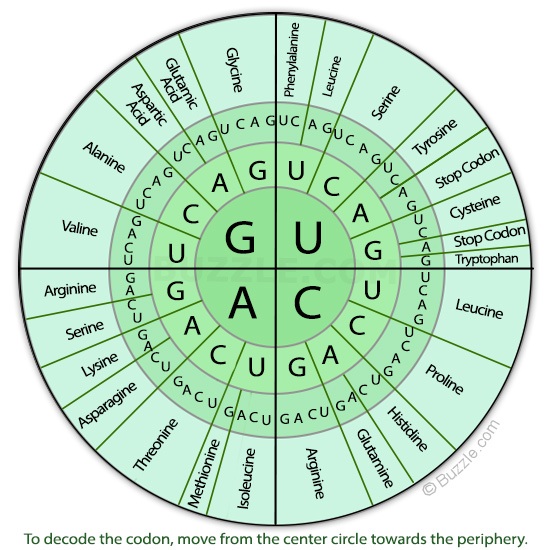
A sequence of a DNA template strand is shown.
3' TCC AAT GGC TTA TTT 5'
Which of these is the correct amino acid chain produced from the DNA template strand?
Arginine, Leucine, Proline, Asparagine, Lysine
Arginine, Serine, Leucine, Proline, Asparagine
Arginine, Leucine, Asparagine, Proline, Lysine
Arginine, Leucine, Proline, Lysine, Asparagine
What is the primary cause of genetic variation during meiosis?
chromosomes lining up
"crossing over" of chromosomes
separation of chromosomes
chromosomes pulling apart
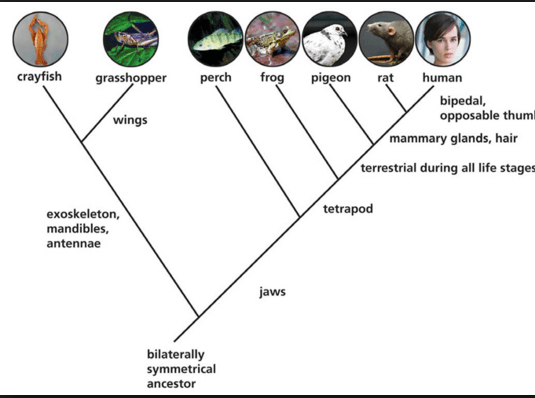
According to the cladogram, which characteristic is shared by every organism listed?
bilateral symmetry
jaws
exoskeleton
no wings
What is the correct order of classification?
kingdom, domain, phylum, class, order, family, genus, species
domain, kingdom, phylum, class, order, family, genus, species
domain, phylum, class, order, kingdom, family, genus, species
species, genus, family, phylum, order, class, domain, kingdom

The diagram illustrates an embryonic stage of two organisms. Which of the following can be determined by observing the embryos shown in the diagram?
The organisms share a common ancestor.
The organisms belong to the same genus.
The organisms are native to the same geographic areas.
The organisms will grow into anatomically similar adults.

If there is 1000 Kcal available in the producers in trophic level 1, how much energy is available in the herbivores in trophic level 2?
10Kcal
1Kcal
100Kcal
1000Kcal

Which structure is unique only to this particular cell type?
13
9
7
2
Which would be the best evidence that a cell is using active transport to move a substance across its cell membrane?
ATP is moving rapidly across the cell membrane.
ATP is being rapidly consumed near the cellular membrane.
Substances are moving from high to low concentrations.
Substances are moving through channels in the cell membrane.
Transcription and translation are important processes involved in gene expression. Which of the following is true about the products produced by these processes?
Transcription produces DNA molecules, whereas translation produces proteins.
Transcription produces RNA molecules, whereas translation produces proteins.
Transcription produces proteins, whereas translation produces RNA molecules.
Transcription produces RNA molecules, whereas translation produces DNA molecules.

The diagram below shows a single bacterial colony before, shortly after, and one hour after exposure to an antibacterial gel. Which statement best explains why the antibacterial gel did not eliminate the entire bacterial colony?
Exposure to the antibacterial gel caused some of the bacteria to become highly resistant to its effects.
Natural resistance to the antibacterial gel allowed most of the bacteria in the colony tosurvive the treatment.
Inconsistent application of the antibacterial gel caused some of the bacteria to receive a lower dose than others.
Genetic diversity within the bacterial colony allowed some of the bacteria to survive the treatment and reproduce.

The chart below shows several species found in a pond ecosystem and the pH levels in which the species can survive. The normal pH of the pond is 6.5. If the pH of the pond fell to 5.0 due to acid rain, which of the species shown in the chart would most likely survive?
Snails
Bass
Trout
Clams

A food web for an aquatic ecosystem is shown below. Which of the following correctly describes one of the paths through which energy flows in this ecosystem?
Phytoplankton receive energy from krill, krill receive energy from jellyfish, and jellyfish receive energy from sea turtles.
Puffins receive energy from herring, herring receive energy from krill, and krill receive energy from phytoplankton.
Mussels receive energy from copepods, copepods receive energy from phytoplankton, and phytoplankton receive energy from krill.
Lobsters receive energy from codfish, codfish receive energy from herring, and herring receive energy from krill.
The individual strands of a rat's hair can either be agouti (banded) or non-agouti (solid). This is determined by a single gene locus. Agouti fur (A) is dominant to non-agouti fur (a). Two rats mate and have offspring. Half of the offspring have agouti fur, and the other half have non-agouti fur. Which of these most likely represents the genotypes of the parent rats?
AA x aa
Aa x aa
Aa x Aa
aa x aa
A small population of a specific plant species is found in a grassland habitat. Each plant bears flowers that are either white or dark purple. The color of the plant's flowers does not affect the plant's chance of survival or its reproductive success. A wildfire that occurs in the habitat kills all of the plants with dark purple flowers, as well as many of the plants with white flowers. This causes the gene for dark purple flowers to be lost from the population. Which of the following processes caused the loss of the gene for dark purple flowers from this population?
Genetic drift
Speciation
Adaptation
Natural selection
Which of the following correctly matches a property of an organic molecule with how that property helps the organic molecule function in living organisms?
Nucleic acids contain multiple carbon-hydrogen bonds. This allows nucleic acids to provide energy for living organisms by breaking these bonds.
Proteins contain nucleotides that encode genetic material. This allows proteins to accurately pass genetic information from one cell to another.
Carbohydrates lower the activation energy of certain reactions. This allows metabolic processes to take place at a rate that can sustain life.
Lipids are insoluble in water. This allows lipids that make up biological membranes to regulate the entry and exit of many substances.

A small population of lake trout were introduced into a lake ecosystem. The graph below shows how the population changed from when it was introduced to four years after its introduction into the ecosystem. Which of the following most likely occurred at year 1?
The population reached its carrying capacity.
The ecosystem doubled in size due to excessive flooding.
The ecosystem experienced an extreme drought.
A new population that preyed on lake trout was introduced.

An example of meiotic cell division is shown below. In the diagram, genetic material is shaded according to the parent from which it was inherited. Based on the diagram, which processes contributed to the genetic diversity of the daughter cells?
Crossing over and cytokinesis
Cytokinesis and differentiation
Differentiation and independent assortment
Independent assortment and crossing over
A farmer sprayed his crops with an insecticide multiple times to reduce the damage caused by a certain species of insect. Each time the farmer used the insecticide, fewer insects died. Why did the insecticide kill fewer insects each time it was used?
Insects in the population that were resistant to the insecticide lived and reproduced.
None of the insects in the initial population were resistant to the insecticide.
Insects in the population that were resistant to the insecticide were killed and could not reproduce.
All of the insects in the initial population were resistant to the insecticide.
The cell membrane serves many functions. One of the cell membrane's functions is to help the cell maintain homeostasis. Which of the following statements best supports this claim?
The cell membrane contains proteins.
The cell membrane contains a polar region and a nonpolar region.
The cell membrane contains phospholipids.
The cell membrane regulates what goes in and out of the cell.
What is NOT part of the cell theory?
All living things are made of cells - basic unit of life
All new cells are produced from existing cells
Cells are the basic units of structure and function in living things
All cells have a nucleus

incomplete dominance
codominance
sex-linked
recessive

What is the correct classification of the structure shown?
Monosaccharide, Carbohydrate
Amino Acid, Protein
Glycerol/Fatty Acid, Lipid
Nucleotide, Nucleic Acid

According to the image, which solution has a greater solute concentration outside of the cell?
Hypertonic
Isotonic
Hypotonic
Osmosis

Which is the correct phase and cell type in the image?
Anaphase, Plant
Anaphase, Animal
Telophase, Plant
Telophase, Animal
Which answer best describes why does ice float in liquid water?
The high surface tension of liquid water keeps the ice on top.
The ionic bonds between the molecules in ice prevent the ice from sinking.
Stable hydrogen bonds keep water molecules of ice farther apart than water molecules of liquid water.
The crystalline lattice of ice causes it to be denser than liquid water.

Water is polar because.....
The unequal sharing of electrons gives the water molecule a slight negative charge near its oxygen atom and a slight positive charge near its hydrogen atoms.
The molecule has two poles, which one results in the poles being colder than other regions of the molecule.
The unequal sharing of electrons gives the water molecule a slight negative charge near its hydrogen atoms and a slight positive charge near its oxygen atom.
The water molecule is neutral and therefore the two poles cancel each other out.

