Wayground logo

Free Printable Worksheets

Font size

S
M
L
XL
Worksheets

Ecology OL

Total questions: 62

Worksheet time: 51mins

Name
Class
Date
1.
What does every food chain start with? (Even if it's not drawn or written there!)
a)
producers
b)
sun
c)
consumer
d)
decomposers
2.
An organism that needs to eat other organisms to obtain energy is known as a:
a)
Autotroph
b)
Producer
c)
Consumer
d)
Mutualist
3.
Consumer that eats plants
a)
heterotroph
b)
herbivore
c)
producer
d)
community
4.
relationship in which two species live closely together
a)
resource
b)
mutualism
c)
succession
d)
symbiosis
5.
Where an organism lives
a)
habitat
b)
niche 
c)
heterotrogh
d)
biosphere
6.
What is the term for each step in the transfer of energy and matter within a biological community?
a)
energy path
b)
food web
c)
trophic level
d)
food pyramid
7.
The amount of energy that usually transfers from one trophic level to the next...
a)
10%
b)
20%
c)
80%
d)
50%
8.
What does every food chain start with? (Even if it's not drawn or written there!)
a)
producers
b)
sun
c)
consumer
d)
decomposers
9.
An organism that needs to eat other organisms to obtain energy is known as a:
a)
Autotroph
b)
Producer
c)
Consumer
d)
Mutualist
10.
Consumer that eats plants
a)
heterotroph
b)
herbivore
c)
producer
d)
community
11.
What does a food web represent?
a)
All connections of energy flow throughout all organisms in a habitat.
b)
The specific ways that mutualism is carried out.
c)
A single pathway or energy flow between organisms. 
d)
How carnivores get their food. 
12.
Where an organism lives
a)
habitat
b)
niche 
c)
heterotrogh
d)
biosphere
13.
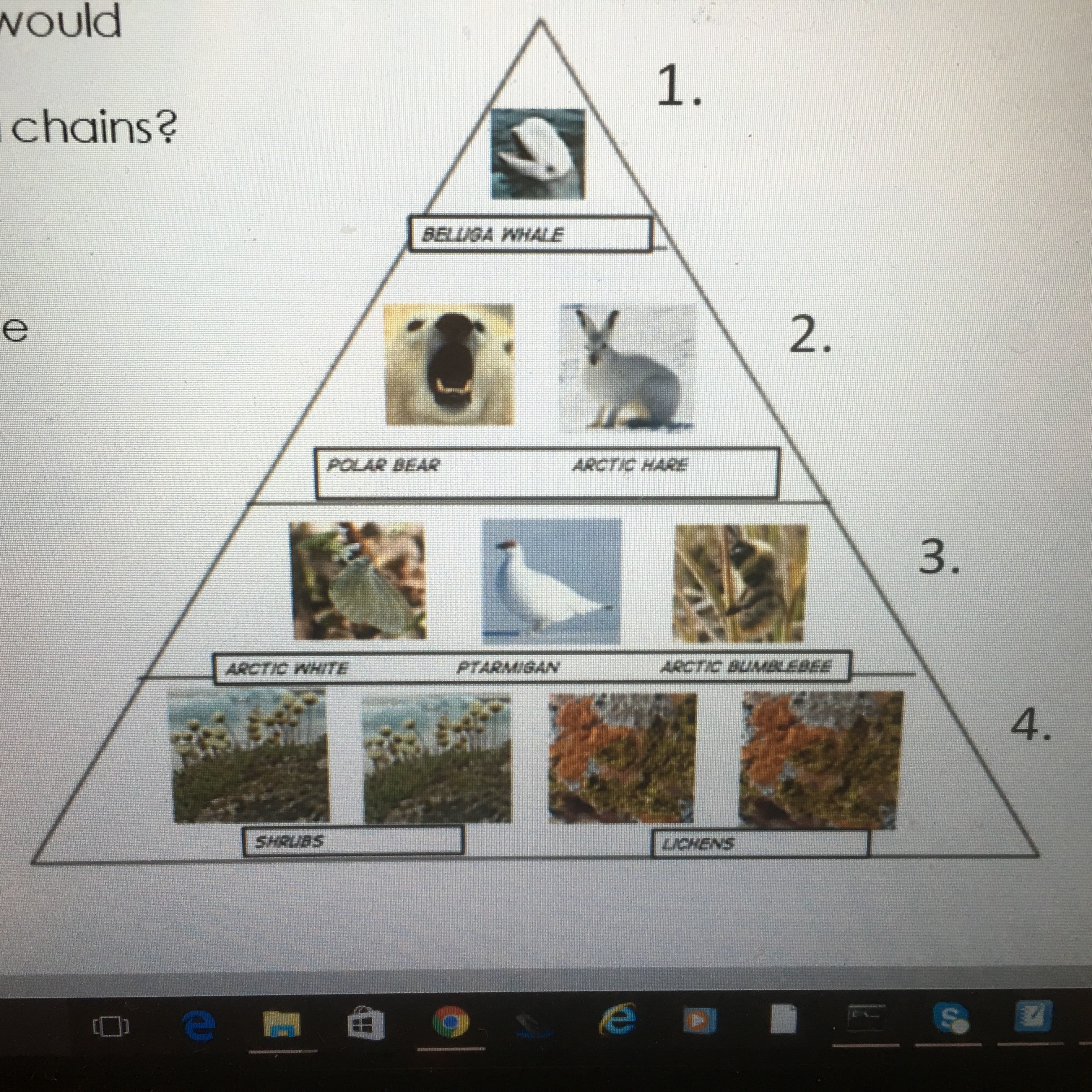
In this Food Web Pyramid Which type of consumer gets only 10% of the energy stored in plants?
a)
Herbivore
b)
Carnivore
c)
Omnivore
d)
Secondary Consumer
14.
Which one is not a consumer?
a)
anemone 
b)
bear
c)
shark
d)
vulture
15.
What is the term for each step in the transfer of energy and matter within a biological community?
a)
energy path
b)
food web
c)
trophic level
d)
food pyramid
16.
The image provided is an example of a(n):
a)
Carnivore
b)
Herbivore
c)
Producer
d)
Autotroph
17.
The amount of energy that usually transfers from one trophic level to the next...
a)
10%
b)
20%
c)
80%
d)
50%
18.
An illustration that uses arrows to show the MANY possible directions in which matter and energy can pass through the organisms in an ecosystem.
a)
Food chain
b)
Food web
c)
Energy Pyramid
d)
Succession Map
19.
The nonliving aspects of an ecosystem.
a)
Abiotic factors
b)
Biotic factors
20.
The living portions of the ecosystem.
a)
Biotic factors
b)
Abiotic factors
21.
A graphic illustration that shows each trophic level and the amount of useable energy contained within.
a)
Food chain
b)
Food web
c)
Energy Pyramid
d)
All of these
22.
A collection of organisms that make up a community as well as all of the nonliving aspects of the environment.
a)
Population
b)
Community
c)
Habitat
d)
Ecosystem
23.
As you move upward, from level to level, in an energy pyramid, energy _____.
a)
increases
b)
decreases
c)
stays the same
d)
increases exponentially
24.
 plants that convert energy from the sun
a)
decomposer
b)
primary consumer
c)
secondary consumer
d)
producer
25.
What are the Abiotic factors in this image? 
a)
water, sunlight, dirt, air
b)
birds and plants
c)
birds, water, dirt
d)
plants, water
26.

What would be a good example of a primary consumer?

a)

carnivore

b)

detrivore

c)

decomposer

d)

herbivore

27.
Members of a species in a defined area
a)
Ecosystem
b)
community
c)
biodiversity
d)
population
28.

What would be a good example of a primary consumer?

a)

carnivore

b)

detrivore

c)

decomposer

d)

herbivore

29.

The monkey would be a

a)

decomposer

b)

producer

c)

primary consumer

d)

secondary consumer

30.

A lion that eats a zebra that eats grass is a

a)

primary consumer

b)

secondary consumer

c)

tertiary consumer

d)

quaternary consumer

31.
Members of a species in a defined area
a)
Ecosystem
b)
community
c)
biodiversity
d)
population
32.
Study of interactions between organisms and their environment 
a)
niche
b)
community 
c)
ecology
d)
ecosystem
33.
Non-living factor that affects an ecosystem
a)
biotic factor
b)
abiotic factor
c)
food chain 
d)
biome
34.
A collection of organisms that belong to different populations but all live in the same area and interact with one another.
a)
Population
b)
Ecosystem
c)
Community
d)
Ecosphere
35.
Individuals that can breed with one another make up a
a)
species
b)
population
c)
community
d)
ecosystem
36.
All of the living and nonliving things in an area that interact with each other are called a/an ______.
a)
community
b)
habitat
c)
population
d)
ecosystem
37.
An individual belonging to a specific species
a)
Biotic
b)
Community
c)
Organism
d)
Reptile
38.
An area where an organism finds food, shelter and water in a specific arrangement
a)
niche
b)
biosphere
c)
biome
d)
habitat
39.
The living part of an ecosystem
a)
Biotic
b)
Abiotic
c)
Mother Earth
d)
Flowers
40.
Two or more members of a particular species living and interacting in the same area
a)
Community
b)
Population
c)
Organisms
d)
Biosphere
41.
Series of steps in which organisms transfer energy by eating and being eaten
a)
foodweb
b)
consumer
c)
food chain
d)
omnivore
42.

An organism's place in the biotic environment and its role in an ecosystem is

a)

Habitat

b)

Habit

c)

Niche

d)

Community

43.
Which one is NOT an example of a decomposer?
a)
mushroom
b)
leaves
c)
mold
d)
worm
44.
Examples of a producer
a)
frog
b)
algae
c)
worm
d)
mouse
45.
Example of a decomposer
a)
fungus
b)
mouse
c)
plants
d)
frogs
46.
What is a producer?
a)
an organism that gets energy from eating other organisms
b)
an organisms that uses sunlight to make its own food
c)
an organism that gets energy from eating dead organisms, non-living material or waste
d)
an organism that uses chemical energy to make its own food
47.
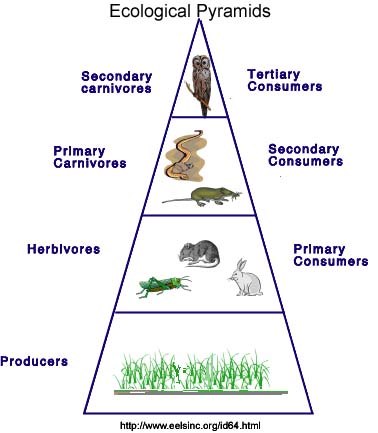
In the energy pyramid here, which organisms have the most energy available?
a)
Producers
b)
Carnivores
c)
Herbivores
d)
Top Predator
48.
In the energy pyramid below, which organism has the least amount of energy available?
a)
Producers
b)
Herbivores
c)
Carnivores
d)
Top Predator
49.
If there is 1000 Kcal available in the producers in trophic level 1, how much energy is available in the herbivores in trophic level 2?
a)
10 Kcal
b)
1 Kcal
c)
100 Kcal
d)
1000 Kcal
50.
If these organisms were arranged in a food pyramid, which organism would have the least amount of total energy available?
a)
coyote
b)
insect
c)
lizard
d)
shrub
51.
Which organism recieves the least amount of energy from the producer?
a)
Owl
b)
Grasshopper
c)
Lilypad
d)
Mouse
52.
The largest group of organisms found in a food web would be:
a)
Primary Consumers
b)
Producers
c)
Decomposers
d)
Tertiary Consumers
53.
A food pyramid represent the relative amount of energy in trophic levels. Which of the following correctly shows a food pyramid?
a)
A
b)
B
c)
C
d)
D
54.
A third-level consumer has to be which type?
a)
Carnivore.
b)
Decomposer.
c)
Producer.
d)
Herbivore.
55.
A secondary consumer 
a)
eats primary consumers
b)
eats producers
c)
eats plants
56.
Level 1 is called the _____________ trophic level. 
a)
Tertiary consumer
b)
Tertiary producer
c)
Primary consumer
d)
Primary producer
57.

What amount of percentage does the energy decrease as it goes up the pyramid?

a)

100%

b)

1000%

c)

10%

d)

1%

58.

How does the energy flow in an energy pyramids?

a)

up the pyramid

b)

down the pyramid

59.
Which is the smallest level of an ecosystem?
a)
organsism
b)
population
c)
community
d)
ecosystem
60.
a system of food chains that shows the transfer of energy  is termed
a)
food web
b)
food chain
c)
prey
d)
predator
61.
Biodiversity is 
a)
the variety of species within an ecosystem
b)
a large number of the same species in an ecosystem
c)
an abundant amount of the same primary consumers 
d)
the ability to have an abundant source from the same species
62.

Photosynthesis is important because...

a)

it makes carbon dioxide

b)

it makes food for the food webs

c)

it makes water

d)

it's not important