wayground logo

Free Printable Worksheets

Font size

S
M
L
XL
Worksheets

Bench mark revision mod d

Total questions: 173

Worksheet time: 3hrs 48mins

Name
Class
Date
1.

Ecology is the study of:

a)

only the living things in the environment

b)

only the nonliving things in the environment

c)

how living things interact with each other and the nonliving things in the environment

d)

scientists who perform research on living things

2.

What term do ecologists use to describe where an animal lives (an animal’s home)?

a)

Ecosystem

b)

Ecologist

c)

Habitat

d)

Population

3.

What is a species?

a)

Different animals that compete for the same resources

b)

A group of similar organisms that can reproduce with each other

c)

A group of organisms that live together

d)

A group of organisms that are physically and functionally very different from each other

4.

Which of the following is an example of a living thing?

a)

A bacterium

b)

A shell

c)

Water

d)

Sweat

5.

Which of the following is NOT a nonliving thing? (which one is living?)

a)

Sun

b)

Rocks

c)

Milk

d)

Wood

6.

What type of organism can make its own food?

a)

A producer (an autotroph)

b)

A consumer (a heterotroph)

c)

A decomposer

d)

All of the above

7.

Organisms that can make their own food do so by the process of:

a)

decomposition

b)

respiration

c)

photosynthesis

d)

scavenging

8.

What type of consumer eats plants?

a)

Herbivore

b)

Omnivore

c)

Carnivore

d)

Both herbivore and omnivore

9.

What is a food chain?

a)

A representation of an organism’s life cycle

b)

A way to show the feeding relationships between organisms

c)

The sequence of events that occurs during photosynthesis

d)

A way to show how animals interact with nonliving parts of the environment

10.

The first organism in a food chain is ALWAYS a:

a)

producer

b)

consumer

c)

decomposer

d)

Any of the above

11.

What is a niche?

a)

The habitat that an organism lives in

b)

An organism’s “role” in an ecosystem

c)

A type of consumer

d)

The relationship between a producer and consumer

12.

What happens when different species try to occupy the same niche?

a)

The species compete with each other

b)

The species cooperate with each other

c)

The species coexist with each other

d)

All of the above

13.

How does oxygen cycle between plants and animals?

a)

Plants and animals both release oxygen

b)

Plants and animals convert water into oxygen

c)

Plants take in oxygen that is produced by animals

d)

Animals take in oxygen that is produced by plants

14.
What does every food chain start with? (Even if it's not drawn or written there!)
a)
producers
b)
sun
c)
consumer
d)
decomposers
15.
An organism that needs to eat other organisms to obtain energy is known as a:
a)
Autotroph
b)
Producer
c)
Consumer
d)
Mutualist
16.
Consumer that eats plants
a)
heterotroph
b)
herbivore
c)
producer
d)
community
17.
What does a food web represent?
a)
All connections of energy flow throughout all organisms in a habitat.
b)
The specific ways that mutualism is carried out.
c)
A single pathway or energy flow between organisms. 
d)
How carnivores get their food. 
18.
The rabbit in this food web would be considered a:
a)
Decomposer
b)
Producer
c)
Secondary Consumer
d)
Primary Consumer
19.
Where an organism lives
a)
habitat
b)
niche 
c)
heterotrogh
d)
biosphere
20.
In this Food Web Pyramid Which type of consumer gets only 10% of the energy stored in plants?
a)
Herbivore
b)
Carnivore
c)
Omnivore
d)
Secondary Consumer
21.
The image provided is an example of a(n):
a)
Carnivore
b)
Herbivore
c)
Producer
d)
Autotroph
22.
An illustration that uses arrows to show the MANY possible directions in which matter and energy can pass through the organisms in an ecosystem.
a)
Food chain
b)
Food web
c)
Energy Pyramid
d)
Succession Map
23.
The nonliving aspects of an ecosystem.
a)
Abiotic factors
b)
Biotic factors
24.
The living portions of the ecosystem.
a)
Biotic factors
b)
Abiotic factors
25.
A collection of organisms that make up a community as well as all of the nonliving aspects of the environment.
a)
Population
b)
Community
c)
Habitat
d)
Ecosystem
26.
 plants that convert energy from the sun
a)
decomposer
b)
primary consumer
c)
secondary consumer
d)
producer
27.
What are the Abiotic factors in this image? 
a)
water, sunlight, dirt, air
b)
birds and plants
c)
birds, water, dirt
d)
plants, water
28.

A chimpanzee eats fruits, nuts, leaves, and small mammals. What kind of organism is a chimpanzee?

a)

carnivore

b)

decomposer

c)

producer

d)

omnivore

29.

Which of the following is NOT an example of a predator with its prey?

a)

a fox and a rabbit

b)

a bear and a fish

c)

a honeybee and flower

d)

a spider and a fly

30.

Which of the following refers to a community of living organisms and the way they interact with nonliving parts of their environment?

a)

trophic

b)

biome

c)

habitat

d)

ecosystem

31.
Which example shows a relationship between a living thing and a non-living thing?
a)
An insect is food for salmon.
b)
Water carries a rock downstream.
c)
A tree gets nutrients from the soil.
d)
A flower makes food for a butterfly.
32.
All the ponds in an area dried up during a drought. Which organism is most affected by the drought?
a)
deer
b)
frog
c)
hawk
d)
snake
33.
A food web is composed of many...
a)
food webs
b)
food chains
c)
fast-food chains
d)
bike chains
34.
A series of events in which one organism eats another and obtains energy is called a
a)
ecosystem
b)
food web
c)
food chain
d)
Pokemon (Gotta Catch 'Em All!)
35.
There are 3 roles an organism can play in an ecosystem are:
a)
producer, consumer, decomposer
b)
herbivore, carnivore, omnivore
c)
producer, director, actor
d)
predator, prey, scavenger
36.
An organism that can make its own food is called a 
a)
consumer
b)
producer
c)
decomposer
d)
composer
37.
An organism that obtains energy by feeding on other organisms is called a
a)
consumer
b)
producer
c)
decomposer
d)
brujeria
38.
A consumer that eats only other organisms is called a
a)
herbivore
b)
carnivore
c)
omnivore
d)
scavenger
39.
Nonliving parts of an ecosystem are called
a)
abiotic factors
b)
biotic factors
c)
rocks and dirt
d)
funiture
40.
Living parts of an ecosystem are called
a)
biotic factors
b)
abiotic factors
c)
crazy critters
d)
animals and plants
41.

Heterotrophs that eat producers and other heterotrophs are called...

a)

autotrophs

b)

herbivores

c)

carnivores

d)

omnivores

42.
Members of a species in a defined area
a)
Ecosystem
b)
community
c)
biodiversity
d)
population
43.
Organisms that relies on other organisms for food; consumer
a)
herbivore
b)
decomposer
c)
heterotroph
d)
species
44.
All the organisms in a particular location, including their nonliving environment
a)
ecosystem
b)
carnivore
c)
niche
d)
population
45.
What does fungi do to dead plants and animals?
a)
Leave them there
b)
Decompose them
c)
Wait for other animals to eat them
d)
Move away
46.
What may happen if the snowshoe hare was removed from the food web pictured?
a)
The insects in the habitat would increase.
b)
The shrew population would decrease due to being only hawk food source.
c)
The willow tree population would decrease.
d)
Foxes would dies due to no food source. 
47.
In the food web shown, the snail would be considered...
a)
primary consumer
b)
secondary consumer
c)
tertiary consumer
d)
producer
48.
Which biome, because of its climate and amount of rainfall, has the largest number of species of plants and animals?
a)
Tundra
b)
Rainforest
c)
Desert
d)
Pineforest
49.
What does a food web represent?
a)
All connections of energy flow throughout all organisms in a habitat.
b)
The specific ways that mutualism is carried out.
c)
A single pathway or energy flow between organisms. 
d)
How carnivores get their food. 
50.
An illustration that uses arrows to show the MANY possible directions in which matter and energy can pass through the organisms in an ecosystem.
a)
Food chain
b)
Food web
c)
Energy Pyramid
d)
Succession Map
51.
Different populations living and interacting with each other in the same area
a)
Biome
b)
Ecosystem
c)
Community
d)
Niche
52.

What happens when different species try to occupy the same niche?

a)

The species compete with each other

b)

The species cooperate with each other

c)

The species coexist with each other

d)

All of the above

53.

The first organism in a food chain is ALWAYS a:

a)

producer

b)

consumer

c)

decomposer

d)

Any of the above

54.
Which of the following is another word for a plant?
a)
autotroph
b)
heterotroph
c)
consumer
55.
What would most likely happen if the rabbit population was removed from the food chain grass —› rabbit —› fox?
a)
their would be more grass
b)
there would be less rabbits
c)
there would be more fox
56.
Which one is NOT an example of a decomposer?
a)
mushroom
b)
leaves
c)
mold
d)
worm
57.
Examples of a producer
a)
frog
b)
algae
c)
worm
d)
mouse
58.
A third-level consumer has to be which type?
a)
Carnivore.
b)
Decomposer.
c)
Producer.
d)
Herbivore.
59.
A secondary consumer 
a)
eats primary consumers
b)
eats producers
c)
eats plants
60.
Which is the smallest level of an ecosystem?
a)
organsism
b)
population
c)
community
d)
ecosystem
61.
a system of food chains that shows the transfer of energy  is termed
a)
food web
b)
food chain
c)
prey
d)
predator
62.

Photosynthesis is important because...

a)

it makes carbon dioxide

b)

it makes food for the food webs

c)

it makes water

d)

it's not important

63.
a system of food chains that shows the transfer of energy  is termed
a)
food web
b)
food chain
c)
prey
d)
predator
64.
Study of interactions between organisms and their environment 
a)
niche
b)
community 
c)
ecology
d)
ecosystem
65.
A collection of organisms that belong to different populations but all live in the same area and interact with one another.
a)
Population
b)
Ecosystem
c)
Community
d)
Ecosphere
66.
Individuals that can breed with one another make up a
a)
species
b)
population
c)
community
d)
ecosystem
67.
Organisms that obtains its energy from abiotic sources, such as sunlight or inorganic chemicals
a)
Autotroph
b)
Heterotroph
c)
Omnivore
d)
Carnivore
68.

the scientific study of how organisms interact with their environment and all the other organisms that live in that environment

a)

biotic factor

b)

food chain

c)

ecosystem

d)

ecology

69.

a particular environment and all the living things that are supported by it

a)

desert

b)

ecology

c)

ecocsystem

d)

tropical rainforest

70.

The monkey would be a

a)

decomposer

b)

producer

c)

primary consumer

d)

secondary consumer

71.
Which of these is the most abundant gas in the air that we breathe?
a)
Nitrogen
b)
Oxygen
c)
Hydrogen
d)
Carbon Dioxide
72.
What is another name for producer?
a)
consumer
b)
herbivore
c)
autotroph
d)
lichen
73.
What does every food chain start with?
a)
producers
b)
sun
c)
consumer
d)
decomposers
74.
An organism that needs to eat other organisms to obtain energy is known as a:
a)
Autotroph
b)
Producer
c)
Consumer
d)
Mutualist
75.
Use the diagram to answer the question.
The Mayfly is a food source for which 3 organisms?
a)
Frog, Dragon Fly and snake
b)
Frog, trout and dragon fly
c)
Frog, salamander and trout
d)
Frog and phytoplankton
76.
Animals that eat both plants and animals
a)
Carnivore
b)
Rabbit
c)
Herbivore
d)
Omnivore
77.
In this food web, which two organisms could be harmed if the mouse population were to decrease?
a)
Deer and caterpillar
b)
Wolf and snake
c)
Oak and grass
d)
Hawk and songbird
78.
Based on the food web, which shows correctly the one way that energy flows?
a)
Plant -->Rat -->Owl
b)
Plant <--Rat <-- Owl
79.
How many carnivores are shown in this food web?
a)
6
b)
4
c)
5
d)
3
80.
Which of these is an example of precipitation?
a)
snow
b)
air
c)
clouds
d)
vapor
81.
Which is the opposite of condensation?
a)
runoff
b)
evaporation
c)
precipitation
d)
transpiration
82.
What is the next stage after EVAPORATION in the water cycle?
a)
CONDENSTATION
b)
GROUNDWATER
83.
What gas is released by plants during photosynthesis?
a)
sulfur
b)
carbon dioxide
c)
oxygen
d)
hydrogen
84.
Which of the following is the correct equation for PHOTOSYNTHESIS?
a)
carbon dioxide + water --> oxygen + glucose
b)
carbon dioxide + glucose + water --> oxygen 
c)
oxygen + water --> carbon dioxide + glucose
d)
glucose+ oxygen ---> water + carbon dioxide 
85.
What is another name for glucose?
a)
Chlorophyll
b)
Chloroplasts
c)
Stomata
d)
Sugar
86.
What pigment absorbs sunlight for photosynthesis?
a)
chloroplast
b)
thylakoid
c)
grana
d)
chlorophyll
87.
In which organelle (part of the cell) does photosynthesis take place?
a)
mitochondria
b)
chloroplast
c)
nucleus
d)
cell membrane
88.
What is the process of combining nitrogen gas with other elements to make nitrogen into usable compounds?
a)
nitrogen composition
b)
ammonia 
c)
nitrogen fixation
d)
denitrification
89.
Organisms require nitrogen to make which of the following?
a)
glucose 
b)
lipids 
c)
proteins 
d)
carbohydrates
90.
In the energy pyramid here, which organisms have the most energy available?
a)
Producers
b)
Carnivores
c)
Herbivores
d)
Top Predator
91.
If there is 1000 Kcal available in the producers in trophic level 1, how much energy is available in the herbivores in trophic level 2?
a)
10 Kcal
b)
1 Kcal
c)
100 Kcal
d)
1000 Kcal
92.
When humans burn fossil fuels, most of the carbon quickly enters the                       as carbon dioxide.
a)
Water
b)
Atmosphere
c)
Sun
d)
Air
93.

How does carbon in a grass plant get into a lion?

a)

The lion eats an antelope that ate the grass

b)

Carbon from grass doesn't end up in a lion.

c)

The lion absorbs the carbon given off by transpiration

d)

The lion breathes in carbon given out by the plant
94.
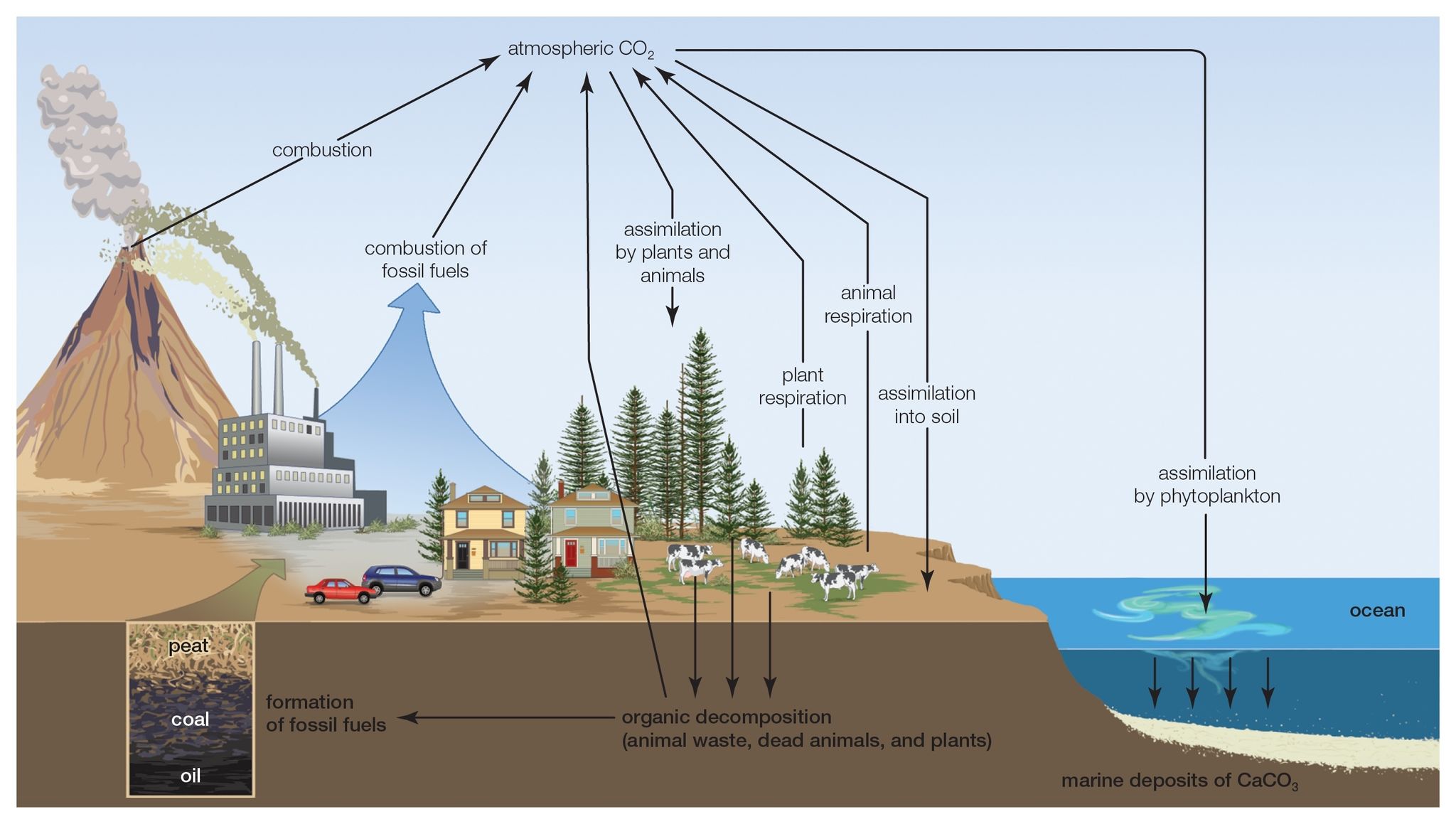
Which of the following add carbon dioxide to the atmosphere?
a)
volcanoes
b)
combustion of fossil fuels
c)
animal and plant respiration
d)
all of these
95.
How nitrogen is "fixed" into useable form for plants
a)
only through action of bacteria
b)
only through lightning
c)
through action of bacteria & lightning
d)
through photosynthesis
96.
TRUE or FALSE?
All of the carbon in existence is continually recycled in the carbon cycle.
a)
True
b)
False
97.
The average temperature of the surface of Earth has increased approximately 1°C in the past century. Which reason best explains this increase in temperature?
a)
lower levels of ozone in the atmosphere
b)
lower levels of nitrogen in the atmosphere
c)
higher levels of carbon dioxide and other greenhouse gases in the atmosphere
d)
higher levels of oxygen in the atmosphere
98.
Which one of these does not add CO2 to the atmosphere?
a)
cooking with gas
b)
planting trees
c)
burning wood
d)
riding in a bus
99.

Which describes the relationship between plants and animals in the carbon cycle?

a)

Plants produce and release oxygen that animals need

b)

Plants produce and release carbon dioxide that animals need

c)

Animals produce and release oxygen that plants need

d)

Animals produce oxygen that plants turn into carbon dioxide

100.
How do  animals get nitrogen?
a)
the atmosphere 
b)
eating other organisms
c)
bacteria
d)
lightning 
101.
Building proteins and DNA is the reason organisms need what substance?
a)
Water
b)
Carbon
c)
Nitrogen
d)
Calcium
102.
Organisms that play a role in the nitrogen cycle
a)
only plants
b)
only animals
c)
only bacteria
d)
plants, animals, & bacteria
103.
When nitrogen gas is turned in to a form that plants and animals can use is called 
a)
Combustion
b)
Photosynthesis
c)
Decomposition
d)
Nitrogen Fixation
104.
What converts nitrogen into a useable form for plants and animals?
a)
bacteria
b)
fungi
c)
rain
105.
Identify the cycle pictured.
a)
The Water cycle
b)
The Carbon cycle
c)
The Nitrogen cycle
d)
The Phosphorus cycle
106.
Identify the cycle pictured.
a)
The Water cycle
b)
The Carbon cycle
c)
The Nitrogen cycle
d)
The Phosphorus cycle
107.

How does carbon in a grass plant get into a lion?

a)

The lion eats an antelope that ate the grass

b)

Carbon from grass doesn't end up in a lion.

c)

The lion absorbs the carbon given off by transpiration

d)

The lion breathes in carbon given out by the plant

108.
Which of the following add carbon dioxide to the atmosphere?
a)
volcanoes
b)
combustion of fossil fuels
c)
animal and plant respiration
d)
all of these
109.
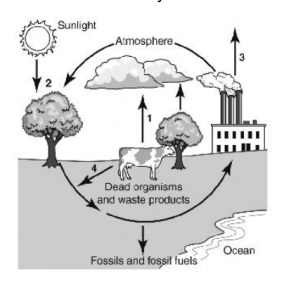
What is happening at 1?
a)
respiration: releasing CO2
b)
decomposing CO2 in the soil
c)
photosynthesis: absorbing CO2
d)
turning CO2 from the atmosphere into organic molecules
110.

features of environment that are alive or were once alive

a)

biotic

b)

abiotic

c)

inbiotic

d)

biography

111.
How much of the atmosphere is composed of nitrogen gas?
a)
87%
b)
38%
c)
78%
d)
21%
112.
Why do all organisms need nitrogen?
a)
To live and grow 
b)
To build phosphorus
c)
To make oxygen levels grow
d)
To help blood circulate better
113.
How nitrogen is "fixed" into useable form for plants
a)
only through action of bacteria
b)
only through lightning
c)
through action of bacteria & lightning
d)
through photosynthesis
114.
Nitrogen fixing bacteria, lives in nodules on the root of a plant called
a)
Broccoli
b)
Legumes
c)
Beats
d)
Carrots
115.
When humans burn fossil fuels, most of the carbon quickly enters the                       as carbon dioxide.
a)
Water
b)
Atmosphere
c)
Sun
d)
Air
116.
The average temperature of the surface of Earth has increased approximately 1°C in the past century. Which reason best explains this increase in temperature?
a)
lower levels of ozone in the atmosphere
b)
lower levels of nitrogen in the atmosphere
c)
higher levels of carbon dioxide and other greenhouse gases in the atmosphere
d)
higher levels of oxygen in the atmosphere
117.
Which one of these does not add CO2 to the atmosphere?
a)
cooking with gas
b)
planting trees
c)
burning wood
d)
riding in a bus
118.

Which describes the relationship between plants and animals in the carbon cycle?

a)

Plants produce and release oxygen that animals need

b)

Plants produce and release carbon dioxide that animals need

c)

Animals produce and release oxygen that plants need

d)

Animals produce oxygen that plants turn into carbon dioxide

119.
How do  animals get nitrogen?
a)
the atmosphere 
b)
eating other organisms
c)
bacteria
d)
lightning 
120.

What is the producer in the picture above?

a)

grasshopper

b)

snake

c)

grass

d)

Sun

121.

What is the decomposer in the picture above?

a)

grass

b)

fungus/mushrooms

c)

hawk

d)

frog

122.

The model above is an example of a ..

a)

food web

b)

food chain

c)

habitat

d)

ecosystem

123.

The model above is an example of a ...

a)

food chain

b)

food web

c)

habitat

d)

ecosystem

124.

What would happen if there were no thrush in the model above?

a)

there would be more insects and slugs

b)

there would be less insects and sluga

c)

there would be more voles

d)

there would be more hawks

125.

A model that shows one direct flow of energy from the Sun to decomposers in an ecosystem is called a

a)

food web

b)

food chain

c)

population

d)

community

126.

A model that shows how all of the food chains in an ecosystem overlap and connect is called a

a)

community

b)

habitat

c)

food chain

d)

food web

127.

In the food web modeled above, where does the flow of energy end?

a)

mangoes and flowers

b)

flowers and frogs

c)

eagle since nothing else in the web gets energy from the eagle

d)

python and wolf

128.

What would harm this food web the most?

a)

the animals roaming about in this ecosystem

b)

rain

c)

pesticides being sprayed

129.

Which organism provides the energy for the producers in this model?

a)

frogs

b)

corn

c)

none of them, the energy comes from the Sun

d)

Eagle

130.

What caused the over abundant elk and bison numbers to begin decreasing in Yellowstone National Park?

a)

the reentry of wolves into the ecosystem

b)

over eating

c)

pesticides

d)

drought

131.

What do decomposers do in a food chain?

a)

they are the first part of a food chain that feeds all of the other organisms

b)

they break down all other organisms to provide nutrients for the soil to help the producers

c)

they serve as food for the consumers

132.

When you compare the deer to the wolf, the deer would be the

a)

decompser

b)

predator

c)

prey

d)

producer

133.

When comparing the deep to the wolf, the wold would be the...

a)

predator

b)

prey

c)

producer

d)

decomposer

134.

The parts of the ecosystem that get their energy from the Sun. They provide energy to other living things in the food chain.

a)

consumers

b)

decomposers

c)

producers

135.

The part of the ecosystem that gets their energy from producers or other living things.

a)

producers

b)

decomposers

c)

consumers

136.

The part of the ecosystem that gets that helps break down the wastes of living things once they are no longer living in order to provide nutrients to the soil.

a)

consumers

b)

producers

c)

decomposers

137.

Ecology is?

a)

The study of living things

b)

The study of relationships between plants, animals and their surrounding environment

c)

The study of bones

d)

The study of the brain

138.
Plants and animals are often referred to as?
a)
Organism 
b)
Things
c)
Werid
d)
Ugly
139.
How many types of organisms are there?
a)
5
b)
4
c)
3
d)
6
140.
A producer?
a)
Eats other plants and animals
b)
Makes its own food
c)
Eats dead plants or animals
d)
Makes toys for kids
141.
A consumer?
a)
Makes its own food
b)
Eats dead plants and animals
c)
Eats plants and other animals for energy
d)
Buys toys for kids
142.
A decomposer?
a)
Eats dead plants or animals and breaks down to put nutrients in the soil
b)
Eats plants or other animals for food
c)
Makes its own food
d)
Machine that gathers trash
143.
a)
Consumer
b)
Producer
c)
Decomposer
144.
a)
Producer
b)
Consumer
c)
Decomposer
145.
a)
Producer
b)
Consumer
c)
Decomposer
146.
a)
Producer
b)
Consumer
c)
Decomposer
147.
All animals are...
a)
producers
b)
consumers
c)
carnivores
d)
omnivores
148.
What do herbivores eat?
a)
Only plants
b)
plants and animals
c)
only other animals
d)
dead organisms
149.
What are organisms that use other organisms for food in order to gain energy?
a)
decomposers
b)
producers
c)
herbivores
d)
consumers
150.
From where do producers get their energy?
a)
the ground
b)
other animals
c)
decomposers
d)
the sun
151.
What do the arrows represent in this diagram?
a)
who is being eaten
b)
the flow of energy
c)
the decomposition of organisms
d)
what things can change into
152.
Which choice has a group of only consumers?
a)
grass, cows, birds
b)
tigers, turtles, seaweed
c)
owl, snake, bear
d)
castus, sun, mushroom
153.
This organism draws its nutrients from dead organisms as it releases enzymes to cause the organisms to break down and break apart. Is it a...
a)
Producer
b)
Consumer
c)
Decomposer
154.
What is the term for secondary consumers in an ecosystem?
a)
Herbivore
b)
Carnivore
c)
Omnivore
155.

Which of the following animals are herbivores?

I Goat

II Bear  

III Lion  

IV Squirrel  

a)

I and II

b)

I and IV

c)

II and III

d)

III and IV

156.

Which statement is true about omnivores?

a)

Animals that only eat one specific type of animals

b)

Animals that only eat one specific type of plants

c)

Animals that eat both plants and animals

d)

Animals that only eat other animals

157.

Which of the following animals are carnivores?

    I Tiger

 II Eagle    

III Rabbit      

 IV Chicken  

a)

I and II

b)

I and IV

c)

II and III

d)

III and IV

158.

What are plants and animals that get their energy from eating other things?

a)

Producers

b)

Consumers

c)

decomposers

d)

herbivores

159.

In this food chain, what will happen if the frogs become extinct?

a)

The snakes will increase.

b)

The grasshoppers will decrease.

c)

The eagles will remain the same.

d)

The grasshoppers will increase.

160.

What is the driving source of energy for the food web?

a)

Sun

b)

Orca

c)

Seal

d)

Larvae

161.

Which type of consumer is always a primary consumer?

a)

Herbivore

b)

Omnivore

c)

Carnivore

d)

Producer

162.

Several food chains linked together make up

a)

food web

b)

food pyraid

c)

ecosystem

163.

What is an example of a consumer getting energy from a consumer?

a)

a tree making food from sunlight

b)

a chipmunk eating seeds

c)

a fish eating insects

164.

_________ is a model that shows the path of energy as it flows from living to another.

a)

food chain

b)

model

c)

food web

165.

Energy goes from

a)

producers to consumers

b)

consumers to producers

c)

decomposers to producers

166.
What is the role of a producer?
a)
Use sunlight to make food
b)
Gain energy from eating other organisms
c)
Keep other species from overpopulating
d)
Breaking down dead stuff 
167.

Observe the food chain above. Which organism’s population would increase if finches were removed from the ecosystem?

a)

Grass

b)

Grasshopper

c)

Snake

d)

Hawk

168.
The arrows in a food chain or web represents what?
a)
They point to the organism that is being eaten.
b)
It shows how sunlight flows within an ecosystem.
c)
They show what direction the energy is flowing between organisms. 
d)
They represent how water is transferred within a habitat.
169.

Look carefully at the image. Which organism is tertiary consumer?

a)
Wolf
b)

bird

c)

lizard

d)

grasshopper

170.

All the following are examples of harmful substances that harm food chains and food web, except

a)

heavy metals

b)

pesticides

c)

microplastic

d)

soil

171.

There are 5 units of pesticide in the leaves, if the beetle eats 5 leaves, how many units of pesticides inside the beetle?

a)

10 units

b)

30 units

c)

25 units

d)

50 units

172.

What will happen to the snake if the snake eats the lizard that contains toxic substances in its body?

a)

Snake can live longer and healthy

b)

Snake's bone might get weaker or the eggs produced cracked

c)

Number of grasshopper increases in the food chain

d)

Number of snake increases in the food chain

173.

Which living thing is the most affected when the toxic substances accumulate along the food chain?

a)

producer

b)

primary consumer

c)

secondary consumer

d)

tertiary consumer