wayground logo

Free Printable Worksheets

Font size

S
M
L
XL
Worksheets

Biology Final Exam

Total questions: 200

Worksheet time: 10hrs 0mins

Name
Class
Date
1.
Environmental factor, such as predation, disease, and competition, that depends on the number of members in a population per unit area.
a)
density-independent factor
b)
density-dependent factor
c)
emigration
d)
immigration
2.
Largest number of individuals in a species that the environment can support long-term.
a)
population delpunsity
b)
dispersion
c)
population growth rate
d)
carrying capacity
3.

There is strong evidence that two species of

cliff-dwelling birds have nested in the same

environment and fed in the same water for

thousands of years, with each having stable

population sizes. Based on this information,

which of the following statements is the best

conclusion?

a)

The two birds compete for food.

b)

One species will displace the other.

c)

The two birds have different ecological niches that allow coexistence.

d)

One species eats a more diverse diet than the other does.

4.

Which cycle are fossil fuels (oil, coal, natural gas) part of?

a)

carbon

b)

water

c)

nitrogen

d)

phosphorus

5.
Identify the cycle pictured.
a)
The Water cycle
b)
The Carbon cycle
c)
The Nitrogen cycle
d)
The Phosphorus cycle
6.

This graph shows ....

a)

When one population increases, the other decreases.

b)

When one population decreases, the other increases.

c)

When one population increases, the other increases instantly.

d)

When one population increases, it causes the other to increases shortly after.

7.
What point on the graph represents the carrying capacity?
a)
A
b)
B
c)
C
d)
D
8.
Which kind of growth does the human population follow? It is described as a J-shaped curve.
a)
Exponential Growth
b)
Logistic Growth
c)
Outstanding Growth
d)
Minimal Growth
9.
Any thing or organism that regulates the size of a population of another organism is known as __________.
a)
a limiting measure
b)
a limiting factor
c)
factorization
d)
materialization of precipitation
10.
A pond ecosystem is shown in the diagram below. Which statement describes an interaction that helps maintain the dynamic equilibrium of this ecosystem?
Which statement describes an interaction that helps maintain the dynamic equilibrium of this ecosystem?
a)
The frogs make energy available to this ecosystem through the process of photosynthesis.
b)
The algae directly provide food for both the rotifers and the catfish.
c)
The green-backed heron provides energy for the mosquito larvae.
d)
The catfish population helps control the populations of water boatman and waterfleas.
11.
Organisms that breaks down and absorbs nutrients from dead organisms 
a)
consumer
b)
trophic level
c)
decomposer
d)
species
12.
Non-living factor that affects an ecosystem
a)
biotic factor
b)
abiotic factor
c)
food chain 
d)
biome
13.
Members of a species in a defined area
a)
Ecosystem
b)
community
c)
biodiversity
d)
population
14.
symbiotic relationship in which one organisms benefits and the other organism is not affected
a)
invasive (non-native) species
b)
mutualism 
c)
nitrogen fixation
d)
commensalism
15.
diagram that shows the energy available to each trophic level in an ecosystem; 10% is passed on to upper levels, the rest is lost as heat
a)
succession 
b)
cellular respiration
c)
energy pyramid
d)
biochemical cycle
16.
What does a food web represent?
a)
All connections of energy flow throughout all organisms in a habitat.
b)
The specific ways that mutualism is carried out.
c)
A single pathway or energy flow between organisms. 
d)
How carnivores get their food. 
17.
An organism that produces its own food supply from inorganic compounds is called a(an)
a)
heterotroph
b)
consumer
c)
detritivore
d)
autotroph
18.
What is the original source of almost all energy in most ecosystems?
a)
carbohydrates
b)
sunlight
c)
water
d)
carbon
19.
In a biological community, the number and abundance of different species.
a)
genetic diversity
b)
species diversity
c)
ecosystem diversity
d)
background extinction
20.
Increasing concentration of toxic substances, such as DDT, in organisms as trophic levels increase in food chains or food webs
a)
Edge Effect
b)
Habitat Fragmentation
c)
Biological Magnification
d)
Eutrophication
21.
What is labeled "a"
a)
proton
b)
neutron
c)
electron
d)
molecule
22.
What is labeled "b"
a)
proton
b)
neutron
c)
electron
d)
molecule
23.
What is labeled "c"
a)
proton
b)
neutron
c)
electron
d)
molecule
24.
What is labeled "a"
a)
enzyme
b)
substrate
c)
active site
d)
product
25.
What is labeled "b"
a)
enzyme
b)
substrate
c)
active site
d)
product
26.
What is labeled "c"
a)
enzyme
b)
substrate
c)
active site
d)
product
27.
What is labeled "d"
a)
enzyme
b)
substrate
c)
active site
d)
product
28.
Vinegar would best be classified as ______.
a)
acidic
b)
basic
c)
neutral
d)
water
29.
Bleach would best be classified as ______.
a)
acidic
b)
basic
c)
neutral
d)
water
30.
What represents the reactant?
a)
A + B
b)
C + D
c)
d
d)
e
31.
What represents the product?
a)
A + B
b)
C + D
c)
d
d)
e
32.
What represents the energy released?
a)
b
b)
c
c)
d
d)
e
33.
What represents the activation energy WITHOUT the enzyme?
a)
b
b)
c
c)
d
d)
e
34.
What represents the activation energy WITH the enzyme?
a)
b
b)
c
c)
d
d)
e
35.
A chemical reaction is a process by which atoms or groups of atoms in substances are
a)
dissolved in other substances
b)
ionized by the loss of protons
c)
mixed together with atoms in other substances
d)
reorganized into different substances
36.
Which equation satisfies the law of conservation of matter?
a)
CH4 + 2O2 = CO2 + 2H2O
b)
2CH4 + 2O2 = 2CO2 + 2H2O
c)
4CH4 + 2O2 = CO2 + 2H2O
d)
CH4 + 2O2 = 4CO2 + 2H2O
37.
Which is true in a covalent bond?
a)
The bond forms between ions
b)
The bond forms when electrons are shared
c)
The bond holds atoms weakly
d)
The bond is caused by van der Waals forces
38.
Which is true about enzymes?
a)
They act on nonspecific, randomly chosen substrates
b)
After a reaction, they cannot be reused
c)
They can speed up metabolic processes in the body
d)
They cannot change shape
39.
Which is an example of a solute?
a)
soil suspended in water
b)
sugar dissolved in water
c)
water that dissolves salt
d)
water with undissolved soil
40.
Adhesion is the aspect of water that causes ....
a)
polar covalent bonds to join water molecules to other substances
b)
nonpolar covalent bonds to enable water to dissolve other substances
c)
ionic bonds to cause electrons to flow through water
d)
hydrogen bonds to form between water and another substance
41.
What is the primary function of a nucleic acid?
a)
To store energy
b)
To provide energy
c)
To provide structure
d)
To transmit and store genetic information
42.
What are the building blocks of nucleic acids?
a)
monosaccharides
b)
nucleotides
c)
amino acids
d)
fatty acids
43.
Two nucleic acids are ...
a)
MNA and CNA
b)
DNA and RNA
c)
DNA and nucleotides
d)
RNA and nucleotides
44.
The building blocks of proteins are called ______.
a)
monosaccharides
b)
glycerides
c)
amino acids
d)
nucleotides
45.
How many structures of proteins are there?
a)
One
b)
Two
c)
Three
d)
Four
46.
Which is NOT a function of proteins?
a)
Carry genetic information
b)
Structure
c)
Cell Signaling
d)
Speed up chemical reactions
47.
What is the primary function of lipids?
a)
Pass on genetic information
b)
Provide quick energy
c)
Speed up chemical reactions
d)
Store energy for long term use
48.
What are the long chains highlighted in yellow called?
a)
Glycerol
b)
Fatty Acid Tails
c)
Lipase Chains
d)
Carbohydrate Tails
49.
Which of these would not be classified as a lipid?
a)
Butter
b)
Olive Oil
c)
Ear Wax
d)
Honey
50.
 The molecules shown can best be described as ...
a)
Monosaccharides
b)
Disaccharides
c)
Polysaccharides
d)
Polymers
51.
A carbohydrate composed of two units, such as lactose or sucrose, is called a ...
a)
Monosaccharide
b)
Disaccharide
c)
Polysaccharide
d)
Polymer
52.
This picture shows three different moleucles; starch , cellulose, and glycogen.  Which statement summarizes these molecules?
a)
All of these molecules are monomers that are more specifically called a monosaccharide.
b)
All of these molecules are polymers that are more specifically called polysaccharides.
c)
All of these molecules are made of different monomers.
d)
All of these molecules are proteins that are called polysaccharides.
53.
Which is a function of a carbohydrate?
a)
Pass on genetic traits.
b)
Store energy to be used long term.
c)
Provide quick energy
d)
Relay messages through the body.
54.

A potato serves as energy storage from the plant as photosynthesis creates extra glucose molecules. This _________ starch is an excellent energy source that is formed through _______.

a)

monosaccharide; hydrolysis

b)

polysaccharide; dehydration synthesis

c)

disaccharide; dehydration synthesis

d)

polypeptide; hydrolysis

55.

An organic compound is a compound that contains

a)

carbon

b)

oxygen

c)

hydrogen

d)

nitrogen

56.
These red blood cells are swelling and bursting.  We can assume that they are in a _____________ environment.
a)
Hypertonic
b)
Hypotonic
c)
Isotonic
d)
Hostile
57.
We can assume that the cells in the plant on the right are in a _____________ environment.
a)
Hypertonic
b)
Hypotonic
c)
Isotonic
d)
Rainforest
58.
Diffusion : ______ :: Osmosis : ___________
a)
only salt; water
b)
any molecules; water
c)
water; only salt
d)
water; any molecules
59.
What is a major difference between facilitated diffusion and active transport?
a)
Active transport moves substances against a concentration gradient
b)
Active transport uses proteins
c)
Facilitated diffusion moves molecules across the membrane
d)
Facilitated diffusion requires energy
60.
What characteristic of the plasma membrane is illustrated in this drawing?
a)
selective permeability
b)
phospholipid bilayer
c)
impermeability to water
d)
permeability to macromolecules
61.
Which statement would NOT be included in a summary of the cell theory?
a)
The cell is the basic unit of organization
b)
All cells contain a nucleus that controls cell division
c)
All organisms are made up of at least one cell.
d)
All cells come from preexisting cells.
62.
In which structure would you find a nucleus?
a)
bacterial cell
b)
plant cell
c)
prokaryote
d)
virus
63.
Which is present only in eukaryotic cells?
a)
cell membrane
b)
chromosomes
c)
DNA
d)
nucleus
64.
Which statement is true about bacterial cells?
a)
The cells are very large
b)
The cells have no nucleus
c)
They are eukaryotes
d)
They have organelles
65.
Which organelle provides usable energy to the cell?
a)
mitochondria
b)
nucleus
c)
ribosome
d)
vesicle
66.
On a laboratory exam, a student is asked to determine if the cells under a microscope are plant cells or animal cells.  What might the student look for?
a)
chloroplasts & a cell wall
b)
ribosomes & vacuoles
c)
a nucleus & ribosomes
d)
a cell membrane & mitochondria
67.
Which organelle is present in a paramecium protozoan (a one celled animal-like organism) but absent in the cells of a strawberry plant?
a)
cilia
b)
cytoskeleton
c)
microtubules
d)
nucleus
68.
Which organelle is large in plant cells but small or absent in animal cells?
a)
centriole
b)
chloroplast
c)
nucleolus
d)
vacuole
69.
How can the cytoskeleton of a cell be described?
a)
framework and anchor for organelles
b)
selectively permeable series of membranes
c)
semifluid material
d)
transport system
70.
Which of these organelles is most closely associated with protein building
a)
vacuole
b)
mitochondria
c)
ribosome
d)
cell membrane
71.
The arrows in the diagram below represent the movement of oxygen and carbon dioxide in an ecosystem.  What is the main source of oxygen in an ecosystem?
a)
Combustion by cars
b)
Photosynthesis by animals
c)
Respiration by animals
d)
Photosynthesis by plants
72.
What are the products of photosynthesis?
a)
Energy and oxygen
b)
Glucose and oxygen
c)
Carbon dioxide and water
d)
Glucose and carbon dioxide 
73.
According to these equations, which of the following is a reactant during respiration?
a)
Water
b)
Sugar
c)
Energy
d)
Carbon dioxide
74.

The process that releases energy from sugar (glucose) and has to have oxygen present is called?

a)

Synthesis

b)

Cellular Aerobic Respiration

c)

Fermentation

d)

Photosynthesis

75.
Photosynthesis occurs in which organelle?
a)
Chloroplast
b)
Endoplasmic Reticulum
c)
Vacuole
d)
Mitochondrion
76.
Which process requires the presence of oxygen to produce energy?
a)
Glycolysis
b)
Anaerobic Respiration
c)
Transpiration
d)
Aerobic Respiration
77.
The two main processes by which cells absorb, release, and use energy are
a)
Fermentation and respiration
b)
Digestion and Photosynthesis
c)
Photosynthesis and Cellular Respiration
d)
Aerobic and anaerobic respiration
78.
Which process occurs in plants and animals?
a)
Cellular Respiration
b)
Photosynthesis
79.
In cells, the energy available in food is used to make an energy rich compound called?
a)
Water
b)
Glucose
c)
ATP
d)
ADP
80.
What is the pigment that makes a plant green?
a)
Chloroplast
b)
Chlorophyll
c)
Cytoplasm
d)
Mitochondria
81.

Before cells can divide, what happens to the DNA?

a)

It is replicated

b)

It increases in size

c)

It is divided in half

d)

It decreases in size

82.

How many chromosomes do humans have?

a)

23

b)

46

c)

50

d)

92

83.

What happens in the S phase of interphase?

a)

The cell grows

b)

The cell prepares for cell division

c)

The cell divides

d)

The DNA replicates

84.

What happens in anaphase of mitosis?

a)

The chromosomes become visible; nucleus disappear; spindles form

b)

The chromosomes align in the middle of the cell

c)

The sister chromatids separate

d)

The chromosomes uncoil into chromatin; nucleus reappears; spindles disappear

85.

What happens in cytokinesis?

a)

The chromosomes become visible; nucleus disappears; spindles form

b)

The chromosomes align in the middle of the cell

c)

The DNA is duplicated

d)

The cytoplasm divides into two new daughter cells

86.

Which phase of mitosis is shown here?

a)

prophase

b)

metaphase

c)

anaphase

d)

telophase

87.

Which phase of mitosis is shown here?

a)

prophase

b)

metaphase

c)

anaphase

d)

telophase

88.

Which of the following is the correct order of mitosis?

a)

prophase, metaphase, anaphase, telophase

b)

metaphase, telophase, anaphase, prophase

c)

telophase, anaphase, metaphase, prophase

d)

prophase, anaphase, telophase, metaphase

89.

In mitosis, the resulting two daughter cells are

a)

identical to each other

b)

half the chromosome numbers

c)

different from each other

d)

none of the above

90.

Mitosis deals with what type of cells?

a)

body cells (somatic)

b)

sex cells (gamete)

c)

dead cells

d)

none of the above

91.

How many pairs of chromosomes do humans have?

a)

23

b)

46

c)

50

d)

92

92.
A cell spends __% of its cycle in ____.
a)
100, interphase
b)
10, cytokinesis
c)
40, mitosis
d)
90, interphase
93.
A repeating sequence of growth and division...
a)
Mitosis
b)
Interphase
c)

Cell Cycle

d)
Somatic
94.
What is the role of the spindle during mitosis?
a)
it changes the chromatin to chromosome
b)
duplicate the DNA
c)
breaks down the membrane
d)
separates the chromatids.
95.
What is the purpose of mitosis?
a)
create genetic diversity
b)
increase cell volume
c)
produce new offspring
d)
replace damaged cells and growth
96.

Centrioles are only found in ________ cells and help support the cell by elongating into the __________.

a)

plant cells; spindle fibers

b)

animal cells; spindle fibers

c)

prokaryotes; nuclear membrane

d)

eukaryotes; chromatin

97.

When carcinogens such as smoking or UV exposure cause a failure in the regulation of cell growth and development, what condition might occur?

a)

normal mitosis

b)

uncontrolled cell growth in the form of cancer

c)

cell plates form

d)

apoptosis

98.

__________ cells divide through binary fission.

a)

Eukaryote

b)

Prokaryote

99.

Cancer cells can reproduce rapidly because they

a)

are smaller than normal cells

b)

bypass interphase and enter mitosis right away

c)

undergo mitosis faster

d)

spend less time in interphase

100.

Mitosis uncontrolled may lead to an abnormal cell growth called _______.

a)

cleavage furrow

b)

apoptosis

c)

cyclin

d)

tumor

101.

Which description best identifies characteristics of asexual reproduction.

a)

one parent, union of gametes, offspring similar to but not genetically identical to the parent

b)

one parent, no union of gametes, offspring genetically identical to the parent

c)

two parents, union of gametes, offspring similar to but not genetically identical to parents.

d)

two parents, no union of gametes, offspring genetically identical to the parents.

102.

Which is the number of chromosomes in a haploid cell?

a)

1n

b)

2n

c)

3n

d)

4n

103.

What term is used to describe pairs of chromosomes having DNA segments, or genes, for the same traits?

a)

homologous

b)

analogous

c)

homozygous

d)

parallel

104.

An organisms with the genotype DD for a trait is

a)

heterozygous dominant

b)

heterozygous recessive

c)

homozygous dominant

d)

homozygous recessive

105.

What is formed as a result of mitosis?

a)

four genetically different cells

b)

four genetically identical cells

c)

two genetically different cells

d)

two genetically identical cells

106.

After performing a monohybrid cross, it is important to analyze the results with a Punnett square. What does each box in a Punnett square represent?

a)

possible phenotype

b)

possible genotype

c)

one individual

d)

two possible gentoypes

107.

The tall allele, T, is dominant to the short allele, t, in Mendel's pea plants. You examine a pea plant that exhibits the tall phenotype. What is its genotype?

a)

A. Tt

b)

B. TT

c)

C. tt

d)

both A and B are possible

108.

A true-breeding tall pea plant is crossed with a true-breeding short pea plant, and all the offspring are tall. What is the most likely genotype of the offspring assuming a single-gene trait?

a)

tt

b)

Tt

c)

TT

d)

TT or tt

109.

A white mouse whose parents are both white produces only brown offspring when mated with a brown mouse. The white mouse is most probably ___________.

a)

homozygous recessive

b)

heterozygous

c)

homozygous dominant

d)

haploid

110.

Create a dihybrid cross for two parents that have the genotype MmXx. What fraction of this cross will be recessive for both traits?

a)

1/2

b)

2/16

c)

1/4

d)

1/16

111.

You are given a sample of unknown human cells to examine. Analysis of their nuclei reveals that each cell contains 23 chromosomes. What types of cells might these be?

a)

egg cells

b)

skin cells

c)

liver cells

d)

white blood cells

112.

Which is a difference between meiosis I and meiosis II?

a)

Cytokinesis occurs during meiosis II but not meiosis I.

b)

Meiosis I has a prophase stage, but meiosis II does not.

c)

Meiosis II results in four haploid cells instead of two diploid cells.

d)

Nuclear membranes form during meiosis II but not meiosis I.

113.

During which phase of meiosis do homologous chromosomes align as tetrads in the middle of the spindle?

a)

prophase I

b)

prophase II

c)

metaphase I

d)

metaphase II

114.

What process is taking place in the illustration shown below?

a)

fertilization

b)

prophase

c)

polyploidy

d)

crossing over

115.

What are the possible game types that can be produced from a parent who is ZzFf?

a)

All ZF

b)

All zf

c)

half ZF and half zf

d)

ZF, Zf, zF, zf

116.

According to Mendel's law of segregation, what takes place during meiosis?

a)

Pairs of alleles cross over on chromosomes, exchanging one for the other.

b)

Pairs of alleles separate in meiosis, and each gamete receives one allele of a pair.

c)

Part of an allele is separated, or broken off, from its chromosome.

d)

One chromosome is suppressed, and the other chromosome of the pair determines the traits of the offspring.

117.

Which describes the 23 pairs of human chromosomes?

a)

1 autosome pair; 22 sex chromosome pairs

b)

1 sex chromosome pair; 22 autosome pairs

c)

2 autosome pairs; 21 sex chromosome pairs

d)

2 sex chromosome pairs; 21 autosome pairs

118.

What is the effect of sickle-cell anemia?

a)

blocked respiratory pathways

b)

decreased neurological functions

c)

inefficient oxygen transportation

d)

susceptibility to contracting malaria

119.

What is the genotype of a MAN with color blindness?

a)

XCXC

b)

XXc

c)

XY

d)

XCY

120.

How can the genetic disorder known as hemophilia be defined?

a)

dominant, sex-linked disorder common to females

b)

dominant, sex-linked disorder common to males

c)

recessive, sex-linked disorder common to females

d)

recessive, sex-linked disorder common to males

121.
What is shown at "B" in this diagram of a nucleotide?
a)
Sugar
b)
Phosphate
c)
Nitrogenous Base
d)
Hydrogen
122.
What is shown at "C" in this diagram of a nucleotide?
a)
Sugar
b)
Phosphate
c)
Nitrogenous Base
d)
Hydrogen
123.
Which scientists discovered the double helix model of DNA?
a)
Chargaff and Levene
b)
Franklin and Wilkins
c)
Hershey and Chase
d)
Watson and Crick
124.
A molecule of DNA is made up of 
a)
amino acids and proteins
b)
ATP and enzymes
c)
paired nucleotides
d)
receptor enzymes
125.
Why is the presence of DNA important for the cellular metabolic activities?
a)
DNA directs the production of enzymes
b)
DNA is the structural component of cell membranes
c)
DNA directly increases the solubility of nutrients
d)
DNA is the major component of cytoplasm
126.
Which base always pairs with guanine?
a)
adenine
b)
cytosine
c)
thymine
d)
uracil
127.
Which defines a codon in DNA and mRNA?
a)
pair of nucleic acid and sugar
b)
pair of phosphate and sugar
c)
three-base code
d)
two-base code
128.
Which is the function of the DNA helicase enzyme in the DNA replication process?
a)
coils new DNA strands
b)
joins DNA to RNA primer
c)
matches nucleotide pairs
d)
unwinds the double helix
129.
A DNA segment is changed from -AATTAG to -AAATAG.  This is a(n) _______.
a)
frameshift mutation
b)
insertion
c)
substitution
d)
deletion
130.
What molecule is this?
a)
DNA
b)
mRNA
c)
rRNA
d)
tRNA
131.
What is the complimentary mRNA sequence to the DNA sequence T-A-G-G-C-A?
a)
A-T-C-C-G-T
b)
C-G-A-A-T-G
c)
A-U-C-C-G-U
d)
C-G-A-A-U-G
132.
What is the function of DNA polymerase during replication?
a)
bonds mRNA to original parent strand
b)
bonds new nucleotides to parent strand
c)
unwinds the replication DNA strand
d)
winds up the replicated DNA strand
133.
Which is the central dogma of biology?
a)
DNA codes for RNA, which guides enzyme synthesis
b)
DNA codes for RNA, which guides protein synthesis
c)
RNA codes for DNA, which guides enzyme synthesis
d)
RNA codes for DNA, which guides protein synthesis
134.
If the structure of DNA were likened to a ladder, what would make up the "supporting structure" (not the 'rungs') of the ladder?
a)
amino acids and proteins
b)
nucleotide bases, including thymine
c)
nucleotide bases, including uracil
d)
sugar-phosphate molecules
135.
What causes the two sides of the double helix of DNA to stay joined together?
a)
the joining of base pairs
b)
joining of phosphate molecules
c)
joining of sugar molecules
d)
joining of RNA molecules
136.
Process in which mRNA is synthesized from the template DNA
a)
Transcription
b)
Translation
c)
Protein Synthesis
d)
Replication
137.
Process in which mRNA attaches to the ribosome and a protein is assembled
a)
Transcription
b)
Translation
c)
Protein Synthesis
d)
Replication
138.
A permanent change in a cell's DNA
a)
mutagen
b)
mutation
c)
codon
d)
anticodon
139.

What is number 2?

a)

mRNA

b)

DNA

c)

tRNA

d)

codon

140.

What is number 7?

a)

Ribosome

b)

Anticodon

c)

Amino Acid

d)

Protein

141.

What is number 8?

a)

Ribosome

b)

Anticodon

c)

Amino Acid

d)

Protein

142.

What is number 6?

a)

Ribosome

b)

Anticodon

c)

Amino Acid

d)

Protein

143.

What is number 5?

a)

Ribosome

b)

Anticodon

c)

Amino Acid

d)

Protein

144.

What is number 4?

a)

mRNA

b)

DNA

c)

tRNA

d)

codon

145.

What is number 3?

a)

mRNA

b)

DNA

c)

tRNA

d)

codon

146.
The disappearance of a species.
a)
Evolution
b)
Extinction
c)
Migration
d)
Mutation
147.
According to the law of superposition, which layer is the youngest?
a)
A
b)
B
c)
C
148.
All the individuals of a species that live in a particular area are called a
a)
variation
b)
population
c)
fossil
d)
group
149.
Two organisms that are closely related would have
a)
very similar DNA sequence
b)
exactly the same DNA sequences
c)
no proteins in common
d)
completely different DNA sequence
150.
The environment around Manchester, England, changed during the Industrial Revolution.  How did this change affect peppered moths living in the area?
a)
Natural selection favored moths with dark wings because predators could not see them on the soot-colored trees.
b)
Natural selection favored moths with white wings that were easy for predators to see.
c)
Natural selection favored moths with white wings because predators could not see them on the soot-colored trees.
d)
Natural selection caused moths with white wings to become extinct.
151.
What is embryology?
a)
the age of organisms
b)
the oldest stage of development
c)
the life span of an organism
d)
the earliest growth stage of development
152.

What do we call a change in a species over time?

a)

Adaptation

b)

Evolution

c)

Extinction

d)

Environmental influences

153.
The diagram shows fossils in different rock layers. Which of these statements about the age of these fossils is most likely correct?
a)
Fossil A and C are the same age
b)
Fossil B is older than fossil C
c)
Fossils A is older than fossil B
d)
Fossil D is older than fossil C
154.
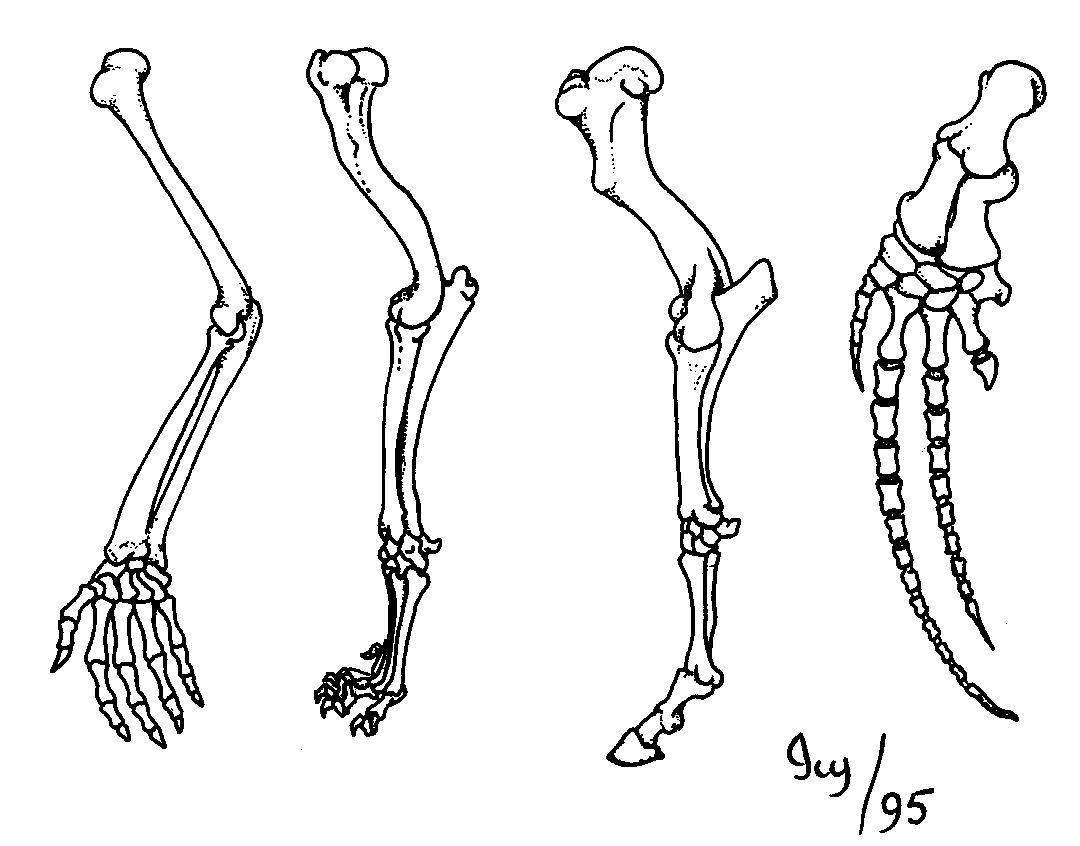
Structures with the same parts have different functions; suggests that organisms share a common ancestry
a)
vestigial structures
b)
homologous structures
c)
adaptive radiation
d)
fossil
155.
Inherited trait that helps an organism survive is a(n) __________.
a)
Fossil
b)
Adaptation
c)
Ancestor
d)
Natural selection
156.
Where the better adapted organisms survive to pass traits along to offspring.
a)
Evolution
b)
Natural Selection
c)
Extinction
d)
Artifical Selection
157.
Why are advantageous traits more likely to be passed onto offspring?
a)
Because they are more likely to survive and reproduce.
b)
Because they come from dominant alleles.
c)
Because they come from recessive alleles.
d)
Because the trait is an acquired phenotype.
158.
Which best describes mutations?
a)
Always helpful
b)
Always harmful
c)
Can be helpful or harmful
d)
Always neutral
159.

Whales are aquatic mammals that contain a pelvis (hip) bone. Even though it does not aid in its movement, the function must have been used by a common ancestor of the whale. Thus, the pelvis is referred to as a(n)

a)

vestigial structure

b)

analogous structure

c)

homologous structure

160.
The ability of an organism to survive and reproduce in its specific environment 
a)
diversity.
b)
evolution
c)
adaptation
d)
 fitness
161.
Genetic differences between organisms of the same species
a)
Variation
b)
Adaptation
c)
Behavior
d)
Environment
162.

Based on the image, why are these similar looking birds now considered different species, even though they have a common ancestor?

a)

all these birds could swim, so they went to different continents to evolve

b)

their environments changed over time, so they had to adapt to those environment

c)

the birds acquired the new traits while trying to adapt to their new environments

d)

there were fewer species of birds in the past, now there are more

163.
____________ believed that those organisms that were best suited for their environment would survive and pass on their beneficial traits to their offspring. 
a)
Darwin
b)
Lamarck
c)
Watson
d)
Mendel
164.

A hurricane wipes out half the population of blue jays in Cape Hatteras, North Carolina. This is an example of?

a)

Natural Selection

b)

Mutation

c)

Genetic Drift

d)

Gene Flow

165.

Mutations are important because ____.

a)

they bring genetic variation needed for a population to evolve

b)

mutations are not important

c)

they bring about benefits for the individual not the population

d)

they bring death of the organism in which they develop

166.

The science of naming and classifying is called

a)

Classology

b)

Taxonomy

c)

Genetics

d)

Biology

167.

The scientific name Felis domesticus indicates that ________ is the species name.

a)

Felis

b)

domesticus

c)

Felis and domesticus

d)

Feline

168.

All kingdoms except Archebacteria and Eubacteria have cells that are

a)

eukaryotic

b)

prokaryotic

c)

enclosed in a cell wall

d)

without a nucleus

169.

Organisms in the kingdom _______ are described as plant-like, animal-like, and fungus-like.

a)

Fungi

b)

Animalia

c)

Plantae

d)

Protista

170.

Some Protozoa, like the __________ move by pseudopods, which are flowing extensions of the cell.

a)

paramecium

b)

mushroom

c)

yeast

d)

amoeba

171.

Beneficial fungi include decomposers, those used in food production, and

a)

those that cause ringworm

b)

those that produce the antibiotic penicillin

c)

slime mold

d)

poisonous mushrooms

172.

Organisms that coannot make their own food are considered

a)

semitrophs

b)

heterotrophs

c)

autotrophs

d)

multicellular

173.

Plant cells have cell walls made of cellulose but fungi have cell walls made of _____.

a)

chitin

b)

cellulose

c)

lipids

d)

semipermeability

174.

Nonvascular plants do not have ______

a)

vessels (xylem and phloem)

b)

chloroplasts

c)

cell walls

d)

water

175.

Green algae are in the Protista kingdom and are thought to be the ancestors of the _________ kingdom.

a)

Fungi

b)

Animalia

c)

Eubacteria

d)

Plantae

176.

The classification level _______ is the most specific among these choices.

a)

kingdom

b)

phylum

c)

genus

d)

order

177.

The Kindgom Animalia contains _______ organisms

a)

unicellular

b)

multicellular

c)

prokaryotic

d)

semicellular

178.

Unicellular organisms that can live in extreme conditions such as hot springs, hydrothermal vents, and acidic environments are part of the Domain and Kingdom _____.

a)

Eubacteria

b)

Bacteria

c)

Archaebacteria

d)

Protista

179.

Bacteria are classified according to their ______.

a)

size

b)

shape

c)

symmetry

d)

color

180.

The word Bacilli means _____

a)

rod-shaped

b)

spiral-shaped

c)

heart-shaped

d)

sphere-shaped

181.

Identify the type of root system shown on the right.

a)

tap root

b)

fan root

c)

fibrous root

182.

What does the vacular tissue phloem transport?

a)

water

b)

nutrients

c)

waste

183.

What do you call the porelike openings that allow gases to enter and leave the leaf?

a)

chlorphyll

b)

stomata

c)

xylem

d)

phloem

184.

What type of tropism is this plant demonstrating?

a)

Phototropism

b)

Gravitropism

c)

Thigmotropism

185.

Is this a picture of a gymnosperm or an angiosperm?

a)

Gymnosperm

b)

Angiosperm

186.

The stamen is the ______ part of the flower

a)

male

b)

female

187.
This is the top part of the pistil of a flower which receives the pollen grains; germination happens here.
a)
petal
b)
sepal
c)
filament
d)
stigma
188.

What group of plants makes up the majority of plant species?

a)

ferns

b)

gymnosperms

c)

angiosperms

d)

moss, hornworts, and liverworts

189.

Liverworts, hornworts, and moss are all ____________

a)

vascular plants

b)

nonvascular plants

c)

ferns

190.
During the lytic infection by a virus, the host cell is-
a)
destroyed
b)
copied
c)
passed on to the lysogenic cycle
d)
not affected
191.
Which statement regarding viruses is true?
a)
a virus can only reproduce inside of a living cell
b)
viruses do not contain DNA
c)
viruses are unicellular
d)
viruses are generally larger than cells
192.
The process of converting nitrogen into a form plans can use is known as nitrogen
a)
conjugation
b)
sterilization
c)
fixation
d)
decomposition
193.
What is Flagella?
a)
A tail like structure that help protist move
b)
Hair like fibers that help protist move
c)
A place where spores are kept
d)
A fake foot that help protist move
194.
A mushroom growing on the forest floor gets most of its energy by:
a)
eating insects
b)
eating moss
c)
absorbing sunlight
d)
absorbing nutrients
195.
A hidden virus in the lysogenic cycle...
a)
cannot attach to a host cell
b)
becomes part of the host cell's genetic material
c)
immediately takes over the cells functions
d)
attaches to but does not enter the cell
196.

Bacteria go through this asexual reproduction process.

a)

budding

b)

binary fission

c)

sporulation

d)

regeneration

197.
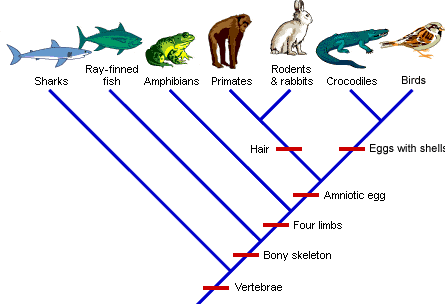
According to this cladogram, sharks are MOST closely related to which organism? 
a)
Amphibians
b)
Ray finned fish
c)
Crocodiles
d)
Birds
198.

How many options should every branch in a dichotomous key have?

a)

1

b)

2

c)

3

d)

4

199.
Which kingdoms are prokaryotic?
a)
Archaebacteria and Animalia
b)
Eubacteria and Archaebacteria
c)
Fungi and Protista
d)
Plantae and Eubacteria
200.
Identify the kingdom...
Microscopic unicellular organism found in a mud puddle.  Organism's DNA is contained in a nucleus and it moves by beating tiny hairs in the water.

a)
Archaebacteria
b)
Eubacteria
c)
Protista
d)
Fungi