
 Worksheets
AP Bio Unit 8 Ecology
Total questions: 198
Worksheet time: 3hrs 47mins
Which of the following is an environmental influence on populations? (Select all that apply)
density
distribution
age structure
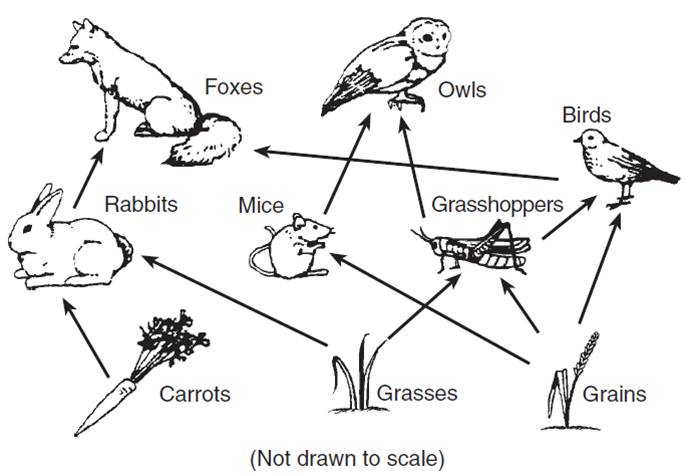
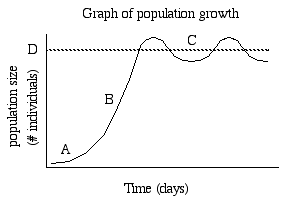
If the larvae of a particular species of mosquito are to survive to the adult stage, the eggs must be laid in the trapped pool of water of the northern pitcher plant. The mosquito larvae provide no apparent benefit or harm to the pitcher plant. This type of interaction is an example of
commensalism
mutualism
parasitism
competition

Organisms with low birthrates and increased care of young, would follow which of the following survivorship curves?
Type I
Type II
Type III
The black rhinoceros is a mammal found in Africa. Weighing in at up to 1,350 kg, these rhinos can live roughly 35 years. Gestation in the black rhino lasts for 15-16 months, with calves staying under the mother’s parental care for up to four years.
Black rhinos have been hunted extensively by humans for their horns. Poaching pressure has reduced the black rhino population to an endangered level. Ongoing efforts are attempting to save the animal from extinction.
How can the black rhino survivorship strategy be categorized?
K-selection, type I
K-selection, type III
r-selection, type I
r-selection, type III
In 1976, the dominant finch on Daphne Major in the Galapagos Islands was the medium ground finch, with a population of 1,200. In 1977, a drought struck the island negatively affecting most of the vegetation. As a result, the population of medium ground finch dropped to 180 due to starvation. In 1983, however, a large amount of rainfall fell on the island creating optimal conditions for vegetation. The medium ground finch population increased to 1,100. What type of factor affected medium ground finch populations in 1977 and 1983?
Density independent
Logistic
Density dependent
Biotic
In 1976, the dominant finch on Daphne Major in the Galapagos Islands was the medium ground finch, with a population of 1,200. In 1977, a drought struck the island negatively affecting most of the vegetation. As a result, the population of medium ground finch dropped to 180 due to starvation. In 1983, however, a large amount of rainfall fell on the island creating optimal conditions for vegetation. The medium ground finch population increased to 1,100. After the rainfall of 1983, what type of population growth did the medium ground finch experience?
Logistic
Quantitative
Exponential
Abiotic
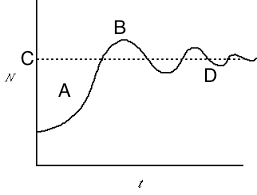
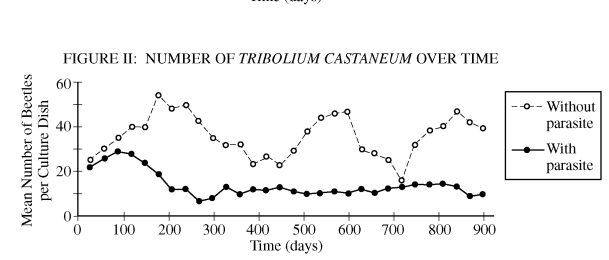
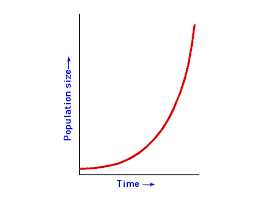
If the population maintains the current growth pattern, a plot of its growth would resemble which of the following?
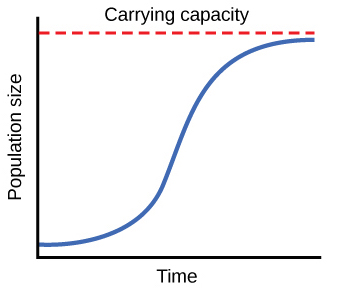
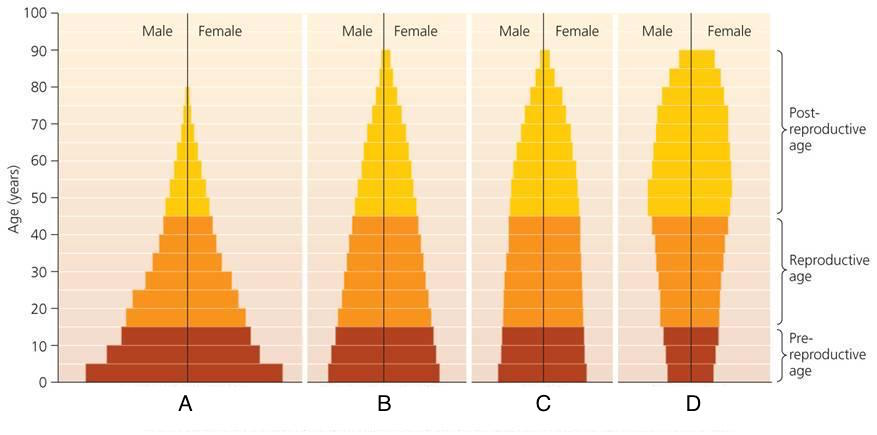
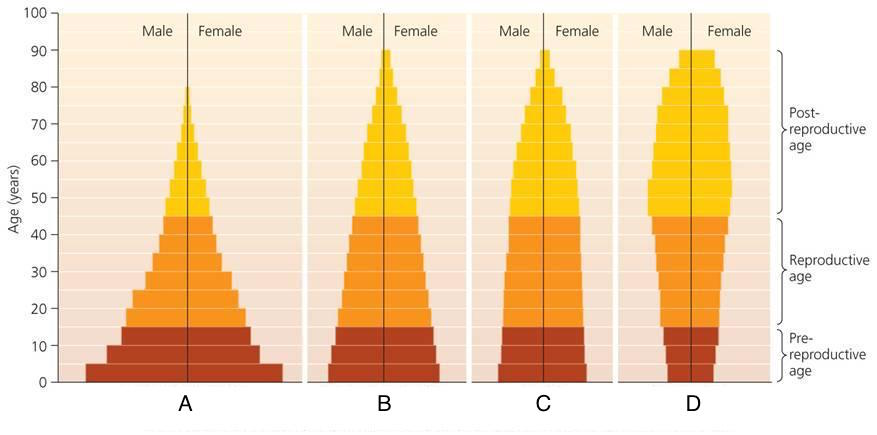
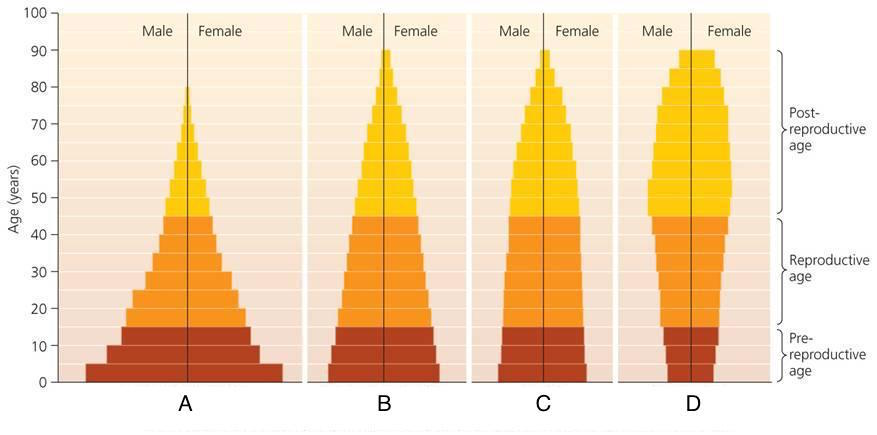
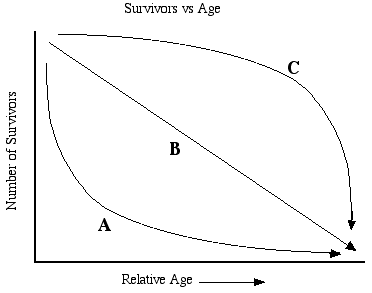
Which best describes an organism that fertilizes externally?
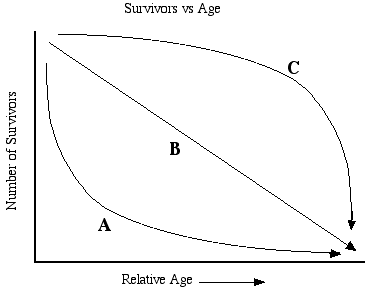
Which curve best describes an organism that invests a lot of energy in parenting?
A certain population of mice is growing exponentially. The growth rate of the population (r) is 2.0 and the current population size (N) is 2,500 individuals. How many mice are added to the population each year?
1250
2500
500
5000
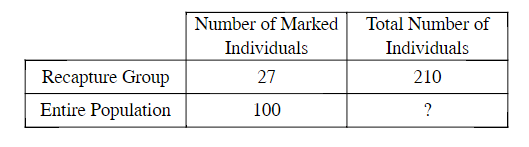
Researchers used the mark-recapture method to estimate the number of individuals in a population. Using the results presented in the table below, estimate the total number of individuals in the population. Give your answer to the nearest whole number.
500
665
778
889
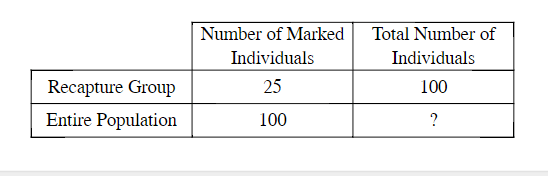
Researchers used the mark-recapture method to estimate the number of individuals in a population. Using the results presented in the table below, estimate the total number of individuals in the population. Give your answer to the nearest whole number.
50
250
400
450
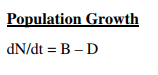
There are 300 falcons living in a certain forest at the beginning of 2013. Suppose that every year there are 50 falcons born and 30 falcons that die.
What is the population growth rate (include units)? Interpret the value.
100
50
20
10
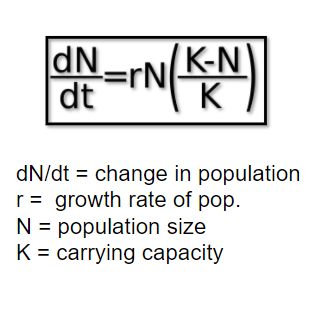
If a population has a carrying capacity (K) of 1000, and the growth rate (r) is 1.1, what is the population growth when the population (N) is 500?
147
227
337
1124
If a population has a carrying capacity (K) of 1000, and the growth rate (r) is 1.05, what is the population growth when the population (N) is 500?
263
563
456
1142

Which type of community is more resilient to chance?
Less diversity & fewer parts
Lass diversity & more parts
More diversity & fewer points
More diversity & more parts
Keystone species have a…
Disproportionate affect relative to abundance
Proportionate affect relative to abundance
What happens if a keystone species is removed…
Community becomes more diverse
Ecosystem collapses
No effect due to minor role
Population becomes less diverse
Which of these does not contribute to maintain diversity?
Decomposer
Essential abiotic/biotic factor
Keystone species
Producer
What type of environment is resistant to change?
Low diversity, low component parts
High diversity, low component parts
Low diversity, high component parts
High diversity, high component parts
If the keystone species is removed what happens?
Their predator population increases
Their predator population decreases
The ecosystem collapses
The ecosystem stabilizes
Abiotic factors
Factor that causes living organism to die
Factor that causes living organisms to reproduce
Living factor
Nonliving factor
Predators are an example of
Abiotic factors
Biotic factors
What happens if sea otters decrease?
Sea urchins increase, kelp increases
Sea urchins decrease, kelp increases
Sea urchins increase, kelp decreases
Sea urchins decrease, kelp decreases
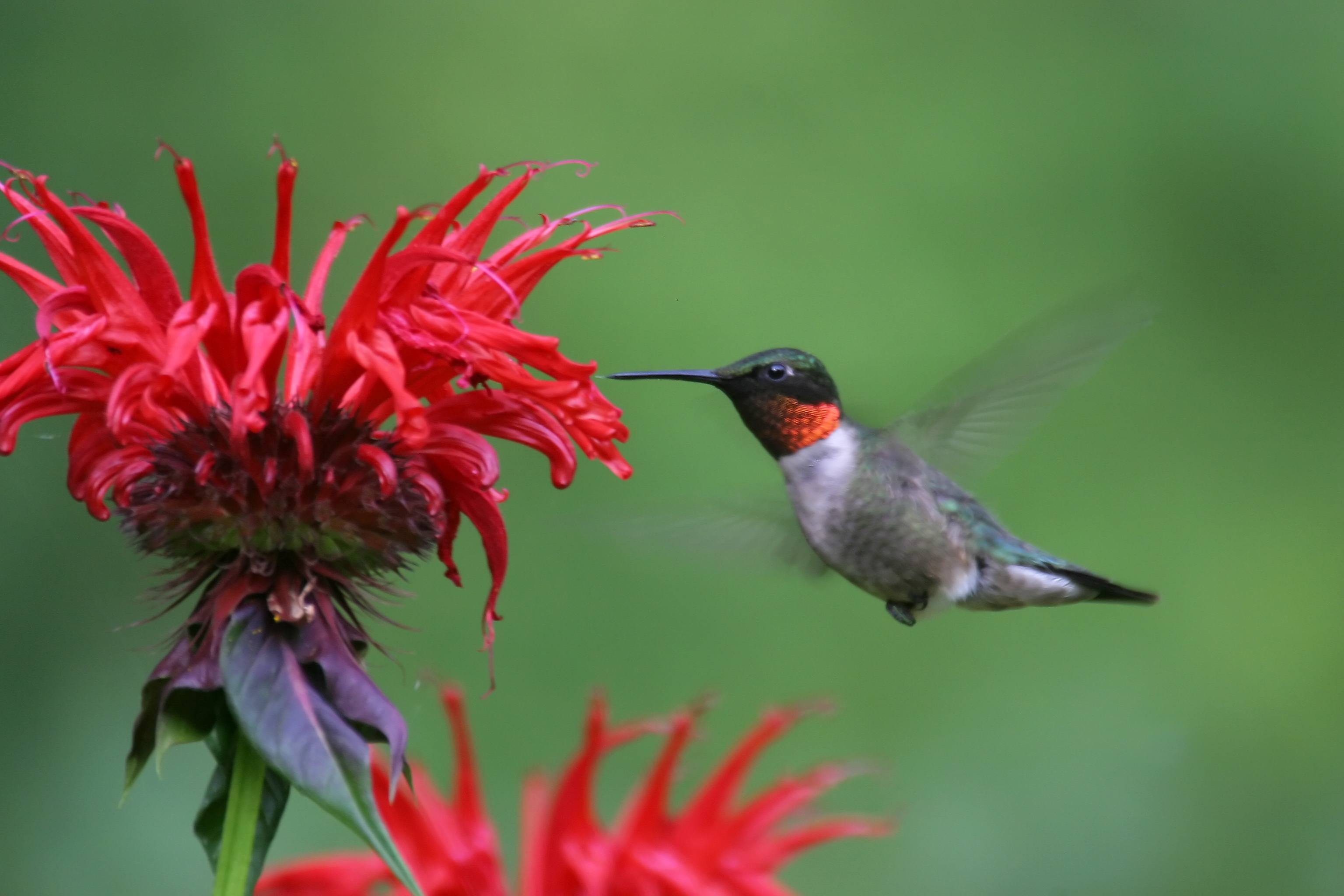
Type of symbiosis: Hummingbirds feed on nectar from flowers. The flowers are pollinated by hummingbirds as they move from flower to flower.
commensalism
mutualism
parasitism
predation
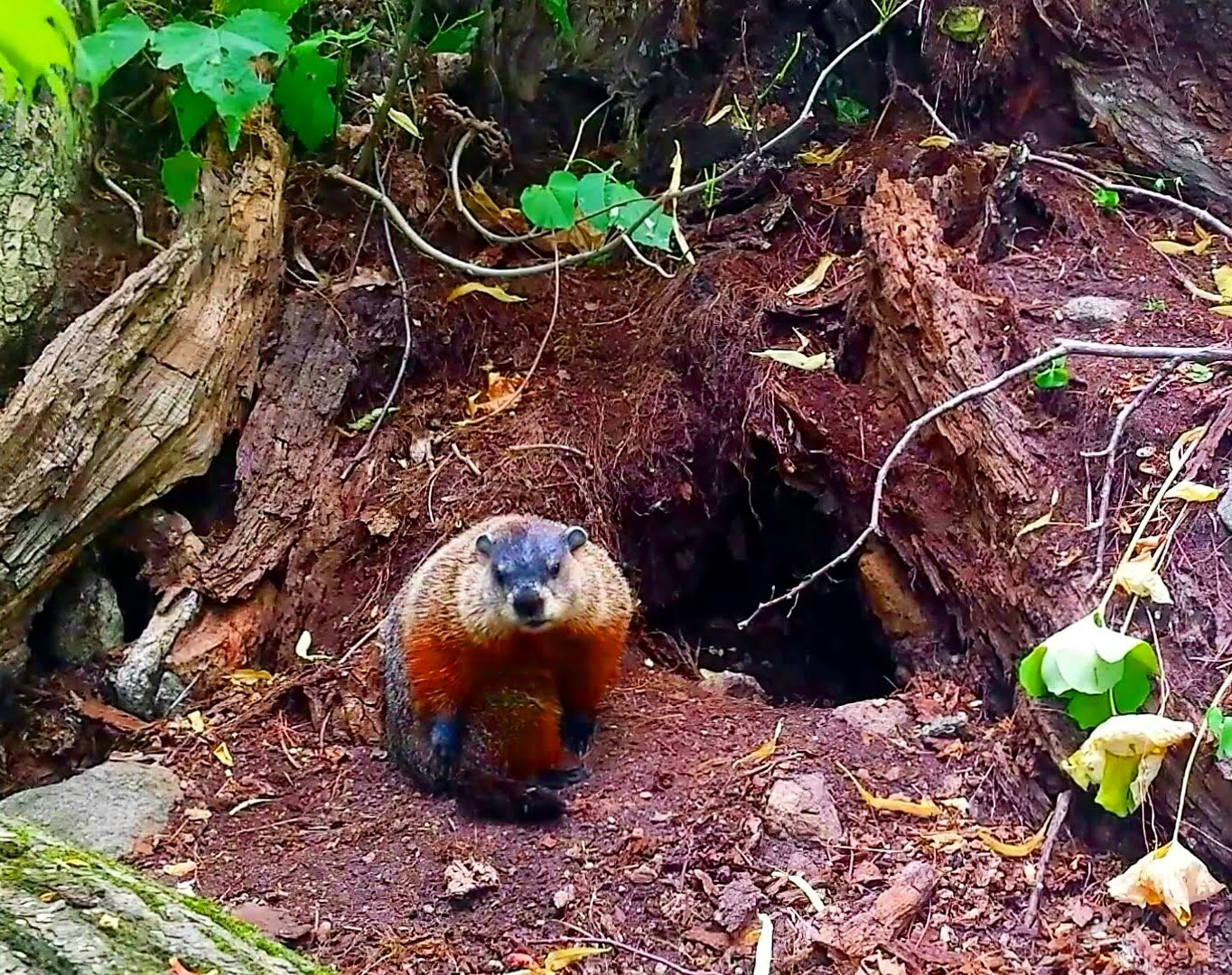
Type of symbiosis: Skunks often live in burrows that have been dug and abandoned by woodchucks.
commensalism
mutualism
parasitism
predation
Bird & Tree: A bird builds a nest in a hole in the trunk of the tree. It is protected from the rain and predators. The tree is not harmed or helped by the bird.
Mutualism
Commensalism
Parasitism
Competition

What level of ecological organization would include all squirrels that live in the same area?
biome
community
ecosystem
population
A symbiotic relationship in which one organism is harmed and another benefits is
mutualism
parasitism.
commensalism.
predation.

Non-living factors such as temperature and humidity are also referred to as (a) factors
Which of the following is not a biotic factor?
Competition
Predation
Soil Nutrient Availability
Herbivory from insects

What type of distribution is this?
Uniform
Random
Clumped
Elephants have few, energetically costly offspring and do a lot of parenting. They likely have a type ____ survivorship curve
1
2
3
18
Draw an animal whose range you would expect to be limited by dispersal
What was the major criticism of the Miller-Urey Experiment?
What do we call naturally occurring lipid vesicles that may have functioned as a predecessor to living things
(a)
Which is not one of the 3 shapes of bacteria
Cocci
Spirilla
Bacilli
rhombi

What is this bacterium doing!?!
Conjugation
Meiosis
Phagocytosis
Binary Fission
What is the purpose of Gram Staining?
The process where life comes from non-living things, such as mud and horse hair, is referred to as ___________ __________
(a)
Which is favorable for long distance in dark?
Auditory
Chemical
Tactile
Visual
Which is favorable for long distance underwater?
Auditory
Chemical
Tactile
Visual
Peacocks are brightly colored to attract a mate. Which does peacock use for mating?
Auditory
Chemical
Tactile
Visual
Birds sing a song to attract a mate. Which does a bird use in mating?
Auditory
Chemical
Tactile
Visual
Which signal is used by dogs for marking territory?
Auditory
Chemical
Tactile
Visual
Innate vs. Learned Behaviors?
Innate is trial/error & learned is born
Innate is born & learned is trial/error
Innate is taught by imprinting & learned is trial/error
Innate is trial/error & learned is taught by imprinting
What is altruism?
Behavior to increase fitness of self
Behavior to find food
Selfless behavior that increases fitness of population
Selfless behavior to feed another member to population
Where a stimulus affects behavior (ex. bell ringing)
Classical conditioning
Conditional learning
Imprinting
Operant conditioning
Behavior affected by negative or positive outcomes
Classical conditioning
Conditional learning
Imprinting
Operant conditioning
A sensitive period where organism learns from parent
Classical conditioning
Conditional learning
Imprinting
Operant conditioning
Mating Calls
Auditory
Chemical
Tactile
Visual
Pheromone trail that ants follow to find food source
Auditory
Chemical
Tactile
Visual
Mating Dance
Auditory
Chemical
Tactile
Visual
Innate behaviors are
Associated arbitrary stimulus
Inborn
Learning through observations
Trial and Error
Learning response to arbitrary stimulus
Classical conditioning
Imprinting
Innate behavior
Operant conditioning
Chick a dee learns if it pecks at milk carton, it will get milk
Classical conditioning
Imprinting
Innate behavior
Operant conditioning
Which type of community is more resilient to chance?
Less diversity & fewer parts
Lass diversity & more parts
More diversity & fewer points
More diversity & more parts
Keystone species have a…
Disproportionate affect relative to abundance
Proportionate affect relative to abundance
What happens if a keystone species is removed…
Community becomes more diverse
Ecosystem collapses
No effect due to minor role
Population becomes less diverse
Which of these does not contribute to maintain diversity?
Decomposer
Essential abiotic/biotic factor
Keystone species
Producer
What type of environment is resistant to change?
Low diversity, low component parts
High diversity, low component parts
Low diversity, high component parts
High diversity, high component parts
If the keystone species is removed what happens?
Their predator population increases
Their predator population decreases
The ecosystem collapses
The ecosystem stabilizes
Abiotic factors
Factor that causes living organism to die
Factor that causes living organisms to reproduce
Living factor
Nonliving factor
Predators are an example of
Abiotic factors
Biotic factors
What happens if sea otters decrease?
Sea urchins increase, kelp increases
Sea urchins decrease, kelp increases
Sea urchins increase, kelp decreases
Sea urchins decrease, kelp decreases
Warm-blooded organisms are actually…
Ectotherms
Endotherms
Where do endotherms get their body heat from?
Cellular Respiration
Environment
Photosynthesis
Thermophiles
“Cold-Blooded” organisms have cold-blood…
True
Falseo
“Cold-Blooded” organisms are…
Ectotherms
Endotherms
Where do ectotherms get their body heat from?
Cellular Respiration
Environment
Photosynthesis
Thermophiles
Assuming the same size of organisms, at cooler temperatures, who would have a higher O2 consumption?
Ectotherms
Endotherms
The smaller the organism, the ____ the metabolic rate.
Higher
Lower
Net gain of energy by organism causes…
Decay & Energy Storage
Gain of Mass & Death
Growth & Energy Storage
Loss of Mass & Death
Net loss of energy results in…
Decay & Energy Storage
Gain of Mass & Death
Growth & Energy Storage
Loss of Mass & Death
What property of water allows for cooling from sweat?
Adhesion
Cohesion
High Heat of vaporization
Less dense as solid
Goosebumps are a vestigial structure to keep warm.
True
False
A reduction in ___ would cause a decrease in entire chain.
Decomposer
Primary Consumer
Primary Producer
Sunlight
When you control producer level, what type of model does this describe?
Bottom-Up Model
Top-Down Model
What are all secondary consumers?
Carnivores
Decomposer
Herbivore
Producer
Where do photosynthetic organisms get most of their energy?
Inorganic molecules
Moonlight
Organic molecules
Sunlight
Where do chemosynthetic organisms get most of their energy?
Inorganic molecules
Moonlight
Organic molecules
Sunlight
What can heterotrophs not metabolize for energy?
Carbohydrates
Lipids
Nucleic Acids
Proteins
Which stores the most energy per molecule?
Carbohydrates
Lipids
Nucleic Acids
Proteins
Fun Fact: Where do lipids enter cellular respiration pathway?
Glycolysis
Krebs Cycle
Electron Transport
Chemiosmosis
What is an endotherm?
Organism generates heat by metabolism
Organism generates heat by basking in sun
Organism that releases heat
Organism that absorbs heat
What is an ectotherm?
Organism that generates heat by performing metabolism
Organism that uses external sources of heat
Organism that releases heat to warm the organism
Organism that absorbs heat to cool the organism
Which organism requires more food at the same temperature?
Ectotherm
Endotherm
Which organism consumes more oxygen at cooler temperatures?
Ectotherm
Endotherm
How does metabolic rate compare to size of organism?
Smaller the organism, the higher the metabolic rate
Larger the organism, the higher the metabolic rate
If a secondary consumer population decreases, what would happen to the producers?
Decrease
Increase
Stay the Same
What is an autotroph?
Produces its own food stored in organic compounds
Produces its own energy from metabolic reactions
Produces its own ATP from feeding on lower trophics levels
Produces its own light energy from chemical reactions
How does chemoautotroph differ from photoautotroph?
Chemoautotroph makes food from sunlight
Photoautotroph makes the food from sunlight (solar energy)
Chemoautotroph makes the food with decomposing detritus
Photoautotroph makes the food from decomposing detritus
Oxygen is required by the photosynthesis process
True
False
Plants require oxygen.
True
False
Plants have a mitochondria.
True
False
What is a heterotroph?
Organism that must consume organic molecules for light.
Organism that breaks down organic molecules for energy.
Which is favorable for long distance in dark?
Auditory
Chemical
Tactile
Visual
Which is favorable for long distance underwater?
Auditory
Chemical
Tactile
Visual
Peacocks are brightly colored to attract a mate. Which does peacock use for mating?
Auditory
Chemical
Tactile
Visual
Birds sing a song to attract a mate. Which does a bird use in mating?
Auditory
Chemical
Tactile
Visual
Which signal is used by dogs for marking territory?
Auditory
Chemical
Tactile
Visual
Innate vs. Learned Behaviors?
Innate is trial/error & learned is born
Innate is born & learned is trial/error
Innate is taught by imprinting & learned is trial/error
Innate is trial/error & learned is taught by imprinting
What is altruism?
Behavior to increase fitness of self
Behavior to find food
Selfless behavior that increases fitness of population
Selfless behavior to feed another member to population
Where a stimulus affects behavior (ex. bell ringing)
Classical conditioning
Conditional learning
Imprinting
Operant conditioning
Behavior affected by negative or positive outcomes
Classical conditioning
Conditional learning
Imprinting
Operant conditioning
A sensitive period where organism learns from parent
Classical conditioning
Conditional learning
Imprinting
Operant conditioning
Mating Calls
Auditory
Chemical
Tactile
Visual
Pheromone trail that ants follow to find food source
Auditory
Chemical
Tactile
Visual
Mating Dance
Auditory
Chemical
Tactile
Visual
Innate behaviors are
Associated arbitrary stimulus
Inborn
Learning through observations
Trial and Error
Learning response to arbitrary stimulus
Classical conditioning
Imprinting
Innate behavior
Operant conditioning
Chick a dee learns if it pecks at milk carton, it will get milk
Classical conditioning
Imprinting
Innate behavior
Operant conditioning
Which variable represents carrying capacity?
dN/dt
N
K
r
As K approaches N, what happened to the dN/dt?
Decreases, then increases
Decreases, then remains constant
Increases, then decreases
Increases, then remains constant
When is dN/dt = 0?
N < K
N > K
N = K
Which type of factor is an earthquake?
Density dependent
Density independent
Which type of factor is a disease?
Density dependent
Density independent
If N = 500, K = 250, and r = 0.01, solve for dN/dt?
-500
-50
50
500
Which of the following does not represent density?
Number of bacteria in a 10 mL of nutrient media
Number of elephants in 1 acre of savanna
Number of offspring in each generation
Number of fish in a square mile
What happens to the growth rate as population size approaches carrying capacity?
Decreases
Increases
Stay the Same
How do density dependent factors affect growth rate?
As population size increases, growth rate decreases
As population size increases, growth rate increases
As population size increases, growth rate stays the same
How do density independent factors affect growth rate?
As population size increases, growth rate decreases
As population size increases, growth rate increases
As population size increases, growth rate stays the same
Disease
Density dependent factor
Density independent factor
Landslide
Density dependent factor
Density independent factor
An adaptation is…
Favored by selection and provides no advantage in environment
Favored by selection and provides advantage in environment
Not favored by selection and provides no advantage in environment
Not favored by selection and provides advantage in environment
What is a mutation?
Change in amino acid sequence
Change in cell types
Change in DNA
Change in polypeptide
When the mutation allows the organism to better match its environment?
Adaptations
Carrying capacity
Conformer
Imprinting
Why are invasive species “favorable”?
No natural predators
Unlimited resources
Uncontrolled growths
All of the above
Which population growth curve do invasive species have?
C shape
J shape
S shape
W shape
Invasive species can out compete native species.
True
False
Type of symbiosis: Hummingbirds feed on nectar from flowers. The flowers are pollinated by hummingbirds as they move from flower to flower.
commensalism
mutualism
parasitism
predation
Type of symbiosis: Skunks often live in burrows that have been dug and abandoned by woodchucks.
commensalism
mutualism
parasitism
predation
What level of ecological organization would include all squirrels that live in the same area?
biome
community
ecosystem
population
Exponential growth
j-curve
s-curve
Predation, space/territory, disease are examples of:
density dependent limiting factors
density independent limiting factors
What type of distribution is this?
Uniform
Random
Clumped
Which biome is characterized by seasonal changes in temperature (low to high) with medium to high precipitation and dominated by hard wood trees?
Tropical Rainforest
Taiga
Temperate Deciduous Forest
Grassland
Desert

What trophic level(s) does the Thrush (bird on the right side) belong to?
Producer
Primary Consumer
Secondary Consumer
Higher-Level Consumer
Here is a sample food chain, Flower -> Goat -> Wolf. If there are 2,000 calories of flower eaten by the goat and then the goat is eaten by the wolf, how many of those calories will be in the wolf?
2,000
1,000
500
200
20

The removal of sea otters led to the crash of the entire community. How would you classify the sea otter?
Keystone species
Autotroph
Detrivore
Abiotic
In the woods, there are hawks and robins. They both try to occupy the same niche by competing for worms as the only source of food in that same area at that same time. The hawks outcompete the robins, and the robins are forced to leave that area. This is an example of:
Mutualism
The competitive exclusion principle
Commensalism
Neutralism
In an ecosystem, there are populations of deer, rabbits, grass, and pine trees. Suddenly, a fire blazes through the area, which kills all of the populations. As the months go on, new species of grass begin to take root. This attracts animals, and eventually the ecosystem is restored.
What type of ecological succession happened?
Primary succession because it started with rocks.
Primary succession because there was soil to begin with, and plants existed before the disaster.
Secondary succession because it started with rocks.
Secondary succession because there was soil to begin with, and plants existed before the disaster.

In this photo, two lions are fighting for a resource. What type of competition is this?
Interspecific competition
Intraspecific competition
Machismo
Competitive exclusion principle
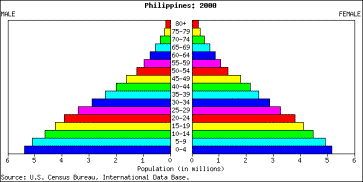


Name the type of pyramid in the picture.
slow growth
rapid growth
zero growth
negative growth

How would this population pyramid of Germany in 2015 be described?
Positive growth
Stable growth
Negative growth

How would the population growth of the United States in 2010 be described based on this population pyramid?
Positive growth
Stable growth
Negative growth

During which day did this population reach carrying capacity?
Day 2
Day 11
Day 23
Day 35

What is the carrying capacity of the beetle population?
3
5
7
9

What type of population growth does this graph show?
Logistic Growth
Exponential Growth
R-Selected Species
Immigration
Stable conditions allow for this type of species to grow.
R-Selected
K-Selected
THESE SPECIES ONLY MAKE A FEW BABIES IN THEIR LIFETIME AND THEY INVEST IN THEM HEAVILY...
K-SELECTED
R-SELECTED
P-SELECTED
Z-SELECTED

