wayground logo

Free Printable Worksheets

Font size

S
M
L
XL
Worksheets

Unit 11 Phases, Eclipses, and Seasons

Total questions: 87

Worksheet time: 51mins

Name
Class
Date
1.

What is a high tide?

a)

Sea pulled TOWARD the moon where Earth is CLOSEST to the moon

b)

Sea pulled AWAY from the moon where Earth is FARTHEST to the moon

c)

Sea pulled AWAY from the moon where Earth is CLOSEST to the moon

2.
Which body has the greater effect on Earth's tides?
a)
Sun
b)
Saturn
c)
Moon 
d)
Venus
3.

Wha type of tide would this arrangement of earth-moon-sun create?

a)

full moon tide

b)

new moon tide

c)

neap tide

d)

spring tide

4.
What type of tides would this arrangement of earth-moon-sun create?
a)
neap tide
b)
spring tide
c)
new moon tide
d)
full moon tide
5.
Tides are caused by
a)
strong winds that blow over ocean waters.
b)
the interaction of Earth, the moon and the sun.
c)
the shifting of the plates on the ocean floor.
d)
variations in the salinity of ocean water
6.
What causes tides?
a)
gravity
b)
wind
c)
spring
d)
neap
7.
If tides alternate from high to low and there are two of each type of tide a day, about how many hours will generally be between each different tide?
a)
2 hours
b)
6 hours
c)
12 hours
d)
24 hours
8.
How many low tides and high tides happen in a day?
a)
1 low tide, 1 high tide
b)
4 low tides, 4 high tides
c)
3 low tides, 3 high tides
d)
2 low tides, 2 high tides
9.
You visited the beach at 12 pm (noon) and it is high tide. If you return 6 hours later what tide will you see? 
a)
high 
b)
low 
c)
none
d)
spring 
10.
What do we call the small tides that happen when the sun and moon are at right angles to each other?
a)
Neap Tide
b)
Spring Tide
c)
Larger Change
d)
Smaller Change
11.
The Moon has a greater influence on Earth tides than the Sun because...
a)
it is smaller than the Sun
b)
it revolves around the Earth
c)
it is closer to the Earth
12.
Differences in the moon's and sun's pull on different sides of the Earth cause _________.
a)
gravity
b)
lunar phases
c)
tides
d)
dabbing
13.
The bulge of water on the side of the Earth closest to the moon produces ___________.
a)
high tide
b)
low tide
c)
neap tide
d)
spring tide
14.
A neap tide is a tide with the greatest difference between low and high tides
a)
true
b)
false
15.
What is a difference between spring and neap tides?
a)
Spring tides occur when the earth and sun are IN LINE with the new or full moon. 
b)
Spring tides occur when moon in 3rd or 1st quarter phases
c)
Spring tides are LOWER than neap tides
d)
Spring tides occur in Spring and neap tides can occur in any season
16.
darkest, innermost part of the shadow
a)
penumbra
b)
umbra
17.
lighter, outer part of the shadow
a)
penumbra
b)
umbra
18.
What type of eclipse occurs when the moon blocks the sun's light and cast a shadow on earth?
a)
solar
b)
lunar
19.

What type of eclipse occurs when the earth's shadow is cast on the moon?

a)

solar

b)

lunar

20.
What moon phase occurs during a solar eclipse?
a)
Full moon
b)
new moon
c)
1st quarter
d)
waxing gibbous
21.
What moon phase occurs during a lunar eclipse?
a)
full moon
b)
new moon
c)
3rd quarter
d)
waxing crescent
22.
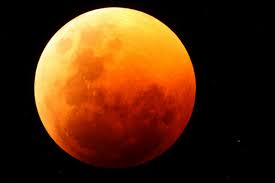
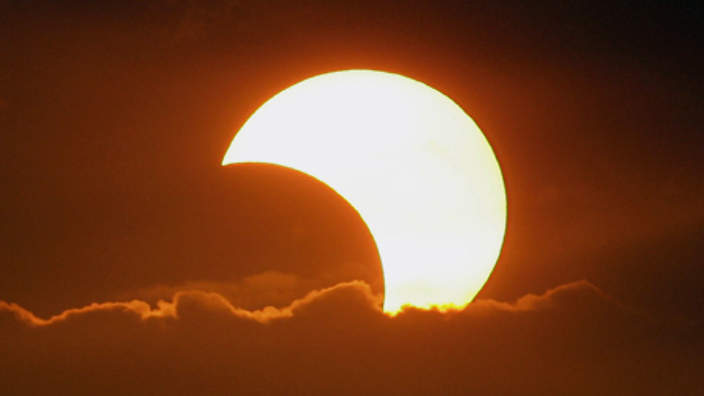
What type of eclipse is this?
a)
Solar eclipse
b)
Lunar eclipse
23.
What type of eclipse is this?
a)
Solar Eclipse
b)
Lunar Eclipse
24.

When is a lunar eclipse visible ?

a)

day

b)

night

c)

varies

25.

What time is a solar eclipse visible ?

a)

day

b)

night

c)

varies

26.

Can only be seen if you are in the Path of Totality (umbra).

a)

total solar eclipse

b)

partial solar eclipse

c)

total lunar eclipse

d)

partial lunar eclipse

27.

Where do you have to be in order to see a total lunar eclipse?

a)

in the Path of Totality (umbra)

b)

anywhere on Earth

c)

on the nighttime side of Earth

28.

Why are most people unlikely to see a total solar eclipse?

a)

It only happens at night.

b)

the Moon's shadow is small and you have to be in its path

29.

Why don't we see lunar eclipses every month?

a)

the Moon's orbit is tilted

b)

it has to be nighttime

c)

we actually do see them every month

30.

Which eclipse is the most rare?

a)

solar

b)

lunar

31.
What makes the moon turn reddish in a total lunar eclipse?
a)
Earth's Atmosphere
b)
Earth's Rotation
c)
Earth's Water
d)
Earth's Orbit
32.
This image is an example of 
a)
Lunar Eclipse
b)
New Moon
c)
Solar Eclipse
d)
Full Moon
33.
This image is an example of
a)
Lunar Eclipse
b)
Full Moon
c)
New Moon
d)
Solar Eclipse
34.
What moon phase is this picture?
a)
This is the full moon phase.
b)
This is the waxing gibbous moon phase.
c)
This is the waning gibbous moon phase.
d)
This is the first quarter moon phase.
35.
What moon phase is this picture?
a)
This is the waning crescent phase.
b)
This is the waxing gibbous phase.
c)
This is the waning gibbous phase.
d)
This is the new moon phase.
36.
What is this moon phase?
a)
This is the waxing crescent phase.
b)
This is the full moon phase.
c)
This is the waxing gibbous phase.
d)
This is the last quarter moon.
37.
What is this moon phase?
a)
This is the waxing gibbous moon phase.
b)
This is the last quarter moon phase.
c)
This is the first quarter moon phase.
d)
This is the new moon phase.  
38.
What moon phase is this picture?
a)
This is the full moon phase.  
b)
This is the waxing crescent moon phase.
c)
This is the waning gibbous moon phase.
d)
This is the waning crescent moon phase.
39.
What moon phase is this picture?
a)
This is the new moon phase.
b)
This is the waxing crescent moon phase.
c)
This is the waxing gibbous moon phase.
d)
This is the waning crescent moon phase.
40.
What moon phase is this image?
a)
This is the full moon phase.
b)
This is the last quarter moon phase.
c)
This is the waxing gibbous moon.
d)
This is the new moon phase.
41.
What phase of the moon is this image?
a)
This is the last quarter moon phase.
b)
This is the full moon phase.
c)
This is the first quarter moon phase.
d)
This is the waxing gibbous moon phase.
42.
What is the difference between a gibbous moon and a crescent moon?
a)
The gibbous shows more than half of the bright side of the moon.
b)
The crescent shows more than half of the bright side of the moon.
c)
The gibbous shows less than half of the bright side of the moon. 
43.
How many phases does the moon go through?
a)
4
b)
8
c)
10
d)
16
44.
What part of the moon do we see from Earth?
a)
all of it
b)
the same side
c)
none of it
d)
only one quarter
45.
The moon seems to change shape from day to day in a cycle that lasts about a month as it goes through _.
a)
revolutions
b)
phases
c)
rotations
d)
eclipses
46.
As the moon's shape appears to get smaller, we say that the moon is _.
a)
swelling
b)
waxing
c)
waning
d)
disappearing
47.
Phases of the moon in which the moon appears to be getting larger are referred to as _.
a)
waxing
b)
waning
c)
new
d)
eclipse
48.
The cycle of the moon lasts about a _.
a)
day
b)
year
c)
week
d)
month
49.
How long is a lunar month?  
a)
30
b)
29.5
c)
27
d)
27.3
50.
CHOOSE THE CORRECT MOON PHASE
a)
FIRST QUARTER
b)
LAST QUARTER
c)
CRESCENT MOON
d)
NEW MOON
51.
CHOOSE THE CORRECT MOON PHASE
a)
WANING GIBBOUS
b)
NEW MOON
c)
FULL MOON
d)
WAXING GIBBOUS
52.

True or False: The moon does not produce its own light.

a)

True

b)

False

53.

When the moon waxes, it

a)

goes froma new moon to a ful moon

b)

seems to get bigger in size

c)

goes from a new moon to a full moon

d)

B and C only

54.

When the moon wanes, it

a)

goes from a new moon to a full moon

b)

goes from a full moon back to a new moon

c)

seems to get smaller in size

d)

B and C only

55.

What happens right after the full moon phase?

a)

The moon becomes new

b)

The moon goes through its phases in the reverse order

c)

The moon seems to disappear in the sky

d)

The moon starts to wax

56.

What is the correct order of the first five phases of the moon?

a)

new, crescent, quarter, gibbous, full

b)

new, crescent, gibbous, quarter, full

c)

full, crescent, quarter, gibbous, new

d)

full, quarter, gibbous, crescent, new

57.

What is true of a new moon?

a)

The moon appears invisible

b)

You can see about half the moon

c)

The moon looks like a pizza pie

d)

Its the second phase of the moon

58.

Why does the moon appear bigger than the planets or stars?

a)

The lack of atmosphere on the moon makes it look bigger.

b)

In reality, the moon is much bigger than the planets and stars.

c)

The planets and stars are farther away

d)

The moon's gravity makes it look bigger

59.

the type of solar eclipse in this image is ........................................

a)

total

b)

partial

c)

annular

60.

this type of solar eclipse is called .............................

a)

annular

b)

partial

c)

total

61.

what is the type of eclipse in the region 4 ?

a)

total

b)

partial

c)

annular

62.

you should wear special glasses during looking at solar eclipse to prevent your eyes from .............................. rays

a)

gamma

b)

ultraviolet

c)

x

63.

the solar eclipse lasts ...........................

a)

2 hours

b)

7 minutes and 40 seconds

c)

7 hours and 40 minutes

64.

What is a moon?

a)

an asteroid

b)

a space object that orbits around a planet

c)

a space object that orbits around a star

65.

True or false: The moon has no air.

a)

True

b)

False

66.

True or False: The moon has no gravity.

a)

True

b)

False

67.

The moon gets its light from

a)

the sun

b)

the Earth

c)

itself

d)

aliens

68.

We see all of the lighted side of the moon during

a)

new moon

b)

crescent moon

c)

gibbous moon

d)

full moon

69.

We see less than half of the lighted side of the moon during

a)

new moon

b)

crescent moon

c)

gibbous moon

d)

full moon

70.

Which NASA missions brought humans to the moon?

a)

Hubble

b)

Mercury

c)

Apollo

d)

Voyager

71.

Who was the first American to step onto the surface of the moon?

a)

Buzz Aldrin

b)

Neil Armstrong

c)

Alan Shepard

d)

Scott Kelly

72.

Sunset happens as we begin to turn away from the sun.

a)

rotation

b)

revolution

73.

Places near the equator don't have much change in season because those places are always close to the sun.

a)

rotation

b)

revolution

74.

When one side of the world is having daytime, the other side is having nighttime.

a)

rotation

b)

revolution

75.

The sun appears to rise in the east and set in the west.

a)

rotation

b)

revolution

76.

Completed in 24 hours.

a)

rotation

b)

revolution

77.

Each season lasts about 3 months.

a)

rotation

b)

revolution

78.

Sunrise happens as we begin to turn toward the sun.

a)

rotation

b)

revolution

79.

The Earth spins at a constant speed, always in the same direction.

a)

rotation

b)

revolution

80.

The sun appears higher in the sky during summer because we are tilted close to the sun.

a)

rotation

b)

revolution

81.

We don't feel the Earth spin because it spins smoothly, never changing pace.

a)

rotation

b)

revolution

82.

As the Earth orbits the sun, the part of the Earth tilted away from the sun is having fall and winter.

a)

rotation

b)

revolution

83.

The Earth spins on its axis.

a)

rotation

b)

revolution

84.

As the Earth orbits the sun, the part of the Earth tilted toward the sun is having spring and summer.

a)

rotation

b)

revolution

85.

The Earth orbits around the sun.

a)

rotation

b)

revolution

86.

The seasons change as the Earth orbits around the sun and due to the Earth's tilt.

a)

rotation

b)

revolution

87.

Completed in 365 1/4 days.

a)

rotation

b)

revolution