wayground logo

Free Printable Worksheets

Font size

S
M
L
XL
Worksheets

Review- qt 1

Total questions: 82

Worksheet time: 1hrs 18mins

Name
Class
Date
1.
What causes day and night?
a)
revolution of Earth
b)
rotation of Earth
c)
orbit of Earth
d)
The moon blocks the Sun
2.
How long does it take for Earth to rotate on its axis one time?
a)
24 hours
b)
24.25 hours
c)
365 days
d)
365.25 days
3.
Period of 24 hours or the time it takes Earth to make one complete spin on its axis
a)
Rotation
b)
Compass
c)
Sundail
d)
Movement
4.
The Earth revolves around the sun.
a)
True
b)
False
5.
When the Earth spins on its axis this causes ___________________
a)
all four seasons to happen.
b)
day and night to happen.
c)
the moon to go through phases.
d)
high tides and low tides.
6.

Earth revolves around the sun every ----, which is why we have a leap year every 4 years.

a)
365.25 days
b)
365 days
c)
24 hours
7.

It takes Earth ____ to rotate on its axis.

a)

24 hours

b)

365 days

c)

one month

d)

one week

8.

At the same time that the Earth spins on its axis it also orbits or revolves around the Sun. This movement is called its _____________.

a)

rotation

b)

axis

c)

revolution

9.

The Earth is rotating on its axis, creating day and night, at the same time it's revolving all the way around the Sun.

a)

True

b)

False

10.

One full orbit all the way around the Sun is one revolution and it takes the Earth _______ days to complete a revolution.

a)

42

b)

18

c)

398

d)

365

11.
For a solar eclipse to occur, what has to happen?
a)
The sun must be directly between Earth and the moon.
b)
The moon must be directly between Earth and the Sun.
12.
During a solar eclipse...
a)
The sun is blocked
b)
The Earth is blocked
13.

Seasons are caused by the tilt of the earth's axis, and:

a)

tides

b)

the earth revolving around the sun

c)

the moon's gravity

d)

wind

14.
Earth's ________ on its axis causes day and night.
a)
rotation
b)
revolution
c)
phase
d)
comet
15.
One full orbit of an object around another object is called a ________.
a)
axis
b)
rotation
c)
revolution
d)
satellite
16.
If it is winter in the Northern Hemisphere, what season is it in the Southern Hemisphere?
a)
Spring
b)
Fall
c)
Winter
d)
Summer
17.
It takes Earth _____________ to make one revolution or orbit around the Sun.
a)
365 days
b)
365 hours
c)
28 days
d)
24 hours
18.
It takes Earth _________ to make one complete rotation on its axis.
a)
24 hours
b)
365 days
c)
28 days
d)
24 days
19.
The sun appears to...
a)
Rise in the East
b)
Rise in the West
c)
Rise in the North
d)
Rise in the South
20.
The sun appears to...
a)
Set in the East
b)
Set in the West
c)
Set in the North
d)
Set in the South
21.

When would I expect to have the most hours of daylight?

a)

Spring

b)

Fall

c)

Winter

d)

Summer

22.
Which season is taking place in the Northern Hemisphere in Position 4?
a)
Winter
b)
Spring
c)
Summer
d)
Fall
23.

What causes there to be longer number of hours of light during the summer

a)

Earth tilt's away from the sun in summer

b)

Earth's revolves slower in summer

c)

Earth tilts toward the sun in summer

d)

Earth is closer to the sun

24.
The earth is a tilted planet.  What is the degree of tilt?
a)
Approximately 25 degrees
b)
Exactly 25 degrees
c)
23.5 degrees
d)
90 degrees with respect to the sun
25.
What season is letter A in the northern hemisphere?
a)
Winter
b)
Summer
c)
Spring
d)
Fall
26.
If its ____ in the Northern hemisphere, then its summer in the Southern hemisphere. 
a)
spring
b)
summer
c)
fall
d)
winter
27.
What are the reasons for the season?
a)
Earth's tilt & rotation
b)
Earth's tilt & revolution
c)
Earth's rotation & rovolution
d)
Earth's tilt & resolution
28.
The hemisphere where you live 
a)
equator
b)
southern
c)
northern
d)
eastern
29.
In winter, the axis of the earth is pointed away or toward the sun?
a)
towards
b)
up
c)
down
d)
away
30.
In summer, the axis of the earth is pointed away or toward the sun?
a)
towards
b)
up
c)
down
d)
away
31.
In spring/summer, the axis of the earth is pointed away or toward the sun?
a)
towards
b)
Neither away or toward
c)
away
32.
Why is it warmer in the summer?
a)
Closer to the sun
b)
More direct light from Earth's tilt
c)
Stronger light from the sun
d)
Earth spins slower
33.
Which season is taking place in the Southern Hemisphere in Position 1?
a)
Winter
b)
Spring
c)
Summer
d)
Fall
34.
Which season is taking place in the Northern Hemisphere in Position 1?
a)
Winter
b)
Spring
c)
Summer
d)
Fall
35.
Which season is taking place in the Northern Hemisphere in Position 2?
a)
Winter
b)
Spring
c)
Summer
d)
Fall
36.
Which season is taking place in the Northern Hemisphere in Position 3?
a)
Winter
b)
Spring
c)
Summer
d)
Fall
37.
Which season is taking place in the Northern Hemisphere in Position 4?
a)
Winter
b)
Spring
c)
Summer
d)
Fall
38.
If its ____ in the Northern hemisphere, then its summer in the Southern hemisphere. 
a)
spring
b)
summer
c)
fall
d)
winter
39.
What moon phase is this? 
a)
waxing crescent
b)
waxing gibbous
c)
waning crescent
d)
waning gibbous
40.
What moon phase is this? 
a)
waxing crescent
b)
waxing gibbous
c)
waning crescent
d)
waning gibbous
41.
What moon phase is this? 
a)
new moon 
b)
full moon
c)
waxing crescent
d)
waning crescent
42.
What moon phase is this? 
a)
first quarter
b)
third quarter
c)
waxing crescent
d)
waning crescent
43.
What moon phase is this? 
a)
new moon
b)
full moon
c)
waxing crescent
d)
waning crescent
44.
What does "waxing" mean?
a)
growing
b)
shrinking
c)
lighted
d)
dark
45.
What does "waning" mean? 
a)
growing
b)
shrinking
c)
lighted
d)
dark
46.
The Moon gets its light from the
a)
Earth
b)
Stars
c)
Sun
47.

What phase of the moon is this?

a)

Waxing Gibbous

b)

Waning Gibbous

c)

Waxing crescent

d)

Waning crescent

48.

What phase of the moon is shown?

a)

waning gibbous

b)

1st quarter

c)

waxing crescent

d)

Waxing gibbous

49.
Name the phase of the moon that comes BEFORE this moon phase.
a)
waxing gibbous
b)
waning gibbous
c)
waning crescent
d)
waxing crescent
50.

What is the phase of the Moon at position #5?

a)

New Moon

b)

Third Quarter Moon

c)

First Quarter Moon

d)

Full Moon

51.

Magnetic lines of force from Earth's polar north and south; they act like a giant magnet- known as...

a)

the magnetosphere

b)

Earth's Magnetic Field

c)

the Magna Doodle

d)

the magnetic poles

52.

Why is Earth's magnetic field important to the survival of life?

a)

the magnetic field holds in oxygen, nitrogen, argon and carbon dioxide

b)

the magnetic field is a like a bubble around the Earth

c)

the magnetic field shields Earth from harmful particles that stream from the Sun

53.

The atmosphere creates air for breathing, while the ________ protects Earth from the Sun's particles.

a)

magnetic field

b)

temperature

c)

atmosphere

d)

water

54.
This type of eclipse 
a)
can only occur every two years
b)
can only occur during night time.
c)
can only occur during a new moon.
d)
can only occur during a full moon.
55.
The line up for a solar eclipse is: 
a)
Sun-Earth-Moon
b)
Earth-Sun-Moon
c)
Sun-Moon-Earth
d)
Earth-Moon-Mars
56.

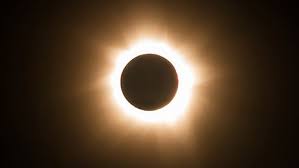
What type of eclipse is this an example of?

a)

Lunar Eclipse

b)

Solar Eclipse

57.

What type of eclipse is this an example of?

a)

Lunar Eclipse

b)

Solar Eclipse

58.

Earth rotates on its' axis. What does rotate mean?

a)

spins

b)

shakes

c)

jumps

59.

Students were making a model to show size relationships between the Earth, the Moon and the Sun. They used a basketball to represent the Sun and a tennis ball to stand for the Earth.

What would best represent the Moon in their model?

a)

Soccer ball

b)

Volleyball

c)

Baseball

d)

Ping Pong Ball

60.

Which of the following lists the Earth, Sun, and Moon in order of size, from largest to smallest?

a)

Earth, Sun, and Moon

b)

Earth, Moon, and Sun

c)

Sun, Earth, and Moon

d)

Sun, Moon, and Earth

61.

Where is Earth's magnetic field strongest?

a)

Along the outside lines

b)

Along the inside lines on either side

c)

Where the lines are close together at the poles

d)

In the space outside of the lines

62.

A lunar eclipse occurs at which moon phase?

a)

quarter moon

b)

new moon

c)

crescent moon

d)

full moon

63.
What is the bigger, less dark part of the shadow called in an eclipse?
a)
Penumbra
b)
Penumbrella
c)
Umbrella
d)
Umbra
64.

What type of eclipse is this an example of?

a)

Lunar Eclipse

b)

Solar Eclipse

65.
Which body has the greater effect on Earth's tides?
a)
Sun
b)
Saturn
c)
Moon 
d)
Venus
66.
Which layer of sedimentary rock is the oldest?
a)
A
b)
B
c)
D
d)
F
67.
Which term describes the motion of the planets around the sun?
a)
rotation
b)
revolution
c)
completion
d)
galaxy
68.
The process of Earth spinning on its axis is referred to as
a)
revolution
b)
ionization
c)
rotation
d)
ellipse
69.
The amount of time it takes Earth to revolve around the sun is a 
a)
day
b)
24 hrs
c)
month
d)
year
70.
How many seasons are there in the United States
a)
4
b)
5
c)
6
d)
7
71.
The sun revolves around the Earth
a)
true
b)
false
72.
The rotation of Earth is responsible for day and night
a)
true
b)
false
73.
Why does the equator stay warm all year long?
a)
Because the direct rays hit the equator all year.
b)
Because the equator is cold all year long.
c)
Because the climate in a year does not change.
74.
In this simple diagram, the motion of both the Earth and Moon can be described as -
a)
Rotation
b)
Revolution
75.
What does ROTATION mean?
a)
To SPIN
b)
To ORBIT or GO AROUND
76.

What is the biggest difference between the Geocentric Model and the Heliocentric Model?

a)

the shape of the planets' orbits

b)

the movement of the moon

c)

the object at the center of the universe

d)

the brightness of the sun

77.

What does the word "Helio" mean?

a)

Earth

b)

Mars

c)

Sun

d)

Juputer

78.

What does "geo-" mean?

a)

Earth

b)

sun

c)

Center

d)

Moon

79.

What is the name of this model?

a)

Heliocentric Model

b)

Geocentric Model

c)

Circle Model

d)

Aristotle Model

80.

Who is the astronomer who came up with the heliocentric model of the solar system?

a)

Copernicus

b)

Newton

c)

Galileo

d)

Ptolemy

81.

Which model is this?

a)

Heliocentric

b)

Geocentric

82.

Which of the models is widely accepted today?

a)

Heliocentric

b)

Geocentric