wayground logo

Free Printable Worksheets

NEW

Font size

S
M
L
XL
Worksheets

ACP review #6

Total questions: 63

Worksheet time: 3hrs 9mins

Name
Class
Date
1.
Why is water considered polar?
a)
It is a universal solvent
b)
It makes 4 covalent bonds
c)
It has a partial charge
d)
It is cohesive and adhesive
2.
2H2   +   O2  →  2H2O
How many moles of water can be produced if 8 moles H2 are used?
a)
4 moles
b)
8 moles
c)
16 moles
d)
2 moles
3.
How many moles are in 19.82 g Mg? 
a)
1.226mol Mg
b)
481.7mol Mg
c)
1.000mol Mg
d)
 0.82 mol Mg
4.
Using the following equation:
Fe2O3(s) + 3H2(g) → 2Fe(s) + 3H2O(l)
How many moles of iron can be made from  6 moles H2
a)
4 moles Fe
b)
6 moles Fe
c)
9 moles Fe
d)
2 moles Fe
5.

When 12 moles of O2 reacts with 1.1 mole of C10H8 what is the limiting reactant if we look at how much H2O if formed?

C10H8 + 12 O2 --> 10 CO2 + 4 H2O

a)

Oxygen

b)

C10H8

c)

Water

d)

Carbon Dioxide

6.
CH4  +  2O2  →  CO2  +  2H2O
24 grams of CH4 was added to the above reaction. Calculate the theoretical yield of CO2.
a)
66 grams
b)
132 grams
c)
33 grams
d)
8.72
7.
Theoretical yield = 73g
Actual yield = 62g
Calculate the percent yield.
a)
1.16%
b)
116%
c)
85%
d)
76%
8.
Boyle's law shows the volume and pressure of a gas are always ........
a)
inversely proportional 
b)
directly proportional 
9.
Charles's law shows that the temperature and volume of a gas are always........
a)
inversely proportional 
b)
directly proportional 
10.
a)
this is a graph representing Boyle's law
b)
this is a graph representing Charles's law
11.
a)
This is an example of Charles's law
b)
This is an example of Boyle's law
12.
In order to convert to Kelvin, you add ______ to the Celsius measurement.
a)
372
b)
273
c)
237
d)
732
13.
You have a gas that has a pressure of 2 ATM and a volume of 10L.  What would be the new volume if the pressure was changed to 1 ATM?
a)
5 L
b)
20 L
c)
It would stay at 10L
d)
1 L
14.
Consider a sample of oxygen gas at 27° C with a volume of 9.55L at a pressure if 2.97 atm.  The pressure is changed to 8.25 atm and the gas is heated to 125° C.  What’s the new volume? 
a)
4.56 L
b)
4.6 L
c)
15.9 L
d)
16 L
15.
Calculate the volume that a 0.323-mol sample of a gas will occupy at 265 K and a pressure of 0.900 atm (make sure you use the correct R value).
a)
7.18 L 
b)
7.81 L
c)
4.63 L
d)
4.36 L
16.
A sample of oxygen gas has a volume of 150.0 mL when its pressure is .947 atm. What will the volume of the gas be if it is lowered to a pressure of 0.658 atm and the temperature remains constant?
a)
72 mL
b)
144 mL
c)
216 mL
d)
288 mL
17.

Which of the following is not true about the volume of a gas?

a)

Most of the volume is empty space.

b)

The volume is occupied by particles in continuous, rapid, random motion.

c)

The volume is about 10 times greater than that occupied by an equal number of particles in the liquid or solid state.

d)

Generally, the volume can be easily changed

18.

Which of the following is the equation needed to calculate the kinetic energy, KE, of a moving particle?

a)

KE = 1/2 mv2

b)

KE = 2mv

c)

KE = mv

d)

KE = 1/2 m2v

19.
The movement of gas molecules is greatly affected by _________.
a)
the shape of the container
b)
size of the container
c)
temperature of the container
20.
Gas molecules can easily be compressed  because ___________. 
a)
gas molecules are soft
b)
gas molecules are far apart
c)
gas molecules follow the shape of the container
21.
What word describes when water is attracted to other substances?
a)
cohesion
b)
adhesion
c)
capillary action
d)
surface tension
22.
Why does ice float?
a)
As water freezes, it expands and its density decreases.
b)
As water freezes, it takes up more hydrogen from the atmosphere, causing it to have a greater buoyancy.
c)
As water freezes, air becomes trapped between the hydrogen bonds of water molecules.
d)
As water freezes, it takes up more oxygen from the atmosphere, causing it to have a greater buoyancy.
23.
Water is a universal solvent because it...
a)
It can be found anywhere
b)
It freezes when it gets cold
c)
floats when frozen
d)
Dissolves most substances
24.
Large bodies of water, such as lakes and oceans, do not quickly fluctuate in temperature. What is the reason for this phenomenon?
a)
Water is an acid.
b)
Water is a versatile solvent.
c)
Water has a high heat capacity.
d)
 Water acts as a buffer.
25.
 Small insects can walk across the surface of calm water. Their feet push the surface of the water down slightly, somewhat like a person walking across a trampoline, but they do not break the surface. What is the best explanation for why this happens?
a)
The insects are light enough so that they do not break the hydrogen bonds holding the water molecules together
b)
The insects actually use their wings to hover slightly above the water's surface and they only skim it with their feet
c)
The insects' feet are non-polar, so they are repelled by the polar water molecules and are pushed away from the water's surface
d)
The insects are small enough to see the individual water molecules, so they are able to step carefully from one molecule to the next
26.

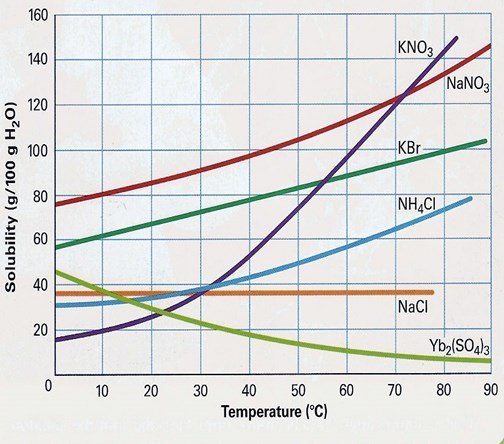
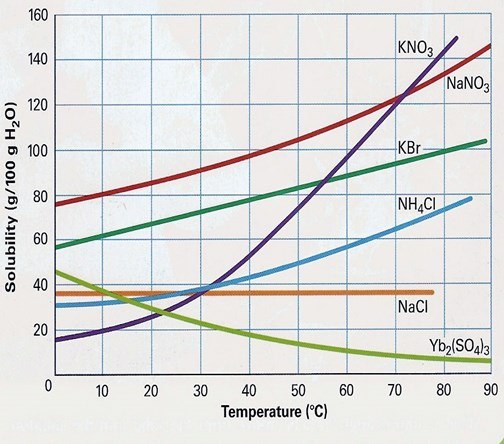
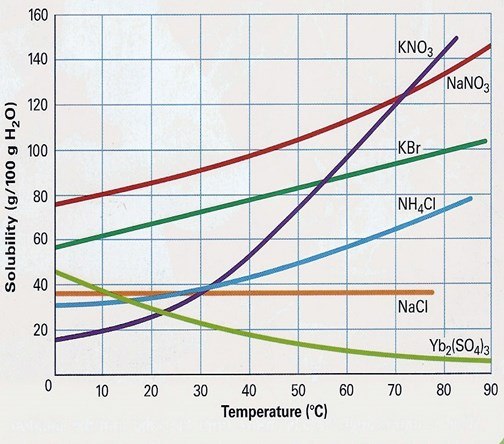
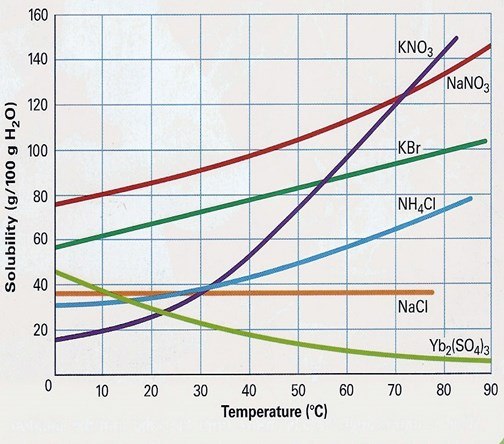
At which temperature do KBr and KNO3 have the same solubility?

a)

60

b)

55

c)

50

d)

Never

27.

At 30'C, which substance has the lowest solubility?

a)

KNO3

b)

KBr

c)

NaCl

d)

Yb2(SO4)3

28.

At 80'C, KBr's solubility is:

a)

100g

b)

90g

c)

80g

d)

0g

29.

Identify if the following solution would be saturated, unsaturated, or supersaturated: 103 g KBr at 70'C.

a)

Unsaturated

b)

Saturated

c)

Supersaturated

30.

After solute is added and the solution is stirred, some solute still remains undissolved. The solution is __________.

a)

Unsaturated

b)

Saturated

c)

Supersaturated

31.

How does a solution become supersaturated?

a)

by pouring lots of solute in it then stirring.

b)

dissolve a little solute in it and stir.

c)

heat the solution to make it dissolve more solute and then cool it down.

d)

dissolve a small amount of solvent in it then heat it up.

32.
How many grams of K2Cr2O7, are soluble in 100 g of water at 95 ºC?
a)
83 grams
b)
75 grams
c)
40 grams
d)
12 grams
33.

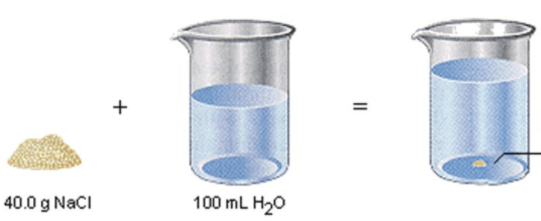
What type of a solution is 180g sugar at 0ºC in 100g H2O?

a)

Saturated

b)

Unsaturated

c)

Supersaturated

34.

What type of a solution is 180g sugar at 0ºC in 100g H2O?

a)

Saturated

b)

Unsaturated

c)

Supersaturated

35.

Which factor affecting solubility is shown in the picture?

a)

temperature

b)

height

c)

stirring

d)

particle size

36.

Why do sugar particles dissolve faster in hot water?

a)

water particles move slow

b)

water particles move fast

c)

water particles settle down

d)

water particles stay on top

37.

What are the factors that affect solubility?

a)

rate of stirring

b)

particle size

c)

temperature

d)

all of these

38.

Which one of the following statements is true?

a)

The salt solution conducts electricity.

b)

The sugar solution conducts electricity.

c)

The pure water conducts electricity.

39.

Which statement is true?

a)

Electrolytes dissociate (split up) in water.

b)

Nonelectrolytes dissociate (split up) in water.

40.

Which of the following describes a solution containing an electrolyte?

a)

The solute particles are so firmly bonded that they do not break apart

b)

The solute particles permit the passage of an electric current

c)

It is unstable, and all the solute will precipitate if the solution is disturbed.

d)

It cannot contain any more solute particles

41.

Which of the following best summarizes the figure below?

a)

HX is the only electrolyte

b)

Both HX and HZ are electrolytes, but HY is not.

c)

Only HY is an electrolyte

d)

All the solutions shown are electrolytes.

42.

What would the substance be classified as?

a)

nonelectrolyte, no dissociation

b)

nonelectrolyte, partial dissociation

c)

strong electrolyte, complete dissociation

d)

weak electrolyte, partial dissociation

43.
ΔH value in an endothermic reaction is a positive number.
a)
True
b)
False
44.
What is meant by the Law of Conservation of Energy'?
a)
a) Energy lost can not be conserved
b)
b) Energy can neither be destroyed or created
c)
c) Temperature at start of reaction = Temperature at end of reaction
d)
d) Energy = Mass of products - Mass of Reactants
45.
If I have 2 blocks of Aluminium (one of 1kg and one of 10 kg) and heat them up.
Which one heats up the fastest.
a)
1 kg
b)
10 kg
c)
They both heat up at the same speed
d)
They don't heat up.
46.

In this Equation "q" stands for

a)

Mass of Fuel

b)

energy change in joules

c)

change in temperature

d)

mass of substance being heated

47.
Energy moves from ...
a)
Cold to Hot
b)
Hot to Cold
48.
A high specific heat means...
a)
It heats up quickly with energy added
b)
It requires more energy to change temperature
49.
What  is the formula to calculate heat energy required to raise the temperature of any substance?
a)
Q=mc∆t
b)
Q=mc
c)
Q= ½mv
d)
m=QC
50.

A 15.75-g piece of iron absorbs 1086.75 joules of heat energy, and its temperature changes from 25°C to 175°C. Calculate the specific heat capacity of iron.

a)

0.46 J/goC

b)

1.654 J/goC

c)

2,567,446.875 J/goC

51.

How many joules of heat are needed to raise the temperature of 10.0 g of aluminum from 22.0°C to 55.0°C, if the specific heat of aluminum is 0.903 J/g°C?

a)

298 Joules

b)

0.003 Joules

c)

297 J/g°C

d)

0.003 J/g°C

52.

If the pH of a solution is 4.0, what is the pOH?

a)

4.0

b)

10.0

c)

1.0 x 10 -4

d)

cannot be determined from the information

53.

For a solution, pH + pOH =

a)

7

b)

14

c)

1.0 x 10⁻¹⁴

d)

-log (1.0 x 10 -14)

54.

The pH of a solution is 8.43. What is the [H3O+]concentration?

a)

3.7 x 10 -9

b)

1.0 x 10-8.43

c)

2.7 x 10⁻⁶

d)

1.0 x 10⁻¹⁴

55.

If the [H3O+] of a solution is 1 x 10⁻³ M, the pH is

a)

11

b)

-3

c)

3

d)

1

56.

If the [OH-] of a solution is 2.7 x 10⁻⁴ M, the pOH of the solution is

a)

10.44

b)

1.00

c)

3.57

d)

-4.43

57.

_____is the joining of atomic nuclei

a)

Fusion

b)

chain reaction

c)

Photosynthesis

d)

Fission

58.

How is the alpha particle written in a nuclear equation?

a)

42He

b)

24He

c)

0-1e

d)

00γ

59.
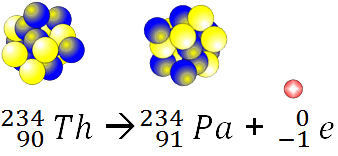
Which type of nuclear radiation is being emitted here?
a)
Alpha
b)
beta
c)
gamma 
d)
none
60.
Solve this equation for alpha decay.
85209At = ___ + 24He
a)
83205Bi
b)
86209Rn
c)
81207Tl
d)
85208At
61.
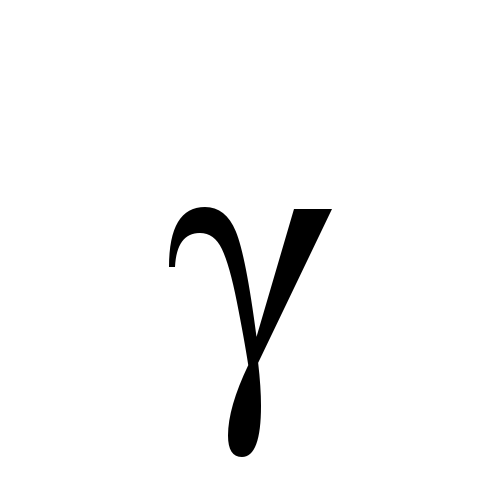
Has the symbol
a)
Alpha
b)
Beta 
c)
Gamma
62.
Has the highest penetrating power.  Can penetrate our body.  Even several cm thick of lead or several meters thick of concrete cannot stop all of it.
a)
Alpha
b)
Beta
c)
Gamma
63.
In a correctly written symbol what would be located in the "A" position?
a)
number of neutrons
b)
atomic number
c)
number of electrons 
d)
mass number