
 Worksheets
Physical Science Final Exam 22/23
Total questions: 92
Worksheet time: 47mins
How many seconds are in one hour?
60
120
360
3,600
How many meters in 5 kilometers?
50
500
5,000
50,000
How many minutes are there in half an hour?
30
60
90
120
What is the symbol for distance?
a
d
v
t
What is the symbol for velocity?
a
d
v
t
What is the symbol for time?
a
d
v
t
What is the symbol for acceleration?
a
d
v
t
A car travels at 7.5 m/s for 16 seconds. What distance does it cover?
120 m
2.1 m
.47 m
1200 m
A student runs 20 meters in 5 seconds. Calculate their speed.
100 m/s
4 m/s
.25 m/s
10 m/s
A jet plane accelerates from rest in a straight line along a runway. After 10 seconds its tires leave the ground as its speed is 60 m/s . Calculate the jet's acceleration during take-off.
6 m/s-2
-6 m/s-2
6000 m/s-2
-6000 m/s-2
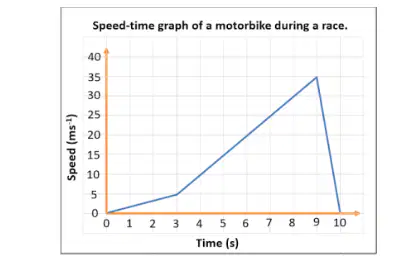
Calculate the acceleration of the motorbike during the first 3 seconds of the race.
15 m/s-2
.2 m/s-2
1.67 m/s-2
5 m/s
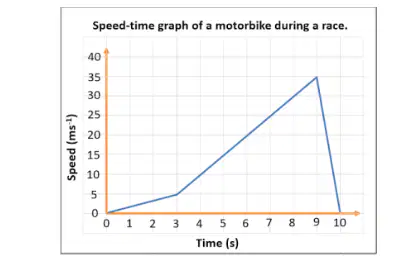
Calculate the distance covered during the first 3 seconds of the race.
15 m
3 m
7.5 m
1.67 m
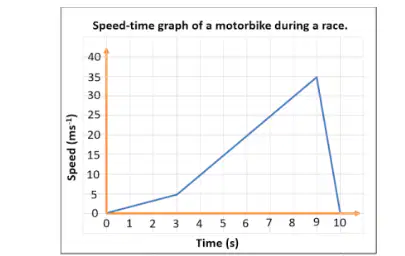
Calculate the acceleration during the 9th and 10th second.
-35 m/s-2
35 m/s-2
0 m/s-2
17.5 m/s-2
What is the acceleration of an object with constant velocity?
0 m/s2
-10 m/s2
10 m/s2
Not enough information
The slope of a velocity-time graph is equal to the…
Position of the object
Displacement of the object
Velocity of the object
Acceleration of the object.
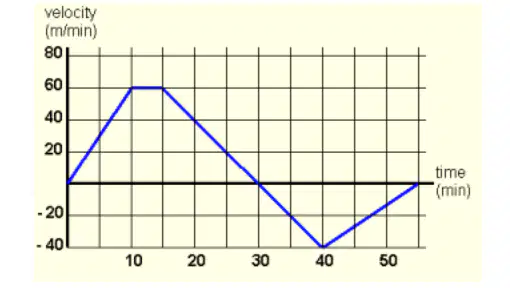
In the velocity-time graph above - for which of the following time frames does the object have a positive acceleration?
10 to 15 minutes
15 to 30 minutes
30 to 40 minutes
40 to 55 minutes
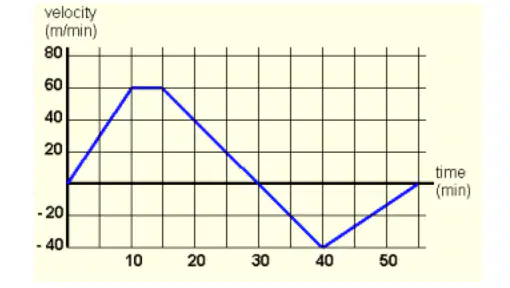
In the velocity time-graph above - for which of the following time frames is the object slowing down?
0 to 10 minutes
10 to 15 minutes
15 to 30 minutes
30 to 40 minutes
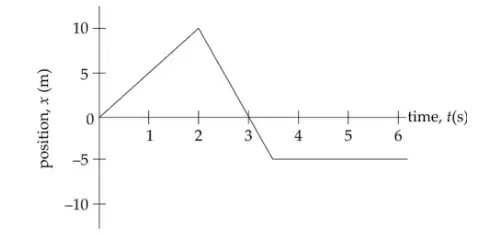
How far does the object travel in the first 2 seconds?
0m
5m
7m
10m
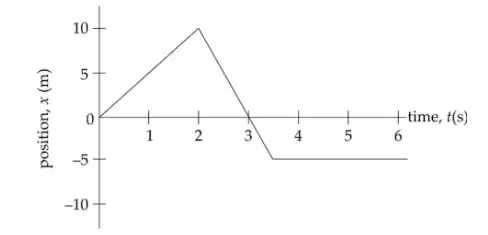
What is the velocity for the first 2 seconds?
2 m/s
10 m/s
5 m/s
15 m/s
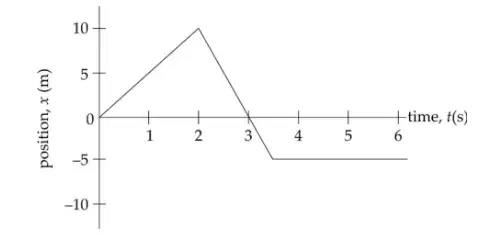
What is the velocity from 3.5 - 6 seconds?
2 m/s
0 m/s
5 m/s
-5 m/s
Energy is a physical object that we can touch.
True
False
Potential energy is stored energy.
True
False
Energy cannot be measured.
True
False
Which of the following is an example of kinetic energy changing into potential energy?
A boy climbs to the top of a slide and sits down.
A branch is not moved by the wind.
A baseball sits on a tee.
A television is turned on.
Which of the following are examples of potential energy? Select Multiple
A boulder rolling down a hill
An apple in a tree.
A car parked on a hill.
A meteor falling from the sky.
A fully charged battery.
Which of the following are examples of kinetic energy? Select Multiple
A boulder rolling down a hill
An apple in a tree.
A car parked on a hill.
A meteor falling from the sky.
A student running a race.
A bowling ball, baseball, golf ball, and ping pong ball are all rolling down a bowling lane at the same speed. Which one has the most kinetic energy?
Bowling ball
Baseball
Golf ball
Ping pong ball
Potential energy increases as:
Kinetic increases
Mass and height increases
Speed and mass increases
The object begins moving
Temperature is a way to measure the ___________ energy of particles of matter.
Kinetic
Potential
Electrical
Chemical
An archer loads an arrow into his bow, pulls back the string and shoots at a target. When does the arrow have the most elastic potential energy?
A fraction of a second after he releases the string.
Before he pulls the string back.
When the string is pulled all the way back.
Just before the arrow hits the target.
A 5 kg apple sits at the top of a tree 40 meters off the ground. If the force of gravity is equal to 10 m/s^2, what is the apple's potential energy?
200 J
2,000 J
20 J
50 J
Gravitational potential energy depends on an object's _____________ and its _______________ above the ground.
mass, height
mass, velocity
velocity, height
density, height
Kinetic energy increases as:
Potential increases
Mass or speed increases
Height or mass increases
The object stops
What is the Law of Conservation of Energy?
Energy will always be constant and will never change
Energy can only be created or destroyed, never transferred
Energy can only travel up and down not left and right
Energy cannot be created or destroyed, only transferred
A 50 kg bowling ball is moving at 20 m/s. What is its kinetic energy?
100 J
1,000 J
10,000 J
10 J
Which statement is true about roller coasters?
The kinetic energy is at its peak when the roller coaster is at the top of the first hill.
The potential energy is at its peak when the roller coaster is at the top of the first hill.
The total energy will fluctuate.
There will always be more kinetic energy than potential energy when the ride is stopped.
A battery is an example of which type of energy
Kinetic
Chemical Potential
Elastic potential
Sound
The warmth you feel from a fire is an example of which type of energy
Sound
Electrical
Chemical Potential
Heat
Ultraviolet Radiation is an example of which type of energy
Thermal
Sound
Solar (Radiant)
Mechanical
Light bulbs turning on is an example of which type of energy
Electrical
Chemical Potential
Sound
Elastic
________________ is the energy released when the nucleus of an atom is split apart (during fission) or combined with another nucleus (during fusion).
Solar
Thermal
Mechanical
Nuclear
_____________________ is the energy that is stored in the bonds between atoms. (Examples: food, batteries)
Chemical potential
Nuclear
Electrical
Solar
We can create and destroy energy
True
False
As the cars of a roller coaster race down a hill, energy transformations take place. Which of the following is true?
Some energy is destroyed
Some potential energy is transformed into kinetic and other forms of energy
Kinetic energy is stored in the cars as they move downhill
The kinetic energy of the cars is equal to the mass of the cars X force of gravity X height of the hill
What cannot happen to energy according to the law of conservation of energy?
Energy cannot be converted
Energy cannot be changed
Energy cannot be transformed
Energy cannot be created
The following equation illustrates the chemical reaction that occurs in a plant. Water + carbon dioxide + light energy to sugar + oxygen. Based on the law of conservation of energy, what happened to the light energy in the reaction?
It was produced by the plant
It was destroyed
It was changed into oxygen gas
It was converted into chemical energy stored in the sugar
Friction is a force that opposes motion. When friction is present, heat is usually generated. According to the law of conservation of energy, which of the following statements is true about the energy associated with friction?
The law of conservation of energy does not apply.
Some of the energy is converted into thermal energy.
Energy is created with friction.
It was not transformed into another type of energy.
Energy cannot be created nor destroyed, only changed from one form to another. How does listening to music on a radio obey the law of conservation of energy?
Electrical energy remains unchanged.
Electrical energy is gradually destroyed as the radio plays.
Sound energy is changed into potential energy.
Electrical energy is converted into other forms of energy such as sound.
The force which opposes motion is called
gravity
thrust
magnetism
friction
An object has a force of 8 Newtons acting in one direction and 13 Newtons acting in the opposite direction. What is the net force acting on the object?
21N
5 N
104 N
13 N
When the net force acting on an object increases…
The object will stop
The object will travel at a constant speed.
The object will accelerate
None of these.
Which of the following is true of contact forces?
They do not need to touch the object to cause it to move.
They operate using a force field.
Friction is an example.
Magnetism is an example.
The force of attraction between two masses is called:
gravity
thrust
magnetism
friction
An astronaut has a mass of 78 kg on Earth. Which statement is true regarding his mass and weight?
The astronaut’s mass and weight will be the same on the Earth as it is on the moon.
The astronaut’s mass will be different on the Earth and the moon, but his weight will be the same.
The astronaut’s mass will be the same on the Earth and the moon, but his weight will be different.
The astronaut’s mass and weight will change on the Earth and the moon.
What is the unit for weight?
ms-2
kg
ms-1
N
The weight of an 25kg object is:
250 N
245 kg
25 N
25 kg
"For every action there is an equal and opposite reaction" is which of Newton’s Laws?
First Law
Second Law
Third Law
Fourth Law
When a cyclist applies a force to the pedals, the bike accelerates. What is the name of the force applied by the cyclist?
Reaction
Weight
Friction
Thrust
The combined weight of a cyclist and bike is 750N. How much is the reaction force (support) provided by the road surface?
More than 750 N
Less than 750 N
750 N
None of these.
When the horizontal forces acting on a cyclist are balanced, the cyclist will be:
Accelerating.
Decelerating.
At a constant speed.
None of these.
What is Newton’s third law of motion?
For every action, there is an equal and opposite reaction.
Force is equal to the mass multiplied by acceleration.
Unbalanced forces can change an object's speed or direction.
Balanced forces cause an object to remain at rest or continue at a constant speed.
If a man is pushing against a brick wall with a force of 120 N, how much reaction force does the wall provide?
None
60 N
120 N
240 N
Which of the following is NOT true of friction?
Friction opposes motion
Friction occurs when two surfaces are in contact with one another.
Drag is the name of friction occurring in air or water.
Rolling friction is greater than static friction.
What force is needed to accelerate a 0.25kg mass at 4.0ms-2?
0.1N
1 N
10 N
100 N
A 0.2N force is applied to an object and it accelerates at 0.8ms-2. What is the object's mass?
0.25 kg
0.16kg
4 kg
2.5 kg
Which of the following is the correct UNIT symbol for force?
ms-2
kg
F
N
What happens to the acceleration of an object when the mass doubles, but the force stays the same?
The acceleration doubles.
The acceleration stays the same.
Acceleration equals zero.
The acceleration is halved.
What is the weight force acting on an object with a mass of 2kg?
196 N
20 N
1.96 N
0.2 N
How is weight force calculated?
W = m/g
W = g/m
W = m x g
W = m x a
Which of the following would increase weight force?
Moving the object to the moon
Moving the object to outer space
Increasing the object’s mass
Decreasing the object’s mass
A book that weighs 8 N sits on a table. What is the normal force between the book and the table?
.8 N
8 N
78 N
800 N
A large truck collides with a small scooter. Which of the following statements is true?
The truck exerts a larger force on the scooter than the scooter on the truck
The scooter exerts a larger force on the truck than the truck on the scooter
The truck and the scooter exert the same force on each other
The truck and scooter exert a net force of zero on each other
As you approach a positive charge, the voltage will
increase
decrease
stay the same
None of the above
What is the charge on a proton?
Positive
Negative
Neutral
As you approach a negative charge, the voltage will
increase
decrease
stay the same
None of the above
What is the charge on an electron?
Positive
Negative
Netural
How will a proton and an electron interact?
They will repel each other
They will attract each other
There will be no interaction
Which of the following would be attracted to a positively charged object
A neutral object
A positively charged object
A negatively charged object
Both a & b
A __________________ circuit is one in which charge can flow freely.
Closed
Open
Complete
Incomplete
For a simple circuit with a battery and a single light bulb, what is the rule for relating voltage rise and voltage drop?
Voltage Rise = Voltage Drop
Voltage Rise - Voltage Drop = 1
Voltage rise is always higher than voltage drop
If a resistor is added to a series circuit, the total resistance…
Increases
Decreases
Remains the same
Becomes zero
Which of the following is the best definition for voltage?
The amount of charge moving through a circuit
Opposition to current flow
The amount of energy per charge
The excess charge on an object
Which of the following is the best definition for current?
The amount of charge moving through a circuit
Opposition to current flow
The amount of energy per charge
The excess charge on an object
If you increase the total resistance of a circuit, what will happen to the current through the battery?
The current will increase
The current will decrease
The current will stay the same
Cannot be determined
Elements in series have the same…
Resistance
Current
Charge
Voltage
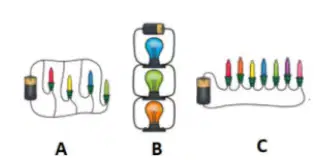
Which two circuits have the most in common?
B & C
A & C
A & B
None of the above
A student wants to build a circuit with four light bulbs and one bell. The student wants to place a switch in the circuit so that only one light will still be on and the bell will still ring when the switch is opened. Which of these circuits should the student build?
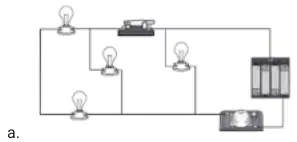
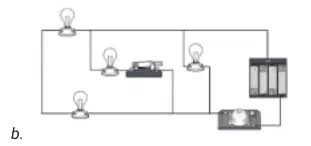
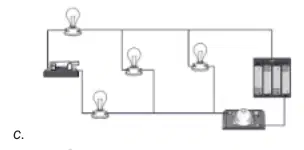
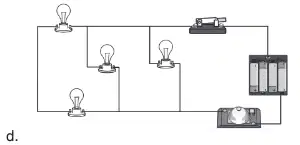
Household circuits are typically wired in parallel. Which of the following statements shows an advantage to this claim?
When multiple lamps are plugged in, the brightness of the lamps decreases.
Adding more plug outlets increases the current in the household.
If electricity stops flowing to one part of the house, it continues to flow to the other parts.
The more devices that are plugged into outlets in the household, the greater the resistance.
The main factor which affects the speed of a wave is the ____
amplitude
frequency
intensity
medium through which it travels
If you double the frequency of a wave without letting it change mediums, then how will the wavelength change?
It will double
It will triple
Decrease by 1/2
Decrease by 1/3
Which of the following are known to commonly use sonar to navigate?
Dolphins
Sharks
Dogs
Cats
In a standing wave the node is the location of…
Maximum constructive interference
Maximum destructive interference
Minimum destructive interference
No constructive or destructive interference

