
 Worksheets
Physics Exam Review -Extra Credit
Total questions: 90
Worksheet time: 1hrs 13mins
Wavelength= .5m
Frequency= 150 hertz
Wavelength= 2.0m
Frequency= _________
Wavelength= __________
Frequency= 600 hertz

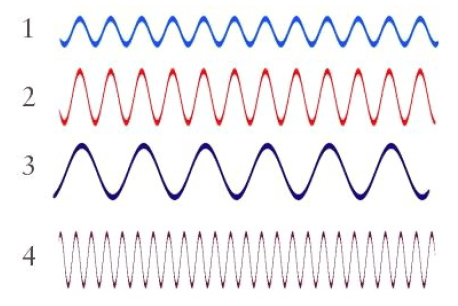
Which wave has a greater frequency?
A
B

Which shows the EM spectrum in order from longest to shortest wavelength?
Gamma, X-Ray, UV, Visible, IR, Microwaves, Radio
Radio, Microwaves, IR, Visible, UV, X-Ray, Gamma
Visible, UV, X-Ray, Gamma, Radio, Microwaves, IR
Visible, Radio, Microwaves, IR, UV, X-Ray, Gamma
Which shows the EM spectrum in order from longest to shortest wavelength?
Gamma, X-Ray, UV, Visible, IR, Microwaves, Radio
Radio, Microwaves, IR, Visible, UV, X-Ray, Gamma
Visible, UV, X-Ray, Gamma, Radio, Microwaves, IR
Visible, Radio, Microwaves, IR, UV, X-Ray, Gamma
The EM spectrum travels as what type of wave?
Transverse
Longitudinal
Sound
S-Waves
Sound is an example of what type of wave?
Transverse
Longitudinal
How are frequency and wavelength related?
As frequency increases, wavelength gets shorter
As frequency increases, wavelength gets longer
As frequency increases, wavelength gets lower
As frequency increases, wavelength gets higher
I have a type of visible light with a wavelength of 5.8X10⁻⁷. What color is it?
Yellow
Red
Violet
Blue

What part of a wave is represented by letter F?
Trough
Crest
Amplitude
Wavelength
A wave has wavelength of 10 m and a speed of 340 m/s. What is the frequency of the wave?
34 m/s
34 hz
3400 m/s
3400 Hz
A wave has frequency of 5 Hz and a speed of 25 m/s. What is the wavelength of the wave?
5 m
5 Hz
125 m
125 Hz
A wave has a frequency of 14 Hz and a wavelength of 3 m. At what speed will this wave travel?
42 m/s
42 m
4.67 m/s
4.67 Hz
A wave has a frequency of 540 Hz and is traveling at 340 m/s. What is its wavelength?
1.59 m
0.63 m
183600 m
91800 m
Which of the following will change the speed of light as it travels?
Air
Water
A tunnel
Space
Review: What is the frequency of a wave?
How fast the wave moves from one point to the next
The time it takes for one wave to happen
The length of a wave
How many waves pass a fixed point in 1 second
Review: Frequency and period are reciprocally related. Therefore, if the frequency of a wave is 5 Hz, then the period is__________.
5 sec
1/5 sec
50 sec
1/2 sec
Review: frequency and period are reciprocally related. Therefore, if the period is 1/2 seconds, then the frequency is ___________.
2 Hz
1/2 Hz
2 sec
5 Hz

As the frequency of a wave increases, then what happens to the wavelength?
Gets bigger / increases
Gets smaller / decreases
Which material would sound travel fastest in?
Air
Water
Steel
Why does sound travel faster in water than in air?
The particles in water are more tightly packed together
The particles in water are more spaced apart
V=fλ
If the frequency is 5 Hz and the wavelength is 2 m, then what is the wave's velocity?
10 m/s
5/2 m/s
2/5 m/s
7 m/s
V=fλ
If the wave velocity is 20 m/s and the wavelength is 2 m, then what is the frequency?
10 Hz
40 Hz
0.1 Hz
V=fλ f=T1
If the time period of a wave is 2 seconds and the wavelength is 4 m long, then what is the wave's velocity?
2 m/s
8 m/s
1/2 m/s
V=fλ
If the velocity of the wave is 10 m/s and the frequency is 5 Hz, then what is the wavelength?
2 m
50 m
5 m
15 m
V=fλ
If the velocity of the wave is 10 m/s and the frequency is 5 Hz, then what is the wavelength?
2 m
50 m
5 m
15 m
What is Energy?
A breakfast serial
The same as force
The ability to do work
Nobody really knows

What type of motion is happening here?
Space travel
Rotation
Wave motion
Illegal
Which cart has the most Gravitational Potential Energy?


The momentum of the all of the balls is __________________ after the break.
Greater
Less
The same
Destroyed

Which are conservation laws in physics?
Conservation of energy
Conservation of heat
Conservation of linear momentum
Conservation of velocity
What is the wavelength of a wave with a frequency of 800 Hz that is moving through sea water at 1,440 m/s?
2.1 m
4.2 m
3.5 m
1.8 m
What is the frequency of light with a wavelength of 7.00 x 10⁻⁷ m?
3.4 X 10¹⁴ Hz
2.1 X 10¹⁴ Hz
5.4 X 10¹⁴ Hz
4.3 X 10¹⁴ Hz
If the frequency of wave crests passing increases, what happens to the wavelength between those wave crests?
wavelength increases too
wavelength stays the same
wavelength decreases
If the frequency of wave crests passing increases, what happens to the period between those wave crests?
period increases too
period stays the same
period decreases
In a transverse wave the material (medium) the wave is moving through moves ___________ to the direction the wave is traveling.
parallel
perpendicular
In a longitudinal or compression wave the material (medium) the wave is moving through moves ___________ to the direction the wave is traveling.
parallel
perpendicular
Light is an example of a __________ wave.
longitudinal / compression
transverse
The area of a longitudinal or compression wave where there is a greater concentration of particles of the medium is called a ____________.
crest
trough
compression
rarefaction
What is the amplitude of a wave?
Where there is no wave movement
The distance the wave oscillates from it's resting position
A disturbance that transfers energy from one place to another
The distance between two corresponding parts of a wave
Definition: Crest
The highest point of a transverse wave
The lowest point of a transverse wave
The center of a transverse wave
The distance between two points on a wave
Definition: Crest
The highest point of a transverse wave
The lowest point of a transverse wave
The center of a transverse wave
The distance between two points on a wave
What type of matter can waves travel through?
Solid
Liquid
Gas
All of the Above
If the wavelength of a wave increased, what would happen to the frequency?
decrease
increase
stay the same
The units of frequency are...
metres
seconds
Hertz
degrees
When we're talking about a pendulum, what does T stand for?
pi
period
length
gravity
What is the unit for the period of a pendulum?
second
meter
m/s/s
Newton
A form of energy that we can see.
Light
Sound
Heat
Force
The above formula is for...


Bumper car X moves at a speed of 2.5m/s moving toward car Y which is at rest. Car X collides with car Y. How does the momentum for each car change after the collision?
Car X’s momentum increases, and car Y’s momentum decreases
Car X’s momentum decreases, and car Y’s momentum increases.
Car X’s momentum is unchanged, and car Y’s momentum decreases.
Car X’s momentum is unchanged, and car Y’s momentum increases.
What is the approximate momentum of a toy car with a mass of 15kg and a velocity of 20m/s?
0.8 Ns
250 Ns
1.33 Ns
300 Ns

Can the Mini Cooper ever have the same momentum as the truck? How?
Yes. If the Mini has a much greater inertia than the truck.
Yes. If the Mini has a much greater velocity than the truck.
No. The masses are not the same.
No. The Mini has a lower velocity.
A constant 4.0-N horizontal force is applied to a 0.10-kg object as it moves a distance of 0.20 m along a horizontal, frictionless surface. How much work does the force perform on the object?
0.8 J
0.08 J
0.4 J
0.04 J

At which point will the roller coaster have the greatest amount of gravitational potential energy?
A, the highest point
B, the lowest point
When it reaches maximum velocity
When it reaches the station
Why does it take your car breaks longer to stop when you are driving faster?
Kinetic energy is higher at higher speeds (1/2mv2)
There is less friction when you drive fast.
Moving at higher speeds requires more energy due to the increase in mass of the car.
It does not take longer. The stopping distance would be equal.
How much power does it take to lift a 15-N object 0.5 m in 1.5 s?
5W
0.05 W
113 W
11.3 W
Which of the following explains the relationship between work and power when running or walking up a flight of stairs?
Running requires more work and more power than walking.
Running requires less work and less power than walking.
Running requires the same amount of work, but more power than walking.
Running requires the same amount of power, but more work than walking.

The diagram represents a wave. If it’s frequency is 32 Hz, what is the approximate speed of the wave?
99 m
352 m
138 m
176 m
What is a transverse electromagnetic waves that can travel through matter and vacuum
sound wave
light wave
longitudinal wave
mechanical wave

