
 Worksheets
CAST Review
Total questions: 100
Worksheet time: 1hrs 6mins
After cooking, you place a hot pan on a cold counter. After a while, the frying pan, the counter, and the air in the room will all be at the same temperature. Why?
Because thermal energy will be transferred from the pan to its surroundings
Thermal energy from the pan will be transferred to the air, but not the counter
Thermal energy from the pan will absorb the coldness from the counter
None of the above

Nash puts his cold Coke Slurpee on to the metal roof of his mom's car. Describe the heat transfer that takes place.
Heat is transferred from the car's roof into the Slurpee and increases the temperature of the Slurpee.
Heat is transferred from the Slurpee into the roof and increases the temperature of the roof.
The Slurpee stays the same temperature until it is completely gone.
The roof doesn't change temperature due to the fact that it sits in the sun all day.
On a cold day, Jamarria puts a hot bowl of soup down on a concrete table. Describe the energy transformation that will occur.
Heat from the air is transferred to Jamarria's hand.
Heat from the hot bowl of soup is transferred to the car door.
Heat from the concrete table is transferred to the hot bowl of soup.
Heat from the hot bowl of soup is transferred to the concrete table.
If energy is lost during a chemical reaction, it is usually lost in the form of...
potential energy
radiant energy
heat energy
all of the above

Heat always travels from...
Warm to cool
Cool to warm
Warm to warm
Cool to cool
H2 + O → H2O
In a chemical reaction, you begin with 23 atoms. When the reaction is over you would expect to have ______ atoms remaining.
23
less than 23
more than 23
There is not enough information to tell
CH4 + 2O2 → CO2 + 2H2O
If reactants' mass is 18g , what is the mass of the reactants ?
15
36
81
18


A person is standing in the middle of a boxcar on a train moving 100 km per hour. If the motion of the boxcar
, where in the boxcar will the person most likely land after he jumps straight up?


Force Q is equal to Force S and Force R is equal to Force T.
Force Q is less than Force S and Force R is equal to Force T.
Force Q is equal to Force S and Force R is greater than Force T.
Force Q is less than Force S and Force R is greater than Force T.

Which bar magnet will experience the greatest magnetic attraction?
Magnet 1
Magnet 2
Magnet 3
Magnet 4
There are two ends of a magnet.
What are they called?
North and East
North and West
North and South
South and East

In which direction will the box move?
A. in the direction arrow P is pointing
B. in the direction arrow Q is pointing
C. in the direction arrow R is pointing
D. in the direction arrow S is pointing

Which person has gained the most gravitational potential energy ?
a. a 50kg person who lives on the second floor
b. a 50kg person who lives on the third floor
c. a 100kg person who lives on the second floor
d. a 100kg person who lives on the third floor

How does the elastic potential energy in the bow change as the archer fires an arrow?
It decreases from Step1 to Step 2, then increases to Step 3.
It increases from Step1 to Step 2, then decreases to Step 3.
It remains constant from Step1 to Step 2, then increases to Step 3.
It remains constant from Step1 to Step 2, then decreases to Step 3.

What happens to Box X and Box Y as a result of the forces?
A. Box X starts moving, speeding up, and Box Y remains at rest.
B. Box X starts moving at constant speed, and Box Y remains at rest.
C. Box X starts moving at constant speed, and Box Y starts moving, speeding up.
D. Box X starts moving, speeding up, and Box Y starts moving at a constant speed.

How does the elastic potential energy change for each of the springs?
The elastic potential energy of both springs will increase.
The elastic potential energy of both springs will decrease.
The elastic potential energy of the spring in set-up A will decrease and the elastic potential energy of the spring in setup B will increase.
The elastic potential energy of the spring in set-up A will increase and the elastic potential energy of the spring in setup B will decrease.

Click on each action that will reduce the rate at which the speed of the basket changes.
Pull with less force
Pull with more force
Add an apple to the basket
Take an apple out of the basket
Roughen the surface to increase friction
An object moves at a constant speed.
What will happen to this object’s motion over time if no new forces are applied?
It will change direction.
It will increase in speed.
It will decrease in speed.
It will maintain a constant speed.
A scientist runs an electric current along a wire. A magnetic compass is placed near the wire.. The scientist observes that whenever the current is turned on, the compass needle moves.
Why does the compass needle move?
The current creates an electric field around the wire.
The current creates a magnetic field around the wire
The current adds electric charge to the compass needle.
The current increases the forces of gravity on the compass needle.

When there is movement, potential and gravitational energy changed to _________ Energy.
chemical
potential
elastic
kinetic


Water vapor is an example of
an atom
a liquid
a gas
a solid
Which is an example of a chemical change?
wood that has burned to ashes
paper that is cut into pieces
ice that melts into water
clay that is rolled into a ball
When heat is added to matter, what happens to its particles?
They move slower.
They move closer together.
They move faster.
They do not change.
Why is seawater considered a solution?
It is made up of sand and water.
Salts are dissolved in water.
It is a mixture of salt, sand, and water.
The salt in the water can be separated by hand.
Ice is an example of a
solid
liquid
gas
mixture
Which tool would you use to measure mass?
balance
ruler
beaker
thermometer
Which object would be most likely to rust?
a glass marble
an iron nail
a plastic comb
a paper cup
Which answer makes a correct statement?
Physical change only changes the size.
Physical change only changes the color.
Physical changes begin and end with the same matter.
Physical changes change the matter into something totally different.
If enough heat is taken away from a container of water, what will happen?
It will begin to boil.
It will become a solid.
It will turn into a gas.
It will increase in weight.
A student is investigating chemical changes by using different materials. Which investigation would provide evidence of a chemical change
and why?
Melting a solid with fire would provide evidence of a chemical change because the solid would change shape.
Cutting cardboard into many smaller pieces would provide evidence of a chemical change because the pieces cannot be put back together.
Placing a solid into hot water and stirring while the solid dissolves would provide evidence of a chemical change because the dissolved material is lost.
Combining two liquids that give off heat and gas would provide evidence of a chemical change because the particles react to make a new material with different properties.
Which investigation would provide evidence of a chemical change?
Spray perfume into the air, and when the air and perfume mix, observe the change in odor that happens as they mix.
Put an antacid tablet in water, and when the antacid and water mix, observe the bubbles that form as a new substance is created.
Heat water in a pan on a stove, and observe the steam that forms as the state of matter of the water changes.
Blow air through a wand filled with soap solution, and observe the bubbles that form as the air becomes trapped.
An example of water changing its state of matter is
mixing water and cooking oil
wood burning
building a snowman
steam rising from a kettle

What are the building blocks of matter?
atoms
molecule
cells

What type of charge does a PROTON have?
negative
positive
neutral

What type of a charge does a NEUTRON have?
negative
positive
neutral

What type of charge does an ELECTRON have?
negative
positive
neutral

Roasting marshmallows over the fire is a chemical change.
TRUE
FALSE

A chemical change is when I combine a solid and a liquid in a beaker and it produces a dissolved solid and an odorless gas.
TRUE
FALSE
Which diagram represents a solid?


Which diagram represents a liquid?


Which diagram represents a gas?


Which phase change is demonstrated when a substance is changing from a solid to a gas?
melting
freezing
sublimation
On a hot summer day, you make a glass of refreshing sweet iced tea by combining boiling water, tea, sugar, and ice.
What type of change occurs and how do you know?
Physical change; sugar dissolves in the tea and water, but the chemical composition remains the same.
Physical change; sugar dissolves in the tea and water which breaks the bonds of the molecules
Chemical change; sugar dissolves in the tea and water due to heat being added to the water
Chemical change; sugar dissolves in the tea and water which breaks the bonds of the molecules
How many electrons does hydrogen of Na?
13
8
1
75
what element is shown in Na?
Gold
Sodium
Hydrogen
Nitrogen
what is the atomic number of Cu?
64
54
1
12
what is the atomic mass of Na?
11
13
65
64
what elements is shown in Cu?
Gold
Hydrogen
Sodium
Copper
How many neutrons are in Na?
14
12
10
1

This change is a
chemical reaction
physical change
musical change
Ice Ice baby
How is a chemical change different from a physical change?
there is no difference
a physical change creates a new substance
a chemical change creates a new substance

A precipitate is a ___________ that forms when 2 liquids react together.
solid
liquid
gas
plasma
Is glass breaking a chemical or physical change?
When mixing milk and vinegar, a white, chunky, solid substance is formed. What has occurred?
Physical change: state of matter
Chemical change: precipitate
Physical change: freezing
Chemical change: new gas
Boiling Water
Physical Change
Chemical Change
A physical change is a change
in an item's properties like its shape, size or density.
that creates a new substance or emits light or heat
that creates a smell
that cannot be undone
Physical change
(Shape)
Cutting paper
Physical change
(solubility)
Dissolving
Kool-Aid
Chemical Change
(Flammability)
Lighting a match
Chemical Change
Creating a new substance
Both a Physical & Chemical change
Bubbles

Choose the best description below for the image
physical change
chemical change

What will the net force on the soccer ball be?
50 N to the left
50 N to the right
200 N to the left
200 N to the right
What effect does friction have on a moving object?
it causes the moving object to slow and eventually stop
it causes the moving object to speed up
it keeps the moving object moving in the same direction forever
it causes the moving object to turn around and move in the opposite direction

Which one is balanced?
Top
Bottom
Both
Neither

What force is pushing up?
gravity
air resistance
friction
normal force
What type of force would be present if you were to win a tug of war?
Balanced Force
Unbalanced Force
Gravity
Net Zero Force

Which boy will have an easier time getting down the hill?
Boy A , because he is experiencing less friction than boy B.
Boy B, because he is experiencing more friction than boy A.
A rightward force is applied to a dresser to accelerate it to the right across the bedroom floor.


A downward-moving skydiver who has just opened the parachute is slowing down.


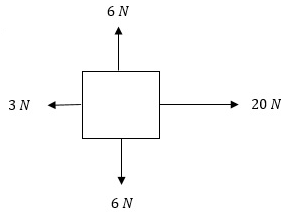
What is the NET FORCE of this diagram?
17 N, right
17 N, left
23 N, right
12 N, up
You push on a tree with 20 N of force. If the tree doesn't move, the tree is pushing back on you with _____of force.
20N
10N
40N
70N

Which one represents the magnetic field lines of magnets repelling?
A
B

What will the magnets in the picture do?
Attract
Repel
Neither attract nor repel
Both attract and repel

What will the magnets in the picture do?
Attract each other
Repel each other
Both attract and repel
Neither attract nor repel

Are the magnets in this picture attracting or repelling?
Attracting
Repelling
As magnets get father apart, the strength of the fields get...
Weaker
Stay the same
Stronger

As mass increases, gravitational force between two objects
increases
decreases
stays the same

