
 Worksheets
Physics 2nd Semester Final Review Quizizz
Total questions: 61
Worksheet time: 2hrs 47mins

Which student drew the lens diagram correctly?
Student A
Student B
Student C
Student D
Which of the following statements about plane mirrors is FALSE? (Remember, size and distance are the same in a mirror.)
Produce upright, virtual images
Produce images that are left-right reversed
Produce images that are the same size as the object
Produce images that are different distances away from the object

How would you describe the size of the image compared to the object?
Same Size
Reduced
Enlarged

What is the next step? (Yes, you can sing the song.)
Draw a line parallel again.
Draw a line through the focal point on the right side.
Draw a line through the focal point on the left side.
Draw a line through the center.

What type of image will be formed?
Larger, real, inverted
Smaller, real, inverted
Larger, virtual, inverted
No image because the lines do not intersect
The charge of an electron is
positive.
negative.
Electrons have no charge.
An atom loses an electron. What type of charge does it have now?
positive
negative
When a balloon is rubbed on clothes, it acquires a charge by ___________
Induction
Reduction
Friction
Conduction
Which of the following is not a good conductor of electricity?
copper
silver
glass
aluminum
Which of the following is not a good insulator?
Copper
Glass
Rubber
Wool
The law of conservation of charge states that...
All atoms have more protons than electrons.
Only protons can be rubbed off of an atom.
Charge cannot be created or destroyed.
Charge cannot be transferred
The Sun emits a solar flare directly aimed at Earth. Which instrument on an orbiting satellite would detect the flare first?
Radio Wave Sensor
Infrared Wave Sensor
X-Ray Wave Sensor
All electromagnetic waves travel at the speed of light
Which of the following colors are primary light colors?
cyan, magenta, yellow
red, blue, green
green, magenta, yellow
yellow, red, blue
Which wave has the least amount of energy?
Infrared
Gamma rays
Radio waves
Ultraviolet waves
Which wave has the most energy?
Infrared
Gamma rays
Radio waves
Ultraviolet waves
What determines an electromagnetic wave's energy?
speed
frequency
amplitude
In which medium does light travel the fastest?
space (vacuum)
diamond
water
air

What can be said about the speed of light as it moves into medium B?
The speed is slower because it is closer to the normal line.
The speed is faster because it moves closer to the normal line.
As the wavelength of a light wave decreases, what happens to the frequency of the wave?
Frequency increases
Frequency decreases
It remains constant
Which of the following statements about Ohm's Law is true?
The current is inversely proportional to the voltage. (As current goes up, voltage goes down)
The current is inversely proportional to the resistance. (As resistance goes up, current goes down)
If the voltage in the circuit increases, then the current will decrease.
A group of students is conducting an investigation of a simple circuit with one bulb to find the resistance of the resistor. How should they measure current, and what relationship would they expect to find?
The students should measure the current with an ammeter connected in series (in line) with the resistor. They should find that as voltage increases, current decreases proportionally.
The students should measure the current with an ammeter connected in series (in line) with the resistor. They should find that as voltage increases, current increases proportionally.
The students should measure the current with an ammeter touching both ends of the resistor (parallel to the resistor). They should find that as voltage increases, current decreases proportionally.
Students are building basic circuits in their physics class, and they are asked to measure the voltage across their circuit, which includes a battery and a single resistor. Which of the following will they need to do to get an accurate reading of voltage? (8b, DOK 2)
Students will need to use a voltmeter and touch it on either side of the battery in parallel to measure the voltage.
Students will need to use a voltmeter built into the circuit in series with the resistor to measure the voltage.
Students will need to use an ammeter and touch it on either side of the resistor in parallel to measure the voltage.
Students will need to make the ammeter a component built into their circuit in series so that electrons flow through it to measure the voltage.
Which of the following statements best describes a parallel circuit?
The voltage drop across each resistor is less than the total battery voltage.
The current splits as it moves through the different branches of the circuit.
The total resistance equals the sum of all the individual resistances in the circuit.

In which circuit would all the bulbs go out if one bulb is unscrewed?
Circuit A
Circuit B
Does not Apply
A student is building an electromagnet for a class experiment. He decides to add several more loops to the coil of wire. Which statement best describes the result of this change?
The electromagnet breaks
The electromagnet picks up less
The electromagnet picks up more
No changes
Which of the following energy conversions occurs in an electric generator?
Mechanical (Movement) --> Electrical
Mechanical (Movement) --> Heat
Electrical --> Heat
Electrical --> Mechanical (Movement)
Which of the following actions will result in magnetic induction producing a greater amount of current?
Decreasing the number of loops in the coil
Moving the magnet faster through the coil
Moving the magnet slower through the coil
Using a weaker magnet

How can you create the most current in the lightbulb?
Move the magnet slowly through the coil.
Move the magnet quickly through the coil.
Place the magnet outside the coil.
Put the magnet next to the lightbulb.
When you move a magnet back and forth through a wire, what is produced?
resistance
magnetism
current
force
Which of the following energy conversions occurs in an electric motor?
Electrical --> Heat
Mechanical (Movement) --> Heat
Electrical --> Mechanical (Movement)
Mechanical --> Electrical
How can you increase the strength of an electromagnet?
Add an iron core and decrease the number of loops
Add an iron core and increase the number of loops
Add a copper core and decrease the number of loops
Add a copper core and increase the number of loops

Why does the compass move when placed near this active circuit?
The needle creates a force
The copper wire creates a force
The compass needle does not move
The current in the wire exerts a force on the needle

Which object has the domain shown in the image?
Iron nail
Copper wire
Permanent magnet
Carpet in Mr. Bryan's trailer

Which magnetic poles are shown in the image?
North and South
South and North
South and South
A loudspeaker is turned on and plays a constant low-frequency note.
Which of the following statements best describes the motion of the dust particle after the speaker is turned on?
A transverse wave will disturb the dust particle, moving it parallel to the wave motion.
A longitudinal wave will disturb the dust particle, moving it parallel to the wave motion.
A longitudinal wave will disturb the dust particle, moving it perpendicular to the wave motion.

What happens to the wavelength when the frequency of a wave increases?
It is longer
It is shorter
It stays the same
Through which medium does sound travel the slowest?
Solid Wooden Table
Swimming Pool Water
Air
Space
Which frequency has the longest wavelength?
690 Hz
871 Hz
542 Hz
437 Hz
Four students are sitting at a train crossing, listening to the horn of a train as it approaches the crossing, passes by, and moves away. Which student best explains the changing sounds in terms of the Doppler Effect?
Student A says the frequency of the sound is increased in front of the approaching train, making the pitch higher. Then, the frequency of the sound is decreased behind the train as it moves away, making the pitch lower.
Student B says the frequency of the sound is decreased in front of the approaching train, making the pitch higher. Then, the frequency of the sound is increased behind the train as it moves away, making the pitch lower.
Student C says the speed of the sound is increased in front of the train, making the pitch higher. Then, the speed of the sound is decreased behind the train, making the pitch lower.
Student D says the amplitude of the sound is increased in front of the train, making the pitch higher. Then, the amplitude of the sound is decreased behind the train, making the pitch lower.
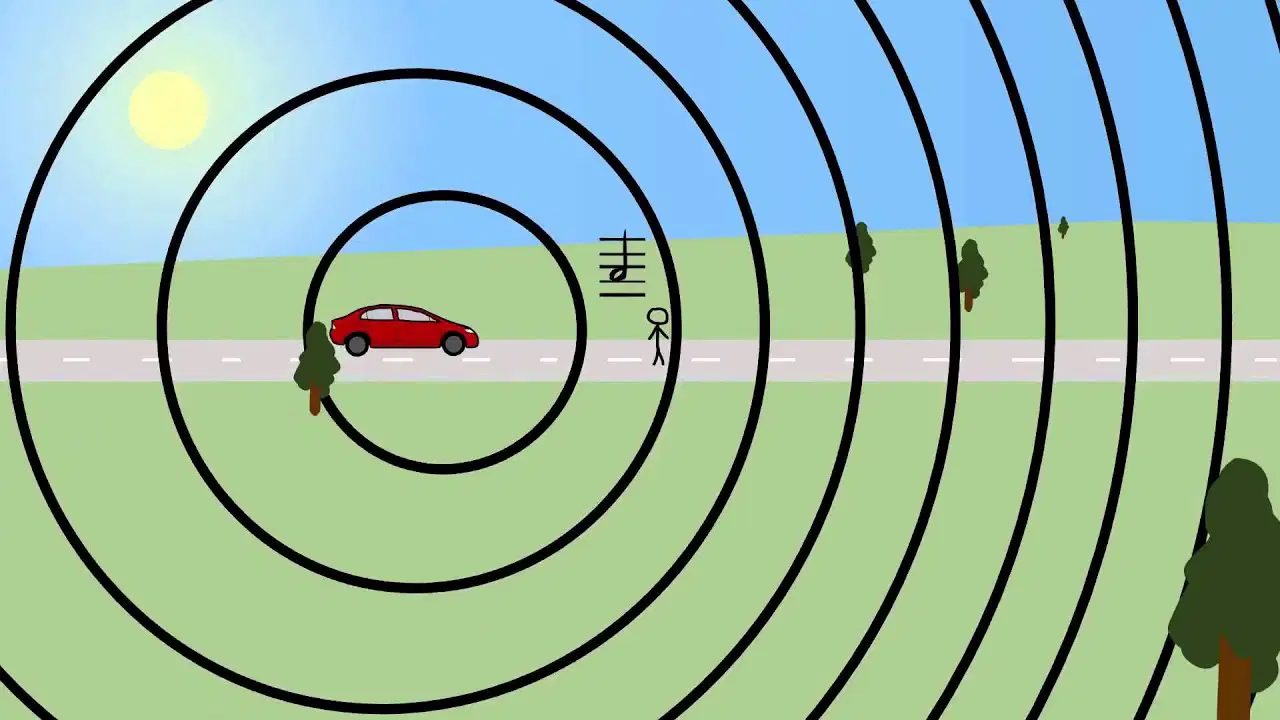
Using the image, which observer would detect a higher pitch as the car drives to the right?
A person in front of the car
A person behind the car
The person in the car
A person on top of the car
What is NOT true about sound?
It is a longitudinal wave that moves parallel.
It can travel through space.
It travels fastest through solids.
It travels slowest through gases.
How can you create a higher pitch of sound?
Longer wavelength
Higher frequency
Higher amplitude
Higher velocity

Would this wave have a high pitch or low pitch?
High Pitch
Low Pitch
No Pitch
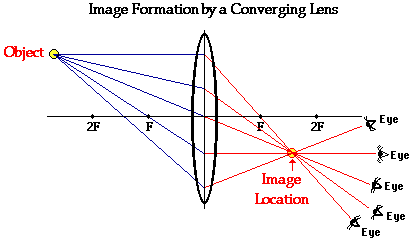
Compared to the object in front of the lens, its image is:
inverted and smaller
inverted and larger
not inverted and smaller
not inverted and larger
An image that you can see, but does not actually exist is called which of the following?
Real Image
Fake Image
Virtual Image
Digital Image
If an image formed by a convex lens is inverted, what type of image is it most likely to be?
Real
Virtual
None of the above
Concave lenses, like those found in the peepholes of doors, always produce images that are...
Virtual, upright, smaller
Real, inverted, larger
Real, inverted, smaller
Virtual, upright, larger

The point where the rays meet is known as...
Fire
the focal point
refraction
Plane of the lens
Which figure represents the path light takes through a converging lens?
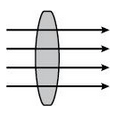
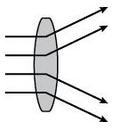
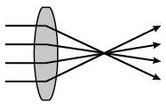
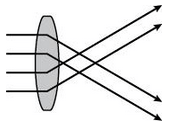
Which lens represents the path light takes through a diverging lens?


What effect does increasing the number of batteries in a series circuit have on the overall voltage of the circuit?
The overall voltage decreases.
The overall voltage increases.
The overall voltage remains the same.
What is the primary function of a capacitor in an electronic circuit?
To increase resistance
To store electrical energy
To decrease current flow
Which material would reduce the effectiveness of an electromagnet if used as its core?
Iron
Aluminum
Plastic
What happens to the frequency of a wave as its wavelength decreases?
The frequency remains the same
The frequency increases
The frequency becomes zero
The frequency decreases
Which of the following materials is most likely to conduct electricity?
Glass
Silver
Wood
Rubber
Which of the following is NOT a property of electromagnetic waves?
They can travel through a vacuum
They require a medium to propagate
They travel at the speed of light in a vacuum
They consist of oscillating electric and magnetic fields
What happens to the resistance of a wire if its length is doubled while its thickness remains the same?
The resistance is halved
The resistance becomes zero
The resistance is doubled
The resistance remains unchanged
Which of the following best describes the image formed by a convex lens when the object is placed beyond twice the focal length?
Virtual, inverted, smaller
Virtual, upright, larger
Real, inverted, smaller
Real, upright, larger

