wayground logo

Free Printable Worksheets

Font size

S
M
L
XL
Worksheets

Earth Science FINAL Review

Total questions: 110

Worksheet time: 2hrs 40mins

Name
Class
Date
1.
What does this symbol on a weather map indicate? 
a)
High pressure system
b)
Low pressure system
c)
Cold front
d)
Warm front
2.
What does this symbol indicate on a weather map? 
a)
High pressure system
b)
Low pressure system
c)
Cold front
d)
Warm front
3.
What kind of weather is usually associated with a high pressure system?
a)
Sunny weather
b)
Precipitation (rain, snow, etc.)
4.
The boundary  between two air masses is known as:
a)
front
b)
storm
c)
climate
d)
flood
5.
Which condition usually means cloudy, stormy weather?
a)
high pressure
b)
low pressure
6.
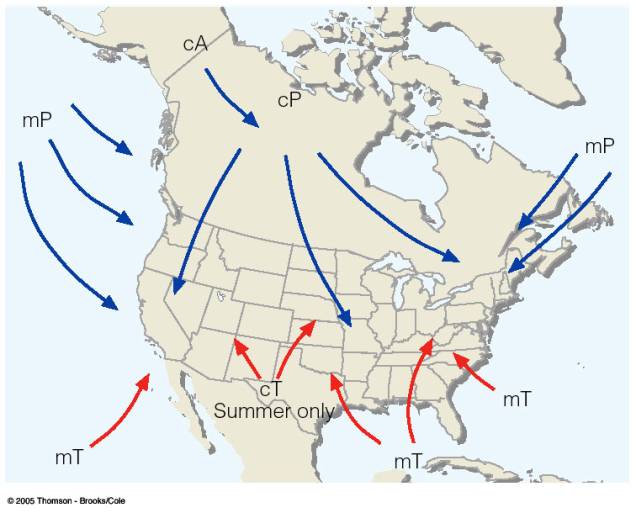
A wet and cold air mass would be a...
a)
Maritime polar
b)
Continental polar
c)
Maritime tropical
d)
Continental tropical
7.
A dry and cold air mass would be...
a)
Maritime polar
b)
Continental polar
c)
Maritime tropical
d)
Continental tropical
8.
A dry and hot air mass would be...
a)
Maritime arctic
b)
Maritime tropical
c)
Continental tropical
d)
Continental polar
9.
Which abbreviation of an air mass can be identified as cold and moist?
a)
cP
b)
mP
c)
cT
d)
mT
10.
Which abbreviation of an air mass can be identified as dry and hot?
a)
cP
b)
mP
c)
cT
d)
mT
11.

The condition in the atmosphere over a short period of time is called

a)

climate

b)

weather

c)

global warming

d)

atmospheric pressure

12.

All of the following impact climate EXCEPT

a)

latitude

b)

ocean currents

c)

prevailing wind

d)

tectonic plates

e)

atmospheric pressure

13.
______ is the average pattern for weather over a long period of time.
a)
climate
b)
weather
c)
forecast
d)
sunlight
14.
The epicenter of an earthquake is
a)
The point below the surface where rock begins to break and the first motion occurs
b)
The seismic station closest to the earthquake
c)
The place where the greatest damage occurs
d)
The point on the surface directly above the focus
15.
The Richter scale measures:
a)
the amount of radon gas released
b)
the movement of plates
c)
the strength of an earthquake
d)
the weight of tectonic plates
16.
Which travels fastest, always being the first detected by seismic stations?
a)
P waves
b)
S waves
17.
Earthquakes under the water can cause _________________________________.
a)
tornadoes
b)
tsunamis
c)
lightening
d)
hailstorms
18.

Many earthquakes happen along the borders of...

a)

Countries

b)

Tectonic Plates

c)

Climate Zones

d)

None of the above.

19.

What type of boundary is shown in the diagram?

a)

Divergent

b)

Convergent

c)

Transform

20.
Before lava reaches the surface it is called
a)
rock
b)
magma
c)
volcanic ash
d)
liquid fire
21.
Magma leaves a volcano through a 
a)
dike
b)
sill
c)
vent
22.
This volcano is most likely which type of volcano?
a)
Felsic
b)
Composite
c)
Shield
d)
Cinder cone
23.
Once magma reaches the earth's surface it is called.....
a)
Silica
b)
Rock
c)
lava
24.
A volcano with a broad base and gently sloping sides is called a _________ volcano. 
a)
shield 
b)
cinder cone
c)
composite
d)
fissure
25.
Smaller volcanoes that typically throw ash into the air during eruption
a)
cinder cone
b)
shield
c)
composite
d)
fissure
26.

Name the volcano type pictured:

a)

cinder cone

b)

Composite/ stratovolcano

c)

shield volcano

d)

none of the above

27.

Which city is closest to the epicenter?

a)

A

b)

B

c)

C

28.

5. Which type of wave travels the fastest?

a)

Primary Wave

b)

Secondary Wave

c)

Long Wave

29.

What scale determines the amount of damage an earthquake causes?

a)

Richter scale

b)

Mercalli scale

c)

Moment magnitude scale

d)

seismographic scale

30.
What type of fault is this?
a)
Normal
b)
Reverse
c)
Strike-slip
31.

Liquefaction is when...

a)

the soil behaves like liquid

b)

the air behaves like a liquid

c)

magma rises to the surface

d)

a large wave of water occurs

32.

What is the measure of the amount of energy released in an earthquake?

a)

Intensity

b)

Epicenter

c)

Magnitude

d)

Seismogram

33.
Which gas in our atmosphere is most abundant?
a)
Argon
b)
Oxygen
c)
Nitrogen
d)
Carbon Dioxide
34.
In which layer of the atmosphere does weather occur?
a)
Mesosphere
b)
Thermosphere
c)
Stratosphere
d)
Troposphere
35.
Which of the following is the correct order of the atmosphere layers from Earth to space?
a)
troposphere, stratosphere, mesosphere, thermosphere, exosphere
b)
troposphere, mesosphere, thermosphere, exosphere, stratosphere
c)
thermosphere, stratosphere, mesosphere, troposphere, exosphere
d)
troposphere, stratosphere, mesosphere, exosphere, thermosphere
36.
The layer of the atmosphere containing the ozone layer is
a)
troposphere
b)
stratosphere
c)
thermosphere
d)
mesosphere
37.
Where we live.
a)
stratosphere
b)
thermosphere
c)
troposphere
d)
mesosphere
38.
A measure of the amount of water vapor in the air is called what?
a)
Rigidity
b)
Moisture
c)
Humidity
d)
Fog
39.

what is a stationary front?

a)

where a cold and warm front meet and neither moves very much

b)

a cold front

c)

a warm front

d)

none of these

40.

where do maritime air masses form?

a)

over land

b)

over the ocean

c)

over the arctic

d)

over the south pole

41.

what type of cloud is fluffy like cotton balls?

a)

stratus

b)

nimbus

c)

cumulus

d)

cirrus

42.

what are the two main gases in the atmosphere?

a)

argon and oxygen

b)

nitrogen and argon

c)

oxygen and nitrogen

d)

carbon dioxide and oxygen

43.
The curving path of a moving object from an otherwise straight path due to Earth's rotation is called what?
a)
Sublimation
b)
Continental Deflection
c)
Transpiration
d)
Coriolis Effect
44.
In which direction do prevailing westerlies flow?
a)
from east to west
b)
from west to east
c)
from north to south
d)
from south to north
45.
I am a fast-moving ribbon of AIR that moves from west to east in the Northern Hemisphere around the Earth.
a)
California Current
b)
Gulf Stream
c)
Jet Stream
d)
Atlantic Ocean
46.
Which of the following are narrow belts of strong winds found in the upper troposphere?
a)
doldrums
b)
westerlies
c)
trade winds
d)
jet streams
47.
The tropical winds running from 0 to 30 degrees latitude are called:
a)
subtropical westerlies
b)
polar westerlies
c)
trade winds
d)
polar winds
48.

Long periods of rain can cause a...

a)

thunderstorm.

b)

hurricane.

c)

drought.

d)

flood.

49.

What are the three main types of clouds? (Select all three answers)

a)

precipitation

b)

cirrus

c)

evaporation

d)

cumulus

e)

stratus

50.

Which cloud is the highest in the sky?

a)

cirrus

b)

cumulus

c)

stratus

51.

Which cloud is thin and feathery?

a)

cirrus

b)

cumulus

c)

stratus

52.

Which cloud covers the whole sky and looks like a blanket?

a)

cirrus

b)

cumulus

c)

stratus

53.

Which shows a cirrus cloud?

a)
b)
c)
54.

Which shows a cumulus cloud?

a)
b)
c)
55.

Which shows a stratus cloud?

a)
b)
c)
56.

What are clouds made of?

a)

water droplets, ice crystals, and dust

b)

water droplets and rocks

c)

only water droplets

57.

Classifies hurricanes according to wind speed on a scale ranging from Category 1- Category 5.

a)

Enhanced Fujita scale

b)

Richter scale

c)

Saffir-Simpson scale

d)

Secrest-Perry scale

58.
The circulation of the earth's water, in which water evaporates from the sea into the atmosphere, where it condenses and falls as rain or snow, returning to the sea by rivers or returning to the atmosphere by evapo-transpiration is called the...
a)
carbon cycle
b)
nitrogen cycle
c)
water cycle
d)
rock cycle
59.
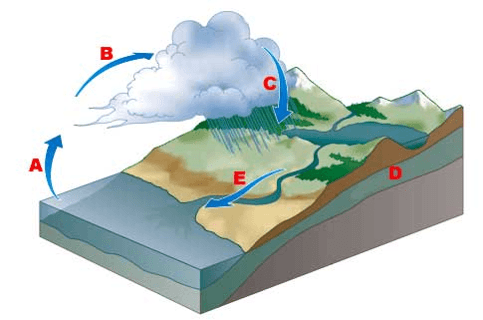
What is occurring at A in the diagram?
a)
runoff
b)
precipitation
c)
evaporation
d)
condensation
60.
What process is happening at C in the diagram?
a)
runoff
b)
precipitation
c)
condensation
d)
transpiration
61.

Movement of water through the soils of Earth is what?

a)

Diffusion

b)

Infiltration

c)

Exfoliation

d)

Precipitation

62.

Which of the following is NOT a source of nitrates and phosphates into a river?

a)

Fertilizers

b)

Animal waste

c)

Wastewater

d)

Burning fossil fuels

63.

Eutrophication is caused by

a)

excess nutrients building up in the water.

b)

industrial point-source pollution.

c)

unlined landfills and septic tanks.

d)

wastewater from homes mixing with drinking water.

64.
A flat area next to the stream that gets sediment when the river overflows its banks
a)
floodplain
b)
drainage basin
c)
tributary
d)
channel
65.
Land that supplies water to a river system.
a)
wetlands
b)
watershed
c)
estuary
d)
river system
66.

divide

a)

a stream that flows into a lake or into a larger stream

b)

the boundary between drainage areas that have streams that flow in opposite directions

c)

the path that a stream follows

d)

the upper surface of underground water; the upper boundary of the zone of saturation

67.

What is all of the land area whose water drains into a stream system?

a)

Runoff

b)

Watershed

c)

Divide

d)

Suspension

68.

What is a meander?

a)

A small lake that has been cut off from the main stream channel

b)

A bend/curve in a river

c)

The area of land drained by a river

d)

A small stream that flows into a larger river

69.

______________________ is the amount of water a river or stream can carry in a given amount of time.

a)

Load

b)

Gradient

c)

Discharge

d)

Alluvium

70.

______________________ is the total of dissolved and suspended sediments and those that roll or bounce along the bed.

a)

Load

b)

Gradient

c)

Discharge

d)

Alluvium

71.

What theory states that at one time, the entire universe was confined to a dense, hot, super mass ball?

a)

Nebular Theory

b)

Identity Status Theory

c)

Theory of Relativity

d)

Big Bang Theory

72.

What are the Terrestrial Planets

a)

Jupiter, Saturn, Earth, Mars

b)

Jupiter, Saturn, Uranus, Neptune

c)

Mercury, Venus, Uranus, Neptune

d)

Mercury, Venus, Earth, Mars

73.

What are the Jovian Planets

a)

Jupiter, Saturn, Earth, Mars

b)

Jupiter, Saturn, Uranus, Neptune

c)

Mercury, Venus, Uranus, Neptune

d)

Mercury, Venus, Earth, Mars

74.
This is a stream of charged particles that streams out into space through the corona.
a)
solar flare
b)
sun spots
c)
solar prominence
d)
solar wind
75.
Innermost layer of the sun's atmosphere, produces the sun's light.
a)
chromosphere
b)
corona
c)
photosphere
d)
radiative zone
76.
What color are the hottest stars?
a)
red
b)
yellow
c)
orange
d)
blue
77.

What is the largest span of geological time?

a)

Era

b)

Period

c)

Epoch

d)

Eon

78.

What is the name of the supercontinent that separated in the Mesozoic Era?

a)

Pangea

b)

Pangaea

c)

League of Nations

d)

United Nations

79.

What era are we currently living in?

a)

Paleozoic Era

b)

Mesozoic Era

c)

Cenozoic Eon

d)

Cenozoic Era

80.

Approximately how old is the Earth?

a)

4.6 billion years old

b)

4.6 million years old

c)

5 billion years old

d)

5 million years old

81.

This chronological time chart is broken into different time chunks, the largest being the Eon, then Era, Period, and Epoch.

a)

Timeline

b)

Calendar

c)

Geological time scale

d)

Time chart

82.

What type of resources are considered finite and cannot be replenished in a short amount of time?

a)

Renewable Energy

b)

Nonrenewable Energy

c)

All Energy

d)

Generational Energy

83.

Which of the following are fossil fuels? (Select all that apply.)

a)

Coal

b)

Oil

c)

Natural Gas

d)

Nuclear Energy

84.
What are renewable resources?
a)
Resources that can be replaced in a short amount of time
b)
Resources that are used faster than they can be replaced
c)
They can not be replaced
85.
Name two examples of Renewable energy?
a)
Coal and Nuclear
b)
Oil and Gas
c)
Solar Panels and Hydroelectric
86.
The biggest factor in determining climate is?
a)
elevation
b)
an ocean
c)
latitude
d)
mountain
87.
The gradual increase in the temperature of the atmosphere is known as ___________________.
a)
greenhouse effect
b)
global warming
c)
fossil fuels
d)
ice ages
88.
Climates are classified according to which two major factors?
a)
elevation & precipitation
b)
latitude & temperature
c)
elevation & latitude
d)
precipitation & temperature
89.

Which of the following events would be MOST likely to add Greenhouse Gases to the atmosphere?

a)

Hurricane

b)

Tsunami

c)

Forest Fire

d)

Ecological Succession

90.

What is one way volcanic eruptions can effect climate?

a)

When a volcano errupts, secondary succession begins

b)

Lava is hot which makes the community hotter

c)

Ash blocks sunlight, causing temperatures to drop

91.

Which of the following is contributing to an INCREASE in carbon dioxide in the atmosphere?

a)

deforestation

b)

photosynthesis

c)

oceans

d)

all of the above

e)

the loss of animal species

92.
Which natural process removes carbon dioxide from the atmosphere?
a)
forest fires
b)
volcanic eruptions
c)
cellular respiration
d)
photosynthesis
93.

What is sonar?

a)

A device used to measure ocean temperature

b)

A device used to measure ocean salinity

c)

A device used to measure ocean depth

d)

A device used to measure ocean currents

94.

What is a continental margin?

a)

The area where the ocean meets the land

b)

The area where the ocean is deepest

c)

The area where ocean currents are strongest

d)

The area where ocean tides are highest

95.

What is a continental shelf?

a)

A steep slope leading to the ocean floor

b)

A flat, shallow area near the shore

c)

A deep trench in the ocean

d)

A large underwater mountain range

96.

What is a continental slope?

a)

A steep slope leading to the ocean floor

b)

A flat, shallow area near the shore

c)

A deep trench in the ocean

d)

A large underwater mountain range

97.

What is the Mid-Ocean Ridge

a)
A continuous underwater mountain range
b)
A large coral reef
c)
A deep trench in the ocean floor
d)
A volcanic island chain
98.

Define Tide

a)
The movement of water caused by wind
b)
The process of cleaning clothes using a washing machine
c)
The change in temperature throughout the day
d)
The rise and fall of the sea level caused by gravitational forces
99.

What is a Tidal Range

a)
The speed at which tides move.
b)
The distance between two tidal waves.
c)
The depth of the ocean during high tide.
d)
The difference in height between high tide and low tide.
100.
The study of the ocean is ____.
a)
meteorology
b)
saltyology
c)
oceanography
d)
wavology
101.
The lowest point of a wave is the _____
a)
crest
b)
trough
c)
wavelength
102.
The movement of deep, cold and nutrient-rich water to the surface is _____.
a)
wave train
b)
photosynthesis
c)
upwelling
d)
tsunami
103.
Underwater volcanoes are known as ___.
a)
seamounts
b)
guyots
c)
nekton
d)
sonar
104.
The highest point of a wave...
a)
trough
b)
wavelength
c)
crest
105.

This area of the water column refers where the temperature suddenly changes.

a)

Halocline

b)

Thermocline

c)

Freezing Zone

d)

Chill Space

e)

Convectocline

106.

This is a location along coasts were fresh water and salt water mix.

a)

Delta Sediments

b)

Estuary

c)

Heads of rivers

d)

Waves

e)

Blender zone

107.

The measurement of the amount of dissolved salts in a given amount of liquid.

a)

Sodium Chloride

b)

Salinity

c)

Bio-luminescence

d)

atoll

108.

Tide of increased range that occurs two times a month, at the new and full moons.

a)

Neap Tide

b)

High Tide

c)

Spring Tide

d)

Tidal range

109.

A tide minimum range that occurs during the first and third quarters of the moon.

a)

Neap Tide

b)

Spring Tide

c)

Low Tide

d)

High Tide

110.

The movement of energy through a body of water.

a)

Ocean Current

b)

Wave

c)

Tidal Range

d)

Tidal Bulge